The Other Side of Asymmetric Day Trading: Why Break-Even Trades Matter More Than You Think
The Other Side of Asymmetric Day Trading: Why Break-Even Trades Matter More Than You Think
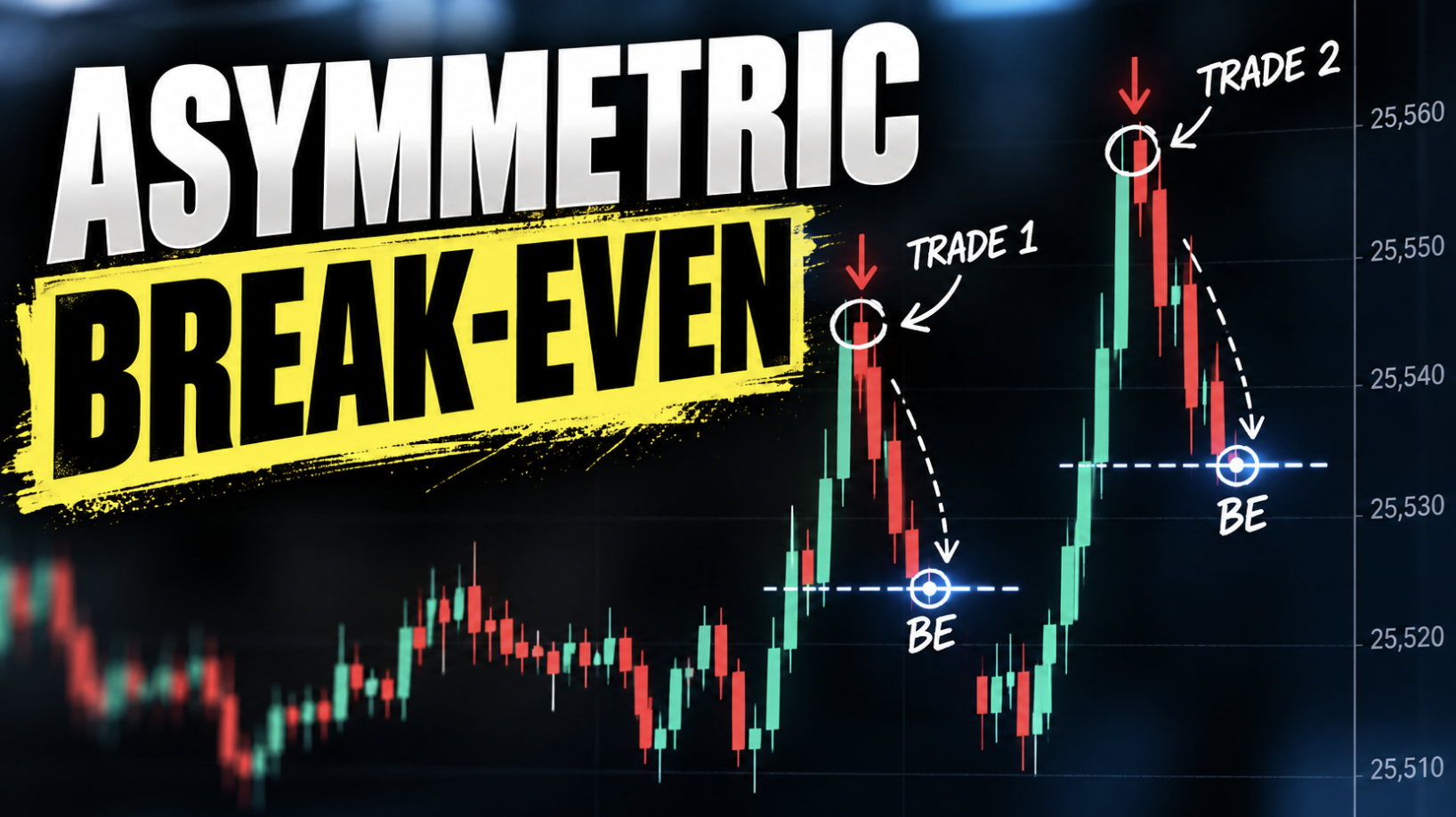
Two trades. Two break-evens. Zero profit. And a lesson about asymmetric trading that most traders completely overlook.
This morning, 16 October 2026, I took two trades on the DAX.
Both ended at approximately break-even.
No 10R winner. No spectacular trade to celebrate. Nothing particularly exciting to post on social media.
And yet, I think these two trades illustrate something incredibly important about asymmetric day trading.
Something that rarely gets discussed.
You see, when people hear me talk about asymmetric trading, they immediately think about the winners.
The 10R trades. The 20R trades. The occasional 30R opportunities.
And understandably so.
After all, the ability to make ten, twenty or even thirty times what you initially risk is what makes asymmetric trading attractive.
But there’s another side to this equation.
What happens to all the trades that don’t become those exceptional winners?
Because here’s something worth considering:
If you’re deliberately positioning yourself for large asymmetric payoffs, you have to accept that most opportunities won’t develop into them.
The question is what happens to your capital while you’re waiting.
And that’s precisely what I want to discuss today.
1. Asymmetric Trading Is Not Just About Making More
Most traders approach profitability from the same direction.
They want to win more frequently.
They spend years searching for better entries, stronger confirmation, more reliable indicators and setups with increasingly high win rates.
But there is another way to approach the problem.
Instead of obsessing over how frequently you win, you can focus on the relationship between what you lose when you’re wrong and what you make when you’re right.
That’s the foundation of asymmetric trading.
Imagine two traders.
Trader A wins 70% of the time but makes just 1R on winning trades and loses 1R on losing trades.
Trader B wins only 30% of the time but averages 5R on winning trades while losing 1R on losing trades.
Ignoring costs, Trader A has an expectancy of +0.4R per trade.
Trader B has an expectancy of +0.8R.
Despite winning less than half as frequently, Trader B has twice the expected return per trade.
But there’s another variable that we haven’t discussed yet.
What if some of Trader B’s unsuccessful trades don’t lose the full 1R?
What if a proportion of those trades can be closed around break-even?
Now we’re getting into something interesting.
Because asymmetric trading isn’t only about increasing the size of your winners.
It’s also about reducing the damage caused by opportunities that fail to develop.
And that brings me to this morning.
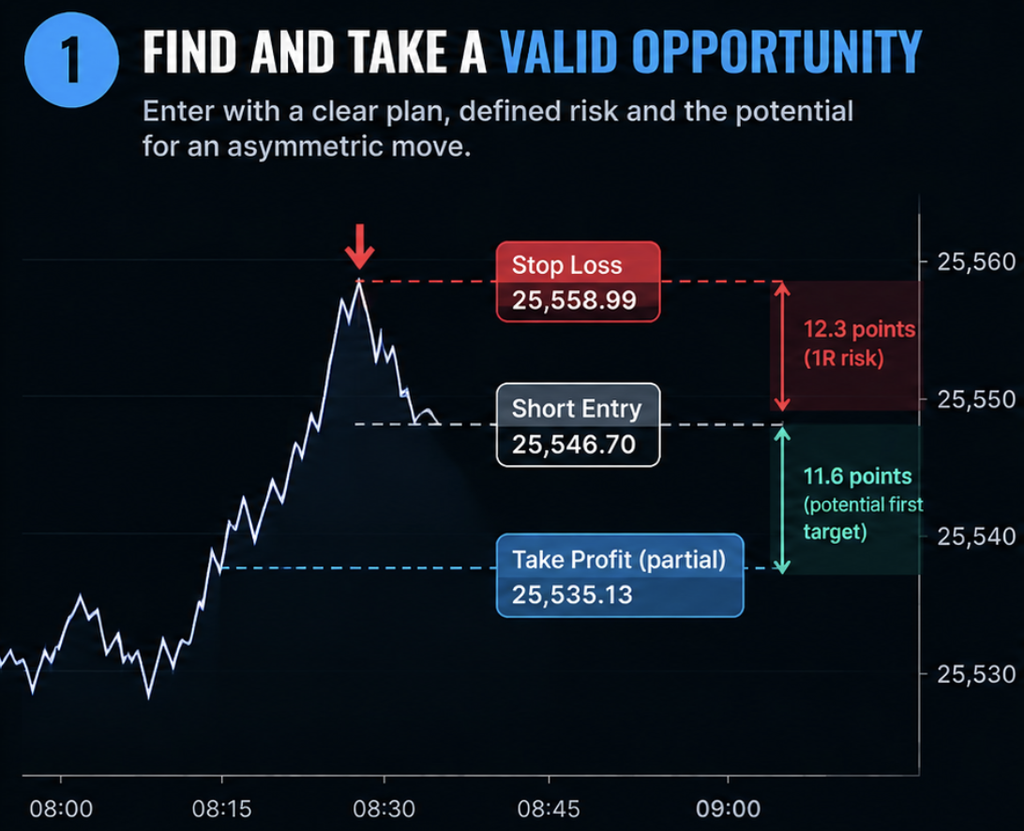
2. Two DAX Trades That Went Nowhere
Let’s look at what happened on Friday, 16 October 2026.
Both trades were taken on the DAX, using the 1-minute chart.
The market had already produced a sharp upward move during the European morning session.
I wasn’t interested in chasing that move.
I was looking for an opportunity to position myself on the short side, with the potential for a meaningful move lower.
The important word here is potential.
I wasn’t predicting that the DAX would collapse.
I was looking for an opportunity where the initial risk could be controlled relative to the possible reward.
Trade One: The First Attempt
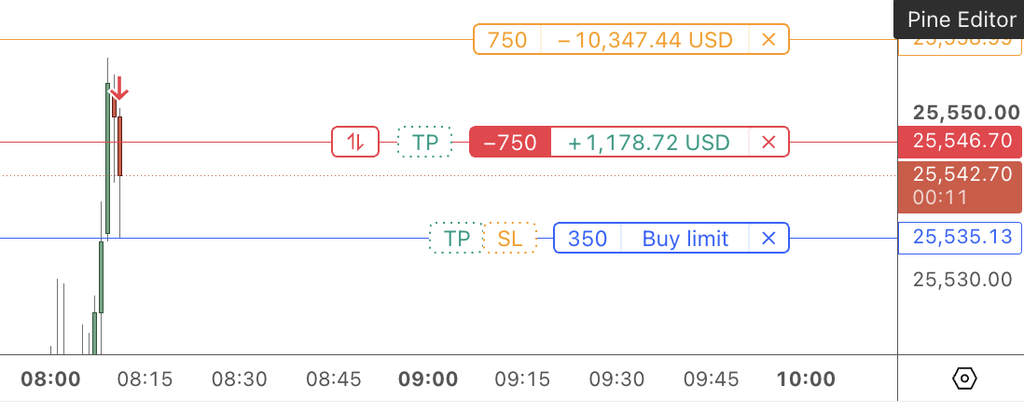
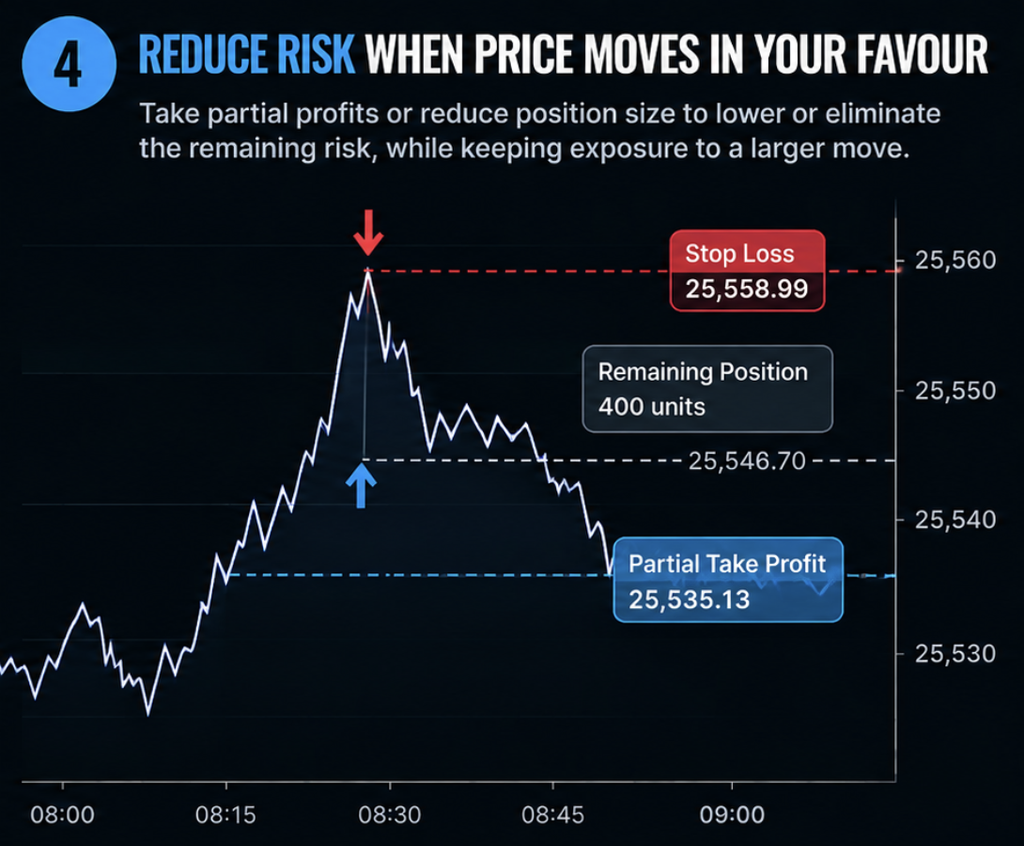
DAX, 16 October 2026, 1-minute chart. The first short position, with the protective stop above the market and a buy-limit order positioned below.
In the first screenshot, you can see the short position around 25,546.70, with the protective stop at approximately 25,558.99.
The market had moved sharply higher, and the trade was positioned to benefit from a potential reversal.
But look at the structure of the position.
There is a defined risk.
There is an opportunity for the market to move significantly in my favour.
And, importantly, there is a plan for what happens if the market initially moves in the right direction but fails to follow through.
I wasn’t entering the market expecting every trade to become a 10R winner.
I was entering because the opportunity justified taking a defined risk.
What happened next?
The DAX moved lower.
Enough to allow me to reduce the exposure on the position.
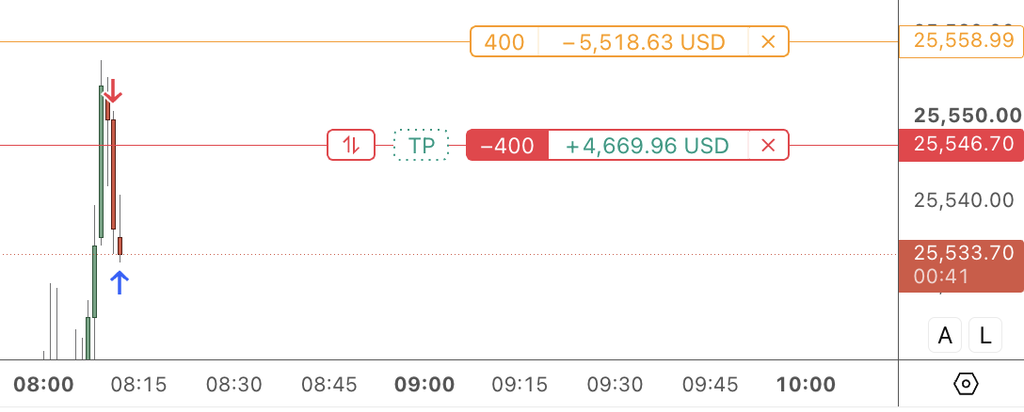
The first trade after the buy-limit order was executed. The short exposure has been reduced from 750 to 400 units.
Notice the change.
The original short exposure was 750 units.
After the buy-limit order was filled, the remaining position was 400 units.
That matters.
By reducing the position after a favourable move, I was able to reduce the risk associated with the original trade.
I usually take 50% of the position size at this point.
Rather than simply hoping for a large winner, I was actively managing the downside.
Ultimately, this trade finished around break-even.
No meaningful profit.
But no meaningful realised loss either, before trading costs.
And that is an important distinction.
Trade Two: Another Opportunity, Same Principle
A little later, another opportunity presented itself.
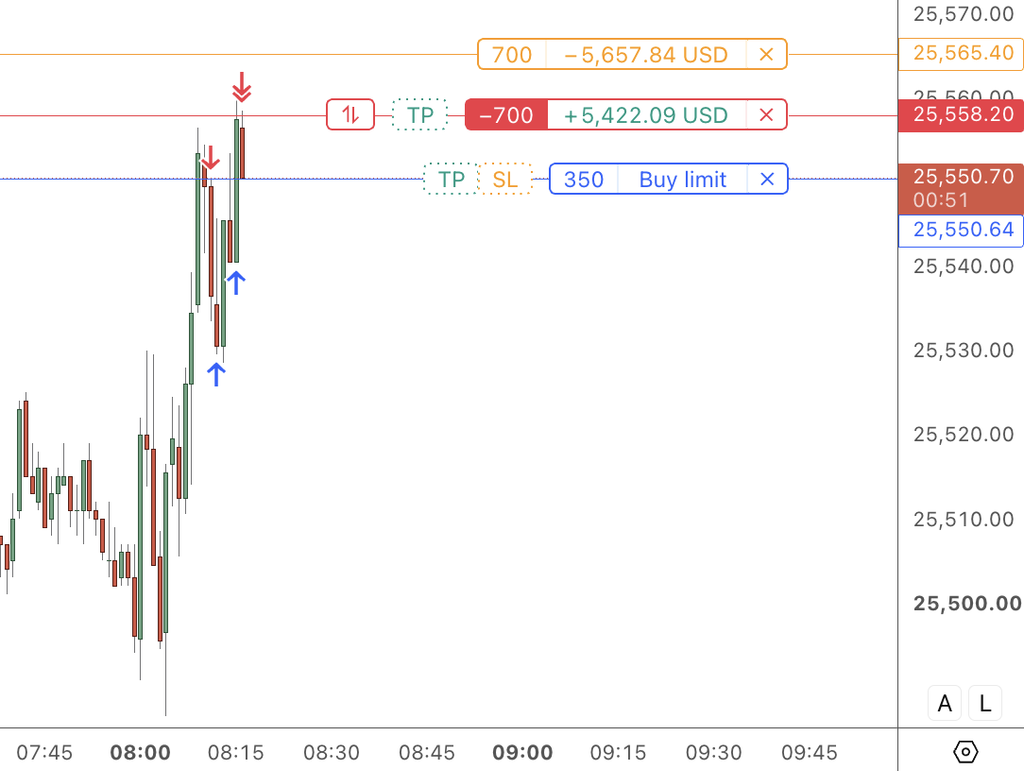
The second DAX short attempt. A 700-unit position around 25,558.20, with the stop at 25,565.40 and a buy-limit order below the market.
This time, the short position was around 25,558.20, with a protective stop at 25,565.40.
Again, the idea was not to capture a tiny move and call it a day.
The objective was to establish a position that could potentially develop into something considerably larger.
But the market doesn’t owe us anything.
Sometimes it moves exactly as anticipated.
Sometimes it moves slightly in our favour before reversing.
And sometimes it stops us out immediately.
We don’t control that.
What we can control is how much risk we accept and how we manage that risk as the trade develops.
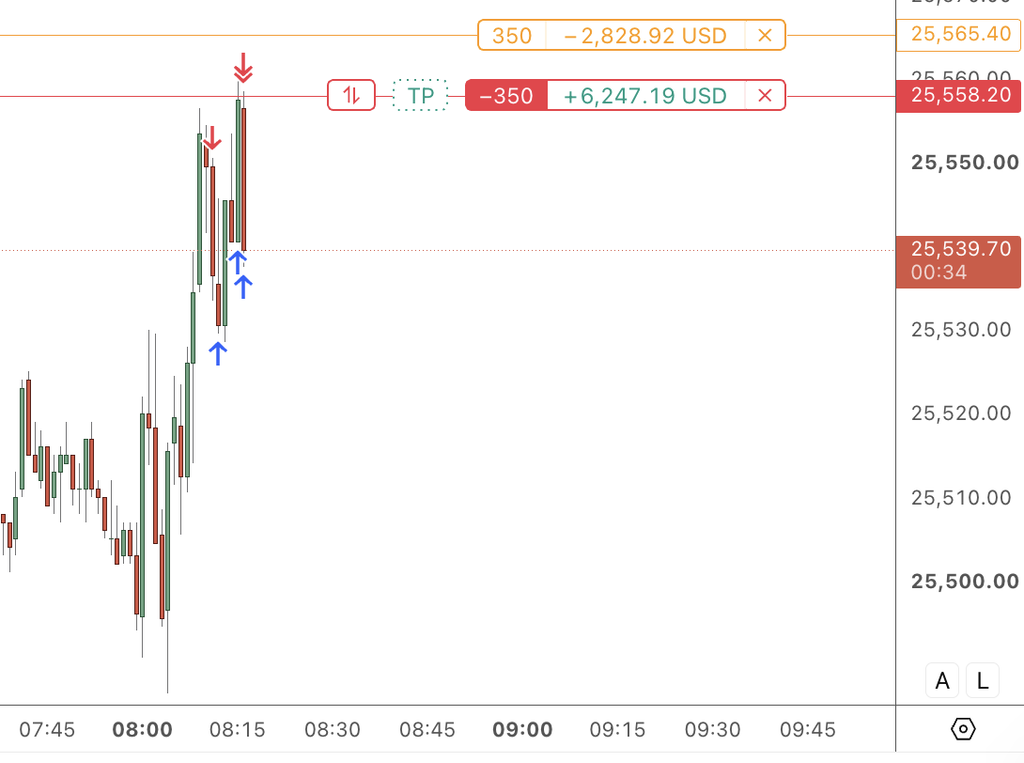
Caption: The second trade after the buy-limit order was executed. Exposure has been reduced from 700 to 350 units.
Once again, the market moved sufficiently in my favour to execute the buy-limit order.
The position was reduced from 700 to 350 units.
The remaining exposure could then be managed with considerably less risk than the original full-sized position.
This trade also eventually finished around break-even.
So, the morning’s result?
Two trades.
Two break-evens.
Approximately zero net trading profit before costs.
Not exactly the kind of result that gets thousands of views on social media.
But that’s not the point.
3. The Real Objective: Create More Risk-Free Opportunities
Here’s how I think about asymmetric day trading.
The objective is to create as many opportunities as possible for a small, controlled risk to turn into a disproportionately large reward.
And whenever the market gives me the opportunity, I want to reduce or eliminate the remaining risk.
That’s a fundamentally different mindset from simply trying to win every trade.
Think about it.
You cannot know in advance which trade will become your next 10R winner.
If you could, trading would be remarkably easy.
Instead, you have to put yourself in situations where a large payoff is possible.
Most won’t deliver it.
But what if you could structure your trading so that some of those unsuccessful attempts cost you very little?
What if you could repeatedly establish positions, reduce your downside when price moves favourably, and retain exposure to the occasional exceptional move?
That’s the idea.
Of course, I should clarify something important.
A trade isn’t literally risk-free simply because part of the position has been closed.
The remaining position still carries risk, and execution costs, slippage and gaps can affect the final outcome.
But by taking partial profits and managing the remaining exposure, it is sometimes possible to reduce the combined position’s worst-case outcome to approximately break-even.
That is what I’m referring to when I talk about creating risk-free opportunities.
And the distinction matters.
Because we aren’t eliminating uncertainty.
We’re trying to change what that uncertainty costs us.
4. Why I Don’t Automatically Move My Stop to Break-Even
There’s another important point here.
When I talk about reducing risk, many traders immediately assume that I mean moving the stop-loss to the entry price.
That’s not necessarily what I’m doing.
In fact, automatically moving stops to break-even can be one of the most expensive habits in trading.
Why?
Because markets fluctuate.
A perfectly valid trade can revisit your entry price before making a substantial move in your favour.
If you mechanically move your stop to break-even every time the market moves a few points in your direction, you may end up protecting yourself from losses while simultaneously eliminating your best opportunities.
And that defeats the purpose of asymmetric trading.
Remember, we aren’t trying to collect the maximum number of break-even trades.
We’re trying to preserve the possibility of exceptional winners while controlling our downside.
Those are two different things.
My preferred approach often involves reducing part of the position at a predetermined level and allowing the remaining position sufficient room to develop.
The partial profit can offset some or all of the risk on the remaining position, depending on the position sizing, execution prices and stop placement.
This is very different from simply dragging the stop to entry and hoping for the best.
One approach manages the economics of the position.
The other can interfere with the trade’s ability to develop.
And in asymmetric trading, that difference can be enormous.
5. The Mathematics of Break-Even Trades
Let’s use a simple example.
Imagine a trader takes 20 trades.
Of those:
- 3 trades produce an average winner of 8R.
- 10 trades lose the full 1R.
- 7 trades finish at break-even.
The result is:
3 × 8R = +24R
10 × -1R = -10R
7 × 0R = 0R
Total: +14R.
Now imagine those seven break-even trades had instead become full 1R losses.
The result would have been +7R.
Same winners.
Same opportunities.
But half the total profit.
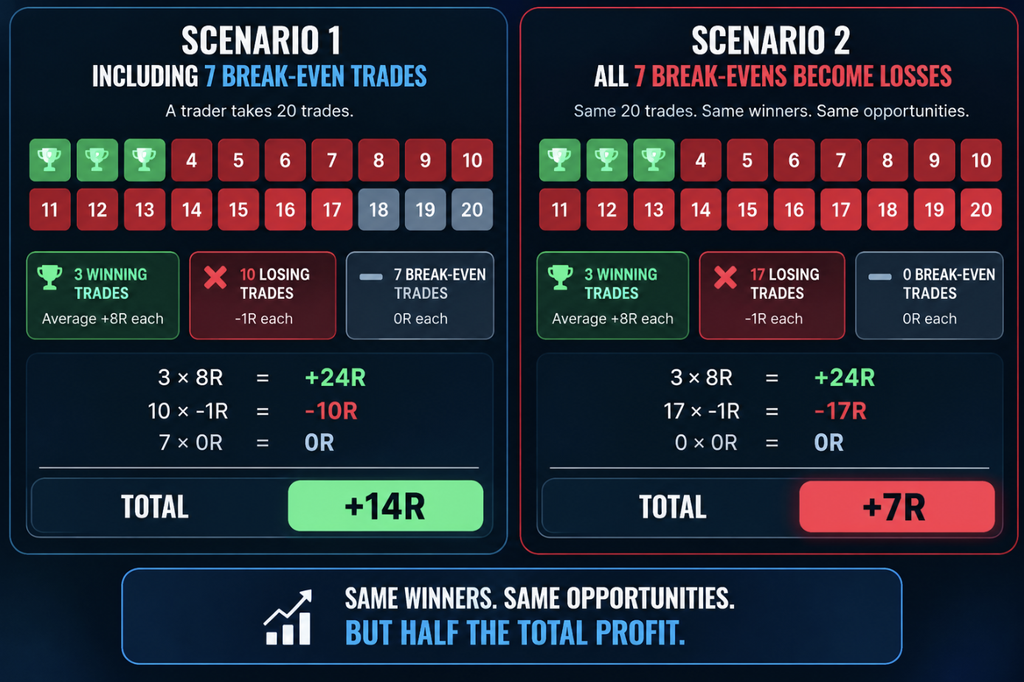
That’s how meaningful loss reduction can be.
And there’s something else.
Reducing the number and magnitude of losses doesn’t just improve the mathematical expectancy of a strategy.
It can also reduce drawdowns.
That matters psychologically.
Because the trader who experiences ten consecutive full losses may behave very differently from the trader who experiences five losses and five break-evens.
Even if both are following a strategy with positive expectancy.
The second trader may find it easier to remain patient and execute the next valid opportunity.
Of course, this example assumes that the break-even management doesn’t reduce the size or frequency of the winners.
In reality, that trade-off must be measured.
If your management technique protects seven losing trades but prematurely exits your biggest winners, it may actually make your strategy worse.
That’s why trade management needs to be part of a tested framework rather than an emotional response.
6. Break-Even Is Not the Goal
This is where many traders misunderstand the concept.
After reading this, you might think:
“Great. I should try to make every trade risk-free as quickly as possible.”
No.
That would be the wrong conclusion.
The goal is not to maximise break-even trades. The goal is to maximise the number of worthwhile asymmetric opportunities while keeping the cost of unsuccessful attempts under control.
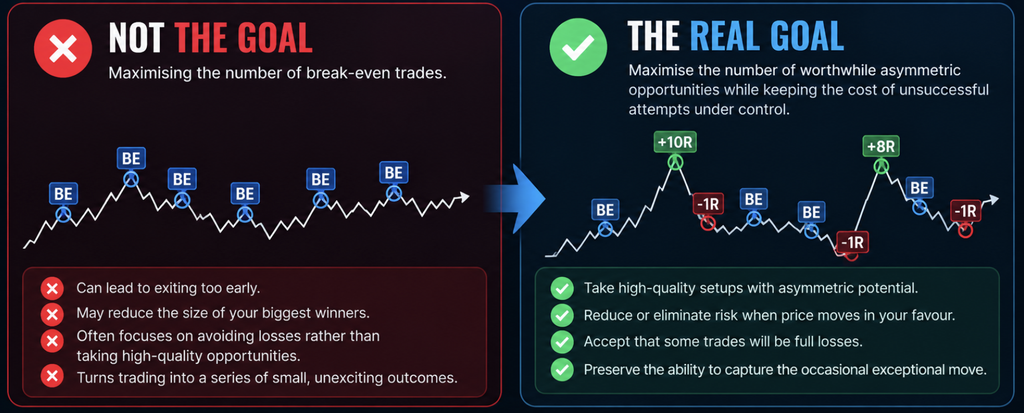
Sometimes that means taking a full loss.
Sometimes it means reducing exposure.
Sometimes it means accepting a small realised profit.
And occasionally, it means doing very little while the market develops into an exceptional opportunity.
The important thing is that these decisions should come from your framework.
Not from fear.
Not from excitement.
And certainly not from the desire to avoid seeing a red number on your screen.
A break-even trade is only a good outcome if the decision that produced it was consistent with the trading plan.
Otherwise, it may simply be a missed opportunity disguised as good risk management.
7. Why Two Break-Even Trades Can Be a Good Trading Day
Let’s return to this morning.
I had two opportunities.
Both initially moved in my favour.
Both allowed me to reduce the original risk.
Neither developed into the kind of asymmetric move I was looking for.
And that’s fine.
Because I didn’t enter those trades knowing what would happen next.
I entered with a defined risk and a plan for managing the position.
The market gave me enough movement to reduce my exposure, but not enough to produce the exceptional payoff I was seeking.
So I finished around break-even.
Would I have preferred a 10R winner?
Of course.
But I can’t force the market to produce one.
And attempting to do so is precisely how traders turn perfectly reasonable sessions into unnecessary losses.
The temptation after two break-even trades is to keep looking.
To find one more opportunity.
To make the morning feel worthwhile.
But the market doesn’t reward effort.
And trading more doesn’t necessarily increase your chances of making money.
Sometimes the best thing you can do is accept what the market has offered and move on.
8. The Other Side of Asymmetry
When people see a 20R or 30R trade or higher, they naturally focus on the reward.
But what they don’t see is the process that makes waiting for those trades possible.
The discipline to accept small losses.
The patience to avoid marginal opportunities.
The willingness to finish a session without making money.
And the ability to manage positions so that some unsuccessful attempts don’t turn into full losses.
That’s the other side of asymmetric day trading.
It’s not particularly glamorous.
It won’t always produce exciting screenshots.
But it is an essential part of the process.
Because the real challenge isn’t simply finding a trade that can produce 10R.
It’s building a trading approach that allows you to keep participating long enough, and with enough discipline, to capture those opportunities when they arrive.
This morning, I took two trades.
Neither became a winner.
But neither became a meaningful loss.
And for me, that’s a perfectly acceptable outcome.
Asymmetric trading isn’t about being right more often. It’s about making the most of the occasions when you’re right, while controlling what it costs you when you’re not.
Sometimes that means taking 10R.
Sometimes it means taking 20R.
Sometimes it means taking 4 trades that give you 79R cumulative:
And sometimes it means walking away with nothing.
The important thing is that you followed the process.
Because the next exceptional opportunity doesn’t care whether you made money this morning.
But your ability to take advantage of it may depend on how well you protected your capital today.
Frequently Asked Questions About Asymmetric Day Trading
What is asymmetric day trading?
Asymmetric day trading is a trading approach that focuses on opportunities where the potential reward is significantly greater than the initial risk. Rather than prioritising a high win rate, traders aim to keep losses controlled while allowing selected winning trades to generate disproportionately large returns, sometimes reaching 10R or more.
Why are break-even trades important in asymmetric trading?
Break-even trades can help preserve trading capital by preventing some unsuccessful opportunities from becoming full losses. When combined with occasional large winners, reducing the cost of unsuccessful trades can improve overall trading expectancy. However, break-even management must not come at the expense of consistently closing potentially profitable trades too early.
Should I move my stop-loss to break-even?
Not necessarily. Automatically moving a stop-loss to the entry price can prematurely close trades that might otherwise develop into substantial winners. An alternative is to take partial profits at predetermined levels while allowing the remaining position enough room to develop. The appropriate method depends on the trading strategy and its tested risk-management rules.
How can partial profit-taking reduce trading risk?
Partial profit-taking involves closing part of a position after the market moves favourably. The realised profit can offset some or all of the potential loss on the remaining position. This allows traders to maintain exposure to potentially large market moves while reducing the overall risk of the trade. Commissions, slippage and remaining stop-loss exposure must still be considered.

Trading involves risk. The examples above illustrate trade-management principles and are not guarantees of future performance. Break-even outcomes may differ after commissions, spreads and slippage.