
How to Set Trailing Stop Loss
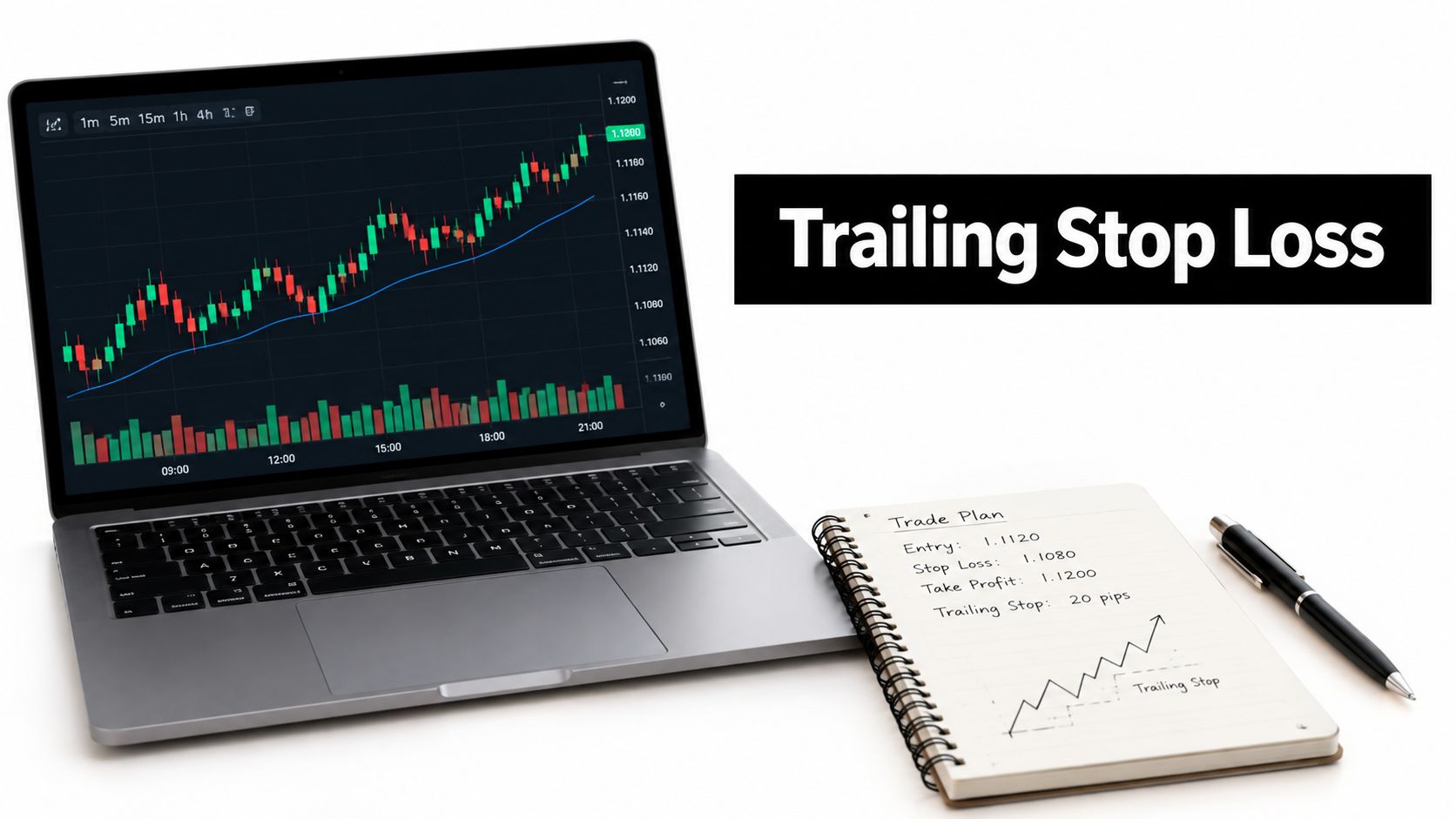
Most traders ask how to set trailing stop loss as if there's one clean number that makes the trade safe. There isn't. A trailing stop is only as good as the structure behind it, and if you treat it like a magic shield, you'll eventually learn the hard way that the stop price and the fill price are not always the same thing.
Used well, a trailing stop is a rules-based exit that follows price only when the market moves in your favor. It can protect part of an unrealized gain without forcing you to babysit every tick, but it can also get clipped by normal noise, left too wide, or hit in a gap where the actual execution is worse than the trigger level. The main job is to place it with enough room for the trade to breathe, then understand exactly how your broker handles the trigger, order type, and market conditions.
Why Trailing Stops Are Trade Management, Not Magic
A trailing stop is not a promise. It's a trade-management rule that says, “if price keeps moving my way, the exit follows.” That matters because the stop only adjusts in one direction, and it stays fixed once price pulls back.
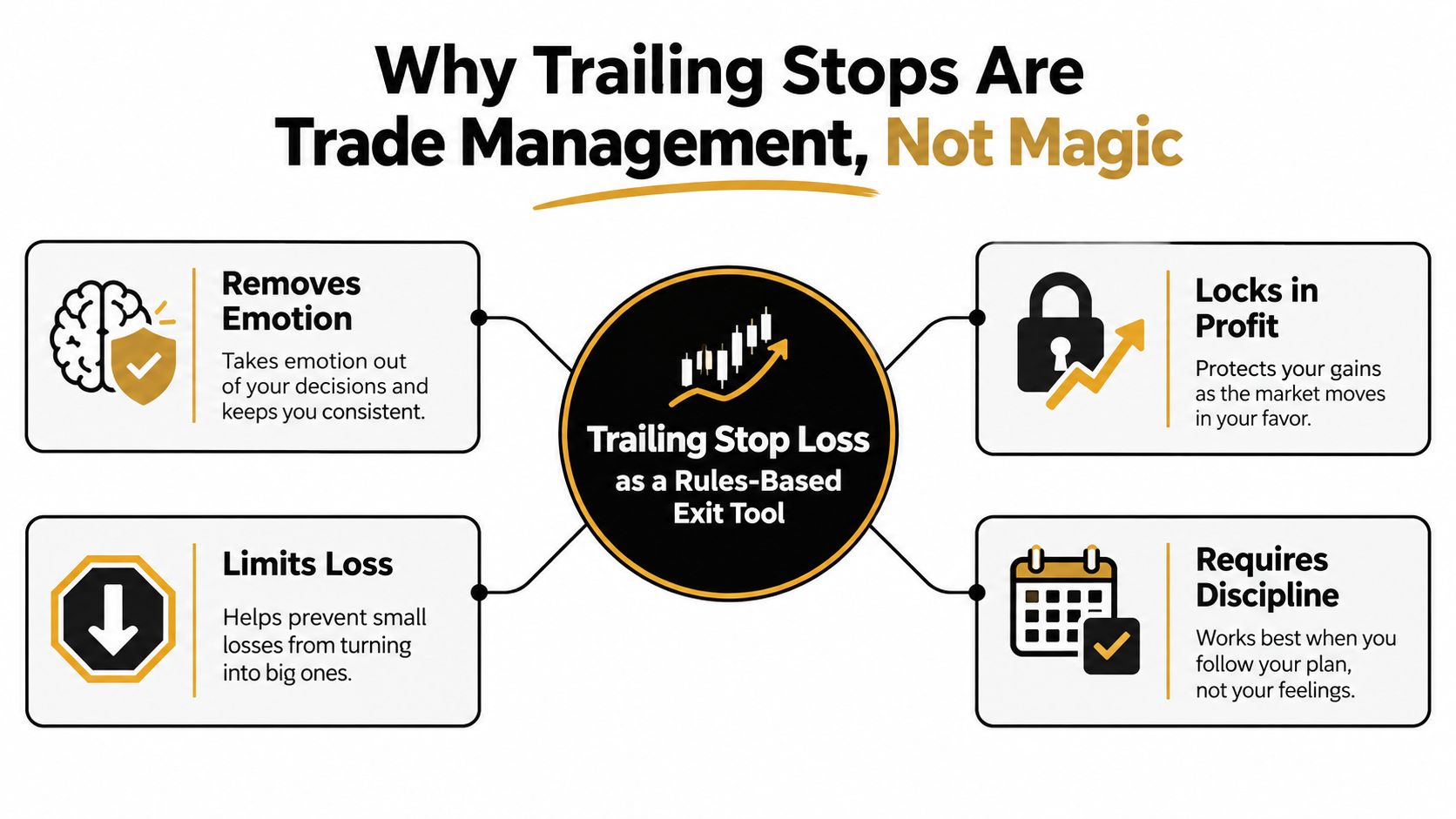
If you want the plain version, it's this. A trailing stop can help you keep part of a winner while removing the urge to manually second-guess every candle. Colibri Trader's overview of trailing stops frames them as a practical part of position management, not a substitute for reading price structure, which is exactly the right mindset for this tool (pros and cons of using trailing stops).
The three beginner mistakes are predictable. The first is placing the stop too close, so normal movement takes you out early. The second is setting it too wide, so you hand back too much of the move. The third is forgetting that a stop trigger is not the same thing as a guaranteed fill.
Practical rule: if the trade thesis is still intact, the trail should usually be based on structure or volatility, not on fear.
FINRA describes trailing stops as sell instructions based on a specified percentage or dollar decline from the market price, and the SEC notes that the trailing amount may be expressed in either form (Investor bulletin on trailing stops). That's the mechanics. The judgment comes from deciding how much normal movement you can tolerate before the setup is invalid.
How a Trailing Stop Loss Works in Practice
A trailing stop on a long position rises with price, but it doesn't fall when price weakens. That one rule is the whole point. If you understand that, you already understand the part traders commonly get wrong.
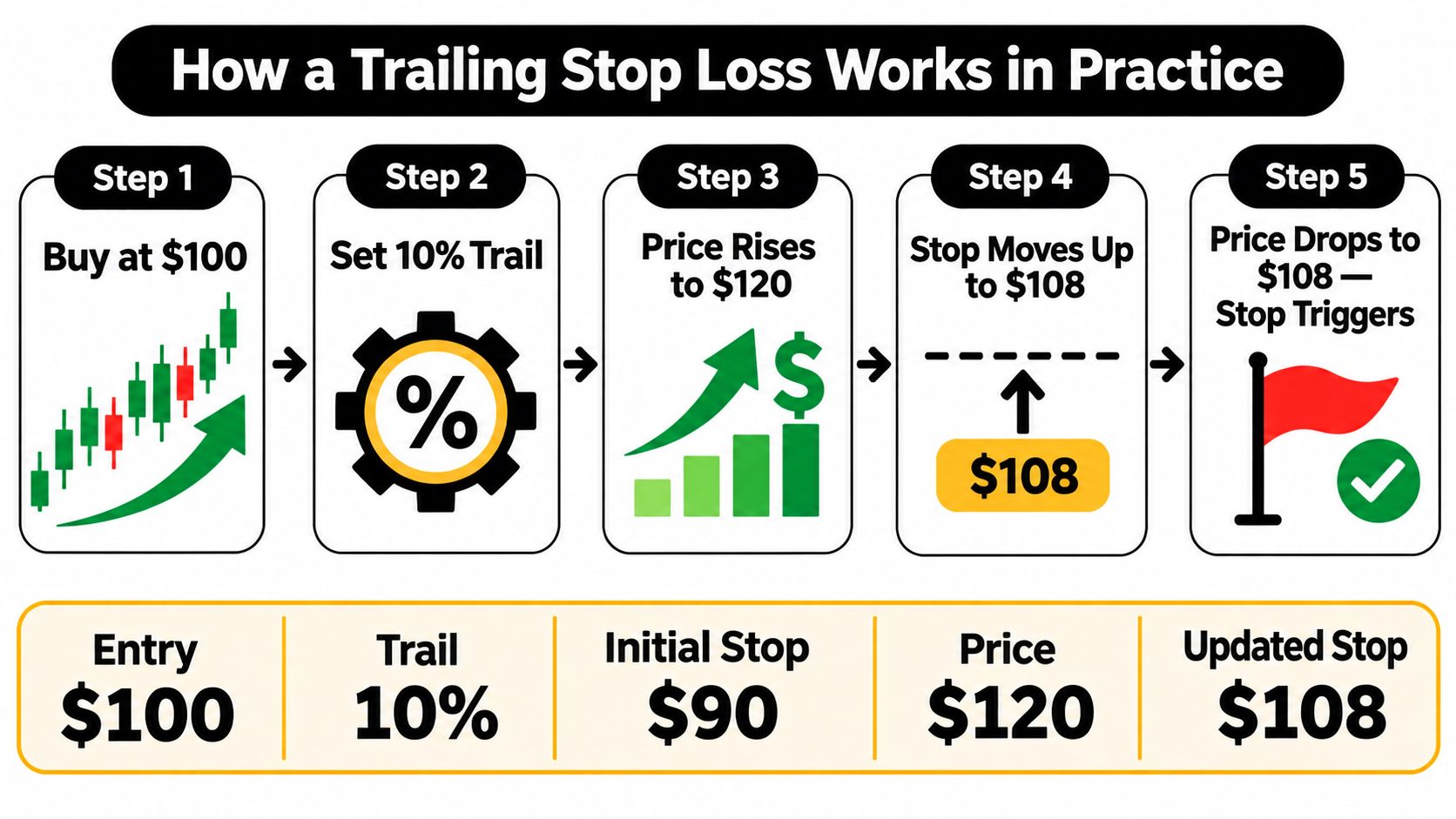
Take a simple long example. You buy at $100 and set a 10% trail. If the highest price reaches $100, the stop generally sits at $90. If price later climbs to $120, the stop can move to $108. If price falls after that, the stop stays at its latest level rather than widening.
That last part matters more than it sounds. A trailing stop doesn't give the trade more room just because the move pauses. It protects the open gain by ratcheting up, then waits for the market to prove the trend is still alive.
What the order is really doing
Think of it as a moving reference point tied to the best price so far, not to your emotions. You're not asking, “How much can I tolerate if I hope the move comes back?” You're asking, “Where does the trade stop making sense if price reverses from the highs?”
For shorts, the logic flips. The stop trails downward as price falls, and it only moves in your favor. That symmetry is useful, but the discipline is the same in both directions: the trail should protect structure, not rescue a bad entry.
Choosing the Right Trail Size for Your Trade
The percentage is not universal. A trail that works on a calm, high-liquidity market can be way too tight for a volatile one, and a trail that survives a noisy asset may be pointless on something that trends smoothly.
Colibri Trader's ATR guide is a good reminder that volatility matters more than guesswork when you're deciding where to anchor a stop (ATR indicator explained). The right question is not “What's the perfect percentage?” It's “How much ordinary fluctuation does this instrument usually need before the trend proves me wrong?”
| Instrument | Timeframe | Starting trail range | Why this range |
|---|---|---|---|
| Major forex pairs | Intraday or swing | Tight to moderate | These pairs often move with cleaner rhythm, so the trail can usually sit closer to price. |
| Large-cap equities | Swing | Moderate | A broader trail often helps avoid getting clipped by routine pullbacks. |
| Crypto majors | Swing or position | Wider | Crypto can swing fast enough to punish a trail that's too tight. |
| Short-horizon intraday trades | Minutes to a session | Very tight, but only around clear structure | The trade has less time to develop, so the exit has to match the setup's speed. |
A useful sequence is simple. First, mark the invalidation level. Then estimate typical volatility over the intended holding period. After that, choose a trail that sits outside routine noise but still protects the trade if the structure fails.
A trail that's too close often behaves like an impatient trader. A trail that's too wide behaves like denial.
One caution. Don't fall in love with a backtested number just because it looked clean in one market regime. Different assets, sessions, and news conditions change the amount of noise, and a setting that worked in one stretch can fail badly in the next.
Anchoring the Trail With ATR and Swing Levels
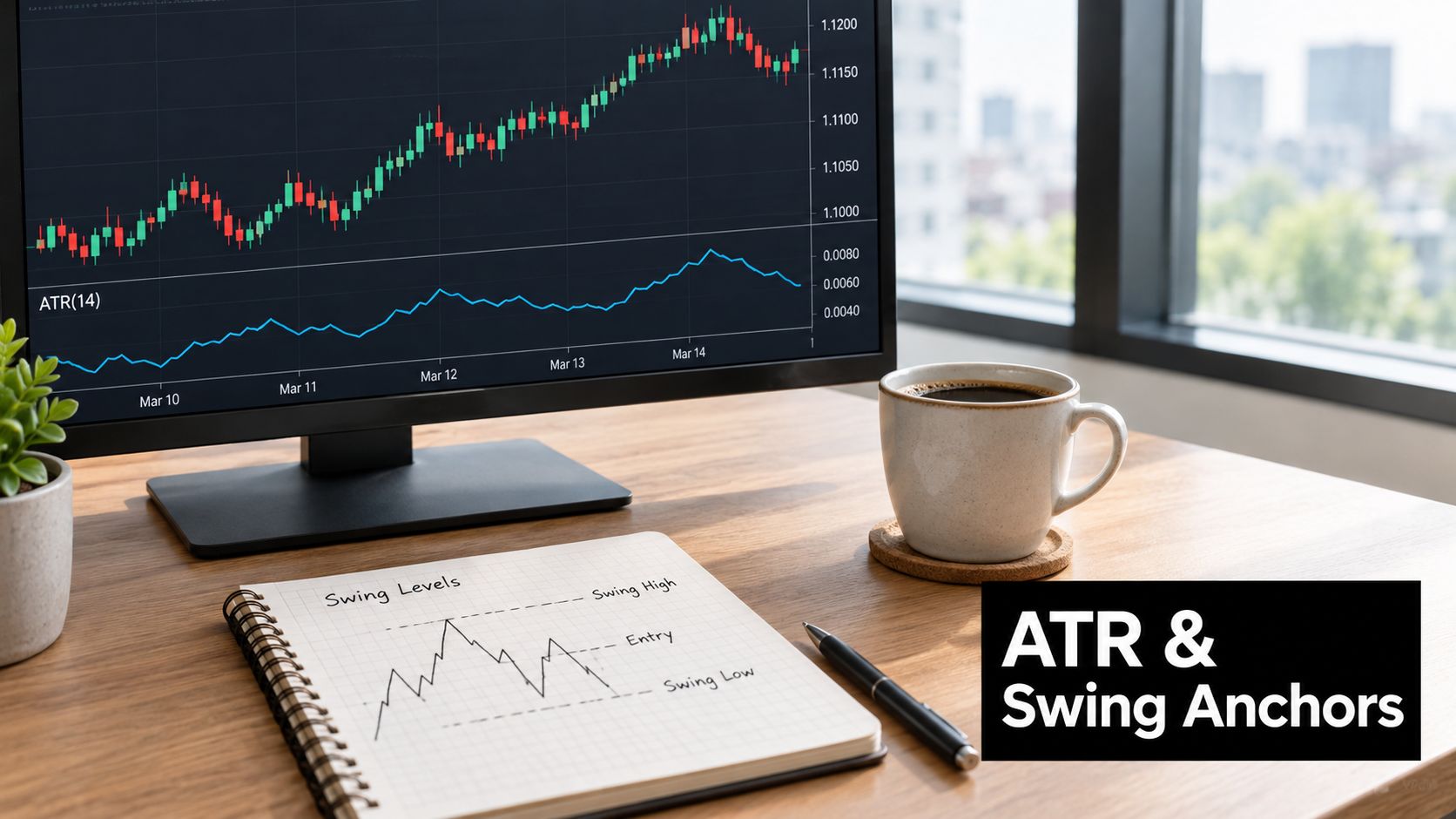
Flat percentages are easy, but they're not always the best anchor. If you trade price action, you'll usually do better by tying the stop to what price is doing instead of relying on a generic number.
ATR based trail
ATR gives you a volatility anchor. If a daily chart is moving around more than usual, a trail that's based on a multiple of ATR can give the trade room without forcing you to guess in advance. A simple example is a 1.5x or 2x ATR trail on a daily chart, where the trail sits that many ATR units behind price.
The value here is consistency. You're saying the stop should reflect ordinary movement for that instrument, not your mood that morning. That makes ATR useful for trend trades where price is allowed to breathe.
Swing and pivot trail
A swing-based trail sits just beyond the most recent higher low on a long, or just below the most recent lower high on a short. That's a cleaner fit for traders who read the chart in terms of structure, because the stop aligns with the pattern that justified the entry.
This approach shines when the market is trending and respecting clear pivots. It's less comfortable in chop, because chop can offer too many minor swings and tempt you to keep tightening the stop until normal movement knocks you out.
How to choose between them
If the market is orderly and you can define a clear pivot, the swing method is often more intuitive. If the market is fast, noisy, or difficult to read cleanly, ATR gives you a more objective buffer. Either way, the trail should sit beyond the price area that would break the setup, not just the area that would make you uncomfortable.
What Really Happens When the Stop Triggers
A trailing stop does not promise an exit at the stop price. Once the trigger is hit, a conventional trailing stop-loss usually turns into a market order, and the fill can land above or below the level you saw on screen.
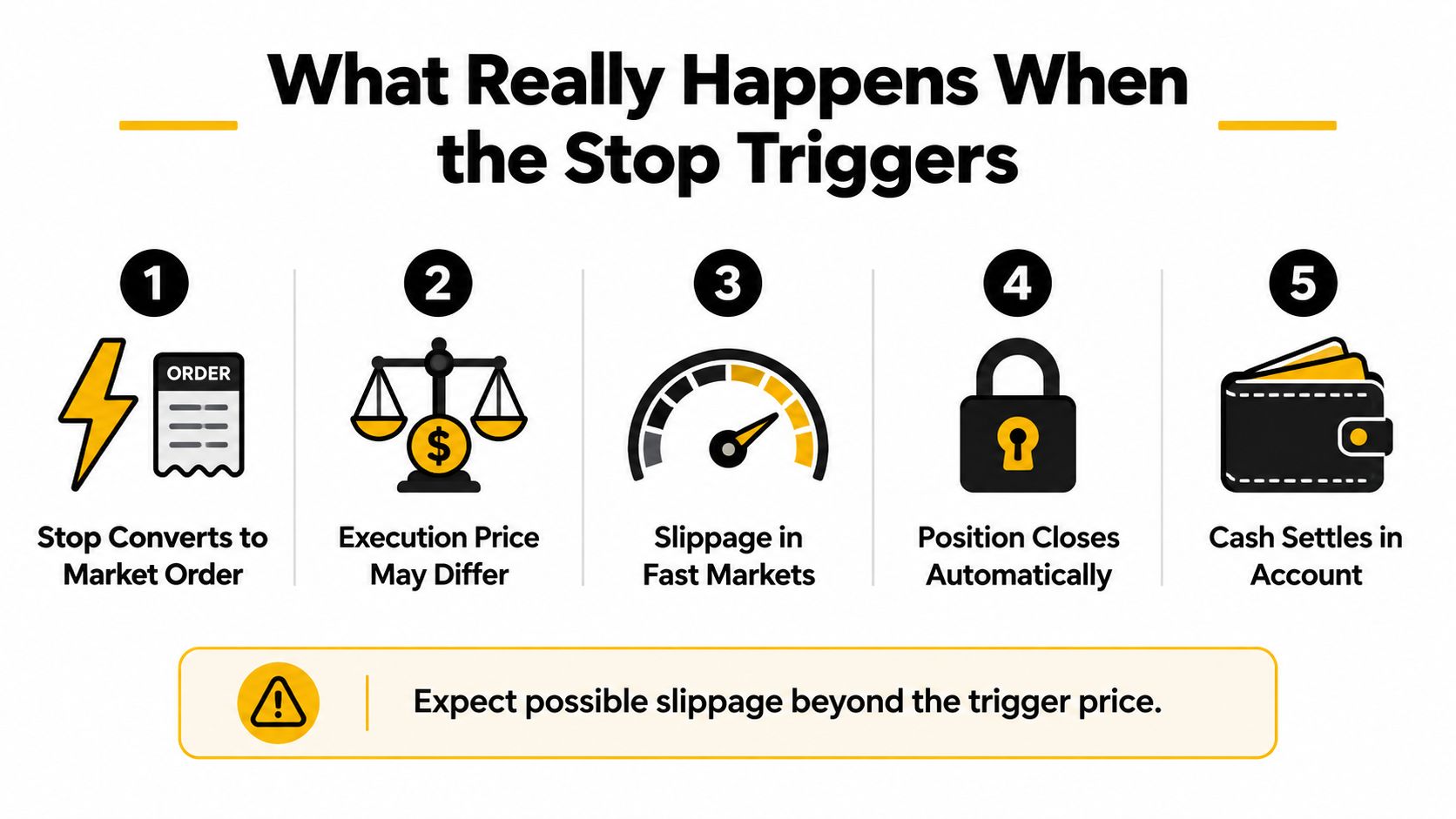
FINRA warns that stop prices are not guaranteed execution prices, and the SEC notes that execution can differ from the stated stop and that trigger rules vary by venue (FINRA regulatory notice on stop orders). The stop manages the exit process. It does not cap the loss in every market condition.
Stop market versus stop limit
A stop-market order is built to get you out after the trigger, but the fill can be worse in a fast move. A stop-limit order protects the price you are willing to accept, but it can leave you stuck if price jumps through your limit. That trade-off matters most during news releases and overnight gaps.
How to think about gaps and slippage
Hold through earnings, macro headlines, or the open after a quiet close, and you have to assume the stop can be jumped. FINRA notes that short-lived sharp moves can trigger stops even if price later recovers, and sell stops can add pressure in extreme volatility. That is why position size should already account for possible slippage, which we break down in detail in what is slippage in trading.
Broker checklist
Before you place the order, confirm these points with your broker:
- Trigger method: Ask how the platform decides the stop was hit.
- Order type: Verify whether your trail becomes a market order or can be set as a limit-based exit.
- Market hours: Check what happens outside regular session hours.
- Liquidity: Know how thin trading can affect the fill.
- Gap risk: Decide whether the position can survive an overnight move.
- News behavior: Test how the platform handles releases, opens, and halt conditions.
If the broker's rules are unclear, assume the worst until you know otherwise. That is basic risk control.
Adjusting the Trail as the Trade Develops
A good trade doesn't need constant interference. If price breaks out cleanly and starts trending, you can tighten the trail after the move proves itself, then leave it alone while the market is still behaving well. What you should not do is keep canceling and replacing the stop every time the candle dips a little.
When a trend extends, the trail should respond to structure, not to every flicker. If price consolidates after a strong run, holding the existing stop is often smarter than nudging it higher too soon. I've seen more good trades damaged by nervous tinkering than by the original stop being a little generous.
Operational rule: never widen a trailing stop, and don't remove it just because the trade feels comfortable.
The most useful review point is a volatility shift. If the market suddenly gets faster, choppier, or news-driven, the original trail may no longer fit the environment. That doesn't mean you widen it blindly. It means you reassess whether the current structure still justifies the position at all.
A trail is a promise to respect the market's next meaningful break, not an excuse to micromanage every pause. Keep the logic consistent and the process gets easier.
Putting It All Together on Your Next Trade
The cleanest way to set a trailing stop loss is to work from structure first, then mechanics. Start by choosing an anchor, either percentage, ATR, or swing-based. Then place the initial trail according to the asset's actual movement, not your wishful thinking.
After that, verify the broker details before you go live. Confirm trigger rules, order type, market hours, and how the platform handles gaps. If the position is exposed to news or thin liquidity, size it so a bad fill doesn't wreck the account.
The final rule is simple. Let the stop do its job unless the trade structure changes in a real way. Price-action traders, including the Colibri Trader approach, treat the stop as a servant of structure, not a replacement for it.
If you want a clearer price-action framework for deciding where a trail belongs, visit Colibri Trader and work through the platform's practical trading lessons. The same mindset that helps you read swings, invalidation, and momentum also helps you place a trailing stop that protects the trade without choking it.