4 Day Trades, 79R and the Power of Risk-to-Reward
Dear traders,
The first week of September gave me a very good example of why I have built my entire day trading approach around asymmetry rather than win rate.
I traded four days.
I took four trades.
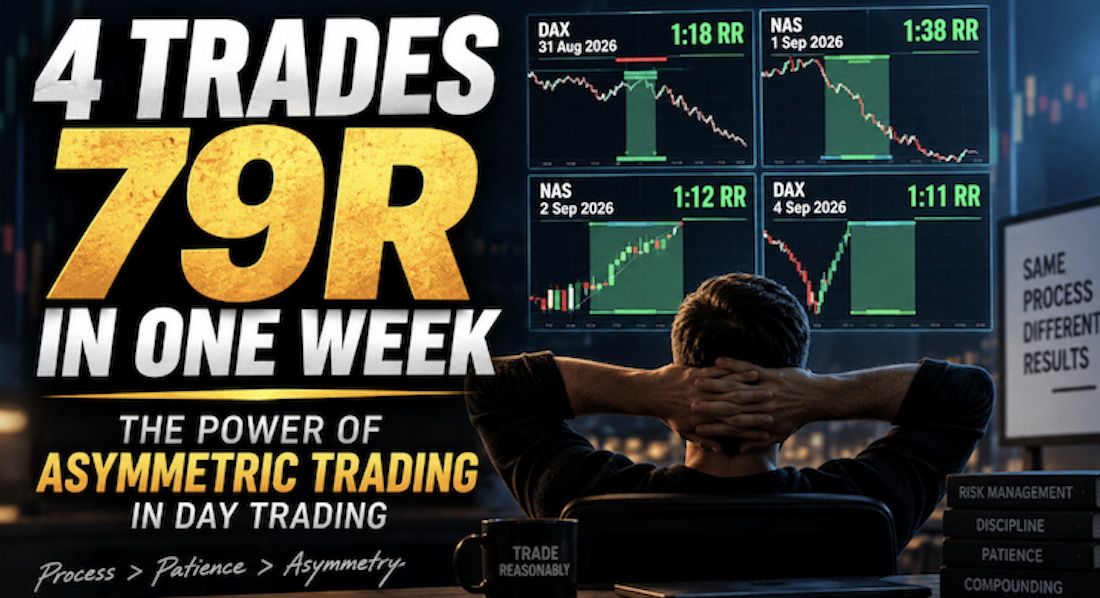
All four reached double-digit risk-to-reward ratios:
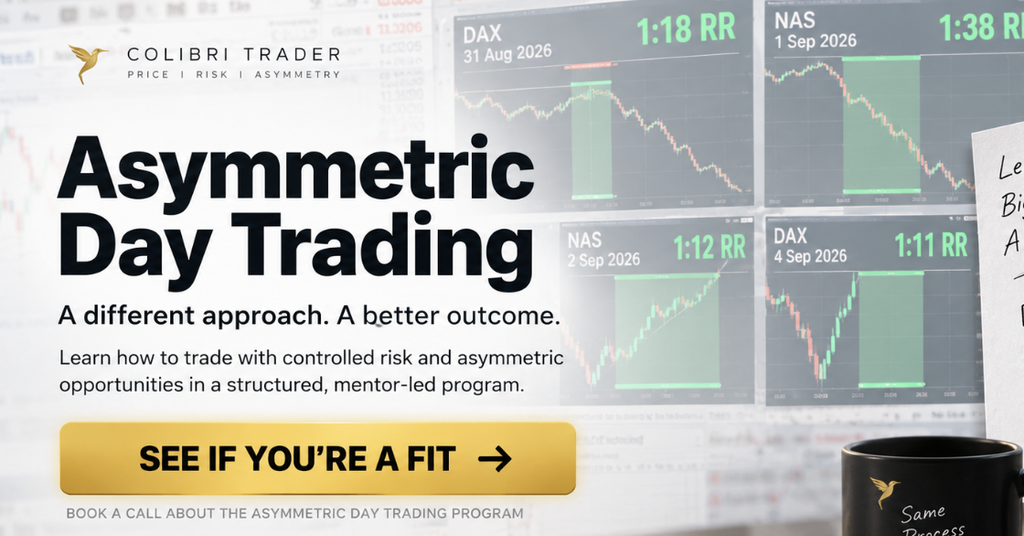
- 31 August – DAX: 1:18 RR
- 1 September – NASDAQ: 1:38 RR
- 2 September – NASDAQ: 1:12 RR
- 4 September – DAX: 1:11 RR
That’s a combined 79R of potential reward relative to the initial risk across four trades.
And yesterday?
I didn’t trade at all.
Before we go any further, however, there is something important I want to make clear:
This is not what every week of day trading looks like.
There will be losing trades.
There will be quiet weeks.
There will be periods when volatility disappears and the market simply doesn’t provide the conditions I am looking for.
In fact, August was much quieter for me.
But that’s precisely the point of asymmetric trading.
You don’t need every day, every trade or even every week to look like this.
You need a system where, over a sufficiently large sample, your winners have the potential to substantially outweigh your losers.
Let me show you what I mean.
Trade #1: DAX – 1:18 Risk-to-Reward
The first trade came on DAX on 31 August.
The trade eventually developed into an 18R move.
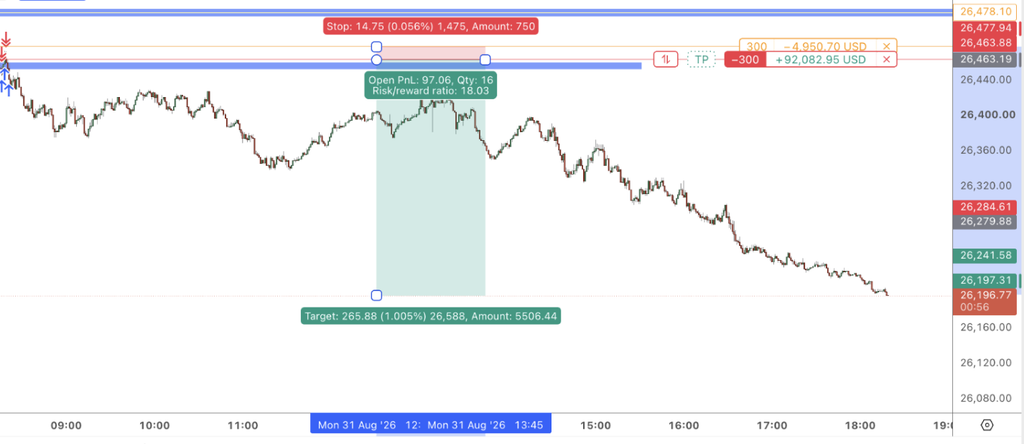
Suggested image caption: DAX asymmetric trading setup reaching a 1:18 risk-to-reward ratio.
Notice what matters here.
It’s not how much money the trade made.
It’s the relationship between what I was prepared to lose and what the market eventually offered in return.
For every 1 unit of initial risk, the move offered 18 units of potential reward.
That distinction is fundamental to understanding asymmetric trading.
Trade #2: NASDAQ – 1:38 Risk-to-Reward
Then came the biggest trade of the week.
On 1 September, I took a short on NASDAQ.
The result:
1:38 RR.
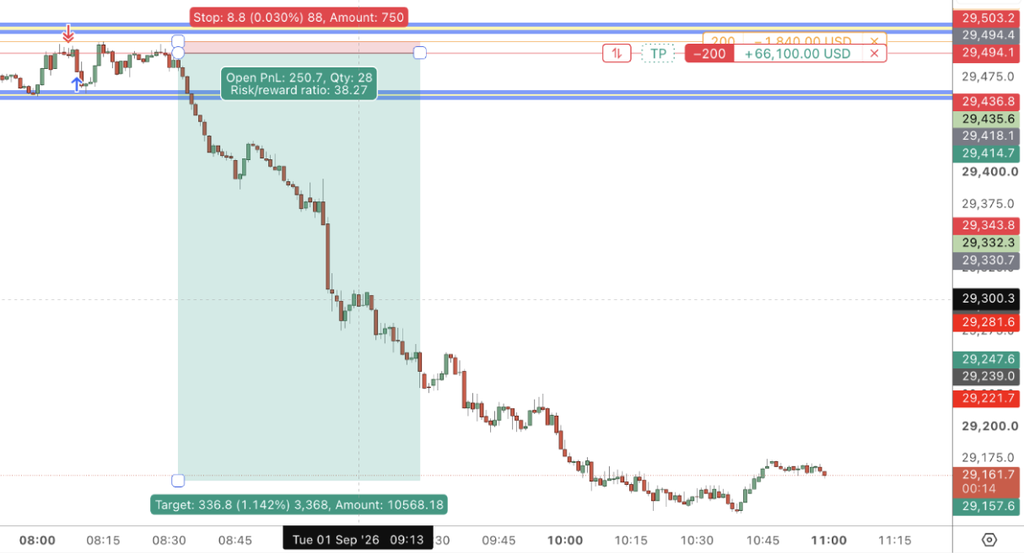
This is the type of trade that changes the mathematics of a trading system.
Not because I expect to catch 38R trades every day.
I don’t.
But because when your downside is predefined and relatively small while your upside is allowed to expand, the occasional outlier can have a disproportionate effect on your overall results.
That’s asymmetry.
And it creates a very different mathematical profile from a trading system designed primarily around achieving a high win rate.
High Win Rate vs High Risk-to-Reward
Many traders are naturally attracted to high win-rate day trading strategies.
It’s understandable.
Winning feels good.
If Strategy A wins 80% of the time and Strategy B wins 40% of the time, most inexperienced traders will instinctively choose Strategy A.
But that’s incomplete information.
Because win rate alone tells you almost nothing about whether a trading system has a positive expectancy.
Imagine two hypothetical systems.
System A: The High Win-Rate Trader
Suppose a trader wins 80% of the time.
Sounds fantastic.
But imagine the average winner is only 0.5R, while each losing trade costs 1R.
Over 100 trades:
80 winners × 0.5R = +40R
20 losers × 1R = -20R
Net result:
+20R
That’s profitable.
But now consider a completely different approach.
System B: The Asymmetric Trader
Suppose this trader wins only 30% of the time.
That means they are wrong on 7 out of every 10 trades.
That sounds terrible to many traders.
But suppose the average winning trade is 5R.
Over 100 trades:
30 winners × 5R = +150R
70 losers × 1R = -70R
Net result:
+80R
Same 100 trades.
Far lower win rate.
But a completely different outcome.
That’s why asking:
“What’s your win rate?”
is often the wrong question.
A much better question is:
“What’s the relationship between your average winner and your average loser?”
The Mathematics Behind Asymmetric Trading
At its simplest, trading expectancy can be thought of as:
Expectancy = (Win Rate × Average Winner) − (Loss Rate × Average Loser)
This is where asymmetric trading becomes interesting.
If your average loss is controlled around 1R, but your winners are occasionally 5R, 10R, 20R or more, you don’t necessarily need to be right very often.
Consider the theoretical break-even win rates:
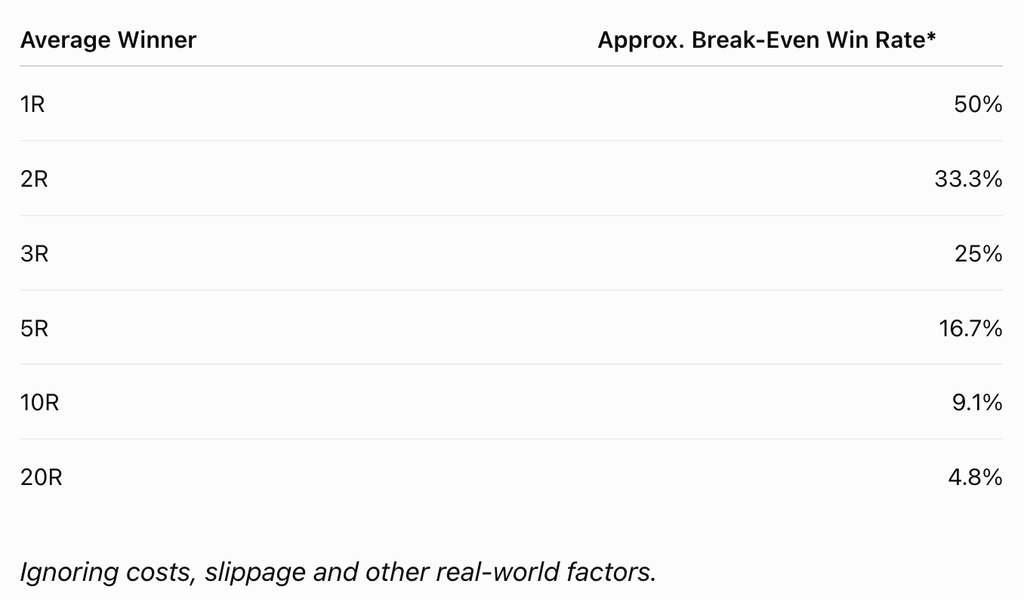
This is one of the most powerful ideas I’ve learned in trading.
You don’t necessarily need to become extraordinarily good at predicting what happens next.
You need to become very good at controlling what happens when you’re wrong, while leaving yourself exposed to meaningful upside when you’re right.
Trade #3: NASDAQ – 1:12 Risk-to-Reward
The following day brought another NASDAQ opportunity.
This time the move produced approximately 12R.
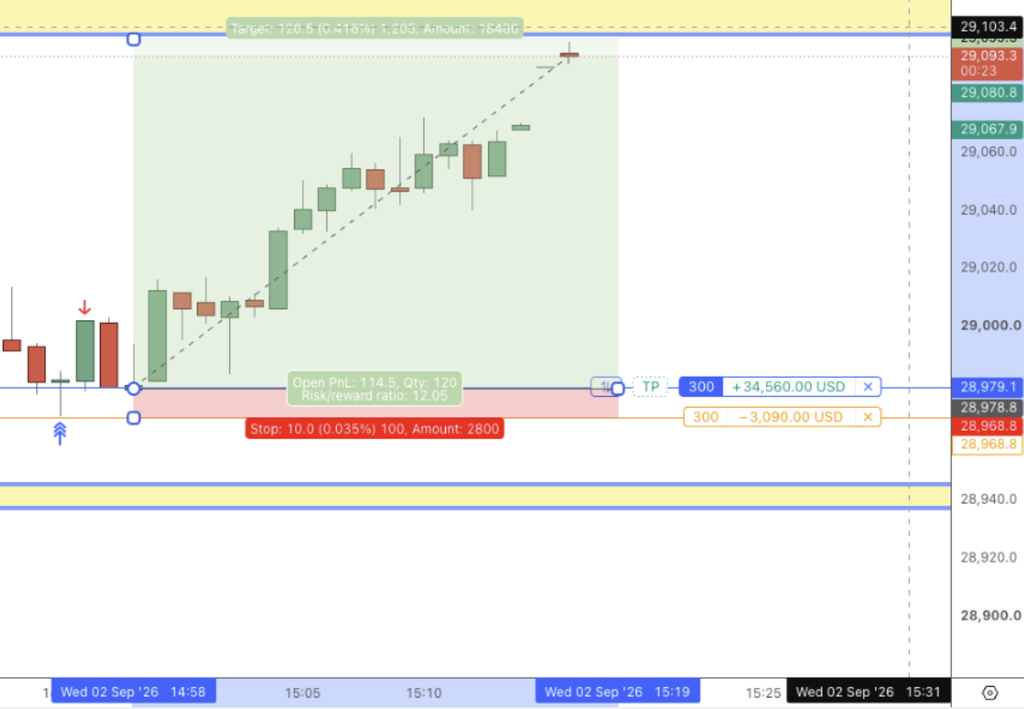
After a 38R trade, 12R almost looks ordinary.
It isn’t.
And this is another psychological trap traders need to avoid.
Once you’ve experienced a very large winner, it’s easy to recalibrate your expectations and start demanding extraordinary results from every trade.
That’s dangerous.
The market doesn’t owe you another 38R trade.
Your job is not to force one.
Your job is to execute the same process and accept whatever the market gives you.
Why I Didn’t Trade Yesterday
Yesterday I didn’t take a trade.
And I think that’s worth including in an article showing four double-digit trades.
Because otherwise I’m presenting a distorted picture of day trading.
Four trades.
One day with no trade.
That’s perfectly fine.
Not trading is a position too.
One of the biggest misconceptions about day trading is that being a day trader means you need to trade every day.
You don’t.
I would rather take no trade than manufacture a mediocre setup because I feel I need to participate.
This becomes particularly important with asymmetric trading.
If I’m looking for situations where a relatively small predefined risk has the potential to turn into a disproportionately large reward, I need to be selective.
Sometimes that means doing absolutely nothing.
Trade #4: DAX – 1:11 Risk-to-Reward
Then this morning, DAX presented another opportunity.
It became my fourth asymmetric trade of the week.
The result was another double-digit move:
1:11 RR.
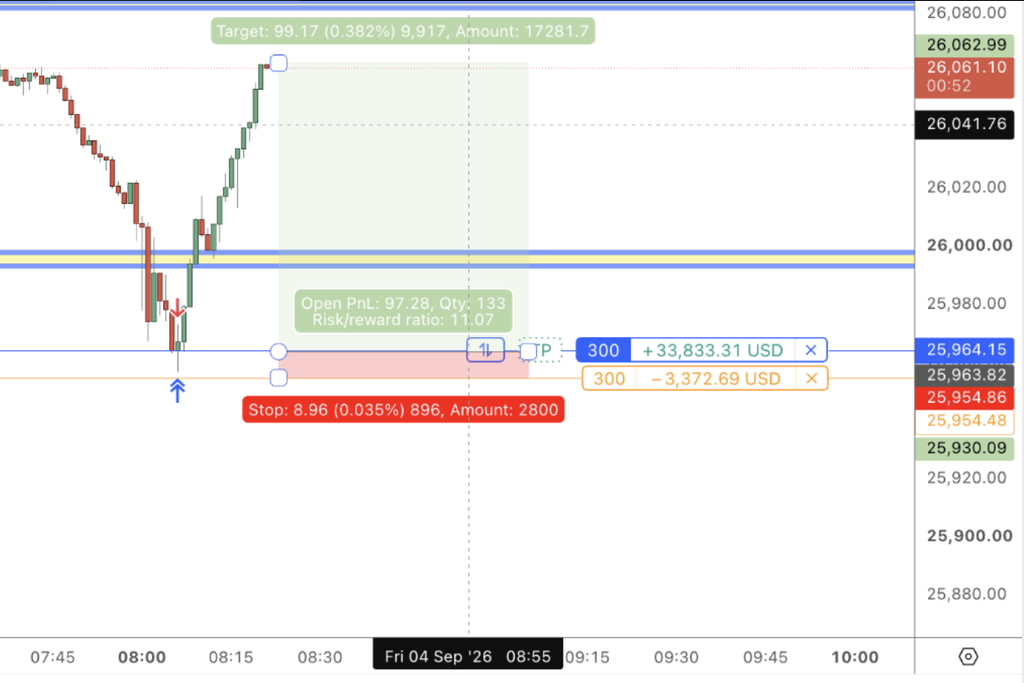
And again, the important thing isn’t that it was another winner.
It’s the payoff profile.
My objective isn’t to eliminate losing trades.
That’s impossible.
My objective is to keep losses reasonable enough that when the market does provide an exceptional move, I am there to participate in it.
18R + 38R + 12R + 11R
Put the four trades together and you get:
18R + 38R + 12R + 11R = 79R
That number looks extraordinary.
And it is an unusually strong sequence.
But I don’t want anyone reading this article and walking away thinking:
“Great. I’ll make 79R every week.”
You won’t.
Neither will I.
That is not the lesson.
The lesson is that asymmetric trading does not require every trade to be extraordinary for the underlying mathematics to remain attractive.
There can be strings of -1R losses.
There can be break-even periods.
There can be weeks when nothing substantial happens.
There can be periods of low volatility where large moves are much harder to find.
The important thing is what happens across the distribution of trades, not what happens on any individual day.
Why I Prefer Asymmetry to Chasing a High Win Rate
There’s another reason I prefer this style of day trading.
It changes what I’m trying to optimise.
I’m not trying to maximise the number of times I can say:
“I was right.”
I’m trying to create a favourable relationship between my downside and my upside.
Those are two very different objectives.
A high win rate can feel psychologically comfortable.
But traders can become so obsessed with preserving that win rate that they:
take profits too early, widen stops, hold losing trades too long, avoid good setups after a loss, or seek excessive confirmation before entering.
All because they desperately want the next trade to be a winner.
Asymmetric trading asks you to think differently.
Can I keep the downside reasonable while giving the upside enough room to surprise me?
That’s the question I’m interested in.
You Don’t Need a 38R Trade
This might actually be the most important point in this entire article.
You don’t need to catch 38R trades for asymmetric trading to work.
The 38R NASDAQ trade is an extreme example.
Even much smaller asymmetry can dramatically change the mathematics of a trading strategy.
At an average 3:1 reward-to-risk, for example, the theoretical break-even win rate before costs is only 25%.
At 5:1, it’s approximately 16.7%.
That doesn’t mean you should arbitrarily place enormous profit targets on every trade.
That’s not asymmetry.
That’s wishful thinking.
The market structure has to support the potential reward.
Your execution has to support it.
Your risk management has to support it.
And, perhaps most importantly, you have to be capable of sitting through the trade without destroying the asymmetry by constantly interfering with it.
Asymmetric Trading Is Not About Taking Bigger Risks
This is where I think people can completely misunderstand the concept.
A 38R trade does not mean taking 38 times more risk.
It’s the opposite.
The idea is to define a reasonable amount of downside and seek situations where the potential upside is many multiples of that risk.
That’s why I don’t particularly like trading screenshots that focus exclusively on monetary P&L.
One trader might make £100.
Another might make £1,000.
Another might make £10,000.
Those figures tell you very little without knowing their equity and how much capital they risked.
Risk £100 to potentially make £1,000 and risk £10,000 to potentially make £10,000 are two completely different propositions.
That’s why I prefer thinking in R and percentage terms.
Trading should not encourage you to risk more simply because you’ve seen somebody else making more money.
If anything, a robust trading framework should encourage you to become more responsible with risk, not less.
The Real Lesson From These Four Day Trades
Four trades.
Four double-digit outcomes.
79R combined.
One day sitting on my hands.
It was an exceptional sequence.
But don’t confuse an exceptional week with an expectation for every week.
That’s not how markets work.
The deeper lesson is the same whether the week produces 79R, 10R, 2R or a loss:
You don’t need to win all the time if your winners can meaningfully outweigh your losers.
You don’t need to predict every move.
You don’t need to trade every day.
And you certainly don’t need to increase your risk because somebody on the internet showed you a big P&L screenshot.
What you need is a repeatable process, controlled downside, patience and the ability to participate when the market finally offers you something exceptional.
That’s the philosophy behind my approach to asymmetric trading and day trading.
Lose reasonably when you’re wrong.
Give yourself the opportunity to win disproportionately when you’re right.
And let the mathematics play out over a sufficiently large sample of trades.
That’s asymmetry.
Atanas