Day Trading Asymmetry: Why the Best Traders Learn to Be Comfortable With Uncertainty
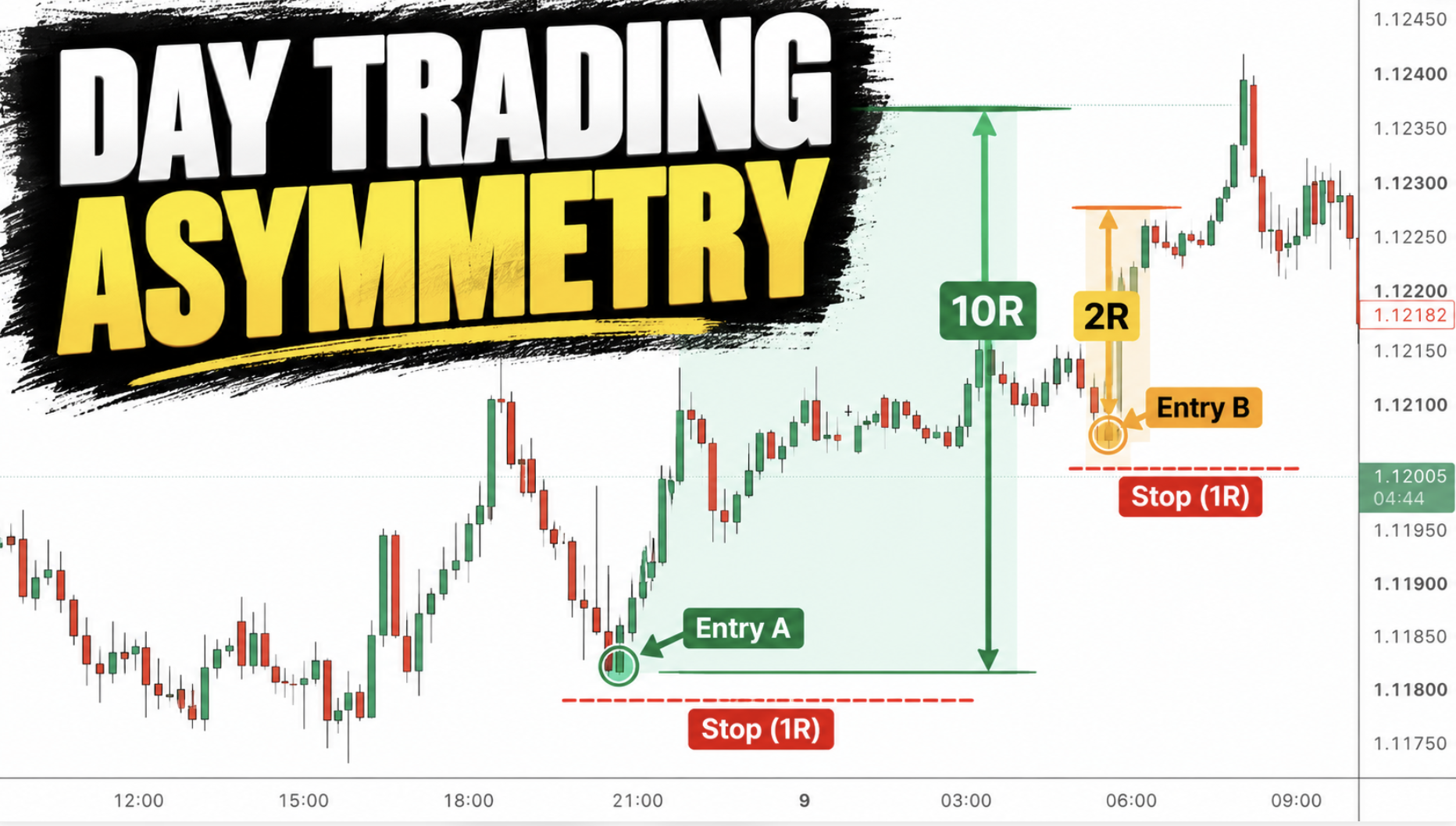
How a 10R+ trade on Columbus Day revealed two psychological mistakes that prevent traders from capturing exceptional opportunities.
There is a strange paradox in day trading.
The more certain traders want to feel, the more they often sacrifice the very thing that makes a trade worth taking.
They wait for additional confirmation before entering.
Then, once they’re in profit, they become increasingly uncomfortable with the possibility of giving some of it back.
So they do something that feels perfectly rational.
They enter too late and exit too early.
And somewhere between those two decisions, they destroy the asymmetry that could have made the trade exceptional.
I have spent years developing an asymmetric day trading strategy designed to do something quite different: accept relatively small, controlled losses in exchange for the opportunity to capture disproportionately large winners.
Sometimes 10R.
Sometimes 20R.
Occasionally even 30R or more.
But here’s what I’ve learned along the way.
Building an asymmetric trading system is only half the challenge.
The other half is developing the psychological discipline to actually trade it.
And a recent NASDAQ trade, which eventually closed above 10R on Columbus Day, offers a particularly useful example.
The 8R Decision: When a Winning Trade Becomes a Psychological Test
Monday started with an opportunity that eventually reached 8R.
For anyone unfamiliar with risk-to-reward terminology, R represents the amount initially risked on a trade.
If you’re risking $100, an 8R profit represents $800 before costs.
If you’re risking $500, that’s $4,000.
The principle is the same regardless of position size.
By the time my trade reached 8R, I was facing a decision that almost every trader will recognise.
Should I close the position, secure the profit and walk away?
Or should I follow my trading rules and allow the position to continue towards a potentially larger target?
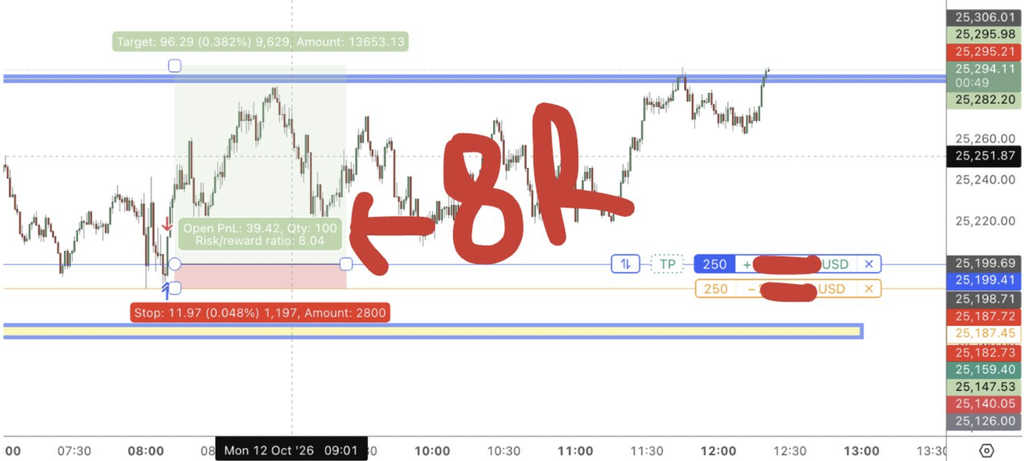
Eight times the initial risk is a substantial return on a single trade.
Many traders would have taken the money without hesitation.
And I understand why.
Closing a profitable position creates an immediate sense of relief. The uncertainty disappears. The profit becomes realised.
But there was one problem.
My system wasn’t telling me to close the position. My emotions were tempting me to.
That distinction matters enormously.
If I repeatedly close positions simply because the unrealised profit becomes uncomfortable, how can I reasonably expect to capture the occasional 20R or 30R trade?
I can’t.
Those exceptional outcomes require giving profitable positions sufficient room to develop, even when doing so feels psychologically uncomfortable.
So I followed my rules.
At that stage, my protective stop had already been moved to break-even.
If the market continued in my favour, I retained the opportunity for a larger payoff.
If it reversed, I could be stopped out around my entry price, although execution costs and slippage could still affect the final result.
Either outcome was acceptable within my plan.
And that leads to something I consider fundamental to asymmetric day trading.
The Psychological Win-Win: Removing the Emotional Cost of Trading
Most traders measure a successful trade by how much money they make.
I look at it differently.
A successful decision is one that respects the trading process, even if the immediate financial outcome is disappointing.
At 8R, I had already accepted the possibility of giving back a significant amount of unrealised profit.
That wasn’t an emotional compromise.
It was part of the strategy.
The important thing was that I no longer needed to constantly negotiate with myself.
Should I close now?
What if the market reverses?
What if I lose everything I’ve made on this position?
Those questions become much less disruptive when you’ve already defined the conditions under which you will exit.
I call this a psychological win-win.
Not because every possible outcome produces a financial gain.
But because neither outcome requires me to abandon my process.
This distinction becomes particularly important when trading frequently over months and years.
Every emotional decision carries a cost.
Every time you override your system because of fear, you introduce inconsistency.
And inconsistency makes it much harder to evaluate whether your strategy actually has an edge.
The goal isn’t to remove emotions entirely.
It’s to build a trading process in which your emotions have less influence over your decisions.
The Result: 10R+ on Columbus Day
The market eventually continued in my favour.
The trade closed at more than 10R.
And interestingly, this happened on Columbus Day, when I hadn’t expected much from the US trading session.
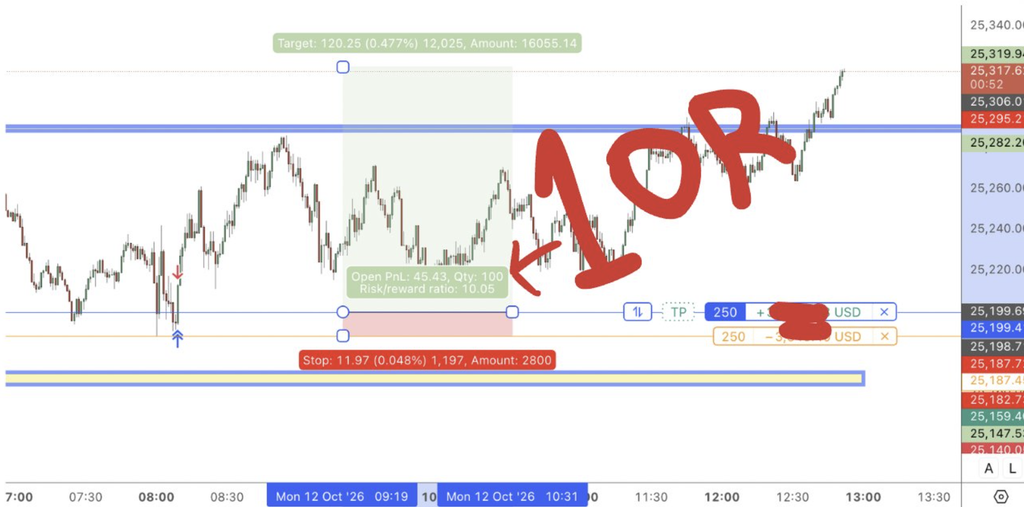
But I want to emphasise something.
The additional 2R wasn’t the most important part of this trade.
The decision I made at 8R was.
Had the market reversed and stopped me out around break-even, I would still consider following my plan the correct decision.
Why?
Because the objective of asymmetric trading isn’t to maximise the profit of every individual position.
It’s to create a repeatable framework capable of capturing exceptional opportunities over a large enough sample of trades.
Of course, that framework must have a genuine statistical edge. Following rules alone cannot make an unprofitable strategy profitable.
But if you’ve developed and tested a system built around asymmetric payoffs, you must give that system the opportunity to express its edge.
Otherwise, you may end up trading something completely different from what you originally designed.
The Other Side of Asymmetry: Why Confirmation Is Expensive
There is another psychological mistake that is closely related to taking profits too early.
And it happens before the trade has even started.
Waiting for too much confirmation.
Imagine two traders looking at exactly the same NASDAQ chart.
They identify the same potential opportunity.
They see the same market structure, the same price levels and the same possible directional move.
But they approach the entry differently.
Trader A identifies an opportunity with a clearly defined invalidation point and enters according to their tested trading plan.
Trader B wants additional confirmation.
Another candle.
A breakout.
Perhaps a retest.
Then some momentum in the expected direction.
Eventually, Trader B feels sufficiently confident to enter.
But there’s a problem.
The market has already moved.
The entry is worse, the stop may need to be wider, and the remaining distance to the target is smaller.
The trader has purchased psychological comfort at the expense of potential reward.
Confirmation is expensive.
Here’s a simplified example.
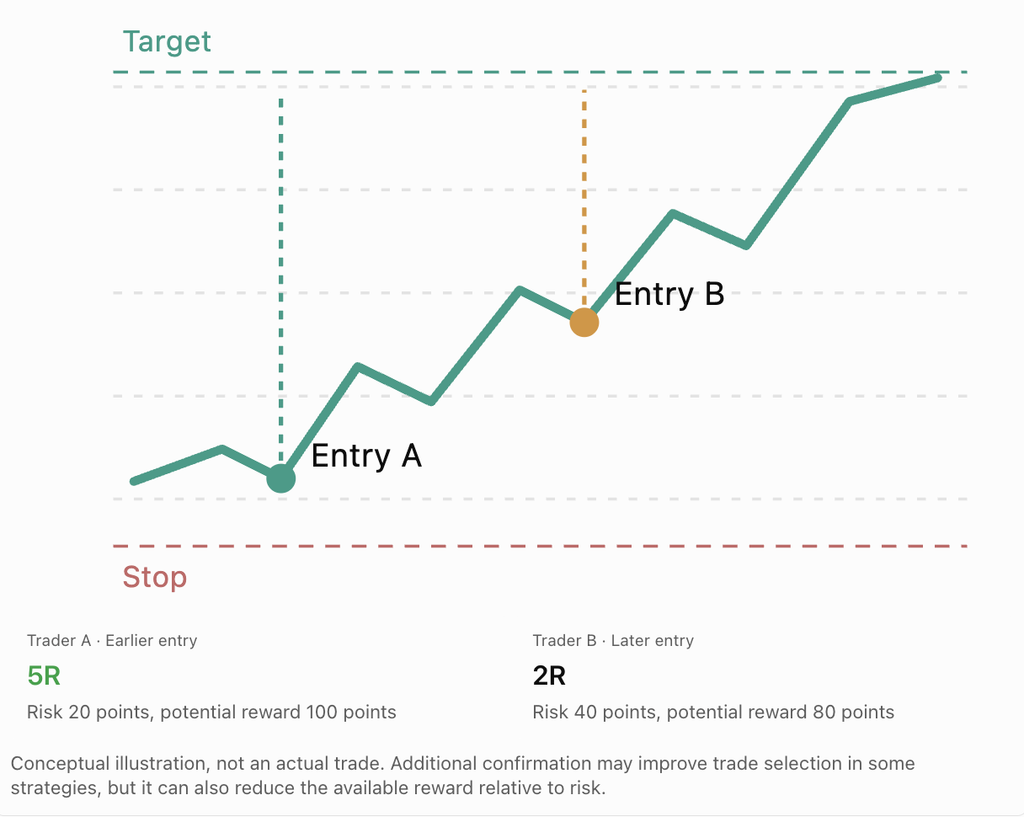
Both traders may ultimately be correct about market direction.
But their financial outcomes can be very different.
This doesn’t mean entering early is always better, or that confirmation is inherently wrong.
It means confirmation must justify its cost.
A later entry may improve the probability of success, but it can also reduce the potential payoff. The relationship needs to be tested, not assumed.
In asymmetric trading, the quality of an opportunity cannot be measured by confidence alone.
The relationship between potential reward, initial risk and probability matters far more.
The Two Psychological Mistakes That Destroy Asymmetry
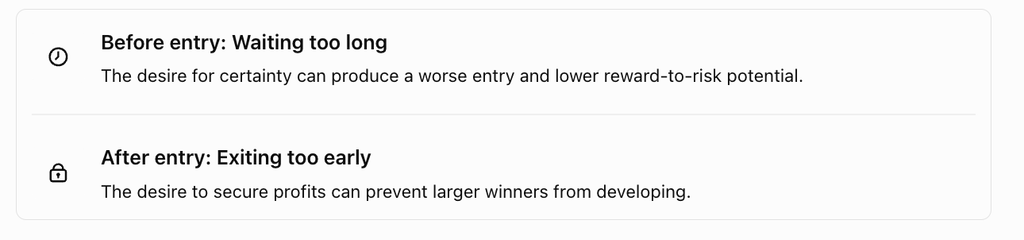
Notice how these two behaviours are connected.
Before entering, traders are afraid of being wrong.
After entering, they’re afraid of losing unrealised profits.
In both cases, they seek comfort.
And in both cases, that comfort can come at a substantial financial cost.
The result?
A trading approach that may generate a reasonable number of winners but struggles to produce exceptional payoffs.
This is particularly dangerous for traders whose strategies depend on relatively infrequent, outsized gains.
If your system is designed around small losses and large winners, repeatedly cutting those winners short can undermine the entire mathematical structure.
And that’s why I believe asymmetric trading requires a different mindset.
You must become comfortable with uncertainty before entering.
And you must remain comfortable with uncertainty after entering.
Why Win Rate Is Not the Most Important Metric
One of the biggest misconceptions in day trading is that successful traders must be right most of the time.
They don’t.
Consider a hypothetical strategy with a 30% win rate.
If the average winner is 5R and the average loser is 1R, the expectancy is:

That’s a positive theoretical expectancy of 0.8R per trade before commissions, slippage and other costs.
Now imagine the same strategy, with the same win rate, but the trader repeatedly closes profitable positions early.
The average winner falls to 2R.

Suddenly, the strategy has negative expectancy.
The win rate hasn’t changed.
The loss size hasn’t changed.
Only the average winner has changed.
This is a simplified mathematical example, not a claim about my own trading statistics. In practice, changing exits can also change the win rate and distribution of results.
But it illustrates why payoff distribution matters more than the emotional satisfaction of being right.
A trader can win frequently and still lose money.
Another can be wrong more often than they’re right and still achieve positive expectancy.
The difference lies in the relationship between their wins and losses.
Trading Less Can Make Asymmetry More Achievable
There is another element to this approach that often surprises traders.
I don’t believe you need to trade constantly to be a successful day trader.
In fact, one of the core principles of my trading framework is to be highly selective.
Some days I identify one or two opportunities.
Other days I don’t trade at all.
And I’m perfectly comfortable with that.
The objective isn’t to participate in every market movement.
It’s to identify situations where the potential reward is disproportionately large relative to the risk, according to a defined set of criteria.
This also reduces the temptation to manufacture opportunities simply because the market is open.
There is no obligation to trade.
No requirement to recover yesterday’s losses immediately.
No need to force another position after a profitable morning.
Patience is not inactivity.
In asymmetric day trading, patience is part of the strategy.
Of course, fewer trades don’t automatically mean better performance. Selectivity only adds value when the criteria used to filter opportunities are supported by evidence.
How to Develop an Asymmetric Trading Mindset
Developing this mindset requires more than simply telling yourself to hold winners longer.
You need a framework that supports those decisions.
For me, that means defining the opportunity before entering, understanding exactly where the trade idea becomes invalid, and knowing how the position will be managed as the market develops.
It also means accepting that many perfectly reasonable trades will fail.
That’s the nature of trading.
The objective isn’t to eliminate losses.
It’s to ensure that losses remain controlled while preserving the possibility of substantially larger gains.
And perhaps most importantly, it means evaluating the quality of your decisions independently of individual outcomes.
A trade that loses money can still represent excellent execution.
A trade that makes money can still represent a serious violation of your process.
If you confuse profitability with good decision-making, you risk reinforcing the wrong behaviours.
Over time, those behaviours become habits.
And habits eventually become your trading results.
The Real Lesson From My 10R Trade
Looking back at Monday’s trade, the result was certainly satisfying.
More than 10R on a session where I hadn’t expected much.
But the most valuable lesson wasn’t the amount of profit.
It was the decision to remain consistent when I had a perfectly understandable emotional reason to do otherwise.
At 8R, closing the position would have felt good.
Following my system required accepting the possibility of giving back a large unrealised gain.
That is the uncomfortable reality of asymmetric trading.
You cannot demand exceptional payoffs while insisting on emotional certainty at every stage of the process.
The market simply doesn’t work that way.
And that brings me back to the central paradox.
The more certainty you demand, the more asymmetry you may sacrifice.
Before entry, excessive confirmation can reduce your potential reward.
After entry, premature profit-taking can prevent your biggest winners from developing.
The solution isn’t to become reckless.
It’s to build a thoroughly tested framework that defines risk, entries, exits and position management before emotions take over.
Because the goal of asymmetric day trading isn’t to feel comfortable all the time.
It’s to become comfortable following your process, even when the outcome remains uncertain.
And sometimes, that discipline is what allows an 8R trade to become a 10R trade.
Or occasionally, something much bigger.
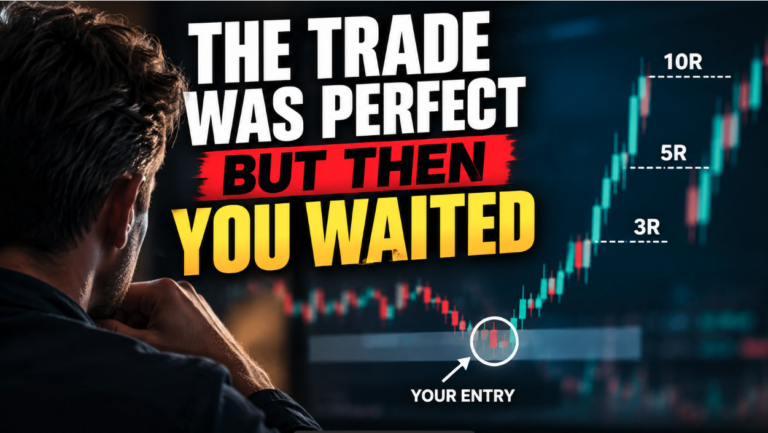
Watch: Why More Certainty Can Mean Less Profit
In my latest six-minute video, I explain why waiting for confirmation can damage your risk-to-reward ratio and why the most obvious-looking trades aren’t always the best opportunities.
Before your next trade, ask yourself two questions:
Am I waiting for more confirmation because my strategy requires it, or because I’m afraid of being wrong?
And when you’re sitting on a substantial unrealised profit:
Am I about to close this position because my system tells me to, or because I’m uncomfortable with the possibility of giving some of it back?
Those two questions might change the way you approach trading.
Yours,
Atanas
Risk disclaimer: Day trading involves substantial financial risk and may not be suitable for everyone. The trade examples and R multiples discussed are illustrative of individual experiences and are not guarantees of future performance. A stop-loss order does not guarantee execution at the specified price.