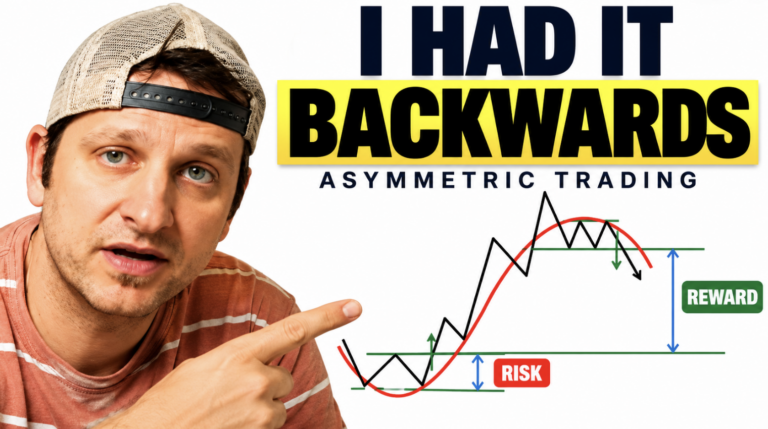

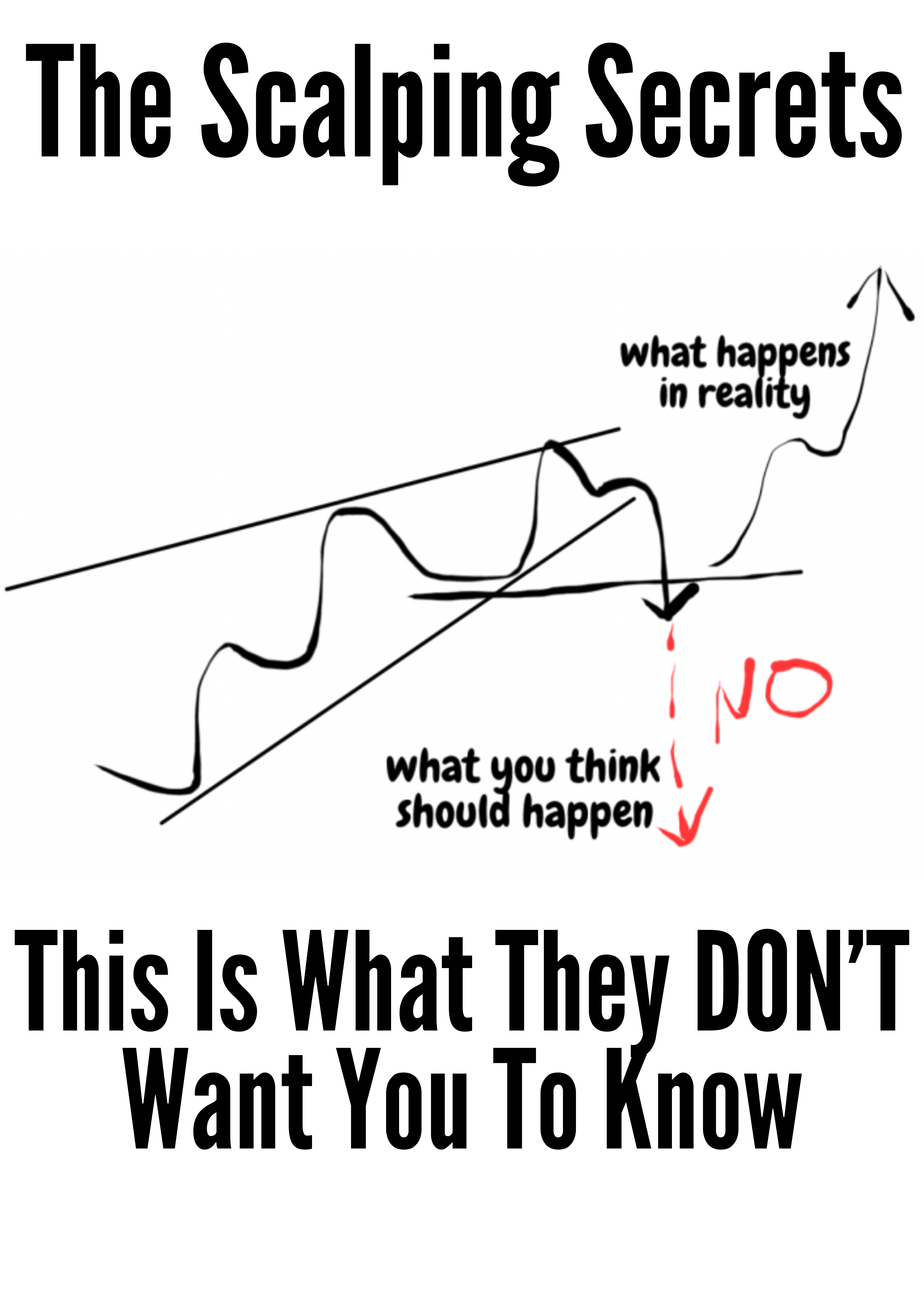
Asymmetric Trading Strategy: Why I Stopped Taking Profits at 2R
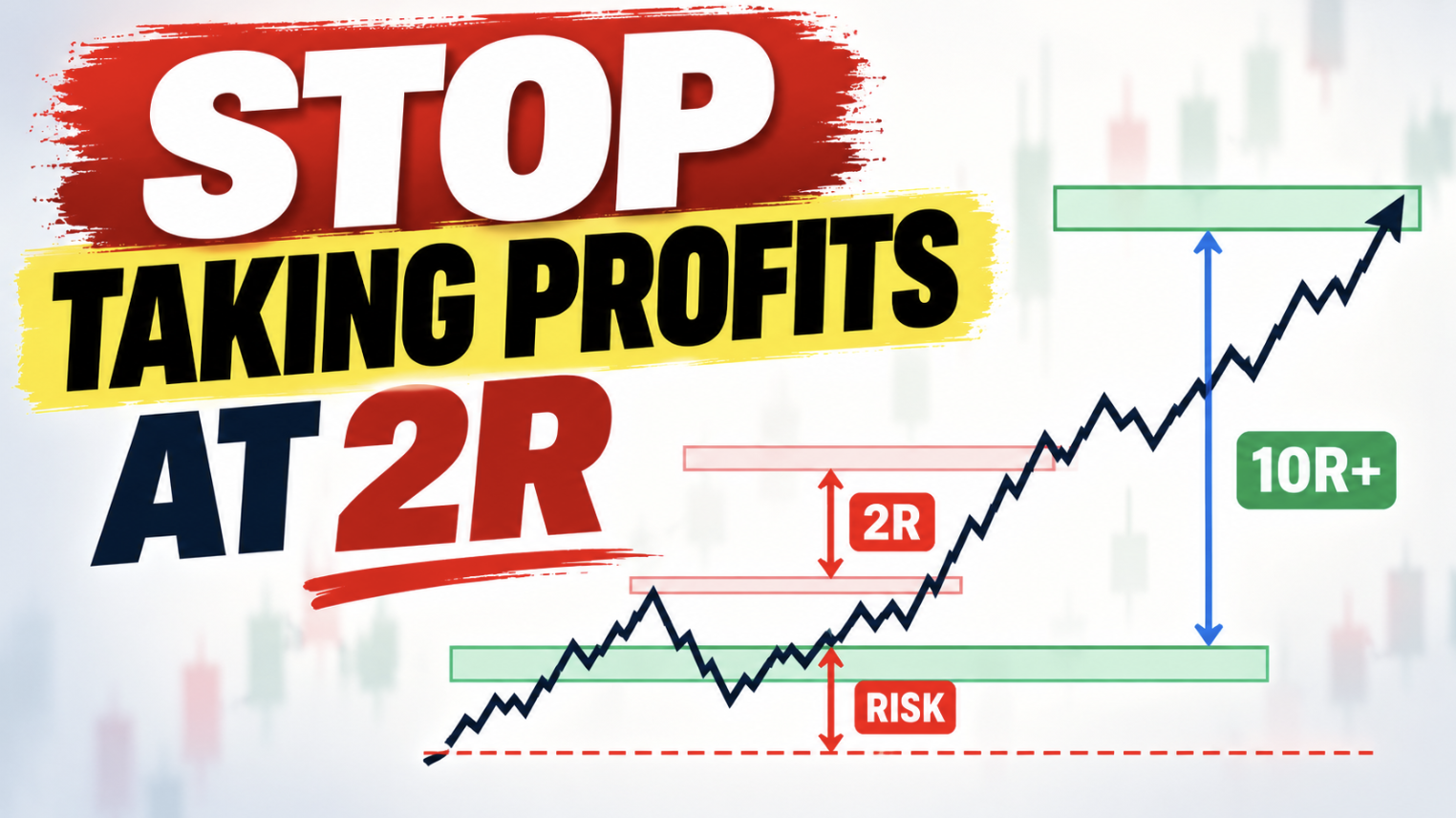
Asymmetric Trading Strategy: Why a 2:1 Risk-to-Reward Ratio Can Limit Your Best Trades
Most traders are taught that a 2:1 risk-to-reward ratio is a sensible approach to trading.
Risk $100 to make $200. Take your profit. Move on to the next opportunity.
There’s nothing inherently wrong with that.
But what happens when the market is willing to give you $1,000, $2,000, or even more?
You didn’t lose the trade. In fact, you made money.
But you might have missed the most valuable part of the opportunity.
This is one of the fundamental differences between conventional trading and what I call asymmetric trading.
And understanding that difference completely changed how I approach the markets.
Watch: Conventional vs. Asymmetric Trading – Why I Stopped Taking Profits at 2R
What Is an Asymmetric Trading Strategy?
An asymmetric trading strategy aims to create a favourable imbalance between potential losses and potential gains.
The basic idea is straightforward:
Keep the cost of being wrong controlled while allowing the potential reward from being right to become significantly larger.
Rather than deciding that every winning trade must end at a predetermined 2R or 3R target, an asymmetric trader looks for opportunities where the market has sufficient room to deliver a much larger move.
This doesn’t mean every trade will produce 10R or 20R.
Most won’t.
It means developing a trading process that doesn’t automatically eliminate the possibility of capturing exceptional moves.
The distinction matters because a trading system can have a high win rate and still perform poorly, while a system with fewer winners can potentially achieve positive expectancy if its average winners are sufficiently large relative to its losses.
Conventional Trading vs. Asymmetric Trading
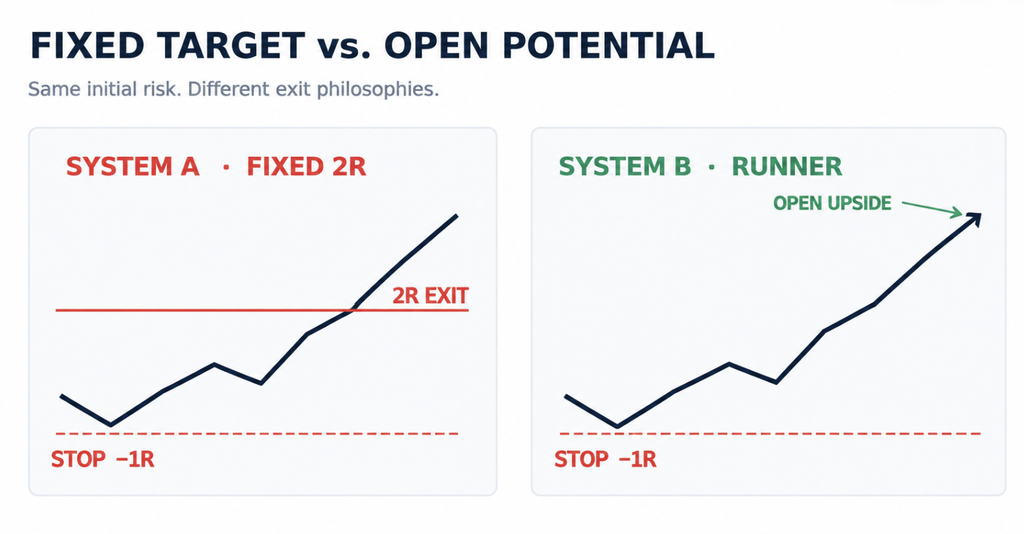
Let’s compare two approaches using exactly the same entry, stop-loss and initial risk.
System A: Conventional fixed-target trading
- Initial risk: 1R
- Profit target: 2R
- Full position closed at target
- Maximum planned profit: 2R
System B: Asymmetric trade management
- Initial risk: 1R
- Partial profit taken at +1R
- Remaining position left open
- Potential reward depends on how far the market travels
Both systems begin with the same downside exposure.
The difference is what happens when the market moves in your favour.
System A has already decided how much the trade is worth.
System B allows the market to reveal whether the opportunity has greater potential.
Of course, the second approach also introduces uncertainty. Some trades that could have closed at 2R may ultimately deliver much less.
That’s the trade-off.
And it’s why the mathematics of the entire strategy matter more than any single impressive winner.
The Problem With Automatically Closing Every Trade at 2R
Imagine entering a trade with a $100 initial risk.
The market moves in your favour.
You reach +2R, close the position and collect $200.
A perfectly respectable trade.
But then the market continues.
First to 3R.
Then 5R.
Eventually, it reaches 10R.
You captured $200 from a move that offered considerably more potential.
Now, there’s no guarantee you could have held the entire move. Real trading involves uncertainty, pullbacks, execution costs and emotional pressure.
But there’s a more important question:
Why did you decide the trade was only worth 2R before the market had shown you how far it could travel?
This is what concerns me about rigid profit targets.
They can place a ceiling on your upside before you’ve had the opportunity to assess the full development of the move.
How I Manage Asymmetric Trades
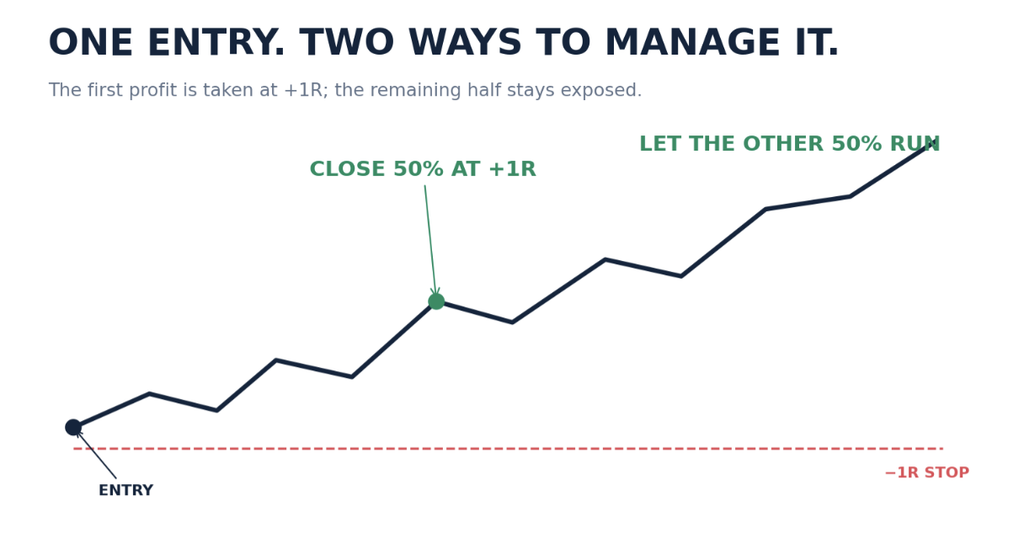
My approach is based on separating the position into two parts.
Once price reaches +1R, I take profit on 50% of the position.
The remaining 50% stays open.
Why?
Because I want to accomplish two things.
First, I want to realise some profit.
Second, I want to preserve exposure to a potentially exceptional opportunity.
Let’s use a simple example.
Suppose I risk $100 on a trade.
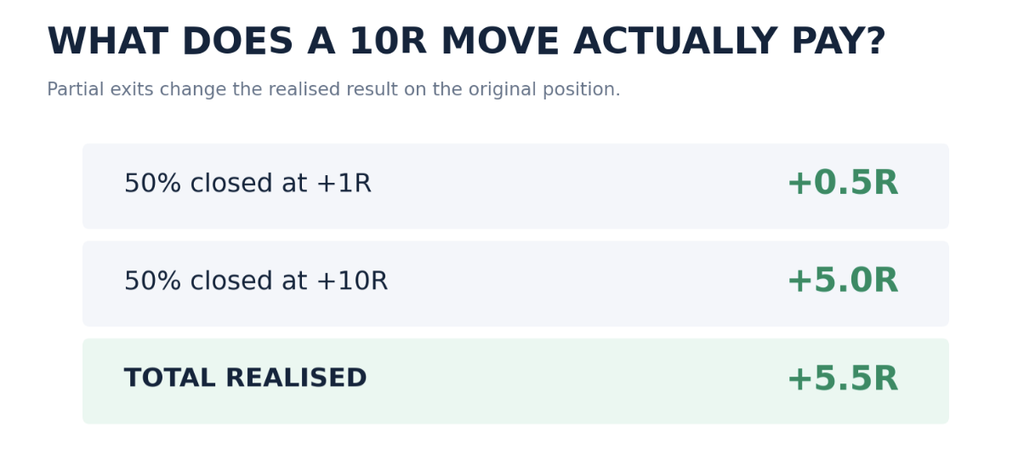
When price reaches +1R, I close half the position for a $50 profit.
If the remaining half subsequently returns to the original stop-loss, it loses $50.
The combined result is approximately break-even, before fees and slippage.
But if the remaining position continues towards +10R, that half generates $500, in addition to the $50 already realised.
The total trade result would be +5.5R, not +10R.
This distinction is important.
When discussing large risk-to-reward moves, we must distinguish between the price movement expressed in R and the actual realised return on the original full position.
The strategy doesn’t magically remove risk.
It changes the distribution of possible outcomes.
Why I Stopped Obsessing Over Win Rate
More than a decade ago, I thought becoming a better trader meant becoming better at predicting price movements.
I wanted a higher win rate.
If I could improve from 50% to 60%, that was progress.
From 60% to 70%? Even better.
So I looked for more confirmation.
More indicators.
More conditions before entering.
But eventually, I realised something.
I was optimising the wrong number.
The goal wasn’t necessarily to predict the next market move with extraordinary accuracy.
The goal was to construct a process in which being wrong had a controlled cost, while being right could occasionally produce a disproportionately large reward.
That’s a fundamentally different way of thinking about trading.
Why Exceptional Trades Look Ordinary at the Beginning
Here’s something I’ve noticed repeatedly in my own trading.
Some of the largest moves don’t look particularly promising when they begin.
They might hesitate around the entry.
They might move to +1R, retrace, and spend considerable time doing nothing.
They might even look like they’re about to fail.
Then something changes.
Price accelerates.
The move extends.
What initially appeared to be an ordinary opportunity develops into something exceptional.
The problem is that you cannot reliably identify every exceptional trade at the moment of entry.
A potential 10R winner doesn’t arrive with a label announcing its destination.
That’s precisely why I don’t want my trading process to automatically close every position at 2R.
I’m not trying to predict every exceptional move. I’m trying to remain exposed when one develops.
The Difference Between a Good Setup and a Good Opportunity
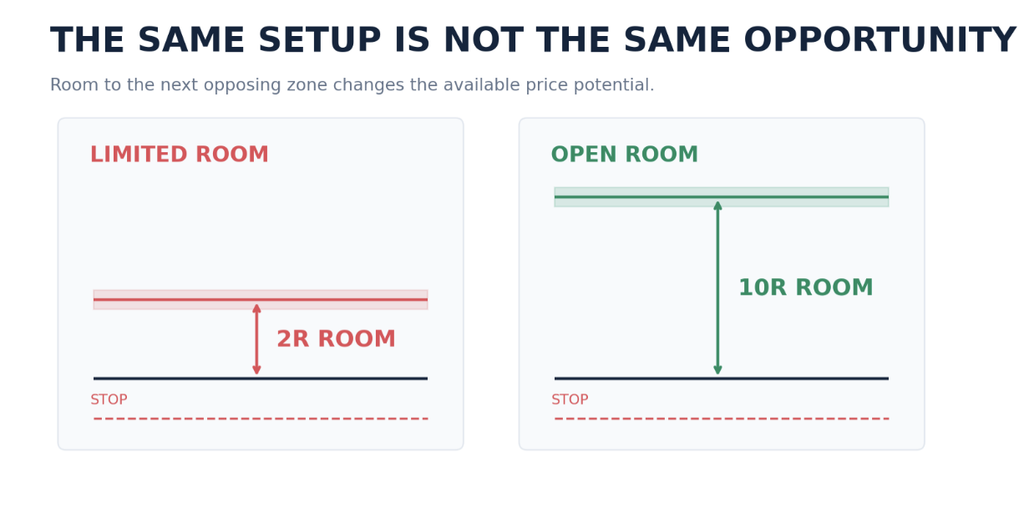
There’s another important distinction traders often overlook.
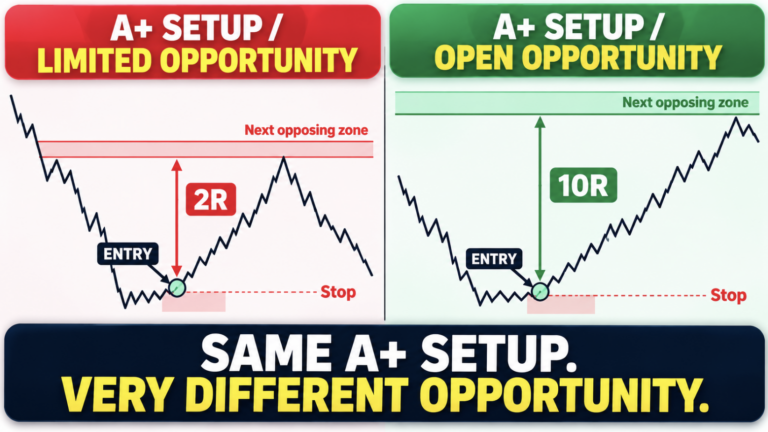
A technically attractive setup doesn’t necessarily represent an attractive opportunity.
You might identify a textbook entry with excellent confirmation.
But what if a major opposing supply or demand zone is only 2R away?
Even if the entry is technically sound, the available price movement may be limited.
Now consider another setup with the same initial risk but substantially more room before the next meaningful opposing structure.
The second trade may offer greater potential for an asymmetric outcome.
This is why I distinguish between setup quality and opportunity quality.
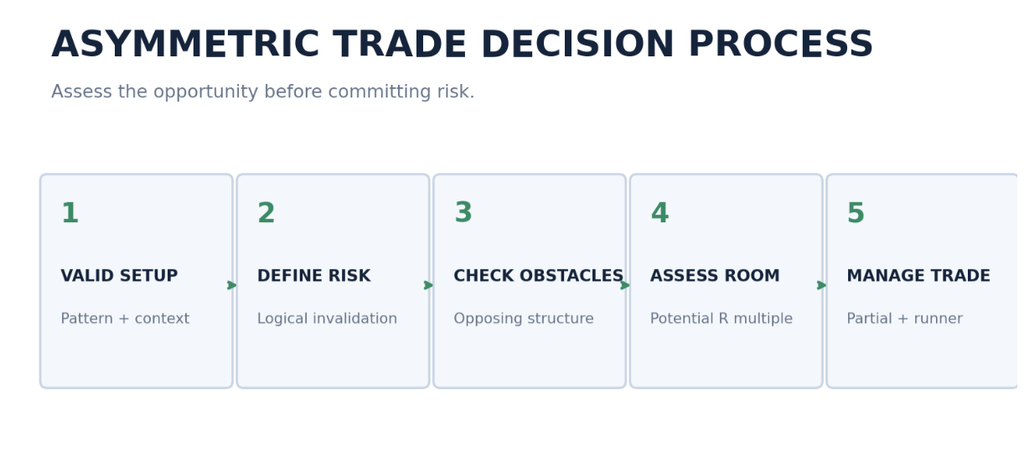
Before entering, I want to understand not just whether the setup is valid, but also how much room the market may have to move.
I consider the location of opposing structures, the broader market context, the initial risk and the potential reward.
A beautiful entry isn’t necessarily a valuable trade.
And a less visually impressive setup may sometimes present a considerably more attractive opportunity.
Does Asymmetric Trading Actually Work Mathematically?
This is the question that matters most.
It’s easy to talk about 10R, 20R or 30R opportunities.
But impressive individual trades don’t establish that a strategy has positive expectancy.
To evaluate an asymmetric trading strategy properly, we need to account for:
- Full losing trades.
- Partial profit-taking.
- Break-even outcomes.
- The frequency of larger winners.
- The realised return from the remaining position.
- Transaction costs and slippage.
For example, taking half the position off at +1R means a move to +10R produces +5.5R on the original position, assuming the remaining half exits at +10R.
Whether that approach outperforms a fixed 2R strategy depends on how frequently each outcome occurs.
A conventional 2R strategy may outperform an asymmetric approach under some market conditions, particularly when prices frequently reach 2R but rarely extend much further.
The advantage of asymmetric trading must therefore be demonstrated through the distribution of actual trade results, not simply through the size of the largest winners.
In Part 2 of this video series, I’ll examine the mathematics behind this approach in greater detail.
Final Thoughts: Stop Trying to Predict Every Big Winner
The biggest change in my trading wasn’t discovering another indicator or finding a more accurate entry pattern.
It was changing the question I asked myself.
Instead of asking:
How can I be right more often?
I started asking:
How can I control what happens when I’m wrong without unnecessarily limiting what happens when I’m right?
That’s the principle behind my asymmetric trading approach.
Not every trade will become exceptional.
Many will lose. Others will finish around break-even, and some will produce modest gains.
But occasionally, the market presents an opportunity that can deliver considerably more.
And when that happens, I want a process that gives me a chance to participate.
Watch the video above to see the two approaches compared on the whiteboard.
If you’d like to explore how I apply these principles in live markets, learn more about my Asymmetric Day Trading Programme.
Frequently Asked Questions About Asymmetric Trading
What is an asymmetric trading strategy?
An asymmetric trading strategy seeks to control potential losses while allowing profitable trades the opportunity to generate disproportionately larger returns.
Is a 2:1 risk-to-reward ratio good for trading?
A 2:1 ratio can be effective, depending on win rate, execution costs and overall expectancy. However, automatically closing every trade at 2R may limit exposure to larger market moves.
How does partial profit-taking work in asymmetric trading?
One approach is to close 50% of a position at +1R and leave the remaining half open. If the remaining half returns to the original stop-loss, the combined result is approximately break-even before trading costs.
Is asymmetric trading better than conventional trading?
This addresses the central comparison in your video and gives you another opportunity to explain that performance depends on expectancy, market conditions and trade management.
Risk disclosure: Trading involves substantial risk of loss. Examples are illustrative, and historical results do not guarantee future performance.