Asymmetric Trading: Why a Perfect Setup Can Still Be a Terrible Trade
Why a Perfect Trading Setup Isn’t Enough
Most traders spend an extraordinary amount of time trying to perfect their entries.
They study candlestick patterns, identify support and resistance levels, wait for confirmation, and develop increasingly complicated checklists.
And eventually, when everything aligns, they tell themselves:
“This is an A+ setup. I have to take it.”
But what if I told you that an A+ trading setup can still be a C-grade trading opportunity?
This distinction is one of the most important principles behind asymmetric trading, and understanding it fundamentally changed the way I approach financial markets.
Because the quality of your entry and the quality of the opportunity surrounding that entry are two completely different things.
Let me explain.
The Difference Between a Trading Setup and a Trading Opportunity
Imagine two traders looking at almost identical setups.
Both identify the same candlestick pattern. Both receive the same confirmation signal. Both enter with a 10-point stop loss.
And both are following their trading strategies perfectly.
Are these equally good trades?
Absolutely not.
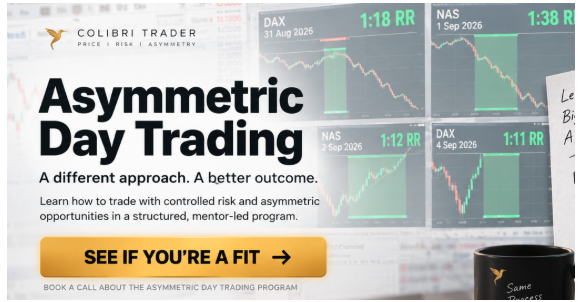
Let’s assume the first trader enters a long position immediately below a major supply zone.
The entry is technically perfect. The confirmation is there. Everything on the checklist looks excellent.
But just above the entry sits an area where sellers have previously demonstrated considerable strength.
The market might have enough room to deliver 1R or perhaps 2R before encountering that opposing structure.
Now consider the second trader.
The entry signal is identical, but the surrounding market structure is completely different.
There is no significant opposing supply immediately above the entry. Instead, there is considerable room before price reaches the next meaningful obstacle.
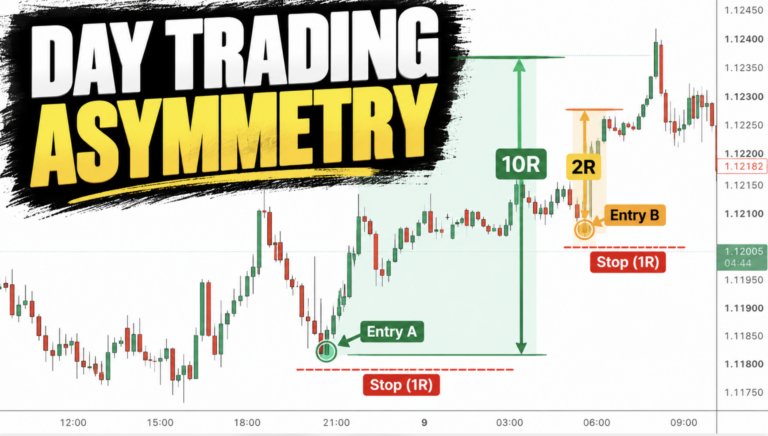
Perhaps that opportunity could accommodate a move of 5R, 10R or more.
We don’t know whether the market will deliver such a move.
But we know that the two opportunities are structurally different.
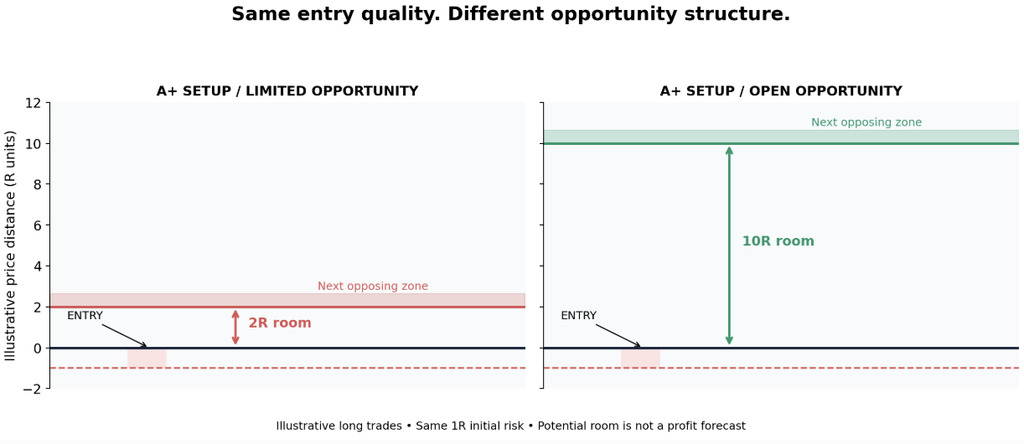
The first trade offers a good entry with limited room.
The second offers a good entry with the potential for a disproportionate payoff.
And that difference is fundamental to asymmetric trading.
Why Setup Quality Does Not Equal Opportunity Quality
Many retail trading strategies are built around entry confirmation.
Traders are taught to look for certain conditions:
- A particular candlestick formation.
- A valid support or resistance level.
- Confirmation from a lower timeframe.
- A defined stop-loss location.
- Agreement between technical indicators.
Once these conditions are satisfied, the trade receives an A+ rating.
But there is a problem.
You’ve graded the entry without grading what exists after the entry.
And the market doesn’t reward you simply because your entry was technically correct.
What matters is what happens after you enter, how much you risk, and how much potential reward is available relative to that risk.
This is where asymmetric trading introduces another dimension to trade selection.
Rather than asking only whether a setup is valid, we also evaluate whether the opportunity is worth taking.
An A+ setup can exist inside a C-grade opportunity.
And recognising that distinction can help eliminate trades that look attractive in isolation but offer limited potential relative to their risk.
Watch: A Perfect Trading Setup Can Still Be a Terrible Trade
Most traders spend their time perfecting entries. But what happens when a perfect entry offers very little room for the trade to develop?
In this 5-minute video, I explain why setup quality doesn’t equal opportunity quality, how two nearly identical setups can offer dramatically different potential rewards, and why evaluating the opportunity before entering is fundamental to asymmetric trading.
What Is Asymmetric Trading?
Asymmetric trading is an approach in which traders seek opportunities where the potential reward is disproportionately large relative to the amount of capital at risk.
For example, consider a trade risking $100.
A conventional 2:1 risk-to-reward trade targets $200.
An asymmetric opportunity might have the structural potential to generate $1,000 or more while maintaining that same initial $100 risk.
That would represent a 10R opportunity.
But there’s an important distinction.
Asymmetric trading is not about predicting a 10R move.
I cannot know beforehand whether a particular trade will generate 10R, 15R or 30R.
Nobody can predict that reliably.
What I can evaluate is whether the surrounding market structure creates the possibility of a disproportionate payoff.
In other words, I’m not asking:
“Will this trade make 10R?”
I’m asking:
“Does this opportunity have the structural room to allow a 10R move without requiring an unreasonable assumption?”
Those are very different questions.
The first requires prediction.
The second requires analysis.
And the second is considerably more useful when making trading decisions.
Three Questions I Ask Before Taking an Asymmetric Trade
Over the years, I’ve become increasingly selective about which trading opportunities deserve my attention.
Rather than taking every valid setup, I evaluate the relationship between risk and opportunity.
There are three questions I consider particularly important.
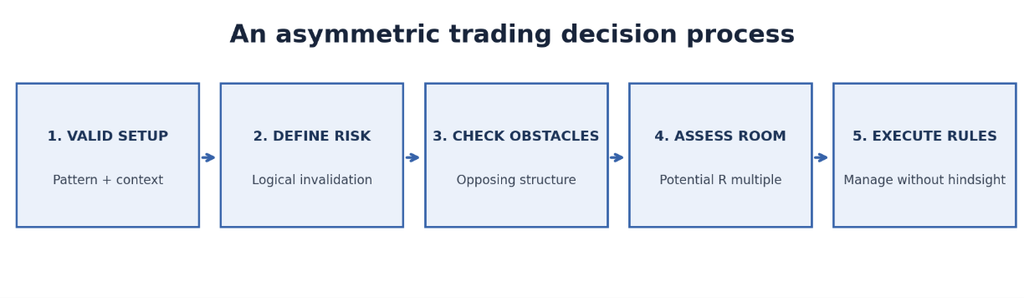
Question 1: Where am I wrong?
Before considering potential profits, I need to establish where the trade idea becomes invalid.
This determines my stop-loss placement and defines the initial risk.
A stop should reflect the market structure and the trading thesis, rather than simply being placed at an arbitrary distance to manufacture an attractive risk-to-reward ratio.
Without a logical invalidation point, there is no meaningful way to evaluate the opportunity.
Question 2: What’s standing in my way?
Next, I look at the obstacles between my entry and the potential destination of the move.
These might include supply and demand zones, previous swing highs or lows, significant support and resistance, or areas where the market has previously reacted strongly.
For a long position, I want to understand what lies above my entry.
For a short position, I want to understand what lies below it.
This is where looking at the broader chart becomes essential.
A beautiful one-minute entry might look completely different when examined against the 15-minute or hourly market structure.
Question 3: If this works, how much room does it actually have?
Finally, I compare the available structural room with the amount of risk required.
Suppose my stop loss is 10 points away.
If the nearest meaningful opposing structure is only 15 points from my entry, the available room is approximately 1.5R.
But if the next significant structural obstacle is 100 points away, the potential room is approximately 10R.
Neither outcome is guaranteed.
However, the second trade offers a very different relationship between risk and potential reward.
This is where asymmetry becomes part of trade selection, rather than something you simply hope will happen after entering.
Figure 2. A structured decision process for evaluating asymmetric trading opportunities before entry.
Download the asymmetric trading process diagram
A Real Example: My DAX Trade That Went From 10R to 18R
Let me illustrate another important aspect of asymmetric trading using a real DAX trade from 19 October 2026.
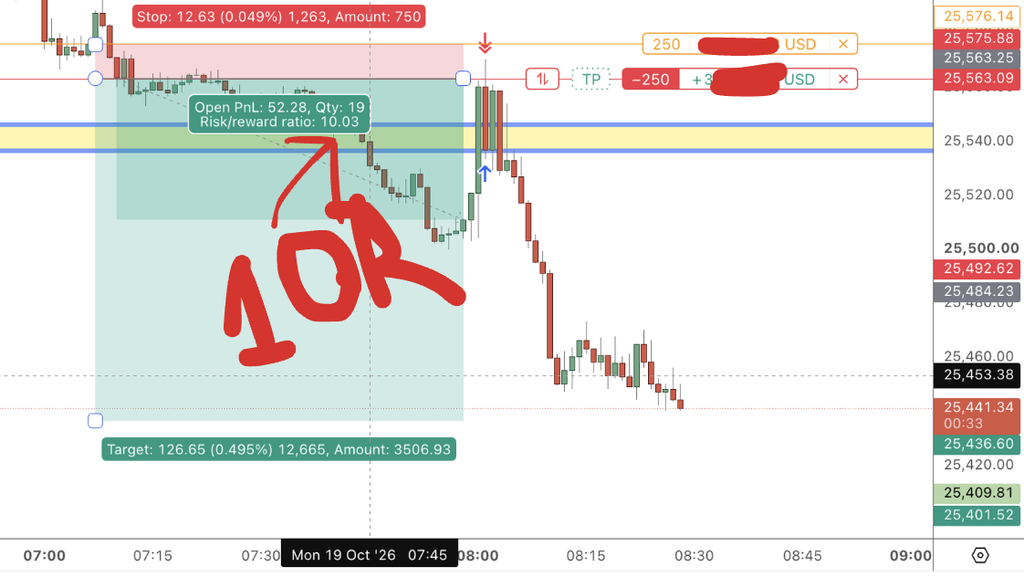
This morning, I entered a short position on the DAX.
The trade developed in my favour, and I eventually closed it at approximately 10R.
For most traders, that would be considered an excellent outcome.
And financially speaking, it was.
Here is my original DAX short position, showing the trade at approximately 10R.
But there was a problem.
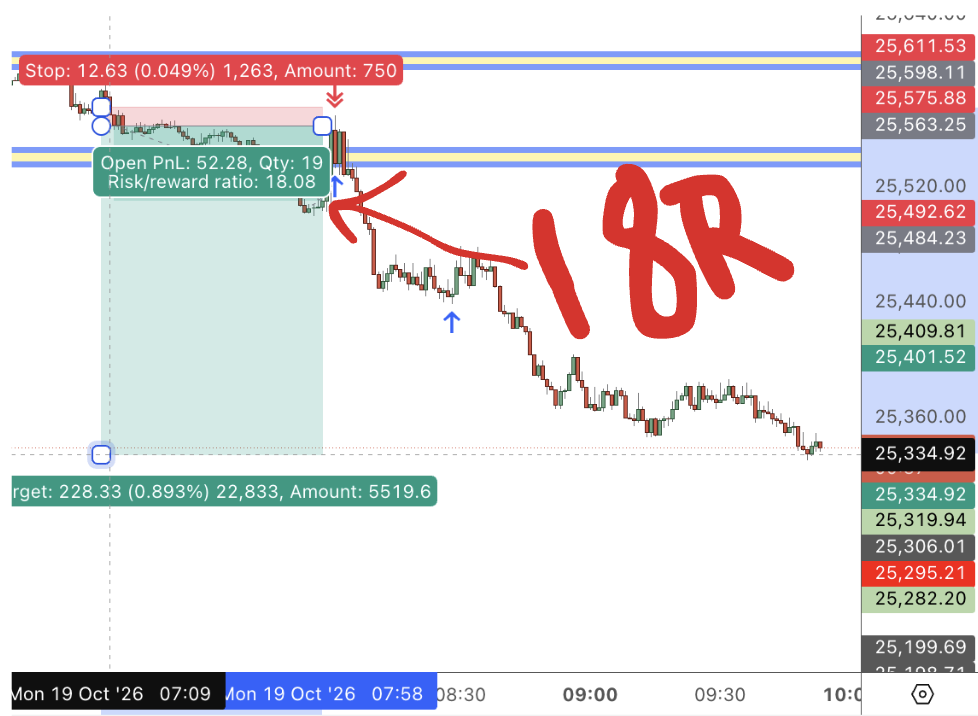
The market continued falling after my exit.
As the session progressed, the move extended to approximately 18R relative to my original risk.
The opportunity had become considerably larger than the profit I actually captured.
Here is the same DAX trade later reached approximately 18R, illustrating the additional move after my exit.
Does that mean closing at 10R was a mistake?
Not necessarily.
An exit should never be judged solely by what the market did afterwards.
There are perfectly legitimate reasons to close a profitable trade before its maximum potential has been realised.
But in this particular case, I had broken one of my own trading rules.
The two-hour rule
Part of my trading process involves allowing qualifying positions sufficient time to develop.
This helps prevent me from repeatedly cutting potentially asymmetric opportunities short simply because a trade has already generated an attractive profit.
On this occasion, I justified an early exit partly because it was Monday.
Taking 10R off the table on a Monday morning seemed perfectly reasonable.
But that justification conflicted with my existing two-hour rule.
And that’s where the real mistake occurred.
Not in missing the additional 8R.
The mistake was allowing a convenient excuse to override my trading process.
The Hidden Danger of Comparing Every Trade to Your Biggest Winner
Last month, I closed a trade at approximately 38R.
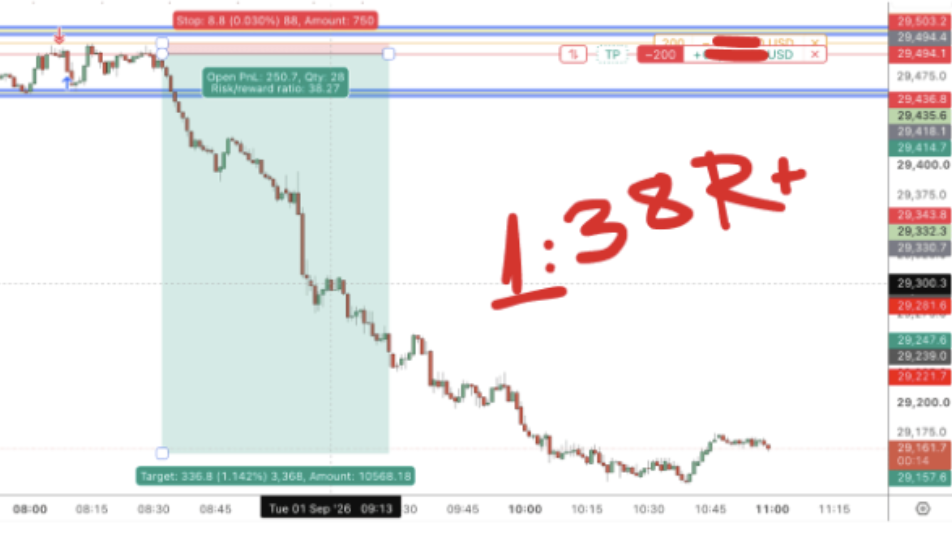
When you’ve experienced moves of that magnitude, something strange can happen psychologically.
A 10R winner can suddenly start feeling disappointing.
Think about how irrational that sounds.
A trade that generates ten times the initial risk is objectively a substantial winner.
Yet when you compare it with 18R or 38R, your perception changes.
And this is dangerous.
Because disappointment can influence your next trading decision.
You might hold a position longer than your rules permit.
You might reject a perfectly valid exit because you’re hoping for another extraordinary winner.
Or you might start searching for opportunities that aren’t actually present.
This is why I believe asymmetric trading requires more than simply identifying opportunities with substantial potential.
It also requires the discipline to execute a consistent process without becoming emotionally attached to previous outcomes.
There is a difference between allowing a trade to develop and refusing to exit because you want a particular result.
The former can be part of a disciplined trading strategy.
The latter is often an emotional decision disguised as patience.
A Profitable Trade Is Not Necessarily a Well-Executed Trade
One of the most important lessons I’ve learned is that profitability and execution quality are not the same thing.
You can make money while breaking your rules.
You can also lose money while executing your strategy perfectly.
This might sound contradictory, but it isn’t.
A trading process should be evaluated over a meaningful sample of trades, not solely by the outcome of an individual position.
Consider my DAX trade.
The financial result was positive.
The opportunity was substantial.
But my execution did not fully respect my predefined rules.
That is useful feedback.
The appropriate response isn’t to punish myself emotionally or attempt to recover the additional 8R on the next trade.
Instead, I acknowledge the deviation, understand why it happened, and return to the process.
The next time I open my charts, I want to evaluate the market as though this trade never happened.
No regrets.
No expectations.
No emotional baggage.
Just a fresh chart and an open mind.
How to Build an Asymmetric Trading Checklist
If you’re currently evaluating trades primarily by the quality of their entry signals, consider expanding your checklist.
Start by confirming that your setup is valid according to your strategy.
Then move beyond the entry.
Identify the structural invalidation point and calculate your initial risk.
Examine the higher-timeframe context to identify nearby opposing zones and other meaningful obstacles.
Estimate the available room before price is likely to encounter those obstacles.
Compare that room with your initial risk.
Finally, consider whether your trade management rules would realistically allow you to participate in a larger move if one develops.
This last point matters.
There is little benefit in identifying a potential 10R opportunity if your management process automatically closes every position at 2R.
Your entry, market selection, risk management and exit process need to work together.
And remember that a large theoretical reward-to-risk ratio does not automatically make a trade attractive.
The probability of reaching the target, the quality of the setup, trading costs and execution conditions still matter.
Asymmetric potential is one component of a complete trading framework, not a substitute for one.
The Real Advantage of Trading Less
One consequence of evaluating opportunities rather than simply setups is that you may take fewer trades.
And I consider that a feature, not a disadvantage.
If your strategy produces five valid setups, but only one offers an attractive relationship between risk and potential reward, there is no obligation to trade all five.
The objective is not to maximise trading activity.
It’s to identify worthwhile opportunities while keeping the cost of unsuccessful attempts under control.
That means accepting that some sessions will produce no trades.
It also means being comfortable watching valid setups develop without participating when the surrounding opportunity isn’t sufficiently attractive.
Trading less doesn’t automatically make someone a better trader.
But greater selectivity, when supported by a tested framework, can help prevent unnecessary exposure to lower-quality opportunities.
Final Thoughts: Don’t Just Grade the Setup. Grade the Opportunity.
The next time you see your favourite trading pattern, resist the temptation to immediately label it an A+ trade.
Zoom out.
Look left.
Look right.
Examine the structure above and below your entry.
Ask where your trade idea becomes invalid, what stands between your entry and the potential destination, and whether the available opportunity justifies the risk.
Because two identical setups can offer completely different outcomes.
One might provide an entry with very little room to develop.
The other might offer the possibility of a disproportionate payoff.
And that distinction sits at the heart of asymmetric trading.
My DAX trade also serves as a reminder that recognising an opportunity is only part of the equation.
You must also develop the discipline to manage it according to your rules.
A good setup gives you a reason to enter. A good opportunity gives that entry a reason to matter.
And learning to distinguish between the two may be one of the most important improvements you can make to your trading process.
Educational disclaimer: Trading involves substantial risk. The DAX examples are historical illustrations, not forecasts or promises of future performance. R-multiples describe returns relative to initial trade risk, and unusually large outcomes should not be treated as typical or guaranteed.