Asymmetric Trading: Why Win Rate Is the Wrong Obsession
Why I Stopped Chasing a Higher Win Rate
I spent years trying to win more trades.
And looking back, I think that obsession was one of the biggest obstacles to my development as a trader.
I studied charts. Refined my entries. Adjusted stop losses. Experimented with different confirmations.
All because I believed that if I could increase my win rate, consistent profitability would eventually follow.
I wasn’t entirely wrong.
But I was asking the wrong question.
It took me years to understand that how often you win is only part of the equation. What happens when you win – and how much it costs when you’re wrong – can matter considerably more.
That realisation eventually changed my approach to the markets and became one of the foundations of my asymmetric trading framework.
But here’s the interesting part.
Just this week, I experienced two trades that perfectly illustrate why this distinction matters.
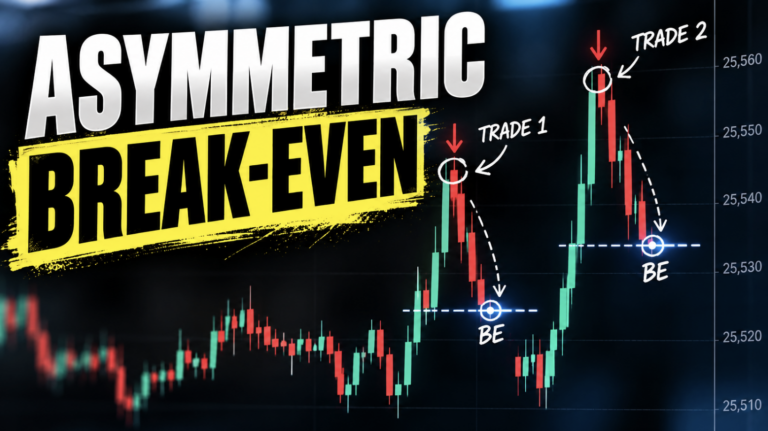
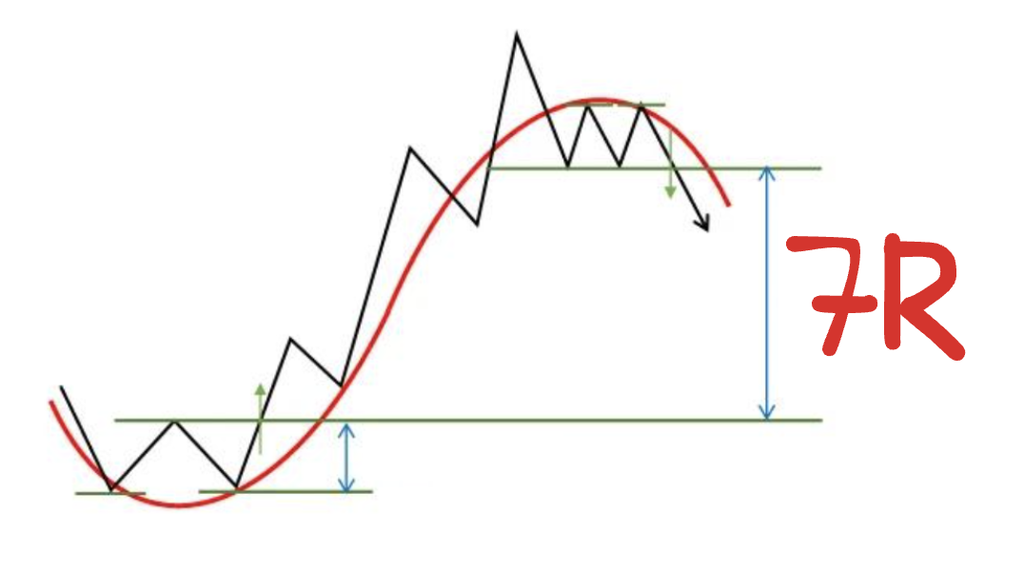
One reached approximately 7R in unrealised profit before the remaining position reversed to break-even.
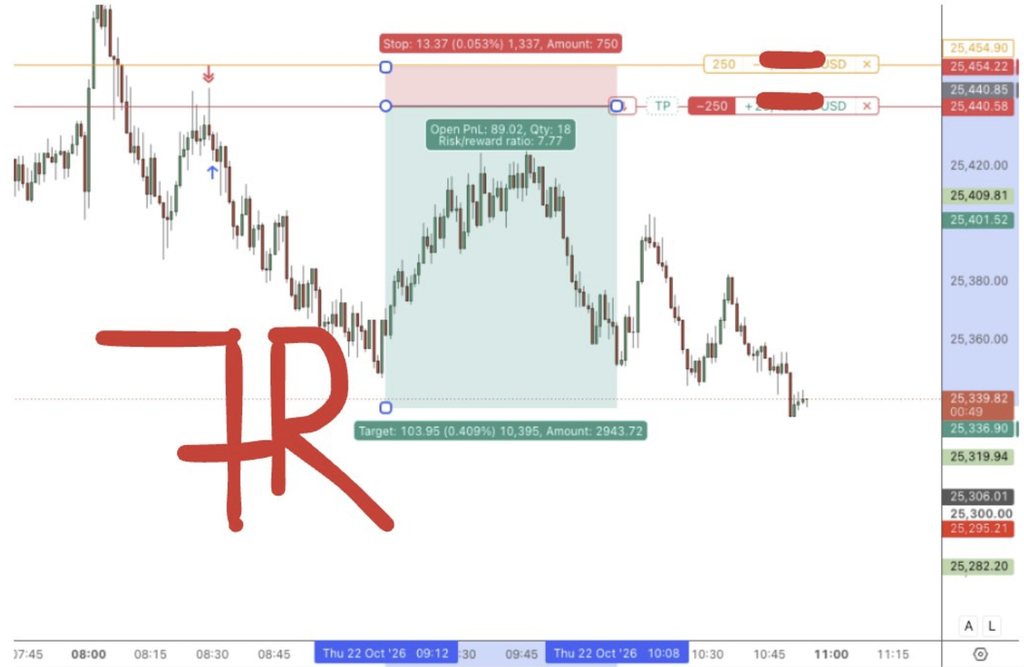
The other, a Dow Jones short on October 21, closed at approximately 10R.
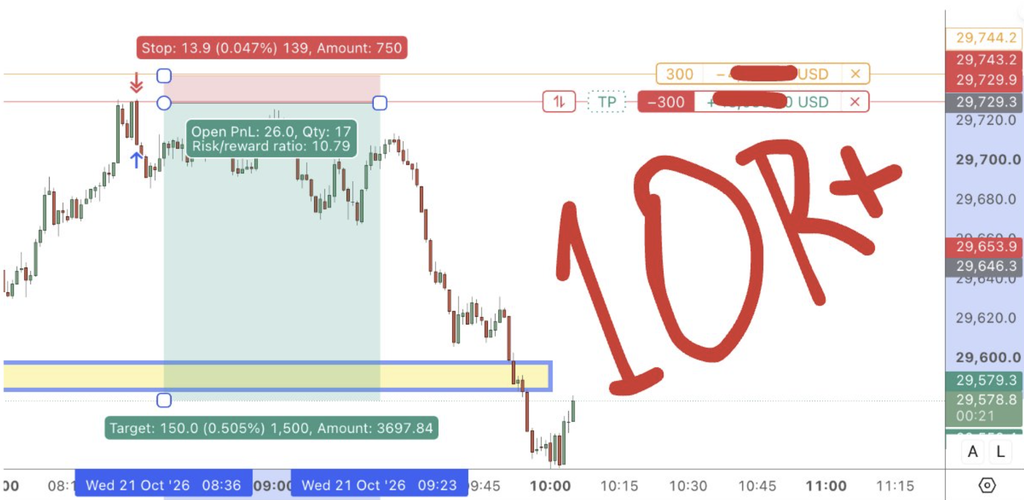
Two very different outcomes.
Yet the most important lesson wasn’t how much I made on the second trade.
It was what could have happened if I’d allowed the first trade to influence my decisions.
Because sometimes the biggest threat to an asymmetric trading strategy isn’t the market. It’s the trader’s reaction to the previous trade.
What Is Asymmetric Trading?
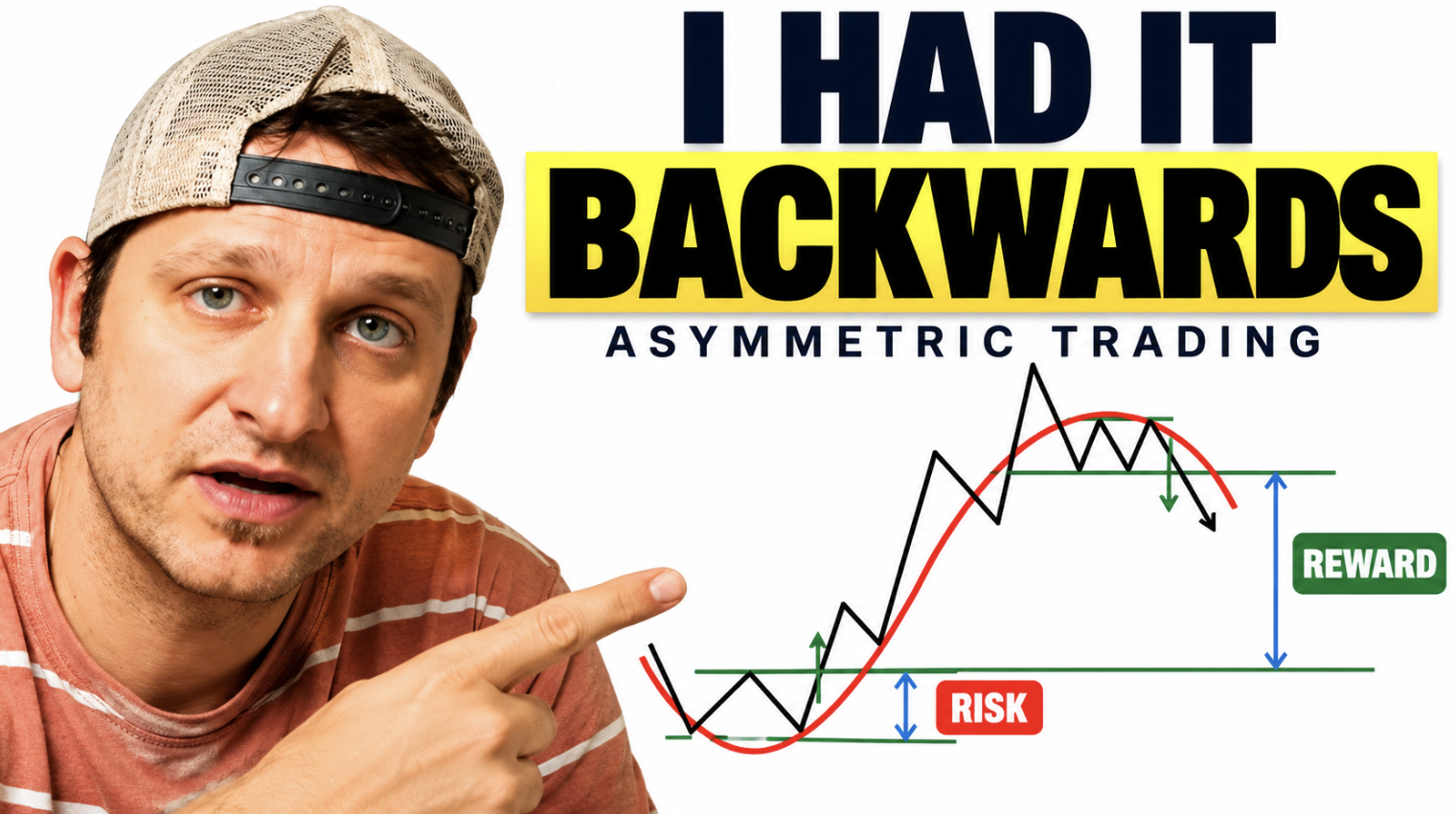
Asymmetric trading is an approach to financial markets in which the potential reward from an opportunity is substantially larger than the initial risk required to participate.
For example, risking $100 to potentially make $1,000 represents a 1:10 risk-to-reward ratio.
But here’s an important distinction.
Simply placing a profit target ten times further away than your stop loss doesn’t make a trading strategy asymmetric in any meaningful sense.
The market must actually offer an opportunity capable of producing that movement.
Otherwise, you’re just hoping.
And hope isn’t a trading strategy.
In my own approach, asymmetric trading is about identifying situations where a relatively small, predefined risk can provide exposure to a considerably larger potential market movement.
The objective is NOT to win every trade.
Nor is it to chase enormous returns at every opportunity.
It’s to control the cost of being wrong while preserving the possibility of a disproportionately large reward when the market moves in your favour.
That sounds simple.
In practice, however, it requires a very different mindset from the one most retail traders develop.
The Problem With Chasing a Higher Win Rate
When I first started trading, I was primarily interested in 1:2 risk-to-reward opportunities.
Risk $100 to make $200.
Perfectly reasonable.
And mathematically, there’s nothing wrong with that approach.
A trading strategy with a sufficiently high win rate and an average reward twice its average loss can be very profitable.
My problem wasn’t the mathematics.
It was my obsession with improving the percentage of winning trades.
I remember periods when everything seemed to click.
Five consecutive winners. Sometimes six.
I would start thinking that perhaps I’d finally figured it out.
Then came the losses.
Three consecutive stop losses.
A premature exit.
A perfectly reasonable setup that failed for no apparent reason.
Suddenly, I was questioning everything again.
Was my entry too early?
Should I have waited for another confirmation?
Was my stop loss too tight?
And so the cycle continued.
I would adjust something, experience a few encouraging results and eventually find myself back where I started.
Looking back, I wasn’t necessarily improving my trading.
I was trying to eliminate uncertainty from something inherently uncertain.
And the more I tried to eliminate it, the more complicated my trading became.
Eventually, I began to question whether winning more often was really the answer.
The Mathematics Behind Asymmetric Risk-Reward
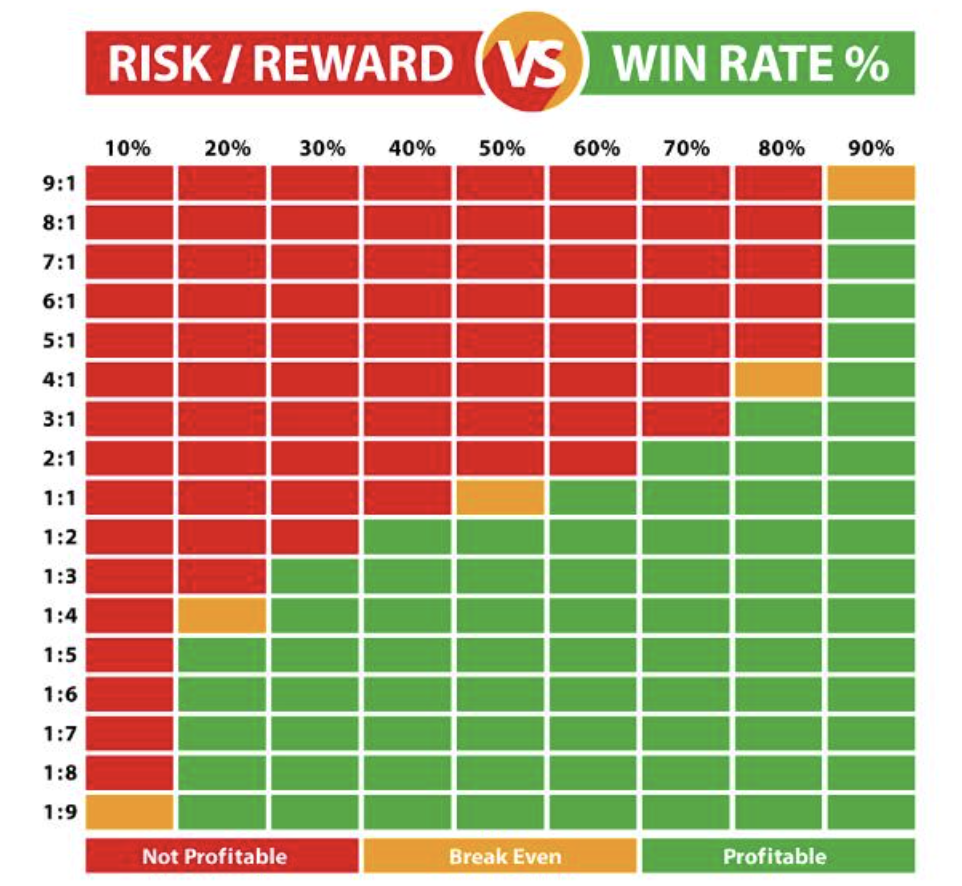
One of the most important concepts in asymmetric trading is something called trading expectancy.
Expectancy describes the average amount a strategy is expected to gain or lose per trade over a sufficiently large sample, assuming its underlying performance characteristics remain stable.
The simplified formula is:
Expectancy = (Win Rate × Average Win) − (Loss Rate × Average Loss)
Consider two hypothetical strategies.
| Strategy A | Strategy B | |
|---|---|---|
| Win rate | 60% | 30% |
| Average winner | 2R | 6R |
| Average loser | 1R | 1R |
| Expectancy | +0.8R | +1.1R |
Strategy A wins six out of every ten trades on average.
Strategy B wins only three.
Yet Strategy B has a higher theoretical expectancy because its average winning trade is considerably larger.
These are illustrative assumptions, not real trading results. Transaction costs, slippage and changing market conditions can materially alter performance.
The point isn’t that a lower win rate is automatically better.
It isn’t.
The point is that win rate alone tells you surprisingly little about the profitability of a trading strategy.
What matters is the relationship between how frequently you win, how much you make when you’re right and how much you lose when you’re wrong.
Once I properly understood this, my attention began shifting.
I stopped asking how I could win more frequently.
Instead, I started asking how I could identify opportunities where being right could produce a substantially larger payoff.
That change in perspective was fundamental.
The 7R Trade That Became Nothing
Now, let’s return to what happened earlier this week.
I had a position that reached approximately 7R in unrealised profit.
Remember this trade?
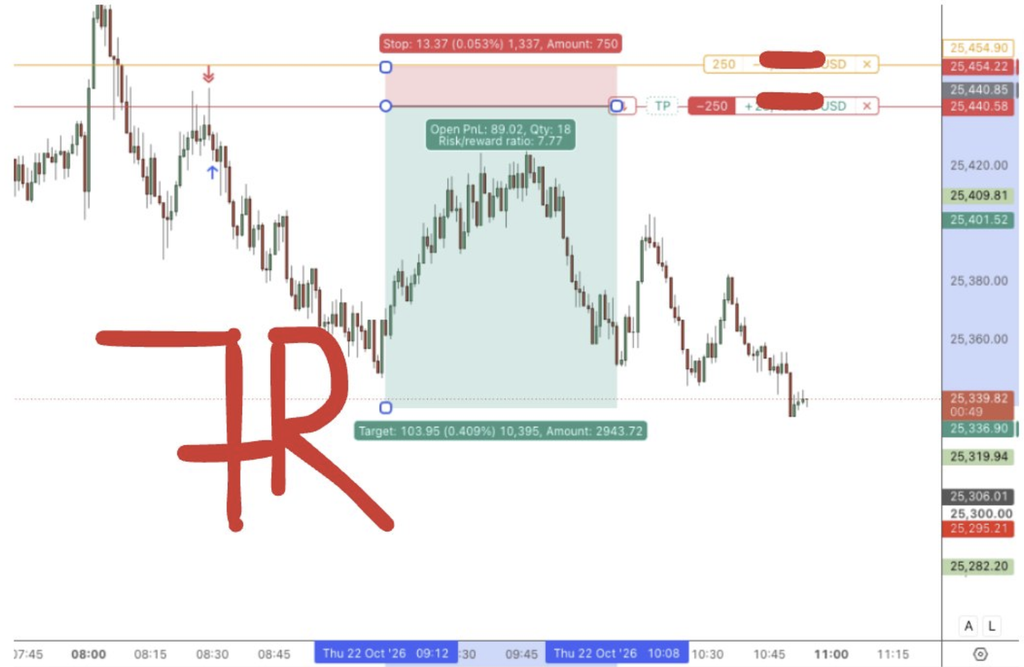
Seven times the initial risk.
For many traders, that’s an excellent result.
But I didn’t close the remaining position.
The market reversed, and that position eventually finished at break-even.
Years ago, that would have driven me mad.
I would have spent the rest of the day replaying the chart.
Why didn’t I close it?
Why didn’t I take the money?
What was I thinking?
And here’s where things become particularly dangerous.
The next time I saw a trade reach 2R or 3R, I probably would have closed it immediately.
Not because my strategy required it.
But because I was afraid of experiencing that disappointment again.
This is how traders gradually change their strategies without even realising it.
One disappointing outcome influences the next decision.
Then the next.
Until they’re no longer trading the system they originally designed.
And the worst part?
Those decisions often feel completely rational in the moment.
After all, what’s wrong with taking a profit?
Nothing.
Unless you’re repeatedly taking profits for reasons that contradict the framework you’re supposed to be following.
One Day Earlier: A 10R NASDAQ Trade
On October 21, 2026, I identified another opportunity on the NASDAQ.
A short position with clearly defined risk and the potential for a considerably larger market movement.
The market moved in my favour.
Eventually, I closed the position at approximately 10R.
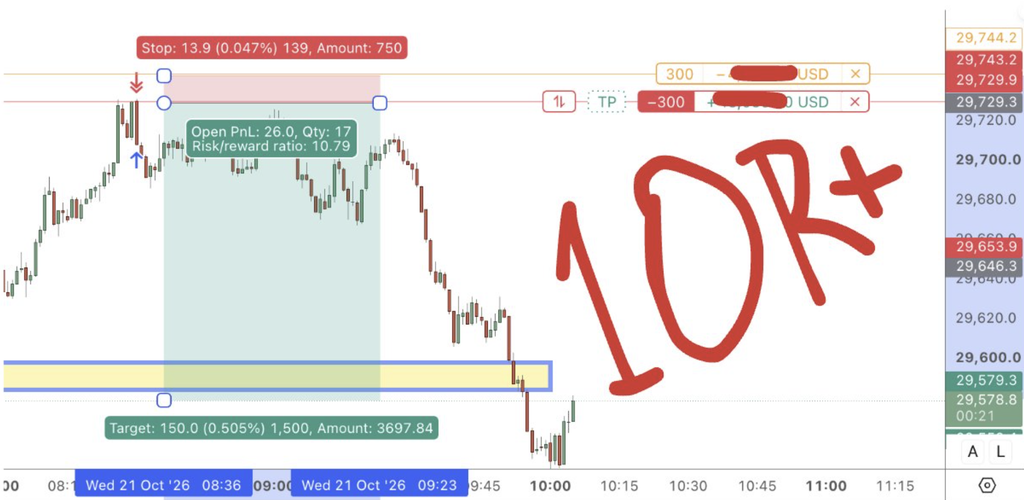
NASDAQ short trade, October 21, 2026. Approximately 10R realised. This is an individual historical example and does not represent typical or guaranteed results.
Financially, it was a very good trade.
But what makes this example particularly interesting isn’t the final return.
It’s what could have happened if I’d allowed the previous trade to influence my decision-making.
Imagine that after watching 7R disappear earlier in the week, I had decided that I wasn’t going to let that happen again.
When the NASDAQ reached 2R, I might have closed it.
Perhaps I would have waited until 3R.
And I probably would have felt pretty good about it.
After all, 3R is a respectable return on the initial risk.
But by closing the position prematurely, I would have missed the subsequent movement that eventually produced approximately 10R.
Now imagine repeating that behaviour over dozens of trades.
You might still have a perfectly reasonable trading strategy.
But it would no longer have the same payoff characteristics as the asymmetric trading framework you originally intended to follow.
And that’s the distinction I want to emphasise.
The decisions that make you feel better about individual trades aren’t necessarily the decisions that produce better results over time.
Of course, that doesn’t mean every trade should be held indefinitely.
Sometimes taking profits early is exactly the right decision.
The difference is whether that decision comes from your trading framework or from fear of repeating a previous outcome.
Why Asymmetric Trading Requires Accepting Uncertainty
One of the most difficult aspects of asymmetric trading is accepting that not every promising opportunity will produce an exceptional result.
Some trades will fail immediately.
Others will move in your favour before reversing.
Some will produce modest profits.
And occasionally, when the market conditions are right, an opportunity may develop into something considerably larger.
The difficulty is that you don’t know in advance which trade will be which.
If you did, trading would be considerably easier.
This creates an uncomfortable reality.
To participate in the occasional outsized move, you may have to accept that some unrealised profits will disappear.
That’s not an argument for ignoring risk management.
Quite the opposite.
It’s an argument for having a clearly defined framework that determines when to enter, how to manage risk and when to exit.
Without such a framework, holding a winning position can quickly become little more than wishful thinking.
But with one, the objective is to execute the process consistently rather than react emotionally to every fluctuation in unrealised profit.
The Hidden Cost of Changing Your Strategy After Every Trade
Here’s something I wish I’d understood much earlier.
A trading strategy isn’t simply a collection of entry signals.
It’s a complete decision-making framework.
That includes how you identify opportunities, manage risk, handle profitable positions and respond to losses.
Change one of those components and you may change the strategy’s overall expectancy.
For example, suppose your approach depends on occasional large winners to compensate for a series of small losses.
If you begin closing those potential winners at 2R because you’re afraid of giving back profits, the distribution of your returns changes.
That doesn’t automatically make the modified approach unprofitable.
But it does mean you can no longer assume it will perform like the original strategy.
The modification needs to be evaluated on its own merits.
This is why I place so much importance on consistency.
Not because every rule is perfect.
But because you cannot meaningfully evaluate a trading framework if you keep changing it in response to the outcome of the previous trade.
And that brings me back to the 7R break-even position.
It was disappointing to watch those unrealised profits disappear.
But allowing that disappointment to influence my next trade could have been considerably more damaging.
The Other Side of Asymmetric Trading
People naturally pay attention to the large winners.
The 10R, 18R or 30R trades.
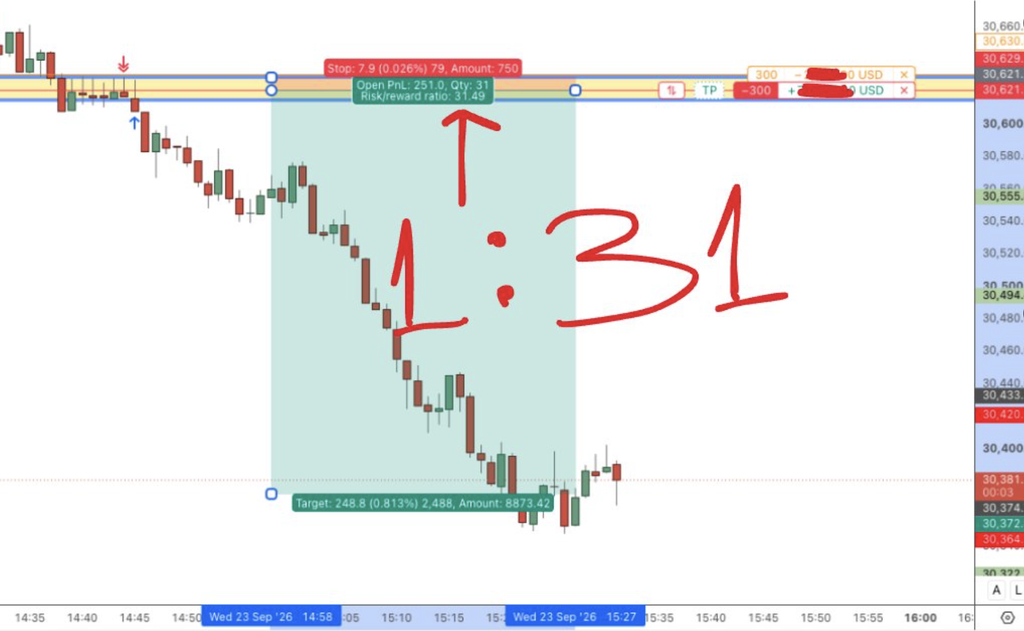
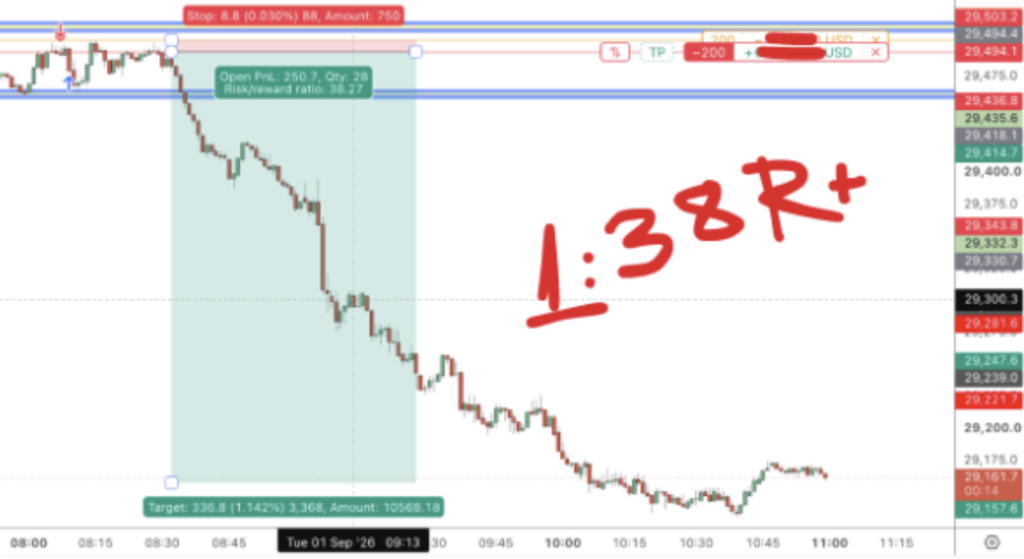
Like those 2 trades we took in September:
1:31R
Or even this 38R asymmetric trade
They’re exciting.
They’re memorable.
And they’re usually the examples that attract the most attention.
But those trades are only one side of asymmetric trading.
The other side is considerably less exciting.
It’s the days when I don’t trade.
The small losses.
The positions that finish at break-even.
And the discipline to avoid opportunities that don’t justify the risk.
In my own trading, I might identify one or two valid opportunities during a session.
Sometimes none.
And I’m perfectly comfortable with that.
Because I don’t believe that being constantly active in the market is necessary for successful trading.
In fact, unnecessary activity can be particularly damaging to an asymmetric approach.
Every additional trade introduces another opportunity to lose money.
And those losses accumulate.
A large winner means considerably less if you’ve spent the previous twenty trades taking risks that weren’t justified.
This is why I focus not only on the potential reward but also on the cost of participating.
Asymmetric trading isn’t about making every winner enormous. It’s about keeping the cost of being wrong under control while remaining available for the occasions when the market offers something exceptional.
A Good Setup Isn’t Always a Good Opportunity
There’s another distinction worth making.
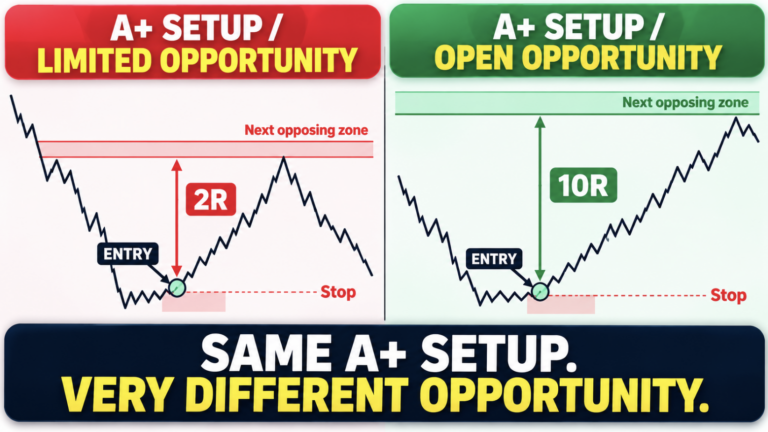
A technically attractive entry doesn’t necessarily represent an attractive trading opportunity.
You can have a beautifully timed entry into a market that offers very little room for meaningful movement.
Equally, an opportunity with substantial potential may not provide the kind of perfect-looking entry many traders expect.
That’s why I believe traders need to evaluate more than just their entry signals.
I’ve explored this distinction in greater detail in my article on Asymmetric Trading – Setup vs Opportunity.
Or you can watch the video I have made on this topic:
The important point here is that the potential payoff should be considered within the broader market context, rather than simply determined by placing a distant profit target.
Why I No Longer Judge Trades Purely by Their Results
Let’s return to the two trades from this week.
One reached approximately 7R in unrealised profit before the remaining position finished at break-even.
The other closed at approximately 10R.
Which was the better trade?
If you judge purely by financial outcome, the answer is obvious.
But that’s not how I want to evaluate my trading.
I would rather ask:
Was the entry justified?
Was the initial risk appropriate?
Did I manage the position according to my rules?
Did I follow the process I had established before entering?
Because a profitable trade can still be the result of a poor decision.
And a break-even trade can still be the result of a perfectly reasonable one.
This doesn’t mean outcomes are irrelevant.
Over a sufficiently large sample, results are essential for evaluating whether a strategy actually has an edge.
But individual outcomes can be misleading.
One 10R trade doesn’t prove a strategy is profitable.
And one disappointing break-even position doesn’t prove that something is wrong.
What matters is whether the underlying process produces favourable results over time.
Is Asymmetric Trading Better Than a High-Win-Rate Strategy?
Not necessarily.
And I think this is important to emphasise.
A well-designed strategy targeting 1:2 risk-to-reward can be very profitable.
So can a strategy with a high win rate and relatively modest average winners.
There’s nothing inherently superior about targeting double-digit returns.
In fact, asymmetric trading introduces challenges of its own.
Large winners may be infrequent.
Profitable positions may reverse.
And periods without meaningful gains can test a trader’s patience.
The real question is whether the strategy has a genuine positive expectancy after costs and whether the trader can execute it consistently.
For me, asymmetric trading became the approach that made the most sense.
Not because it removed uncertainty.
But because it changed how I dealt with it.
The Lesson I Wish I’d Learned Earlier
Looking back, my biggest mistake wasn’t trading 1:2 systems.
My mistake was believing that improving my win rate was the answer to almost everything.
It wasn’t.
I was so focused on being right that I wasn’t paying enough attention to what happened when I was right.
And I was so uncomfortable with losing that I kept trying to eliminate something that could never be eliminated.
Uncertainty.
Today, I approach the markets differently.
I accept that many opportunities won’t work.
I accept that some profitable positions will reverse.
And I accept that there will be days when doing absolutely nothing is the best decision.
I no longer need every trade to prove that I’m a good trader.
The 10R Dow trade doesn’t make me better than I was yesterday.
Just as the earlier break-even trade didn’t make me worse.
Tomorrow, I’ll open my charts again.
Same rules.
Same discipline.
And hopefully, no expectations.
That’s what asymmetric trading means to me.
Not winning every trade.
Not chasing the largest possible return.
But understanding the opportunity, controlling the risk and allowing a carefully developed trading framework to play out over time.
Yours,
Atanas
Frequently Asked Questions About Asymmetric Trading
What is asymmetric trading?
Asymmetric trading is an approach in which the potential reward from a trade is substantially greater than the initial risk. The objective is to identify opportunities with favourable risk-reward characteristics while managing losses and maintaining a consistent trading process.
Can asymmetric trading work with a low win rate?
Yes. A strategy can theoretically have positive expectancy with a relatively low win rate if its average winning trades are sufficiently larger than its average losses. However, the probability of achieving those larger wins, transaction costs and execution consistency are all important.
What is a good risk-to-reward ratio for asymmetric trading?
There is no universal ratio. While 1:10 or larger opportunities may be considered asymmetric, the appropriate ratio depends on market conditions, the probability of success and the strategy’s underlying edge. A larger target does not automatically create a better trade.
Is asymmetric trading suitable for beginners?
The underlying principles of risk management and trading expectancy are valuable for traders at all levels. However, implementing an asymmetric trading strategy can be psychologically demanding, particularly when large winners are infrequent or unrealised profits reverse. Beginners should develop and test their process without risking significant capital.
Risk disclosure: Trading involves substantial risk, including the possibility of losing your capital. The trades discussed are individual historical examples and are neither typical nor guaranteed future results. Please don’t attempt to reverse-engineer these trades from screenshots or conventional strategies found online. My approach follows a proprietary trading framework, and risking money without understanding the underlying methodology can lead to substantial losses.