Why Mentoring Is Important for Traders Learning Price Action
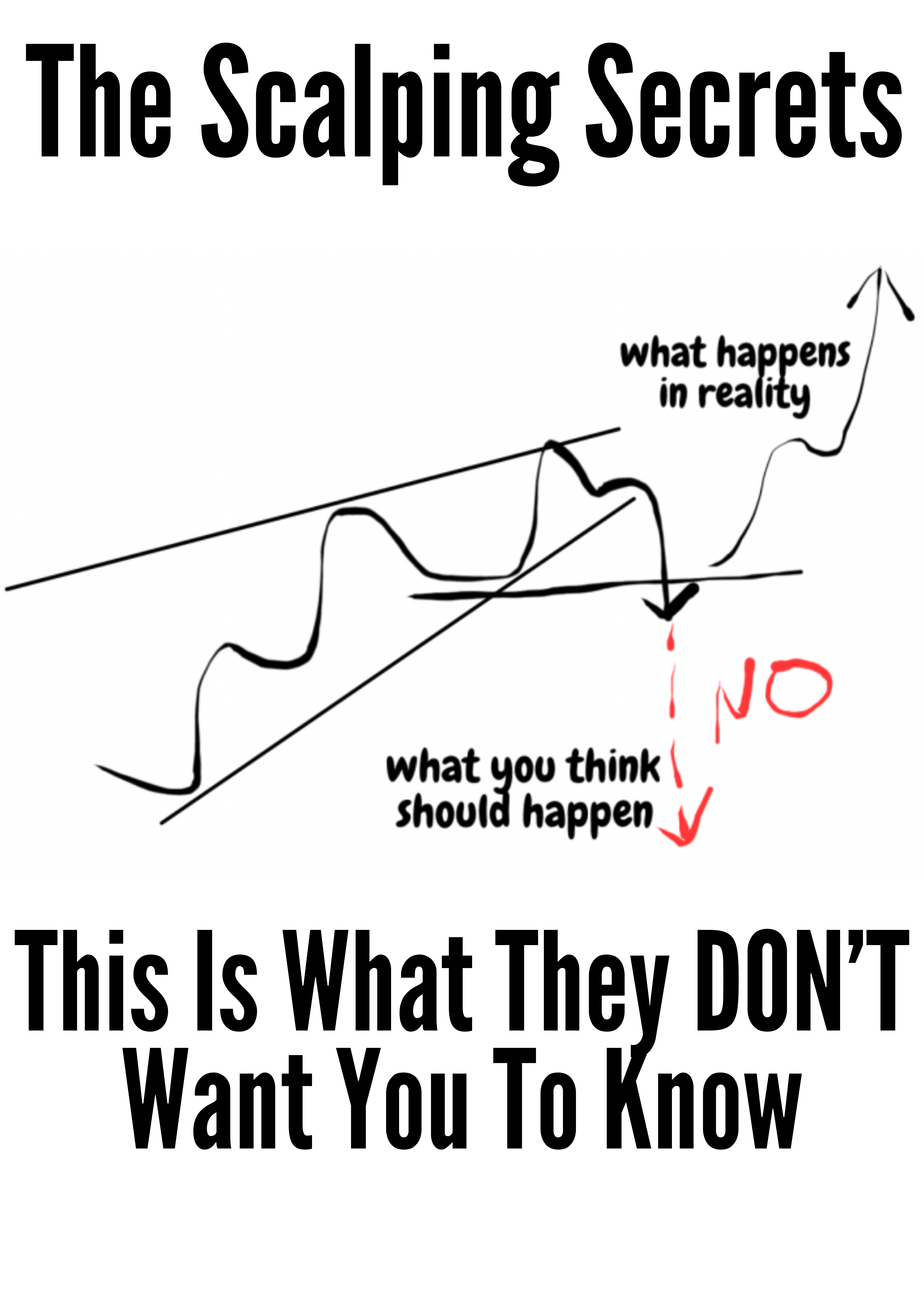
More charts will not fix a broken process. The popular line is that screen time compounds skill, so you sit longer, save more screenshots, and wait for the market to teach you. I have watched that loop stall beginners for a year. They can name a pattern and still place the level in the wrong place, because nobody has ever marked their chart and said no.
Why mentoring is important is not that a mentor hands you a secret setup. It is that a mentor closes the gap between what you think you saw and what price did. A course, a book, or a playlist can describe a support level. None of them can tell you that you drew it through the wick instead of the body, or that you bought a bounce inside a higher-timeframe downtrend. That correction is the whole job.
Why Mentoring Is Important for Traders Who Feel Stuck
You already have the screenshots. Dozens of them, maybe hundreds. You have replayed sessions, highlighted candles, and told yourself the next week will be cleaner. Then the same trade shows up, you enter early, and the stop gets tagged on the retest you knew was coming.
The assumption underneath all of that effort is simple. More exposure equals faster progress. In price action it does not. Exposure without correction just rehearses the same misread. A trader can memorize a breakout-and-retest sequence and still misjudge where the level sits. The books never saw that chart. A mentor does.
Information is not feedback
Self-study gives you vocabulary. Feedback gives you a verdict on a specific decision. Those are different loops.
- Consuming: you watch a supply zone get explained, pause the video, and nod.
- Getting corrected: someone opens your markup, moves the box two candles left, and asks why you treated a single rejection wick as a zone.
- Changing the next trade: you wait for price to test that revised level instead of predicting the touch.
I have sat with traders who could lecture on structure and still entered before price reached the area. They did not lack content. They lacked a person who would stop the trade and show the miss while it was still small.
A saved chart is a record. A marked-up chart is a lesson.
What a mentor does that a course cannot is interrupt you in the middle of a bad read and make you defend it. The rest of this piece covers the four jobs that interruption does, what long-term research measured, how the same setup looks with and without that correction, how to pick a program, and when the relationship itself starts costing you money.
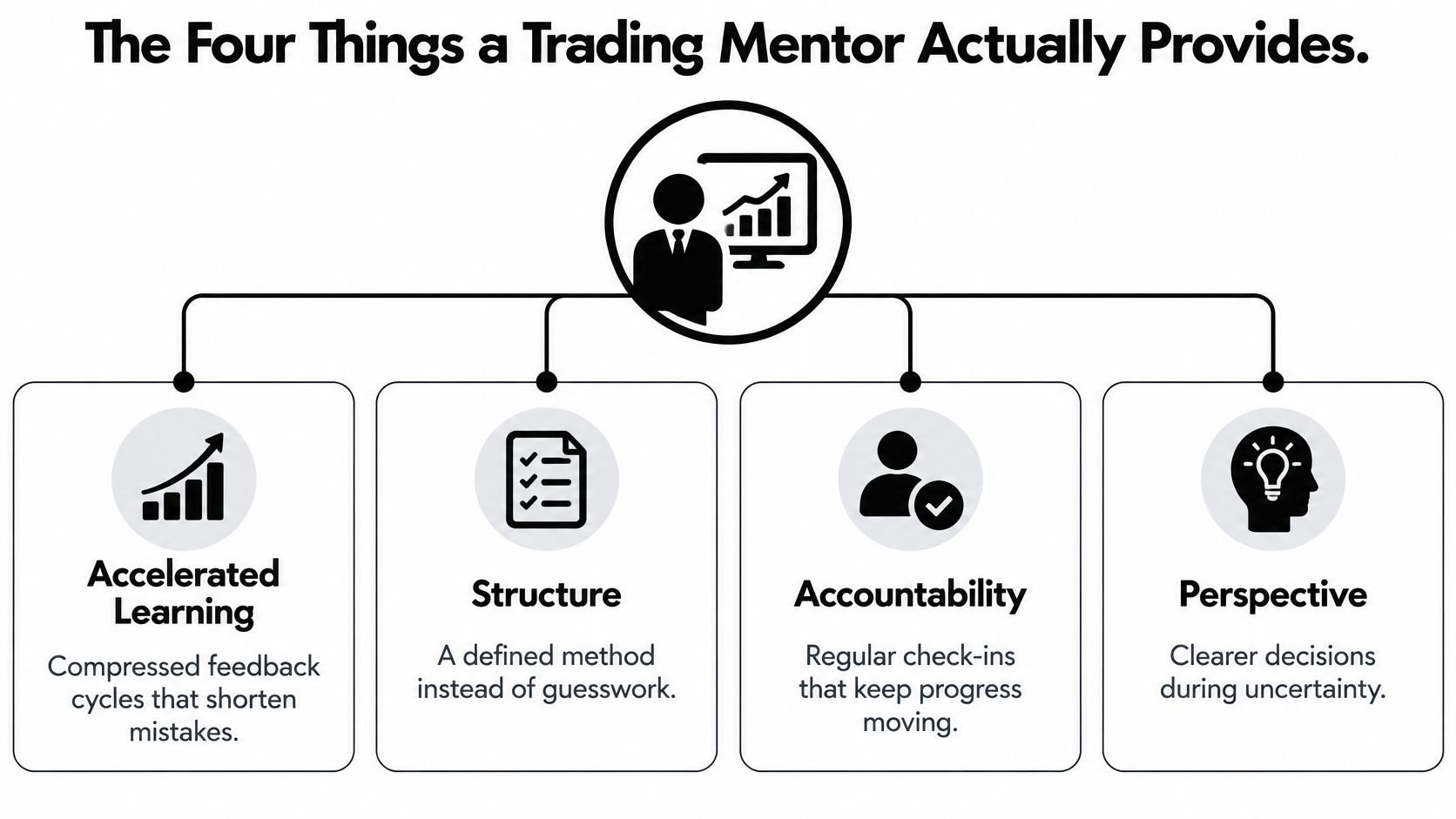
The Four Things a Trading Mentor Actually Provides
Strip the motivational language off mentoring and four jobs remain. You probably lack one of them more than the others. Name that one before you pay anyone.
Compressed feedback, not a longer syllabus
A self-taught trader can spend months discovering that they fade every first touch. A mentor can point at three journal entries in one sitting and show the same early entry. The market would have charged tuition for that lesson. The review does not.
That is accelerated learning in the only sense that matters for price action. The mistake gets named before it becomes a habit you defend.
Your chart, not a textbook chart
Personalized feedback means the mentor works on the level you drew. They question whether the demand box is a real base or just a pause in a selloff. They ask why the entry trigger fired before price traded into the area. They explain the read in the order you should have used, higher timeframe first, then location, then trigger.
A common miss looks small on a screenshot and expensive in the account. The trader labels ordinary resistance as supply because price stalled there once. A mentor separates a single swing high from a zone that held offers. One label changes the trade. The other is a story.
A review you cannot skip
Motivation fades on a red week. A scheduled journal review does not. Accountability is the calendar, not the pep talk. If you already keep notes, a trading journal is the raw material. Without a set time to go through it with someone who will challenge the story you wrote next to the loss, the journal becomes a diary.
Errors caught before they scale
Oversized size, a revenge add after a stop, and a long taken against the higher-timeframe trend are not mysterious. They are visible in the log if someone is looking. Mistake avoidance is catching those repeats while the size is still small enough to survive.
Practical rule: If you cannot point to which of the four you lack, you are shopping for company, not correction.
Structure sits under all four. A defined method replaces the guess that this candle "looks good." Perspective is what you borrow when a choppy session makes every level feel tradable. Neither replaces your own order click.
What the Long-Term Evidence Says About Mentoring
Mentoring research can help set expectations, but youth outcomes are not trading results. The available studies support a narrower conclusion: mentoring relationships have been associated with some later educational, employment, and well-being outcomes. They do not show that a trading mentor improves entries or profitability.
A long-term analysis of Big Brothers Big Sisters examined follow-up data from a 1991 randomized controlled trial of 959 young people. Researchers compared participants who had been randomly offered mentoring with those who had not. The analysis reported that participants connected with mentors had about 15% higher earnings between ages 20 and 25 than comparable nonparticipants. It also estimated that, by age 65, mentored youth would have earned about $146,000 more.
Those findings concern a youth mentoring program and later earnings. They do not establish that mentoring causes every difference observed, or that the results apply to adults learning price action. Random assignment strengthens the comparison, but the earnings estimate does not isolate every influence on participants' later lives.
What that number does not prove
A separate analysis of adolescent health data, published as research in the American Journal of Public Health, reported that 2,323 respondents, 72.9% of that sample, had a mentoring relationship. Reported relationships lasted 1 to 26 years, with an average of 9.1 years. The study found associations between having a mentor and outcomes including high-school completion, college attendance, employment of at least 10 hours a week, self-esteem, and life satisfaction.
The reported duration patterns also need careful reading. Relationships lasting longer than 12 months were associated with greater academic confidence, fewer skipped school days, higher grades, and lower likelihood of drug use. Relationships lasting three to six months showed no significant improvements. These findings describe associations in adolescent data. They do not prove that extending a relationship caused the differences, and they do not establish a minimum number of trading-mentor sessions.
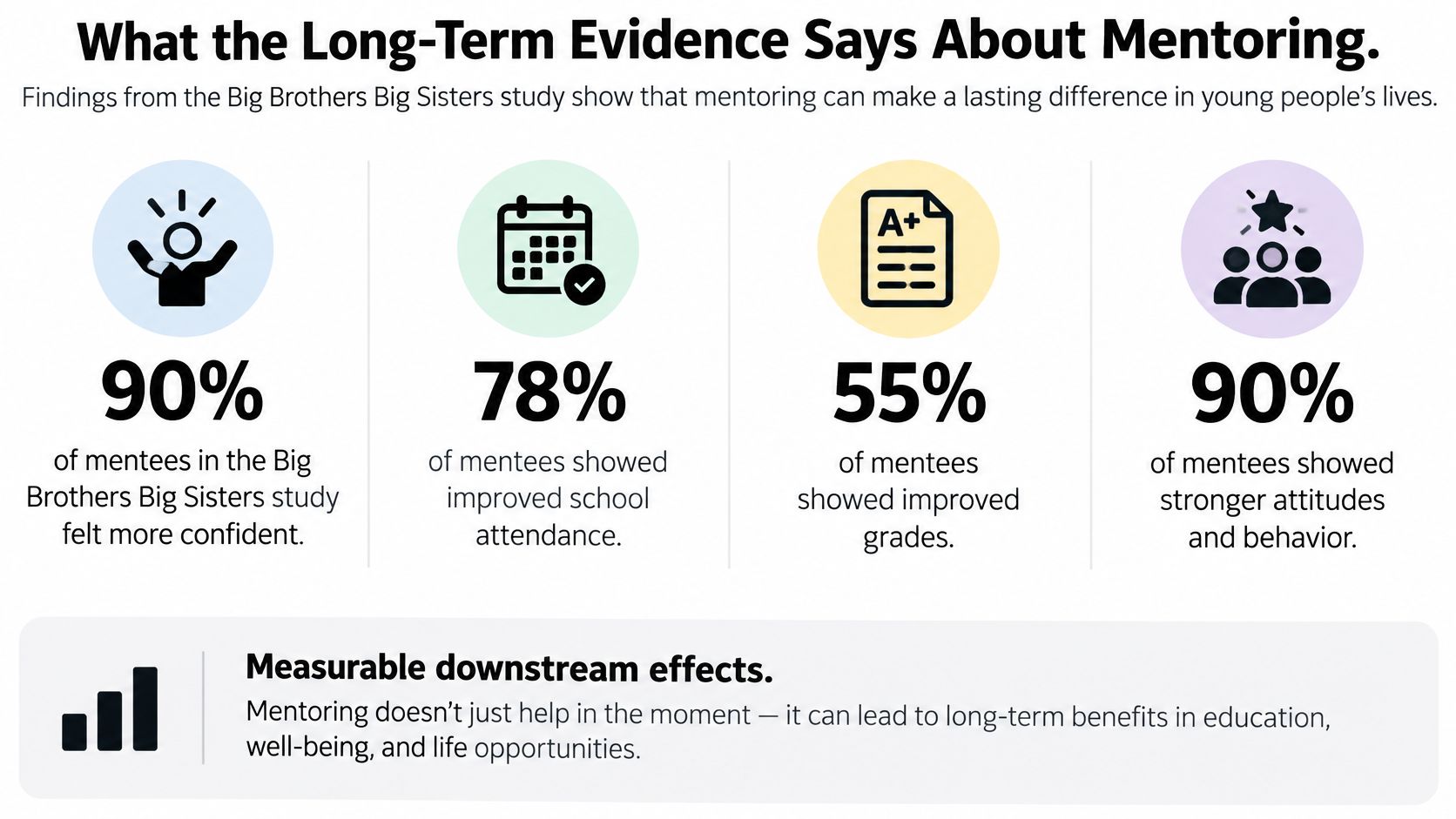
For traders, the practical test is therefore narrower than a promise of improved performance: does the mentor review your decisions, explain the reasoning, and give you a way to assess whether the feedback helps? A coaching vendor's evidence for coaching outcomes can offer background, but it is not a substitute for trading-specific evidence or a measured record of a particular mentor's results. Keep claims about trading performance tied to evidence that directly measures traders.
Mentoring Versus Self-Study in Price Action Training
Take one bullish idea at a support level and run it both ways.
The self-taught version
You read the pattern. Price approaches a level you marked last week. A candle closes green and you buy, a little late, because you wanted confirmation. Price dips back into the zone, tags your stop, and rallies without you. You close the platform convinced the pattern is fake.
What you tested was a late entry on a level that had already been hit twice, inside a higher-timeframe downtrend. Self-study supplied the name of the setup. It did not supply the veto.
The mentored version
You send the same chart before the order. The mentor marks the two prior tests, notes that the daily trend is down, and tells you to wait for a reaction at the level instead of predicting one. You either skip the trade or take a smaller long only after price shows it can hold. The pattern is the same. The decision is not.
Self-study still wins on a few real points. It costs less, it runs on your clock, and it forces you to hunt for levels yourself. That independence matters later, when no one is online. If you want a wider look at format, it helps to compare instructor-led and self-paced training before you assume live calls are always the better buy. In trading, the version of self-paced work that holds up is action-based learning, where you mark levels and review outcomes instead of collecting videos.
| Factor | Self-Study | Mentored Learning |
|---|---|---|
| Feedback speed | Weeks or months, paid in losing trades | Same session, on your chart |
| Cost | Low, mostly time | Higher, paid in fees |
| Personalization | Generic examples | Your levels, size, and journal |
| Accountability | Optional | Scheduled |
| Risk of repeating a bad read | High if you never get contradicted | Lower, until you stop questioning the mentor |
Self-study tells you what the pattern is called. Mentoring tells you why this instance is not the trade.
How to Choose the Right Trading Mentor or Program
Pay for a method you can watch, not a personality you like. Before any invoice, the mentor should trade a defined price-action approach rather than a rotating set of opinions. They should mark live or recent charts and narrate the level, the trend, and the reason to stand aside. Feedback should land on your journal, not on a highlight reel. Goals should be countable, such as fewer early entries over twenty trades, not "feel more confident." Reviews should have a cadence you can put on a calendar.
Format is the second cut. Self-paced programs fit traders who need odd hours and already write things down. Live mentorship fits traders who keep repeating a read nobody has challenged. Copying someone else's fills is a different product entirely. If you are weighing signal-following tools, start with copy trading architecture explained by copyfomo so you do not confuse mirrored orders with skill. A mentor who wants you dependent on their entries is not teaching price action.

What to test in the first month
Colibri Trader is one option built around straightforward price action rather than indicators. It offers a free Trading Potential Quiz, the first two chapters of a price-action book, and action-based programs from Basic and Premium through Supply & Demand and Day Trading. It does not hand out certificates. The claim to judge is whether your read of levels gets cleaner.
Use the same checklist on that program or any other.
- Method: Can you restate their rules without their slides?
- Proof of reasoning: Do they show losers and skipped trades?
- Fit to your book: Is feedback tied to your size and session, not a generic plan?
- Exit: Can you leave without being treated as disloyal?
A practical walkthrough of how traders vet people is in this guide on how to find a day trading mentor. Watch how a mentor talks through one level before you watch a sales video. The order of that explanation tells you more than the testimonials.
When Mentoring Fails and How to Protect Yourself
Mentoring can help, but the relationship itself proves nothing. A review of workplace mentoring found that benefits depend on the people and circumstances involved, while the overall evidence has substantial gaps, as summarized in workplace mentoring research. For a trader, that means judging feedback by what changes in your decisions, not by how encouraging the conversations feel.
Advice that does not fit your account
A mentor's playbook may be outdated, biased, or too risky for your balance. I have seen beginners copy a position size without accounting for their stop distance, then describe the drawdown as part of learning the mentor's style. That is someone else's risk tolerance imposed on your account.
The quieter failures are just as costly. You wait for a reply before every entry, add size because the mentor is bullish rather than because your level held, or stay in a relationship that weakens your ability to decide independently. Useful feedback should sharpen your judgment, not make you dependent on permission.
Mentoring outcomes also vary by relationship and context. A nationally representative longitudinal analysis examined associations between mentor ties and later outcomes. Its findings are a reminder that closeness alone does not establish whether guidance is useful. In price-action training, test the substance directly: can the mentor explain why a level matters, identify what would invalidate the setup, and discuss a losing trade without shifting the rules afterward?
Tests that keep you in charge
- Size test: Try the advice on demo or at the smallest live size before increasing exposure.
- Journal test: Keep your own records so a winning streak does not stand in for evidence of skill.
- Goal test: Review process errors, such as entries against your rules, rather than judging the month only by profit or loss.
- Switch test: Treat leaving as a decision about risk and fit, not as a personal failure.
These checks cannot make a poor mentor effective, and they cannot remove trading risk. They can show whether the feedback is improving your process before you commit more money or time. Set a review point, compare your decisions with your written rules, and stop if the mentor cannot explain the reasoning behind their guidance.
Watch how the mentor responds when you question a call. Mocking questions, hiding losing trades, urging you to increase size after a short winning run, or treating disagreement as disloyalty are warning signs. If those behaviors appear, end the arrangement rather than letting loyalty dictate your risk.
Your Next Step Toward Mentored Price Action Trading
The case is narrower than the ads. A mentor shortens the time between a bad read and a named correction, works on your chart, puts a review on the calendar, and catches size and trend errors while they are still habits instead of identity. The long-run research is strongest when the relationship lasts, not when it is a single intense month. And the same relationship can flatten you if you outsource the click.
Write down the one mistake that cost you the most money or the most confidence over the last three months. Early entries, oversized stops, trades against the daily trend, revenge adds. That line is the mechanism you are missing. If you cannot describe the mistake in one sentence, you are not ready to pay for feedback, because you will not know whether the mentor fixed it.
Then test fit at low commitment. Take a short diagnostic and read a price-action chapter before you buy a program. Treat the first month the way you treat a trade idea. Define the invalidation in advance, review the journal, and be willing to stand aside if the method does not match how you trade in practice. No mentor clicks the order for you. The point of good mentoring is that you stop needing permission and start needing a process.
Colibri Trader teaches price action through action-based programs, a free Trading Potential Quiz, and the opening chapters of its price-action book, aimed at traders who need correction on levels rather than another playlist. If you want structured feedback on support, supply, and demand instead of indicator noise, start with the quiz and the sample chapters before you commit to a plan. Visit Colibri Trader and see whether the method matches the mistake you just wrote down.