How to Find a Day Trading Mentor: The Real Guide
Most advice on how to find a day trading mentor starts with testimonials, follower counts, and a polished curriculum. That's the wrong order. A mentor can collect praise, publish attractive backtests, and sell an impressive lifestyle without proving they can make sound decisions during live market conditions.
The useful question isn't whether a mentor looks successful online. It's whether you can verify how they make decisions at the open, which instruments they trade, how long they hold positions, how they manage drawdowns, and whether they teach a process you can eventually use without them. I've seen enough marketing to know that screenshots are easy to produce. Repeatable decision-making is much harder to hide.
The Unregulated Reality of Trading Mentorship
The most uncomfortable fact is also the starting point: there's no licensing requirement for trading mentors, so the responsibility for due diligence falls on the buyer. That means a confident sales page isn't evidence of trading ability, and neither are paid advertisements, social media reach, or a stream of enthusiastic testimonials. Guidance on trading mentorship programs identifies live-trading verification as the stronger filter precisely because the market doesn't provide a licensing framework for mentors.
This changes how you should evaluate the industry. You aren't choosing between officially approved professionals with comparable credentials. You're investigating an operator whose public claims may be selective, incomplete, or impossible to reproduce. The mentor's job is to make their process understandable and verifiable. Your job is to refuse any commitment until the evidence is strong enough.
Practical rule: Treat popularity as distribution, not proof.
A testimonial tells you that someone had a particular experience. It doesn't establish the mentor's execution quality, risk control, or ability to teach under changing conditions. A paid advertisement tells you that someone bought exposure. It doesn't show what happened when a setup failed, liquidity changed, or a trade moved against the mentor in real time.
What marketing can conceal
Bad coaching often relies on carefully selected outcomes. A winning trade appears without the losing trades around it. A backtest appears without assumptions about spreads, slippage, execution, or data selection. A profitable month appears without the drawdown that made it difficult to survive psychologically.
That's why a resource such as Futurecaps Stocks warns about coaching scams is useful before you speak with a prospective mentor. It encourages the kind of skepticism that protects buyers from sales tactics built around urgency, guaranteed outcomes, and emotional pressure. You should also review practical warnings about forex trading scams when a mentor uses aggressive promises or asks you to trust claims that can't be independently checked.
The lack of oversight isn't only a disadvantage. It gives serious students a clear advantage if they're willing to investigate. You can ask for live examples, request explanations of losing decisions, compare the mentor's public analysis with actual price movement, and observe whether their teaching remains coherent when the market doesn't cooperate.
A Practical Workflow for Vetting Mentors
A useful vetting process begins before you compare prices or book a discovery call. Define what you need to learn, then test the mentor against that requirement. A trader who wants help with opening-session breakouts needs different evidence from someone studying slower intraday reversals.
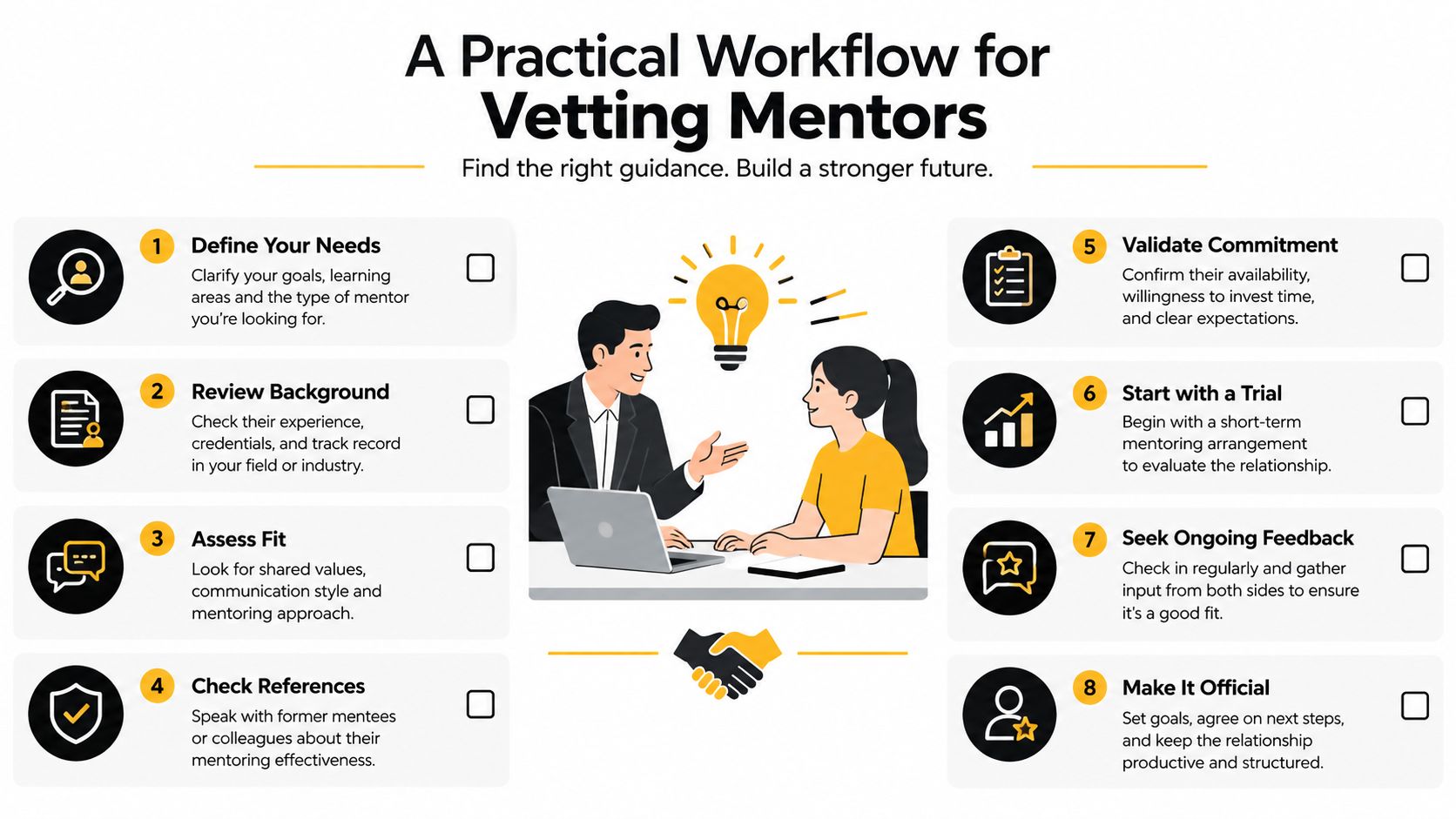
A practical workflow supported by mentor vetting guidance from FX Broker Trust looks like this:
- Define the skill: Write down the exact weakness you want to address. It might be reading price action, planning entries, managing stops, reviewing trades, or controlling impulsive decisions.
- Review public work: Study the mentor's recorded analysis, market commentary, trade reviews, and educational material. Look for complete reasoning, not isolated winning screenshots.
- Verify claims: Check whether stated credentials, affiliations, and regulatory status are relevant and accurate where regulation applies. Don't confuse a business registration or platform partnership with proof of trading skill.
- Inspect performance: Ask how results are recorded, what instruments are included, how losing periods are handled, and whether drawdowns are disclosed. A mentor who only discusses wins is withholding essential information.
- Check conflicts: Find out whether the mentor earns more from subscriptions, signals, referrals, or coaching than from trading. Incentives don't automatically invalidate the mentor, but they affect how you should interpret claims.
- Observe live decisions: Watch how the mentor handles an open market. Pay attention to entries considered and rejected, invalidation points, changes in bias, and the difference between a plan and a reaction.
- Test teaching quality: Ask for feedback on a sample chart or trade journal. Strong teachers explain why a decision was weak and how to improve it. They don't merely replace your judgment with their own.
- Start cautiously: Use a limited trial or small initial commitment before purchasing an extensive program. Teaching quality is easier to judge through feedback than through a sales presentation.
The sequence matters. If you start with price, personality, or testimonials, you may rationalize weak evidence because you already want the mentor to be legitimate. If you start with the skill and the evidence, the commercial decision becomes much clearer.
The right mentor should make your decisions more structured, not make you dependent on their alerts.
Don't ask only, “Can this person trade?” Ask, “Can this person show me a repeatable decision process under different market conditions?” That distinction separates education from signal-following.
Verifying Claims with Hard Data and Evidence
Claims are cheap. A coherent record is not. When a mentor presents performance, ask for enough context to understand what the result represents, rather than accepting a final equity curve or a collection of screenshots.
Independent trading-education guidance suggests checking a record covering roughly 2–3 years and more than 200 trades, because shorter records can overstate skill through a small sample size. You can review that benchmark in Pepperstone's guidance on choosing a trading mentor. It isn't a guarantee of future performance, but it's a more demanding credibility check than a short winning streak.

What the record should reveal
A useful record should let you examine more than net profit. Look for:
- Trade count and coverage: Does the record include enough decisions to show a repeatable process rather than a fortunate sequence?
- Drawdown history: How much pressure did the strategy experience, and how did the mentor respond?
- Average hold time: Does the mentor trade at the pace they teach?
- Instrument focus: Are the results connected to the market you plan to trade?
- Entry and exit logic: Can the mentor explain decisions before the outcome is known?
- Execution conditions: Were trades live, simulated, backtested, or reconstructed afterward?
Backtests can help investigate a hypothesis, but they don't prove that a mentor can execute in real time. A historical chart removes hesitation, changing liquidity, missed fills, emotional stress, and the temptation to reinterpret a setup after seeing what happened. If a mentor presents backtested results, ask what assumptions were used and whether the same rules were applied without hindsight.
Win rate deserves the same scrutiny. A high percentage of winning trades can coexist with poor risk control if losses are allowed to become much larger than wins. For a basic review of the calculation itself, use this guide to calculating win rate, then examine the broader distribution of wins, losses, average risk, and drawdowns.
The strongest evidence is live decision-making that matches the claimed method. Watch the mentor at the market open, when information arrives quickly and plans face immediate testing. A person who teaches patience but chases price, or teaches defined risk but moves stops without explanation, is showing you a contradiction that no spreadsheet can repair.
Choosing the Right Mentorship Format for You
A format can either build independence or replace it entirely. One-on-one coaching offers direct feedback and can expose mistakes quickly, but it may also encourage you to wait for a mentor's opinion before taking responsibility for your own plan. A structured course gives you a repeatable curriculum, though it may provide less personalized correction. Self-paced study gives you control, but it demands honest review and consistent practice.
The best choice depends on the problem you're solving. If you can't identify a setup or understand market structure, a structured program may create a stronger foundation than open-ended calls. If you understand the method but repeatedly violate your rules, targeted feedback on journals and recorded sessions may be more useful than additional theory.
Comparing the main models
| Format | Where it helps | Main risk |
|---|---|---|
| One-on-one mentoring | Personalized review, fast correction, direct discussion of live decisions | Dependence on the mentor's opinions |
| Structured course | Organized lessons, defined concepts, consistent progression | Limited adaptation to your specific mistakes |
| Self-paced program | Flexible practice, repeated study, independent decision-making | Progress stalls without disciplined review |
| Group community | Shared observation, discussion, and accountability | Groupthink or unverified trade ideas |
A good mentor should eventually reduce the amount of authority they exercise over your trades. Independent guidance on mentorship warns about overdependence when relationships become open-ended or overly prescriptive. The purpose of coaching is to improve decision quality while you develop your own risk-management process, not to create a permanent need for someone else's approval.
Group formats also deserve careful distinction. A peer discussion group is not automatically the same as a personality-driven mastermind built around one leader. For a useful comparison of those structures, see peer advisory group vs mastermind group. Ask who reviews decisions, whether disagreement is welcome, and whether members learn a method or follow the loudest trader.
Before paying for extended access, test the feedback loop. Submit a chart with your reasoning and see whether the response identifies context, risk, execution, and alternatives. If the answer is only a new entry signal, you're buying instructions, not mentorship.
Matching Style, Instruments, and Trading Windows
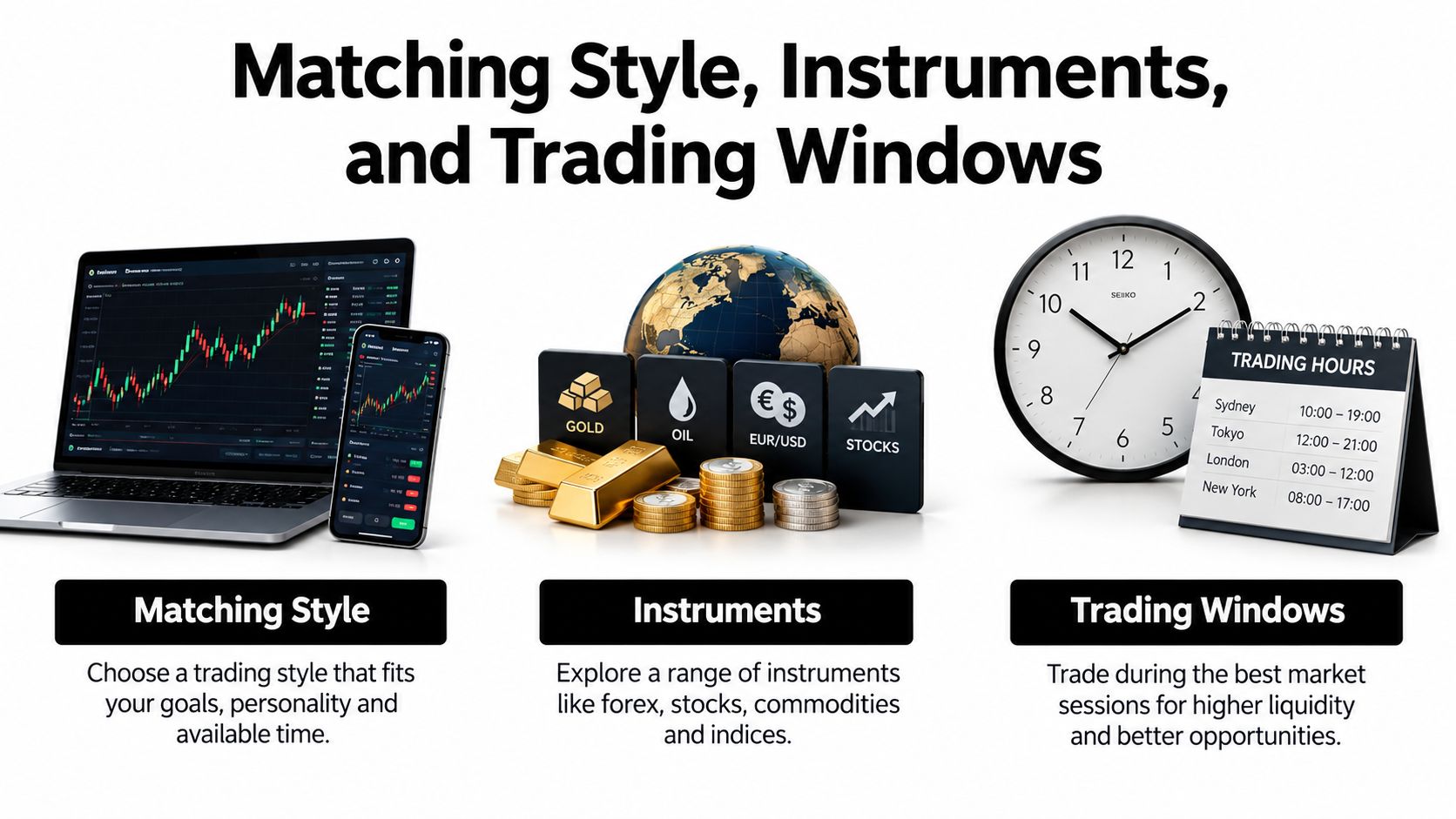
The most overlooked filter is compatibility. A mentor can be highly skilled and still be a poor choice if their market, holding period, and trading window don't match yours. A position trader's analysis won't automatically help a trader who must make decisions during a fast opening session, just as a scalper's pace may be unsuitable for someone who can only monitor charts intermittently.
Intraday traders need session-specific context. Ask the mentor to explain what they watch before the open, how they identify relevant levels, what confirms an entry, and what invalidates the idea. Generic commentary such as “the market may go up or down” has little practical value when you need to decide whether a particular setup is actionable in your trading window.
Questions that expose a mismatch
Ask direct questions about the mentor's working habits:
- Which instruments do you trade most often? Stock, futures, forex, and other markets have different liquidity, volatility, and execution characteristics.
- What is your average hold time? The answer should align with the pace you can realistically manage.
- Which market session do you trade? A mentor who works in a different session may teach patterns you rarely see.
- What happens at the open? Request examples of decisions made while the market is unfolding, not just post-session explanations.
- How do you handle news and volatility? You need rules for conditions that regularly affect your chosen instrument.
- What personality does the method require? A rapid approach may punish hesitation, while a slower method may punish boredom and overtrading.
Your own schedule and temperament matter just as much. If you dislike rapid decisions, don't choose a mentor whose entire method depends on split-second execution because the trades look exciting. If you're available only for a narrow session, choose someone who can teach the price behavior that appears during that period.
You can also compare your routine with guidance on the best time frame for day trading. The point isn't to copy a prescribed chart interval. It's to understand whether the mentor's analysis operates at a pace you can observe, practice, record, and repeat.
Price-performance claims are weaker than fit. A mentor's method must make sense in your market, your session, and your decision window. Otherwise, even legitimate skill becomes difficult to transfer.
Next Steps and Final Vetting Checklist
Before you sign up, turn your research into a decision document. Don't rely on how persuasive the mentor sounds during a call. Write down what they claim, what evidence they provide, what remains unverified, and what you expect the relationship to change in your trading process.
A serious mentor won't need to hide behind certainty. They should be able to discuss losing trades, drawdowns, execution limitations, unsuitable market conditions, and the boundaries of their expertise. They should also explain how feedback will help you develop judgment rather than just receive instructions.
Green flags and red flags
| Green flag | Red flag |
|---|---|
| Shows live decisions and explains changes in bias | Uses only screenshots and testimonials |
| Discusses losses and drawdowns without evasion | Guarantees returns or effortless income |
| Specializes in a market and session relevant to you | Gives identical advice to every student |
| Reviews your reasoning and risk process | Sends alerts without teaching the setup |
| Supports a defined trial or limited commitment | Pressures you to buy immediately |
| Encourages independent journaling and review | Makes you dependent on constant access |
Use a broader financial review before paying, especially if the program involves recurring costs, referrals, or additional trading services. A resource covering 7 essential financial checks can help you examine the commercial side of the decision rather than focusing only on the mentor's trading claims.
Then run the final test:
- Can you state the skill you're buying?
- Can the mentor demonstrate live decision-making in your market and session?
- Can you inspect a meaningful record rather than selected outcomes?
- Does the teaching address risk, execution, and discipline?
- Is there a trial or another way to test feedback quality?
- Will the program help you trade independently?
- Do the mentor's incentives make sense alongside the claims?
If several answers are unclear, don't pay to resolve the uncertainty. Keep studying, replaying sessions, and collecting evidence until the mentor earns a stronger level of trust. The right relationship should make your process more precise, your reviews more honest, and your decisions less dependent on someone else's voice.
Colibri Trader offers price-action-based trading education, specialized day trading and supply-and-demand programs, trade reviews, and personalized mentorship on request. If you want to compare its approach with the live-verification standards in this guide, visit Colibri Trader and review the available learning options before committing.