

What Is Pre Market Trading and How Does It Work

Pre-market trading is the U.S. equity session before the regular open, running from 4:00 a.m. to 9:30 a.m. Eastern Time on Nasdaq, where prices form on much thinner volume than during regular hours. It gives traders a 5.5-hour window to react to overnight news, earnings, and macro events before the cash session begins.
You may be looking at a stock that was quiet yesterday and is suddenly trading sharply higher before breakfast. The chart shows a clean gap, the headline sounds convincing, and the temptation is immediate: buy now, before everyone else arrives. A seasoned trader asks a different question first: who is trading, how much liquidity is available, and will this price still matter when the regular session opens?
That distinction explains why a move at 4:00 a.m. isn't the same as a move at 9:30 a.m. Pre-market prices can reveal information and help you build a plan, but they can also reflect a small number of trades, fragmented venues, wide spreads, and stale quotes. The useful skill isn't just spotting the biggest early gainer. It's learning when the early move deserves attention, when it needs confirmation, and when the safest trade is no trade at all.
What Is Pre Market Trading and Why It Exists
A stock releases strong earnings before the bell and immediately gaps higher. Its last regular-session price sits well below the first pre-market trades, while your platform prints a rising candle sequence. Those candles represent real transactions, yet the conditions behind them differ sharply from the market you will meet at 9:30 a.m. Eastern Time.
Pre-market trading is the buying and selling of U.S. stocks before the regular session begins at 9:30 a.m. Eastern Time. On Nasdaq, the stated window runs from 4:00 a.m. to 9:30 a.m. ET, although your broker may provide only part of it. Nasdaq also reports pre-market data beginning at 4:15 a.m. ET, extending visible activity beyond specialist participants. Exchange market-activity information is available through Nasdaq's market data resource.
The session exists because important information continues to arrive after the regular market closes. Companies release earnings, governments publish economic information, and overseas markets move while U.S. exchanges are shut. Electronic trading networks let participants adjust positions before the regular open.
Why the early price matters, but not too much
Pre-market functions as a thin extension of the broader equity market, rather than a miniature regular session. Buyers and sellers can meet, but fewer participants may quote prices, fewer shares may be available at each level, and separate venues may show different conditions. A 4:00 a.m. gap can therefore reflect a small group of active traders, while a move near the open has a better chance of attracting broader participation. The early chart helps identify attention and possible levels, but it does not guarantee an opening continuation.
The historical schedule has changed over time. Academic research on the NYSE documents an opening-time shift on September 30, 1985, when the exchange moved from 10:00 a.m. to 9:30 a.m., affecting intraday liquidity and volatility patterns. The modern pre-market session reflects continued demand for earlier access to new information.
Working rule: Treat a pre-market price as an early negotiation, not a promise about the opening print.
Pre-market has become a meaningful part of extended-hours activity. NYSE reported that, in Q1 2025, it represented over 55% of shares traded during extended hours, and said the session had grown 15x since 2019 (NYSE market activity coverage). Those figures describe participation, not reliability. Even a larger session can contain thin pockets where one order moves price sharply. Your setup should decide whether that movement is tradable, not the size of the gap alone.
Pre Market Session Hours and How Liquidity Builds
The clock matters because the pre-market session doesn't have one consistent character from start to finish. A quote at 4:05 a.m. may be barely actionable, while a quote closer to the bell can reflect a much deeper pool of orders.
The standard Nasdaq window is 4:00 a.m. to 9:30 a.m. ET, but broker access varies. Many platforms concentrate their most active pre-market trading later in the morning, particularly between 8:00 a.m. and 9:30 a.m. ET, when more traders are active and scheduled news can bring fresh orders. Investopedia's pre-market explanation also emphasizes that access depends on the broker rather than on one universal retail schedule.
The liquidity ramp
| Time Window (ET) | Typical Volume | Typical Spread Behavior | Notable Events |
|---|---|---|---|
| 4:00 a.m. to 6:00 a.m. | Very light and uneven | Often wide, with limited displayed depth | Overnight headlines and early repositioning |
| 6:00 a.m. to 8:00 a.m. | Activity begins building | Spreads may improve as more participants enter | European market participation and company news |
| 8:00 a.m. to 9:00 a.m. | More consistent flow | Usually narrower, though still wider than regular hours | Earnings reactions and scheduled economic attention |
| 9:00 a.m. to 9:30 a.m. | The busiest pre-market period | Often the most competitive early quotes | Positioning before the regular open |
These conditions aren't guarantees. A major headline can create intense activity at any hour, while an ordinary stock can remain almost untouched until the bell. The table is a way to set expectations, not a signal to trade automatically.
Why the final minutes still differ from the open
The final pre-market half-hour often looks more familiar because additional participants prepare for the regular session. Yet the regular open introduces a much broader set of orders, including traders who weren't active earlier and orders waiting for the exchange auction.
Cboe reported that early-hours trading reached 1% of overall Total Consolidated Volume in Q4 2024. It also reported that ETFs increased from 8% to almost 25% of pre-market volumes between the start of 2023 and the end of 2024, while sub-dollar securities rose from 5% to almost 20% over the same period (Cboe's extended-hours analysis). The mix of securities matters because an index ETF, a highly liquid large-cap stock, and a low-priced security can behave very differently in the same time window.
Who Actually Trades Before the Open
A multinational company releases cautious guidance during the European morning. Its shares begin falling before most U.S. traders are online. An institutional desk holding the stock may reduce exposure, while another desk may wait for a lower price to hedge an existing position. Their purpose isn't to chase a green or red candle. It's to respond to information that changed the value of the company.
That institutional reaction is one part of the pre-market crowd. Other participants include:
- Institutional desks: They adjust portfolios, hedge exposure, or respond to earnings and overnight market moves.
- Market makers and proprietary firms: They provide quotes when the expected compensation justifies the execution and inventory risk.
- Hedge funds: They may run gap, arbitrage, or event-driven strategies that depend on fast reactions.
- Retail traders: They often focus on visible catalysts, such as biotech decisions, semiconductor announcements, analyst actions, or merger news.
Everyone arrives with a reason
Regular hours attract many kinds of flow, including investors executing routine orders and traders responding to intraday developments. Pre-market tends to be more concentrated around known catalysts. That concentration can make a stock move quickly, but it can also make the chart look more decisive than it really is.
Consider a biotech company with a regulatory announcement before the open. A few specialized funds may trade immediately, market makers may widen quotes, and retail traders may join after seeing the symbol on a movers list. The resulting gap might be important, but the early price doesn't tell you whether the broader market agrees with it yet. It tells you what the participants currently willing to trade are prepared to pay or accept.
The same pattern appears after a semiconductor company changes its outlook. One group may interpret the update as a temporary issue, another may treat it as a sector warning, and a third may trade only the index response. The early tape records the conflict, not a final verdict.
The pre-market crowd is smaller, but it isn't necessarily less informed. It is simply more selective, more event-driven, and less representative of the full market.
This is why a pre-market leader should be treated as a candidate for investigation, not an automatic trade. Identify the catalyst, check whether the move is company-specific or market-wide, and examine how much actual participation supports the visible price.
Order Types, ECNs, and How Pre Market Trades Execute
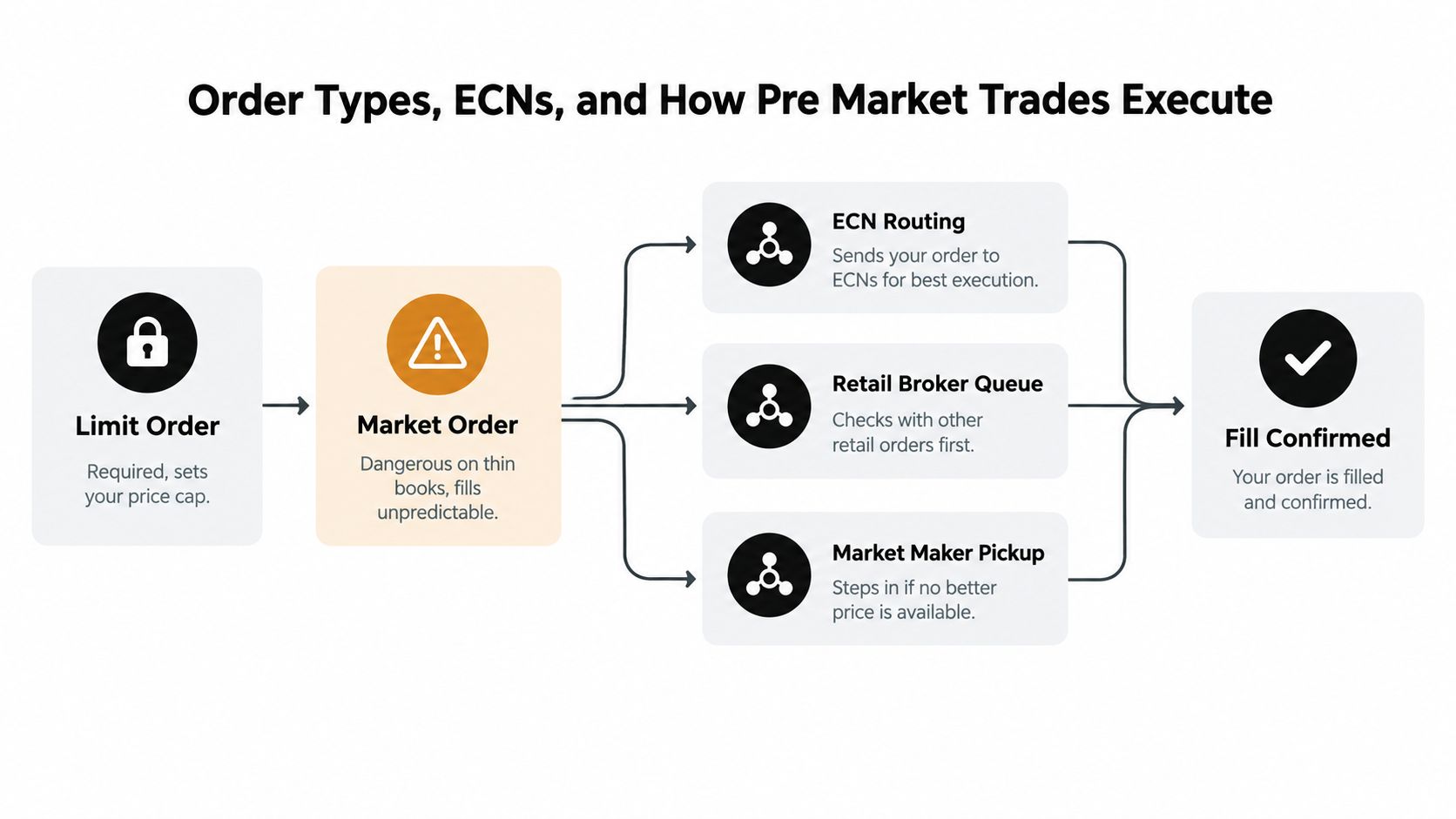
A pre-market order doesn't always travel through the same path as a regular-hours order. Retail orders are commonly routed through electronic communications networks and alternative trading systems, where buyers and sellers are matched electronically. Your broker decides which venues it can access and which order types it will accept.
Limit orders are the practical foundation. A buy limit sets the maximum price you'll pay. A sell limit sets the minimum price you'll accept. Market orders can be dangerous because the next available quote may be far from the last displayed trade, especially when the order book has little depth. Stop and stop-limit orders may also be restricted or behave differently, so read the broker's extended-hours disclosure before assuming regular-session rules apply.
For a plain-language review of market, limit, stop, and stop-limit mechanics, this order types guide for traders is useful preparation.
A fill can be partial, delayed, or different from the screen
Suppose a stock was halted near the previous close and begins trading again before the bell. At 9:20 a.m., you submit a limit buy through your broker. The order sits on an ECN, receives a partial fill at $14.20 when a news trade appears, while another displayed quote still shows a stale $13.90 level. The screen isn't necessarily broken. It may be showing different venue data, a delayed update, or a quote that no longer represents executable liquidity.
This is also why a displayed bid doesn't guarantee that you'll sell there. The quote may disappear before your order reaches the venue, or your broker may not route to the venue showing it. Pre-market protection and quote consolidation can differ from regular-hours expectations, so compare the broker's routing policy with its extended-hours rules.
Before trading, verify:
- Session eligibility: Your order must be marked for extended-hours or pre-market trading.
- Allowed order types: Some brokers accept only limit orders, while others impose additional restrictions.
- Time-in-force rules: An order may expire at the end of the early session rather than remain active.
- Partial fills: Your order can receive only part of the requested quantity.
- Data coverage: Level 1 quotes and deeper order-book information may not cover every venue.
The mechanics reward patience. If the price you want isn't available, letting the order remain unfilled is often preferable to replacing it with a market order.
Risks of Trading Pre Market
At 4 a.m., a stock can jump several points on a handful of orders, then behave completely differently at the 9:30 a.m. open. The early move may reflect genuine news, but it may also reflect a thin order book rather than broad agreement on value. Treating that candle like a regular-session signal is the first major mistake.
Thin liquidity allows a relatively small trade to push price through a level that would barely register later in the day. The chart can show a dramatic breakout or breakdown while offering little dependable support behind it. A wider spread adds another cost. You may buy near the ask and find the bid substantially lower, even though the last-traded price appears close to your entry. If bids vanish during a news burst, a stop order may fill far below the level you expected.
Common failure patterns
- Thin order books: A small order can shift price sharply, creating a breakout or breakdown that lacks follow-through.
- Wide spreads: The spread acts as an immediate transaction cost and can consume much of a short-term setup.
- News whipsaws: A headline can attract buyers, then reverse as traders interpret the details differently.
- Halted symbols: A reopening auction can produce abrupt price discovery and leave little room for a calm exit.
- Stale quotes: A displayed level may remain on screen after executable liquidity has moved elsewhere.
- Borrowed exposure: Borrowing magnifies the effect of adverse fills, gaps, and slippage.
A stock that rises from $40 to $46 after a headline and then fades to $38 before the bell shows the problem clearly. A late buyer can chase after much of the move and then face a reversal that breaks the assumption of follow-through. The prices are only an example. The lesson is that a pre-market gap can expand and retrace before regular-session participation tests it.
| Factor | Pre Market | Regular Session |
|---|---|---|
| Liquidity | Often thin and uneven | Broader participation and deeper books |
| Spreads | Frequently wider | Usually more competitive |
| Price discovery | Fragmented across venues | More centralized and visible |
| Volatility | Can react sharply to isolated orders | Still volatile, but supported by more flow |
| Stops and exits | May fill with significant slippage | Generally more orderly, though not guaranteed |
| Information quality | Catalyst-driven and incomplete | More participants can test the price |
Cboe research connects longer trading windows with changes in volume, volatility, and price discovery. Extended-hours activity is meaningful, yet it does not remove the execution risks that make early trading different. Before taking a setup, ask whether your strategy can tolerate the spread, incomplete participation, and uncertain follow-through. If its edge depends on regular-session liquidity, the best decision may be to wait.
Risk control: Don't use normal-session size because your platform makes the same number of shares available.
Reading Price Action in the Pre Market Session
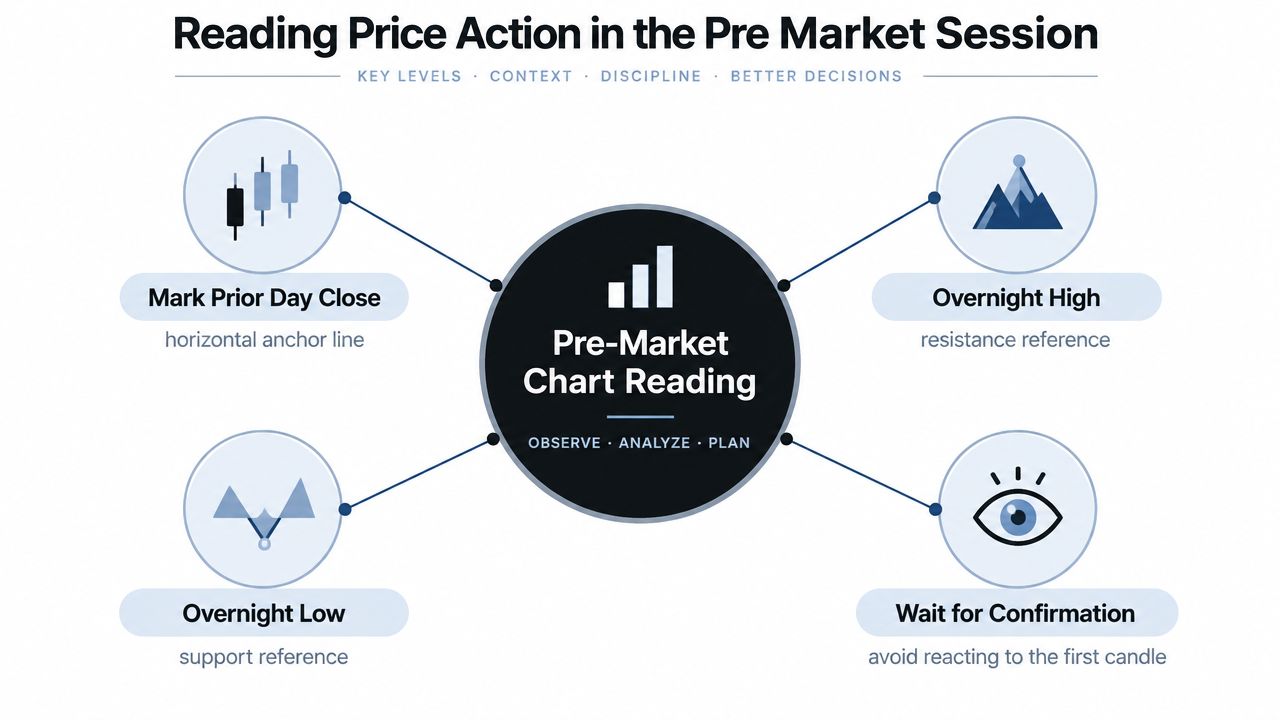
Start with structure, not the first candle. Mark the prior day's close, the overnight high, the overnight low, and the developing pre-market high and low. Those levels give you a map of where price has been accepted, rejected, or left unsupported.
Next, observe how the range develops as participation increases. A five-minute range built after 8:00 a.m. ET can be more useful than a range formed during the quietest part of the session, but it still needs context. Ask whether volume expands with the break, whether the candle closes beyond the level, and whether a retest holds.
A practical reading sequence
- Anchor the chart: Draw the previous close and the overnight extremes.
- Define the range: Track the high and low of the active pre-market period.
- Grade the catalyst: Separate company-specific news from broad market movement.
- Wait for confirmation: Prefer a clean retest with expanding participation over a wick caused by one visible print.
- Plan the regular open: Decide whether the level remains valid when the full session begins.
Suppose a stock gaps higher after an earnings announcement. It pushes above the early range, then pulls back toward the pre-market low as more traders enter. Rather than buying the first spike, you wait to see whether that low holds and whether buyers return with stronger volume. If it does, the pullback may offer a clearer entry and a more defined invalidation point. If it fails, the failure tells you that the gap isn't being defended, which is valuable information before committing capital.
The pre-market high can become resistance, while the pre-market low can become support or a breakdown trigger. Neither level is automatically important. Their value comes from how price reacts there and whether the regular session confirms the behavior.
For a more detailed price-action workflow, see this guide on how to trade pre-market.
Price-action rule: Pre-market can suggest direction. The regular-session open must confirm whether that direction has real participation.
Choosing a Broker for Pre Market Access
The broker's marketing page rarely answers the question that matters most: what happens when you submit an order at the time you intend to trade? Two platforms can both advertise pre-market access while offering different start times, order types, routing options, data, and disclosures.
Use these questions before funding an account:
- When can you place an eligible order? Some brokers support the full 4:00 a.m. to 9:30 a.m. ET window, while others begin later.
- Which orders work? Confirm whether the platform accepts only limits or also supports stop-limit orders.
- Where does the order route? Ask whether the broker routes to multiple ECNs or limits access to selected venues.
- What data appears? Check whether pre-market volume, Level 2 depth, and news are included or require a separate subscription.
- What restrictions apply? Review short-sale rules, minimum account conditions, extended-hours disclosures, and time-in-force settings.
- What does it cost? Read the current fee schedule rather than relying on the regular-session commission headline.
A practical comparison
| Broker Feature | Discount Broker Example | Full-Service Broker Example |
|---|---|---|
| Earliest access | May accept pre-market limit orders from the start of its stated window | May provide broader access with more detailed session controls |
| Order types | Often emphasizes limit orders and may disable stops | May support more order choices, subject to disclosure and risk controls |
| Market data | Basic quotes may be included, with depth as an add-on | Real-time depth, news, and research may be bundled or separately priced |
| Routing | Access may be limited to selected electronic venues | Routing policy and venue coverage may be more clearly documented |
| Platform support | Simple ticket and charting tools | Advanced charts, alerts, news, and order-book displays |
| Verification step | Read the extended-hours agreement and fee schedule | Read the same documents, then confirm data and routing coverage |
A simple platform can work if you only place carefully priced orders around a known catalyst. A more advanced platform may make sense if you need depth, alerts, and detailed routing information, but additional features won't fix a poor setup or oversized position.
Broker rules change, and the same account may qualify for pre-market access without qualifying for every extended-hours feature. Check the broker's current disclosure page, order-routing documentation, and fee schedule before treating the platform as ready for live execution.
When to Skip Pre Market and a Safety Checklist
Many retail traders would improve their results by using pre-market for preparation rather than execution. The early session demands fast interpretation, careful order placement, and enough capital discipline to absorb poor fills. If your edge depends on clean liquidity and patient confirmation, waiting for the regular session may be the higher-probability decision.
Skip the trade when the stock has no clear catalyst, the move comes after an unusually large gap, or the symbol is thin enough that the spread dominates the setup. Be especially cautious before major scheduled macro events, including FOMC or CPI releases, because a position can become obsolete as soon as new information arrives. If the spread exceeds 1% of the stock's price, the execution cost alone may invalidate a short-term idea.
Run this checklist before entering
- Confirm the catalyst: Know whether the move comes from earnings, guidance, company news, sector news, or broad market conditions.
- Inspect participation: Compare current pre-market activity with the stock's usual behavior, and don't treat a visible percentage move as proof of broad conviction.
- Mark the levels: Record the prior close, overnight high and low, and the developing pre-market range.
- Check the spread: If the bid and ask are too far apart for your target and stop, stand aside.
- Use a limit order: Set the worst price you're willing to accept and allow the trade to remain unfilled.
- Reduce exposure: Size the position so slippage and a fast reversal won't breach your daily risk limit.
- Set a time stop: If the trade hasn't worked by 9:15 a.m. ET, consider exiting rather than carrying an unresolved pre-market idea into the open.
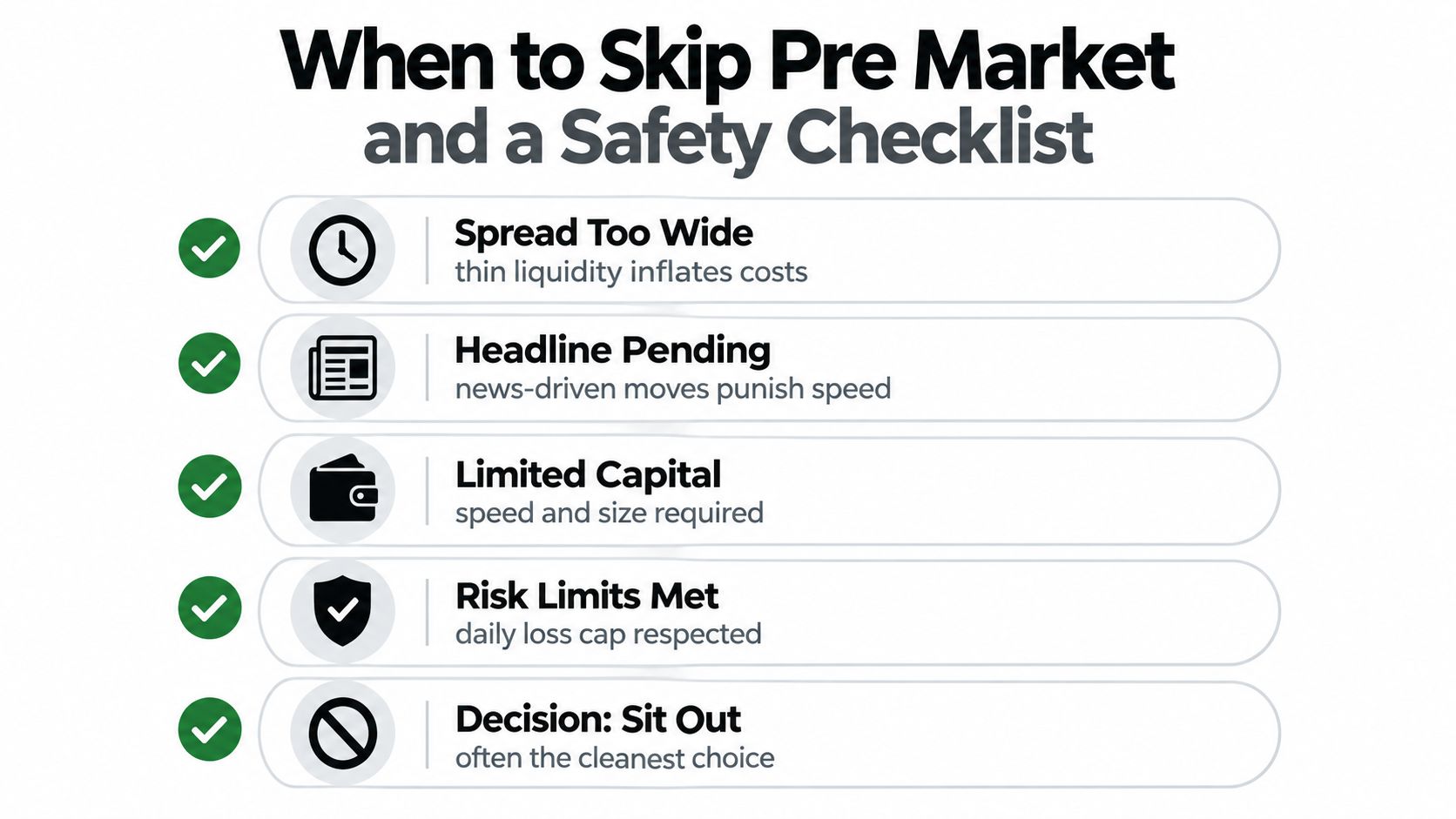
A good checklist should be allowed to end in no trade. That isn't hesitation. It's a decision to avoid paying a wide spread for a setup whose catalyst, liquidity, or price structure hasn't earned your risk.
The broader market is also becoming more fragmented outside the core session. Retail investors can trade stocks overnight through alternative trading systems, and one report says Blue Ocean ATS handles about 90% of overnight ATS volume (Barchart's pre-market tracker). That development makes it even more important to ask which venue your data represents and whether the early move reflects the full market.
For traders who want to build a price-action routine around levels, catalysts, and disciplined execution, Colibri Trader offers education focused on practical price-action training and trading discipline. Visit Colibri Trader to review its free learning resources and decide whether its approach fits the way you want to prepare for the pre-market session.