
What Is a Whipsaw? a Trader’s Survival Guide
A whipsaw is a fast reversal after a directional move or breakout, triggering entries or stops before snapping back and trapping traders on both sides. The word dates to the 15th century, when “whipsaw” named a narrow pit saw typically measuring about 5 to 7.5 feet long, and its market meaning describes the same back-and-forth violence in price action. Merriam-Webster traces the term's path from saw to market language.
You spot resistance, watch price push through it, and finally take the breakout you've been waiting for. Your entry fills, the candle loses momentum, and price drops back into the range. A tight stop closes the trade, then the market turns higher again without you. You've just experienced the defining frustration behind what is a whipsaw, and the answer has less to do with volatility alone than with the exact sequence of events.
The Trader Who Got Caught Twice
The setup looked clean. Price had tested resistance several times, compressed beneath the level, and then pushed above it with enough force to trigger a buy order. A trader entering late often feels justified because the market appears to have confirmed the idea.
Then the breakout fails.
Price falls back under resistance, sellers press into the move, and the trader's stop closes the position. The loss is manageable on paper, but the emotional damage grows when price later recovers and resumes the original bullish direction. The trader has paid to enter, paid again to exit, and now watches the expected move continue without a position.

The definition traders actually need
A whipsaw isn't a chart moving up and down. It's a path-dependent price event. Price must first travel far enough to trigger an entry, a stop order, or a trend signal. It then needs to reverse quickly enough to invalidate that signal and trap the traders who acted on it. Capital.com describes the pattern as a trigger followed by a rapid reversal.
That sequence explains why disciplined traders can suffer from it. They aren't necessarily ignoring their rules. They may be following a valid breakout system, using protective stops, and responding exactly as planned. The weakness appears when the system treats the first threshold crossing as sufficient proof that price will continue.
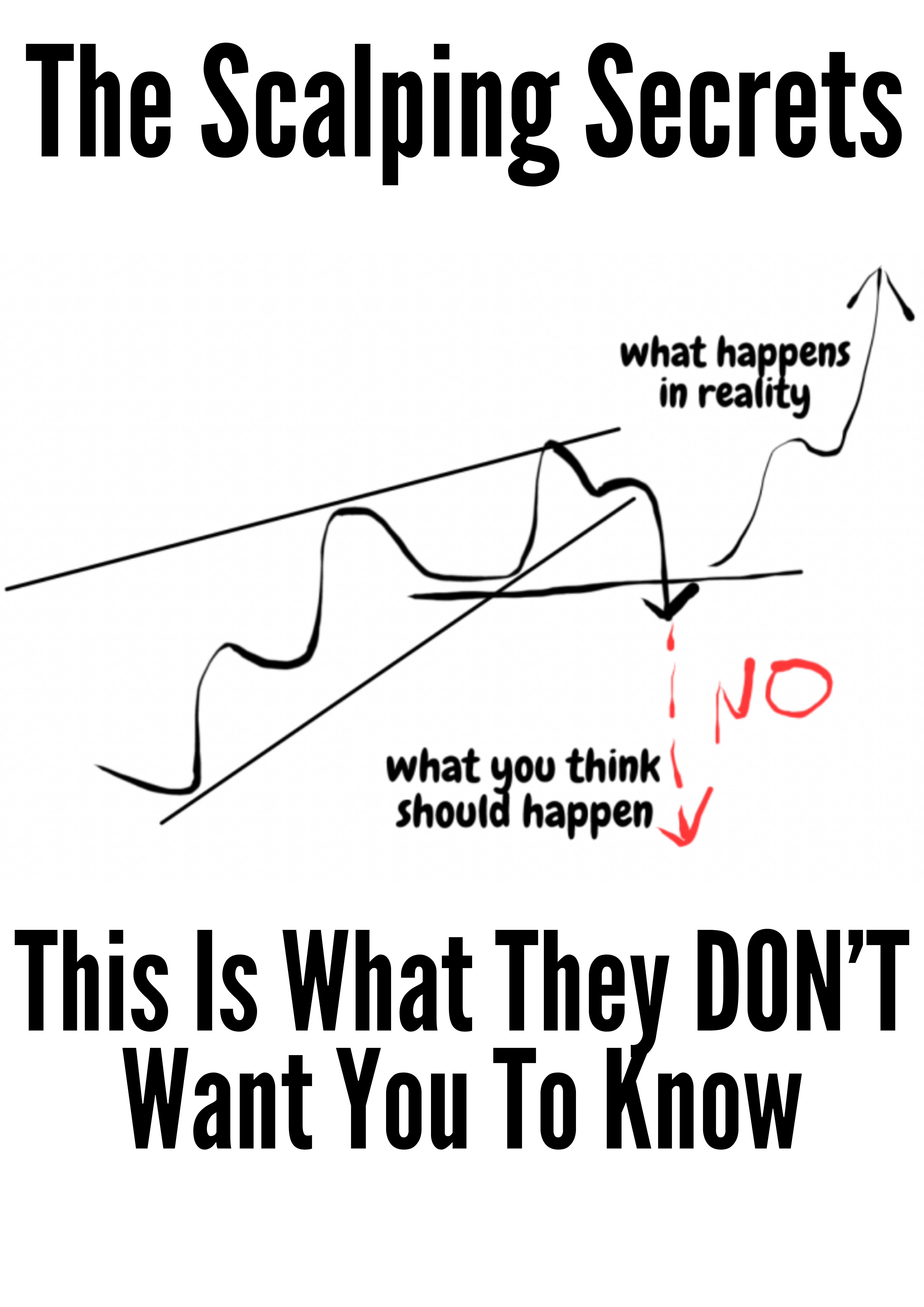
A whipsaw can punish both sides. Buyers enter above resistance and get stopped when price returns to the range. Sellers then enter on the breakdown, only for price to reverse upward and stop them as well. The market hasn't offered a clean trend. It has offered two attractive signals with poor follow-through.
Practical rule: A triggered signal is an event, not confirmation that the market has accepted the new price area.
The useful question isn't “How volatile is this market?” Ask instead, “What happened after price crossed the level?” That shift moves attention from the size of the candle to the quality of continuation.
Understanding the Whipsaw Mechanic
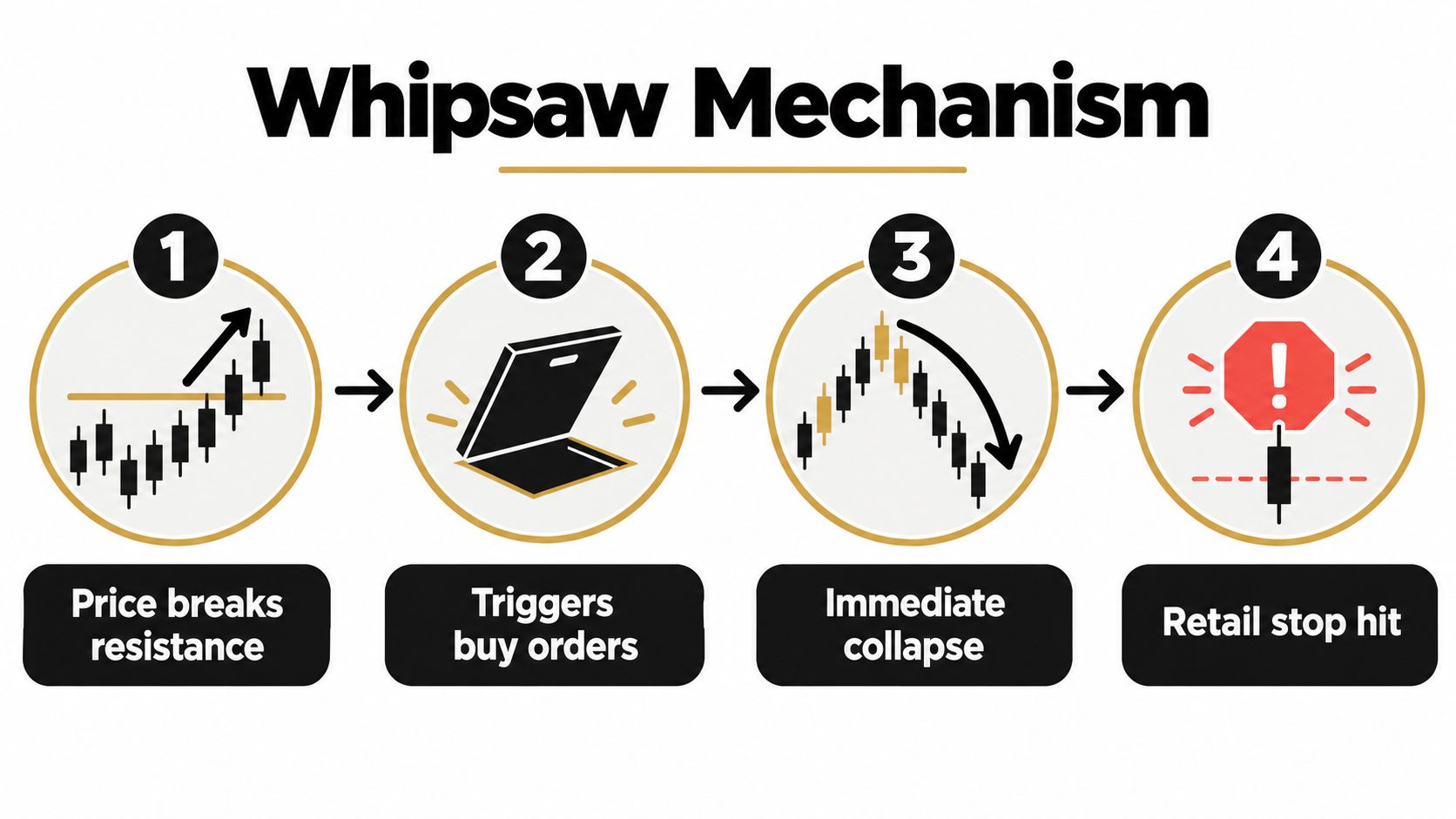
Ordinary volatility can produce large candles, sharp pullbacks, and uncomfortable noise without creating a whipsaw. A whipsaw requires a particular route. Price crosses a level that matters to traders, activates orders around that level, and then moves back through it before the initial participants can establish a durable position.
Sequence matters more than candle size
Consider a market trading inside a range. A brief move above resistance that never triggers a meaningful entry may be noise. A move above resistance that activates buy orders, attracts breakout traders, and then closes back inside the range is different. The second event has created exposure before invalidating the reason for that exposure.
This is why magnitude alone doesn't define a whipsaw. A market may be highly volatile while still respecting direction. Conversely, a relatively modest move can create serious damage if it crosses a crowded trigger level and reverses through nearby stops. Investopedia distinguishes a whipsaw from general market fluctuation by focusing on the sudden reversal after an apparent move.
The practical inspection has four stages:
- Locate the trigger. Identify the resistance, support, moving threshold, or signal level that caused traders to act.
- Check the response. Look for acceptance beyond the level, not merely a brief penetration.
- Measure the return. A fast move back through the trigger weakens the original trade thesis.
- Assess the trap. If late entrants are now positioned against the reversal, the path has produced a whipsaw.
Why fast invalidation hurts
A breakout trader usually enters because the old boundary is expected to become a new area of support. When price returns immediately, that assumption fails. The trader is no longer managing a normal pullback. They're managing evidence that the breakout may have been a liquidity event rather than the start of a trend.
The same logic applies to stops. A stop placed close to an obvious level may protect capital, but it can also sit where many other traders have placed orders. A brief push through that area can trigger exits before price rebalances. The issue isn't that stops are wrong. The issue is placing them without considering market structure and the likely path price must take.
For broader context on monitoring unusual market activity, traders can also consult an insider trading alerts blog, while keeping that information separate from direct price-action confirmation.
When and Why Whipsaws Happen
Whipsaws cluster in conditions where price can cross important levels without finding stable follow-through. Volatility and thin liquidity create that vulnerability because relatively small order flow can push price through nearby stops or breakout levels before the order book rebalances. Equiti links whipsaw risk to thin liquidity, volatility, news, and false breakouts.
Read the environment before the signal
Start with the calendar and session context. News releases can produce an initial move based on the headline, followed by a reversal when traders digest the details. Market opens and closes can also create abrupt order-flow shifts. These aren't automatic reasons to avoid trading, but they are reasons to demand better evidence.
Range-bound markets require another layer of caution. Price repeatedly tests the same boundaries, and each test can encourage traders to anticipate a breakout. When price finally pokes outside the range but quickly returns, the move often exposes traders who treated penetration as proof.
Look for these warning signs:
- Repeated level tests: Each test can leave stops and breakout orders close to the same boundary.
- Weak closes: A candle that trades beyond a level but closes back near or inside the range shows poor acceptance.
- Immediate overlap: New candles that overlap the breakout candle instead of extending away from it suggest hesitation.
- Contradictory context: A bullish break directly into a higher-timeframe supply zone has less room to develop.
- Signal clustering: Momentum indicators and stop-and-reverse systems can flip repeatedly when price oscillates near a threshold.
A liquidity sweep trading guide can help frame why price may briefly run beyond an obvious high or low before reversing. The important distinction is practical: don't label every sweep a trade. First determine whether price has accepted the new area or rejected it.
Indicators need a market filter
Momentum tools can identify movement, but they don't guarantee continuation. In a choppy range, an indicator may respond to each push and reversal, producing a series of valid-looking but low-quality signals. Stop-and-reverse systems face the same problem when their threshold sits inside a noisy zone.
A price-action filter asks what the market did at the level, how quickly it returned, and whether the next reaction confirms rejection or acceptance. If those answers are unclear, standing aside is a position. Reducing size is another option, but smaller risk doesn't turn an unconfirmed breakout into a strong setup.
Chart Examples of Whipsaw Traps
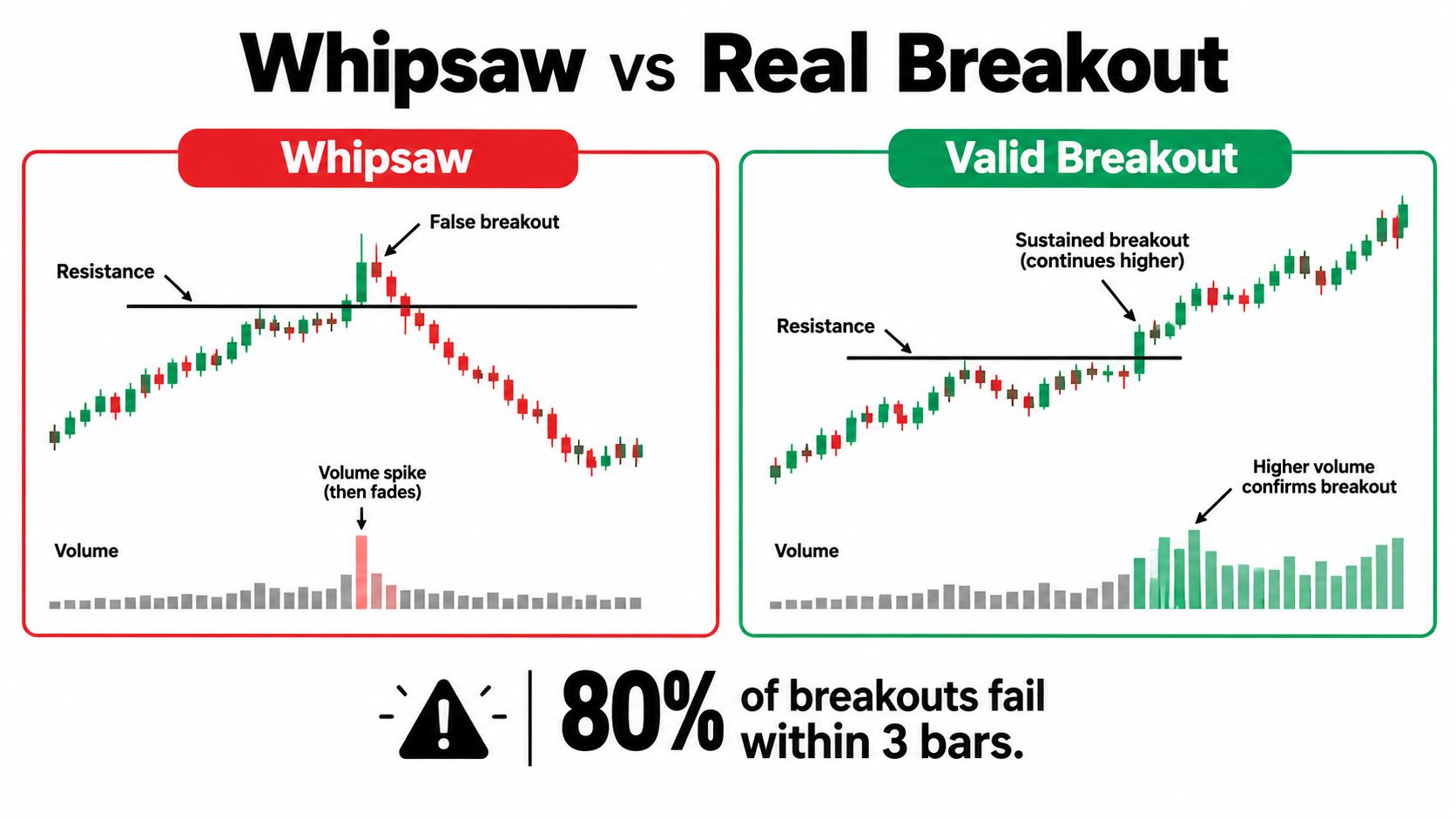
A bullish whipsaw often begins with a resistance level that has become visually obvious. Buyers place breakout orders above it, short sellers place protective stops nearby, and the combined order flow helps price travel through the boundary. The first move looks constructive because the level has been breached.
The trap becomes visible on the next reaction. Price stalls above resistance, prints rejection, and closes back inside the prior range. Late buyers are now holding a trade that depends on the market reclaiming the breakout area. If price continues lower, their stops turn the failed breakout into an orderly exit or a sharp flush.
The bearish version
The mirror image starts below support. Sellers see price break down and open short positions. Buyers who were already long place stops beneath the level, adding fuel to the decline. Then price recovers above support, forcing late sellers to cover while attracting buyers who interpret the recovery as a failed breakdown.
This pattern is commonly called a bear trap. A bear trap trading explanation provides a useful framework for separating a genuine bearish continuation from a breakdown that fails at the level.
The chart sequence matters more than the label:
| Stage | Bullish trap | Bearish trap |
|---|---|---|
| Trigger | Price breaks resistance | Price breaks support |
| First participants | Late buyers enter | Late sellers enter |
| Failure signal | Price closes back inside the range | Price reclaims the support area |
| Consequence | Buyers face stops and trapped exposure | Sellers face stops and forced covering |
Compare the follow-through
A clean breakout usually shows acceptance beyond the old boundary. Price may retest the level, but the retest holds and buyers or sellers continue to defend the new area. A whipsaw shows the opposite behavior. The market crosses the boundary, fails to hold it, and returns quickly enough to challenge the original premise.
Don't demand a perfect chart. Demand an understandable sequence. If you can't explain where the breakout was accepted, where the invalidation sits, and what price must do next, the trade is probably being driven by urgency rather than evidence.
Defensive Price-Action Strategies
Protection starts before entry. The most effective response to whipsaw risk isn't predicting every reversal. It's refusing to treat the first push through a level as complete information.
Require evidence of acceptance
A retest is often more useful than a chase. After price breaks resistance, wait to see whether the old ceiling behaves like support. For a breakdown, observe whether the former floor acts as resistance. This approach sacrifices some early entries, but it filters out moves that can't hold the area they just crossed.
Candlestick behavior adds detail. A long rejection wick, a close back inside the range, or immediate failure on the next candle should lower conviction. None of these signals guarantees a reversal, but they tell you the market hasn't delivered clean acceptance.
Entry filter: If price crosses the level but cannot hold it, treat the breakout as unproven rather than confirmed.
Place risk where the trade thesis fails
An arbitrary stop distance creates two problems. It may sit inside normal market structure, or it may be so wide that the position becomes too large for the account. A structure-based stop belongs beyond the swing point or rejection area that would invalidate the setup.
That doesn't mean widening every stop. It means deciding the invalidation point first, then calculating position size from the amount of capital you're willing to risk. If the required stop makes the trade too large or too expensive for your plan, skip the trade instead of forcing the geometry.
A practical defense framework looks like this:
- Confirmation first: Use a retest, a decisive close, or a clear rejection pattern before committing.
- Structure second: Place the stop beyond the level that disproves the setup, not at a convenient arbitrary distance.
- Size third: Reduce the position when volatility or liquidity makes the stop vulnerable.
- Review fourth: Record the entry, trigger, reaction, and exit so you can identify repeated mistakes.
Control the second mistake
The first stopped trade is information. The revenge trade is usually an emotional response. After a whipsaw, traders often re-enter immediately because they want to recover the loss or prove the original idea was right. That behavior turns one failed signal into a sequence of impulsive decisions.
Wait for a fresh setup. If price later resumes the original direction, you haven't missed a rule-based opportunity. You've avoided paying twice for the same interpretation.
A stop loss can't prevent every whipsaw. It can prevent a failed trade from becoming an uncontrolled position. The discipline is accepting the exit without moving the stop, widening the risk emotionally, or entering again without new evidence.
Building Whipsaw Resilience
Resilience comes from turning frustrating reversals into structured feedback. Review recent trades and mark the precise moment each entry triggered, then record what price did immediately afterward. You're looking for a repeatable pattern, such as entries taken on the first penetration of a level, stops placed inside obvious swings, or trades opened during thin conditions.
Separate stops near meaningful boundaries from stops in open space. A cluster of exits near resistance or support may show that your confirmation is too weak. Stops in the middle of nowhere may point to a broader issue with entry timing, position size, or trade selection.
Build a personal filter
Keep the review simple enough to repeat:
- Mark the level: Note the resistance, support, swing point, or signal threshold.
- Describe the trigger: Write what caused the entry, not what you hoped would happen.
- Record the reaction: Did price hold, retest, reject, or return into the range?
- Classify the exit: Separate a planned loss from a stop moved under pressure.
- Change one rule: Adjust confirmation, placement, timing, or size, then observe the next sample of trades.
A journal with chart replay, annotations, tags for strategy and market condition, and automatic profit and loss or win-rate calculations can make this review more consistent. A position management resource is also useful when the main problem isn't identifying the setup, but managing exposure after the market begins to challenge it.
You won't eliminate false moves. You can reduce how often you enter them, limit the damage when they fail, and avoid turning a stop into a series of emotional trades. The strongest price-action traders aren't those who never get whipsawed. They're the ones who recognize the sequence quickly, respect invalidation, and wait for the next high-quality opportunity.
Colibri Trader offers price-action education, practical risk tools, and trade-management resources that can help you test confirmation rules and review whipsaw patterns with more discipline. Visit Colibri Trader to explore its training, trading journal features, and risk calculators, then use your next stopped trade as structured feedback rather than a reason to chase.