
What Does Dovish Mean? Economic Impact Explained.
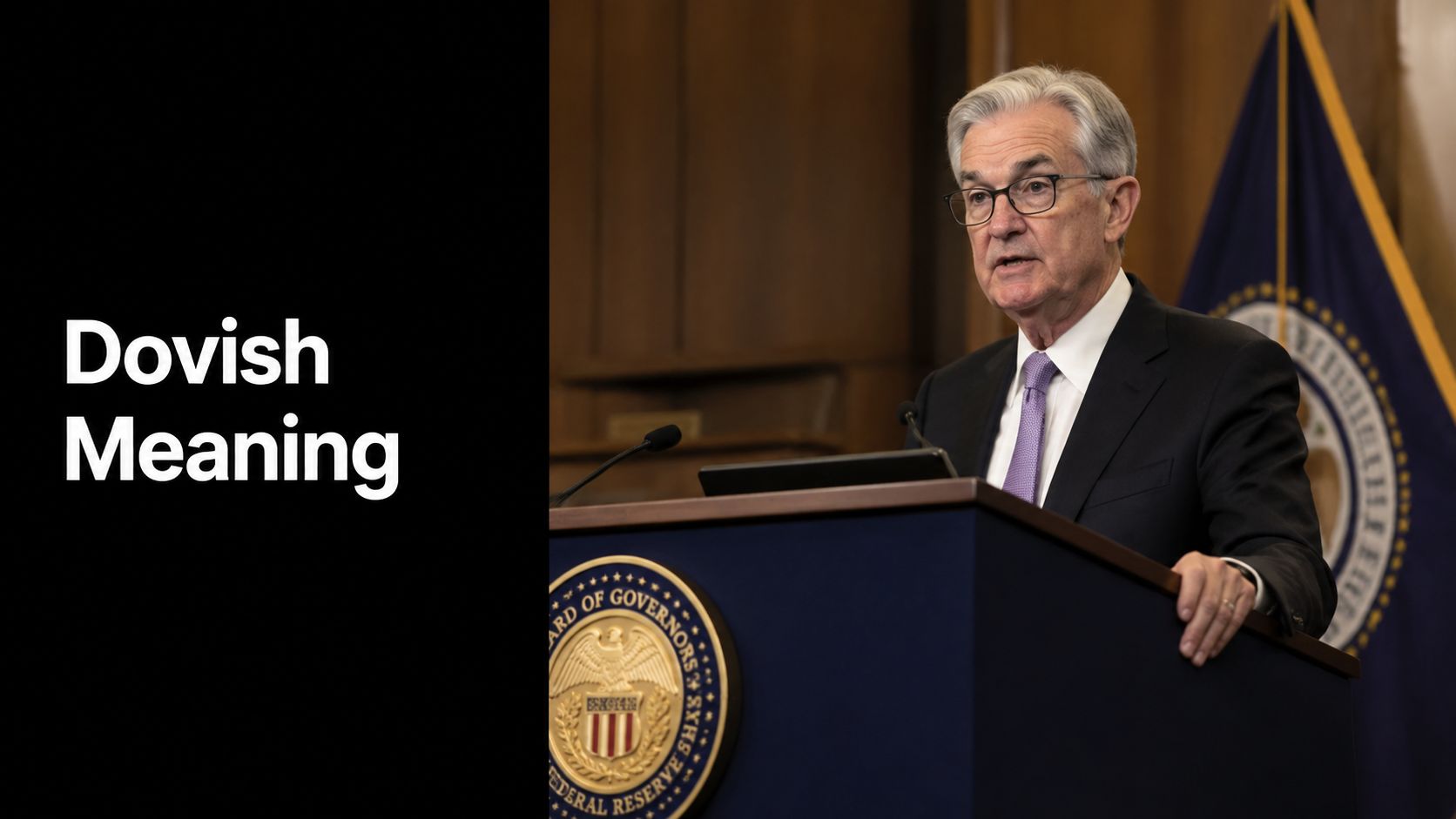
You had a clean setup. Price respected your level, the structure looked good, and then a central banker opened their mouth.
Suddenly the candle explodes. Your stop gets run. The move doesn't care about your trendline, your pattern, or the fact that the setup looked perfect five minutes earlier. Most traders call that “fundamentals” and move on, as if it's random noise you're supposed to tolerate.
It isn't random.
A lot of those violent moves come from a simple shift in tone. One of the most important words behind that shift is dovish. If you understand what dovish means, you stop treating central bank statements like chaos and start reading them as fuel. For a price action trader, that matters because macro language often shows up on the chart before it becomes obvious in headlines.
The Moment a Central Banker Wipes Out Your Trade
The typical sequence is painfully familiar. You're watching a currency pair, an index, or a bond market sitting near a clean technical level. Price coils. Volume dries up. Then a scheduled rate decision, press conference, or policy statement hits, and the market rips in one direction.
If you didn't know what was said, the move feels absurd.
What actually happened
A policymaker likely signaled easier money, or at least less aggressive tightening than traders feared. That's often enough to reprice an entire market in seconds. Stocks can jump because traders expect easier financial conditions. Bonds can rally because lower future rates make existing bonds more attractive. A currency can weaken because lower rates usually make it less appealing relative to others.
The move starts with language, but it doesn't stay in language. It becomes order flow.
Most “surprise” central bank moves aren't surprises at all. They're fast adjustments to expectations.
That's the part many chart traders miss. The statement isn't fighting your technicals. It's changing the reason participants are willing to buy or sell at those levels.
Why this hurts technical traders
Price action works best when you understand context. A pin bar at resistance means one thing in quiet trade. It means something very different when the market has just heard a dovish policy message and large players are repositioning.
The mistake isn't using charts. The mistake is pretending scheduled macro events don't change the pressure behind the candles.
A seasoned trader doesn't need to become an economist. You just need to know when a central bank is telling the market, in plain language, “we care more about supporting growth right now than pressing harder against inflation.” That's usually what traders mean when they say a policymaker sounded dovish.
Once you understand that, the chart gets cleaner, not messier.
Understanding the Dovish Stance in Monetary Policy
At the simplest level, dovish means soft rather than aggressive. The dove is the symbol of peace. In markets, that idea gets translated into policy.
When traders ask, what does dovish mean, they're usually talking about a central bank leaning toward easier money rather than tighter money.
Definition: In central-bank language, dovish describes policymakers who prioritize economic growth and employment over aggressively fighting inflation. In practice, that usually points to lower interest rates, easier credit conditions, or delayed tightening.
That definition fits the Federal Reserve's framework because the Fed has two primary goals, maximum employment and stable prices, which is why market participants often describe a stronger focus on growth and jobs as dovish, as explained in this overview of how central banks shape markets.

What a dovish central bank is trying to do
A dovish stance usually tells you policymakers want borrowing to stay cheap enough to support spending, investment, and hiring. That doesn't mean they don't care about inflation. It means they're willing to tolerate more inflation risk if the bigger problem appears to be weak growth or weak employment.
According to this explanation of hawkish vs. dovish policy, the term describes policymakers who prioritize economic growth and employment over aggressively fighting inflation, and after the financial crisis the Fed cut the federal funds rate to 0%–0.25% in December 2008, a classic example of dovish policy.
The trade-off traders need to respect
Dovish policy isn't “good” in some universal way. It's supportive for some assets and warning-worthy for others. Easier money can lift demand and sentiment, but it can also increase the risk that inflation runs hotter later.
That's why you shouldn't hear “dovish” and think only “buy everything.”
Use a more practical lens:
- Growth first: Policymakers are more concerned about slowdown, unemployment, or financial stress.
- Rates lower for longer: Traders start pricing in fewer hikes, delayed hikes, or cuts.
- Liquidity matters: Easier conditions often help risk appetite.
- Inflation risk remains: If demand outruns supply, the same dovish stance can become a later problem.
One word, two domains
There's one nuance beginners often miss. The word dovish also exists outside finance, where it can mean less aggressive in politics or foreign policy. In trading, context tells you the meaning. If the speaker is a central banker, finance is the right frame.
That distinction matters because markets don't move on dictionary definitions. They move on policy implications.
Dovish vs Hawkish A Tale of Two Policies
You don't really understand dovish until you place it beside its opposite, hawkish. A hawkish central bank leans toward tighter policy and stronger inflation control. A dovish central bank leans toward easier policy and more support for growth and employment.
The chart consequences are usually very different.

The practical difference
A dovish policymaker tends to accept looser financial conditions. A hawkish one tends to accept tighter financial conditions if that's what it takes to control inflation.
That difference sounds academic until you see it hit live markets. One tone supports risk. The other removes oxygen from it.
Dovish vs Hawkish Monetary Policy
| Characteristic | Dovish Stance (The Dove) | Hawkish Stance (The Hawk) |
|---|---|---|
| Primary goal | Support growth and employment | Control inflation |
| Rate preference | Hold lower for longer or cut | Hold higher or raise |
| View of unemployment | More sensitive to labor weakness | More tolerant if inflation is the larger problem |
| Policy bias | Easier money | Tighter money |
| Typical market read | Supportive for risk assets | Restrictive for risk assets |
| Common tone | Patient, supportive, less aggressive | Firm, restrictive, inflation-focused |
The mechanism behind the divergence
Bestinvest's glossary notes that in central-bank usage, dovish means a bias toward easier money, keeping rates lower for longer or cutting them to support growth and employment, while the mechanism is straightforward: lower rates reduce borrowing costs and increase spending and investment, but they also raise inflation risk if demand outpaces supply, as explained in this piece on dovish and hawkish policy.
That single trade-off drives a lot of intermarket behavior. If traders think central bankers are turning more dovish, they often rotate toward the kinds of assets that do well when money becomes easier. If they hear a hawkish shift, they often rotate toward defense.
A helpful way to frame it is through a broader risk on and risk off lens. Dovish language often supports a risk-on response. Hawkish language often pushes the market toward caution.
When you compare dovish and hawkish correctly, you stop hearing “tone” and start hearing “capital rotation.”
How Dovish Signals Affect Price Action
The central issue isn't just what dovish means. The practical effect is what it has on a chart you can trade.
A dovish shift changes expectations about future rates, liquidity, and economic support. Traders then express those expectations through four main channels: equities, bonds, currencies, and commodities.

Equities usually react first
Stocks often respond well to dovish signals because lower expected rates can support valuations, reduce financing pressure, and improve overall risk appetite. When traders believe a central bank is more likely to hold rates steady or lower them, they tend to become more comfortable owning growth-sensitive assets.
Nasdaq's glossary states that a dovish shift often leads traders to expect softer front-end yields and stronger risk assets, because a dovish central bank is more likely to hold rates steady or lower them, which tends to support equities, as noted in its definition of dovish market behavior.
On a chart, this often appears as a sharp impulse higher after the announcement, followed by either continuation or a retest of the breakout area. The best trades usually aren't on the first candle. They're on the pullback after the market shows whether it accepts the new direction.
Bonds often move in the cleanest way
If traders expect lower future rates, bond prices often rise while yields fall. That relationship matters because bond markets frequently process monetary policy faster and more cleanly than stock traders do.
For price action traders, bond charts can act like a translation tool. If equities are rallying but bonds aren't confirming easier-rate expectations, be careful. If bonds are clearly bidding and yields are softening, that often tells you the dovish read is real.
Currencies usually weaken under dovish pressure
A dovish central bank often makes its currency less attractive. If domestic rates are expected to stay lower for longer, foreign capital has less incentive to chase that currency for yield.
On the chart, that can show up as failed rallies, accelerated breakdowns from range support, or a clean trend continuation in the opposite currency pair. In FX, the relative story matters. One central bank being dovish matters less if the other side is even more dovish.
Commodities need context
Commodities don't all react the same way. Some respond more to growth expectations, others more to currency moves. A weaker domestic currency can support dollar-denominated commodities, while easier policy can also improve the demand outlook for raw materials.
Traders often get sloppy. They hear “dovish” and assume every commodity should jump. Sometimes it happens. Sometimes price barely reacts because the market is focused on supply, geopolitics, or a different macro driver entirely.
What to watch on the chart
If you want to connect policy language to price instead of headlines, focus on these features:
- Impulse quality: Did the market break structure with conviction, or did it spike and fade?
- Retest behavior: Does price hold above the breakout level in equities, or below the breakdown level in FX?
- Cross-market confirmation: Do bonds, currencies, and stocks tell the same story?
- Volatility conditions: High-impact policy events can create wide candles and fake breaks, so it helps to understand market volatility before treating the first move as truth.
The first move after dovish news is information. The second move is often the trade.
Real World Examples of Dovish Policy in Action
You don't need dozens of examples to understand dovish policy. Two episodes made the idea unmistakable.
After the financial crisis
Following the financial crisis, the Fed moved rates down to 0%–0.25% in December 2008, according to the earlier-cited Simpler Trading explanation. That move became one of the clearest modern examples of dovish policy. The message was straightforward. Growth had broken down badly enough that policymakers were willing to keep money extremely easy to support recovery.
From a trader's perspective, the lesson wasn't just “rates went low.” It was that policy had shifted from restraint to support. That kind of shift changes the environment for years, not just for one session.
On charts, major market turns after crisis conditions rarely look tidy at first. Price is volatile, headlines are ugly, and confidence is low. But once market participants believe the central bank is committed to easier conditions, the character of price action starts changing. You begin to see failed breakdowns, stronger closes, and trend persistence where panic used to dominate.
During the pandemic shock
The second key example came in the 2020 pandemic, when the Fed again cut its policy rate to 0%–0.25% in March 2020 and launched massive asset purchases, as summarized in the European Central Bank's research bulletin on how dovish FOMC preferences affect policy.
That episode reinforced the modern trading meaning of dovish. It wasn't just soft language. It was easy-money policy in action.
Why these examples matter to traders
The ECB research also notes that when the FOMC is more dovish, it delays policy-rate increases, and after a government spending shock the federal funds rate initially falls while inflation expectations rise. That matters because it shows dovishness has visible market effects. It isn't a vague mood.
For traders, the practical takeaway is simple:
- Dovish policy supports lower-for-longer rate expectations
- Lower-for-longer expectations often support risk assets
- Price tends to trend better when policy and market expectations align
You don't need to predict the whole macro cycle. You just need to recognize when central banks shift from tightening pressure to support.
How to Trade Dovish News with Price Action
Most traders either ignore central bank news or gamble on the first spike. Both approaches are weak.
The better approach is to treat dovish news as context, then let price action give the entry.

Start before the announcement
Mark the obvious levels before the event. I'm talking about clean support and resistance, major swing highs and lows, and clear supply or demand zones on the higher time frames.
Don't wait for the statement to start thinking. By then, you're late and emotional.
A practical pre-event checklist looks like this:
- Mark the key zone on the daily or four-hour chart.
- Know the event time so you're not caught in a position by accident.
- Define invalidation before volatility expands.
- Watch correlated markets if you trade FX or indices.
Listen for tone, not just action
A nuance many beginners miss is that dovish doesn't always mean an immediate rate cut. As Dictionary.com's explanation of dovish usage notes, a dovish tone can mean less aggressive action or delayed hikes, and traders have to infer that from the speaker and venue.
That matters because markets often move on the gap between what was feared and what was delivered. If traders expected a hardline stance and got a softer one, that can still be dovish for price even without an actual cut.
If you trade crypto alongside macro-sensitive assets, it also helps to understand how news, liquidity, and policy feed into valuation frameworks. A useful primer is this guide to fundamental analysis for crypto, especially if you want a broader lens on narrative-driven markets.
Don't trade the first candle
Discipline pays off. The first move after a central bank event is often too fast, too wide, and too noisy. Spreads can widen. Candles can overshoot. False breaks happen.
Wait for one of these cleaner patterns instead:
- Retest of a broken level: Price breaks out on the news, then comes back to test the level.
- Bullish engulfing or bearish engulfing pattern: The market shows decisive acceptance after the initial shock.
- Inside bar after expansion: Volatility compresses, then breaks in the direction of the policy-driven move.
Trading rule: Let the news create the imbalance. Let the retest create the trade.
A short video can help if you want to sharpen that waiting process and avoid chasing reaction candles:
Build the trade around confluence
The strongest setups usually combine three things:
- Macro bias: The central bank sounds dovish.
- Technical location: Price is moving from or through a meaningful level.
- Confirmation candle: The market proves buyers or sellers are still in control after the initial burst.
What doesn't work is forcing a trade because you learned a new word. “Dovish” is not an entry signal by itself. It's a context signal. The chart still has to earn your risk.
If you trade it that way, central bank news stops being something that wipes out your setup. It becomes the reason a good setup follows through.
If you want to turn this kind of market context into a repeatable chart-based process, Colibri Trader is a strong place to build that skill. The training focuses on clean price action, structure, discipline, and trade selection, so you can read what the market is doing without drowning in indicators or guesswork.