
Walk Forward Testing: Build Robust Trading Strategies
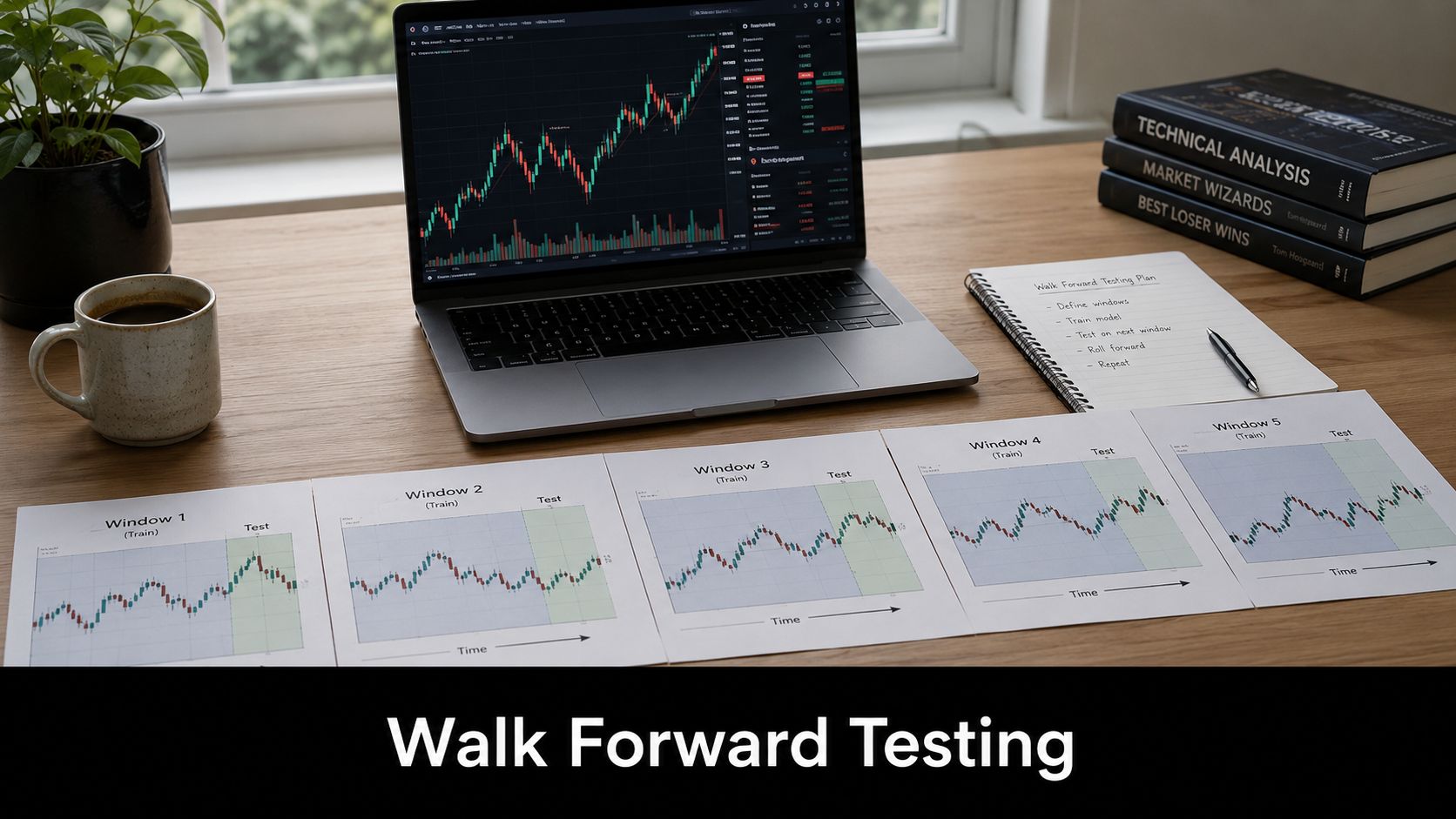
A strategy looks clean in the backtest, the equity curve climbs, and every rule seems logical. Then you trade it live for a few weeks and the thing starts acting like a different system. Entries come at the wrong time. Stops get clipped. The setup that looked disciplined on historical data suddenly feels fragile.
That gap between a pretty backtest and messy live execution is where a lot of traders lose years.
Most of the time, the problem isn't that testing itself is useless. The problem is that the trader tested for confirmation, not for survival. A static backtest can reward a strategy for fitting the exact shape of old price swings. Price action traders fall into this trap too. You see a clean engulfing candle at support, a sharp rejection wick, a nice continuation move, and you start building rules around what already worked. If you keep adjusting filters until the chart looks perfect, you're no longer discovering an edge. You're tailoring one.
That's why walk forward testing matters. It forces a strategy to earn its keep on data it hasn't seen yet. Instead of asking, “Did this idea work on history?” it asks, “Did this idea keep working when the market changed?”
If you need a solid baseline before adding this layer, Polytreasury's guide to backtesting strategies is useful because it frames the testing process before you get into more advanced validation.
Introduction The Backtest That Lied
A trader spends a weekend tuning a strategy built around rejection candles at support and resistance. By Sunday night, the equity curve looks clean, the drawdown looks manageable, and every rule sounds sensible. Two weeks into live trading, the same setup starts missing moves, taking poor entries, and hitting stops in places the backtest seemed to avoid.
That failure usually starts in the testing process, not in the market.
Backtests go wrong when traders keep adjusting rules until old charts look convincing. A tighter stop improves one period. A session filter cleans up another. One pattern variation gets removed because it spoiled the curve. After enough edits, the strategy begins to fit the past like a suit constructed specifically for it. It looks sharp, but only on the body it was cut for.
Price action traders face this problem all the time because chart-based rules are easy to justify after the fact. A wick at a level looks meaningful. A strong close looks like confirmation. A choppy range looks like an obvious skip. Some of those judgments are valid. Some are hindsight dressed up as discretion.
Serious testing has to put pressure on the idea. It has to ask whether the behavior behind the setup persists when market conditions shift, volatility expands, or a clean trend turns into a grind. That is why traders move beyond a single backtest and use methods that force the strategy to perform on unseen data.
Walk forward testing matters because it treats a strategy more like a working trading plan than a chart study. You tune the rules on one segment of history, then test them on the next segment without rewriting them midstream. From a price-action perspective, that matters because markets do not print the same candle sequence forever. Buyer aggression changes. Failed breakouts cluster. Trend legs shorten. A setup that cannot handle those changes will not hold up when money is on the line.
A strategy that only works after constant tweaking is not stable. It depends on hindsight.
What does that solve in practice?
- Rule stability: If your preferred stop, target, or entry filter keeps changing from one period to the next, the edge is probably weak or too sensitive to noise.
- Pattern durability: If a price action setup performs well in one stretch of history and falls apart in the next, it may reflect one regime rather than repeatable behavior.
- Risk decisions: The score that matters is not the prettiest in-sample equity curve. It is whether out-of-sample performance is steady enough to support position sizing, drawdown limits, and realistic expectations.
If you need a baseline before adding walk forward testing, Polytreasury's guide to backtesting strategies is a useful starting point.
For a serious trader, that is the point. Walk forward testing is not about making your research sound more impressive. It is about reducing the odds of funding a strategy that only looked good because you kept giving the past another chance to approve it.
Beyond Backtesting In-Sample vs Out-of-Sample Data
A strategy can look disciplined on a chart review and still fail the moment you stop giving it second chances. That usually starts with one mistake. Traders use the same historical data to create the rules and to judge the rules.
In-sample data is the workshop. You use it to shape entries, stops, targets, and filters.
Out-of-sample data is the audit. The rules are fixed, and the market gets the final vote.

The exam analogy traders remember
In-sample data works like old practice papers. It helps you prepare, but it cannot prove you can perform under fresh conditions.
Out-of-sample data is the unseen exam. You do not rewrite your rules after seeing the next candle sequence. You trade the setup as defined, then measure what happened. That is the only part of the test that answers the question a trader cares about. Would this method have held together without hindsight?
Price action traders need that separation more than most. A rejection wick, failed breakout, or inside bar continuation often looks obvious after the move has already unfolded. Once the chart is complete, the narrative feels clean. In live conditions, the same setup is messier. Context is less certain. Levels are less perfect. Out-of-sample testing forces your pattern rules to face that uncertainty.
Core principle: Performance on unseen data matters more than performance on data used for optimization.
Why out-of-sample results are the real score
In-sample results answer a limited question. Can the trader or optimizer find a rule set that fits the past well enough to look attractive?
That has value. It helps narrow down settings and expose weak ideas early. But it also invites a familiar trap. Every extra adjustment can make a strategy look sharper on old charts while making it less stable in actual trading.
Out-of-sample results answer the harder question. Do the same rules still work once the market changes character?
From a price-action perspective, that distinction matters because the market keeps changing the way it expresses the same underlying auction. Trend legs extend, then compress. Breakouts follow through cleanly for months, then start failing at obvious levels. A strategy that only performs after repeated retuning is not showing edge. It is showing sensitivity.
What the numbers reveal when optimism fades
Repeated unseen tests usually produce a less flattering picture than a single polished backtest. In one academic walk forward study, the results across 34 out-of-sample test periods were modest: a mean quarterly return of 0.14%, 0.55% annualized, quarterly standard deviation of 0.82%, a Sharpe ratio of 0.33, and only 14 of 34 folds finished positive. The best fold returned 2.73%, the worst -1.04%, and the trade-level win rate was 46.5% across 140 total trades (academic walk forward study on market strategy validation).
That is a useful reality check. A strategy can survive out-of-sample testing and still be average, unstable, or too thin to trade with size. Serious traders want to know that early, before they build risk assumptions around an equity curve that came from over-tuning.
This split between in-sample and out-of-sample data is less about statistics for their own sake and more about discipline. It keeps research honest. It also protects capital by forcing you to judge a method the same way the market will judge it later, with no hints and no rewrites.
What is Walk Forward Testing The Rolling Window Explained
A one-time split can still let a weak strategy slip through. One lucky stretch of trend or one unusually clean range can make average rules look tradable.
Walk forward testing puts the strategy through repeated re-checks. Instead of asking, "Did it work on this sample?" you ask, "Did it keep working after the market changed?"

How the rolling window works
The rolling window works like a trader who reviews, adjusts, and then trades the next block of market action without peeking ahead. You optimize on one segment of history, freeze the rules, and test them on the next unseen segment. Then both windows shift forward and the process repeats.
- Choose an in-sample window where you will tune the strategy.
- Choose the next out-of-sample window where those fixed rules will be tested.
- Keep the out-of-sample result as the part that counts.
- Slide both windows forward by the chosen interval.
- Repeat the cycle until you reach the end of the data.
What matters is the chain of out-of-sample results. That stitched-together record shows how the strategy behaved as conditions changed, not how well it could be polished on one block of history. If you need a refresher on the basics first, this guide on how to backtest a trading strategy gives the foundation that walk forward testing builds on.
A useful mental model is a rolling market audition. Each window gives the strategy a new stage, different conditions, and no second take.
Why rolling windows matter for price action traders
Price action edges rarely fail all at once. They usually erode in specific conditions. Breakout continuation setups stop following through. Reversal bars at key levels start sweeping both sides before choosing direction. Pullbacks get shallower, then suddenly too deep to hold the original stop logic.
A static split can miss that. A rolling process exposes it.
That is why walk forward testing matters more to discretionary and semi-systematic price action traders than many realize. The market does not care that a pattern looked clean across one handpicked sample. It only cares whether your rules can survive expansion, compression, failed breaks, late trend legs, and messy rotation.
MultiCharts gives a clear platform-level explanation of that process in its overview of walk forward analysis.
The definition that matters in practice
Walk forward testing is repeated optimization followed by repeated unseen testing across sequential windows of historical data. The point is not to find the prettiest parameter set. The point is to see whether the method stays usable after the environment shifts.
For a price action trader, that changes how results should be read. A strategy that makes less money but holds up across many windows is often more useful than one spectacular run surrounded by weak periods. The first can usually be sized and managed. The second often breaks the moment live conditions stop matching the backtest.
If you only test once, you are checking whether a strategy passed one stretch of history. If you test it repeatedly, you are checking whether it can keep its footing as the auction changes.
That repeated pressure test is what turns pattern recognition into trading process.
A Practical Workflow for Walk Forward Testing
A good walk forward process should feel close to trade review, not lab work. The goal is simple. Keep asking one hard question: if you had to re-tune this strategy in real time, would the next stretch of market still pay you for the same core idea?

Start with a sparse rule set
Price action edges usually break under too much decoration. A clean setup can survive changing conditions. A setup that needs ten filters often survives only in the exact sample that produced those filters.
Keep the structure tight:
- Define one setup family clearly: rejection at supply or demand, breakout pullback continuation, or an engulfing reversal at a major level
- Limit the adjustable inputs: stop placement, target logic, and perhaps a session or volatility filter
- Freeze the execution logic: the entry trigger, invalidation point, and risk model should stay fixed across tests
If another trader cannot apply your rules the same way, the strategy is still discretionary opinion, not a testable process.
Choose windows that fit the trade horizon
Window length should match the way the setup lives in the market. A daily swing pattern needs enough history to include expansion, pullback, and failed continuation. An intraday setup needs enough trades to show whether the edge survives trend days, range days, and opening volatility.
Consistency matters more than finding a flattering split. Traders get in trouble when they keep changing the in-sample and out-of-sample lengths until the equity curve looks clean. That is no different from nudging a stop after the market already showed you where it turned.
Use a schedule you could live with in actual trading. If the method would only work after constant re-optimization every few days, that maintenance burden is part of the strategy and part of the risk.
Practical rule: choose the window structure because it matches market behavior and trade frequency, not because it produces a prettier report.
Judge the method by the stitched out-of-sample record
The training windows are only there to set parameters. The ultimate exam is the chain of out-of-sample results after each reset, taken together as one record.
That record should answer practical questions a trader cares about. Does the strategy hold its shape after conditions shift? Do drawdowns arrive in clusters you could realistically sit through? Do the parameter choices stay in the same neighborhood, or do they jump around so much that the edge looks unstable?
Here is what to inspect:
| What to inspect | What you want to see |
|---|---|
| Out-of-sample equity curve | Steady enough progress that is not carried by one isolated run |
| Drawdown behavior | Heat you could fund and still execute through |
| Parameter stability | Inputs that stay broadly similar from window to window |
| Fold behavior | Some weak folds are normal, but the result should not look random |
| Market fit | Losing periods that line up with identifiable conditions, such as chop or failed breaks |
For broader testing discipline before you get to rolling validation, Colibri Trader's guide on how to backtest a trading strategy is a useful reference.
Use a checklist before you trust the result
A walk forward report can still mislead if the process around it is sloppy.
Check these points before you take the result seriously:
- Include trading costs: spreads, commissions, slippage, and execution assumptions should reflect the instrument and timeframe
- Keep parameters sensible: if the optimizer prefers values that make no chart-based sense, the test is probably fitting noise
- Make sure the method is tradable: a positive result is useless if the drawdown path or execution frequency would cause you to abandon it
- Set a realistic re-optimization cadence: weekly, monthly, or quarterly resets should match how you would maintain the strategy
The best workflow is plain and repeatable. It works like a pressure test on a bridge. If the structure only holds under one carefully staged load, it is not ready for live traffic.
Walk Forward Example with a Price Action Strategy
Take a common price action idea. Price drops into a demand zone, prints a bullish engulfing candle, and closes with intent. The trade plan is straightforward: enter on confirmation, place the stop beyond the zone, and target the next obvious opposing area.
That's a sensible chart pattern. It's also easy to overfit.
A trader might test several stop placement rules, several target rules, a handful of session exclusions, and extra filters around candle size or wick structure. Eventually the historical version looks sharp. The “best” settings seem obvious because the chart has already shown you where price respected the zone and where it didn't.
What a static backtest can hide
Suppose your optimized result says the setup works best with a tight stop beyond the engulfing low and an aggressive profit target. In one slice of history, that may be true because the market trended cleanly and reversals expanded quickly.
The problem appears when conditions change. In a rougher regime, the same tight stop gets tagged before the move develops. In slower conditions, the aggressive target becomes unrealistic. What looked like a precise discovery was really a fit to one kind of tape.
That's where walk forward testing becomes useful for a price action trader. It asks whether the same logic survives as the market rotates through different moods.

How the same setup behaves under rolling validation
You optimize the bullish-engulfing-at-demand strategy on one historical window. The chosen stop and target rules are then frozen and applied to the next unseen window. After that, you roll forward, re-optimize on the new in-sample segment, and test again on the next unseen period.
Now you can observe something far more useful than one polished report:
- Do the preferred parameters stay similar: If stop logic and target logic stay in roughly the same range, the setup may have structural consistency.
- Do weak periods line up with understandable market conditions: Choppy overlap around levels may hurt a continuation-style idea. That makes sense.
- Does the strategy collapse when context changes: If every new regime demands a different personality, the edge may be weak.
Price action trading and statistical discipline should meet. A good chart reader already knows that context matters. Walk forward testing turns that intuition into something testable.
If you want to sharpen the setup side of that equation, this resource on mastering your price action trading strategy is a useful companion because the cleaner your pattern definition is, the more honest your walk forward work becomes.
A stable edge rarely needs a completely new rulebook every time the market changes tempo.
The lesson from the example
The goal isn't to find one magical stop or target. The goal is to discover whether the setup has a repeatable backbone. Walk forward testing helps you separate the backbone from the decoration.
That's especially important with price action because charts are persuasive. A clean historical chart can make almost any rule feel intelligent after the move is over. Rolling out-of-sample testing removes some of that storytelling and replaces it with discipline.
Common Pitfalls and How to Avoid Overfitting
Walk forward testing is strong medicine, but traders still misuse it. The method doesn't save you if your process is dishonest.
Too many moving parts
The fastest way to sabotage the test is to optimize too many variables at once. A price action setup with entry tweaks, candle filters, time filters, volatility filters, target logic, stop logic, and trade management variations gives the optimizer too many ways to manufacture a nice past.
Keep the parameter list short. If the basic pattern doesn't hold up with a small set of meaningful choices, adding more dials usually won't fix the underlying weakness.
Bad window design
Some traders choose windows based on whatever produces the prettiest result. That defeats the purpose. The window lengths should reflect the trading style and the way the setup behaves, not your desire to rescue the equity curve.
A practical fix is to decide your testing structure before you run the analysis. Then leave it alone while you evaluate the strategy.
Ignoring trading friction
A strategy can look acceptable in theory and unusable once execution frictions show up. Price action entries around levels are often sensitive to spread, timing, and fill quality. If the edge is thin, those details matter a lot.
Build them into the test if your platform allows it. If it doesn't, interpret borderline results with extra skepticism.
Mistaking adaptation for robustness
One subtle trap is walk forward overfitting. The trader doesn't just optimize the strategy. The trader also keeps changing the walk forward settings, the pass criteria, and the parameter ranges until the output finally looks respectable.
That's just overfitting at a higher level.
For a broader look at how traders fool themselves in testing long before live execution, Colibri Trader's guide to backtesting trading strategies helps frame the discipline required.
Weak strategies often survive research because the trader keeps editing the test until the answer turns positive.
What works better
Use fewer variables. Keep your windows consistent. Prefer parameter zones over razor-thin “best” settings. Judge the strategy by combined out-of-sample behavior, not by one heroic segment.
If a setup only survives after repeated rescue attempts, let it go.
Interpreting Results and Integrating into Your Trading
A decent walk forward result doesn't mean a strategy is guaranteed to make money next month. It means the strategy has passed a tougher realism check than a standard backtest.
That's enough to make a trading decision.
If the combined out-of-sample performance is coherent, the drawdowns are survivable, and the parameters remain reasonably stable, the strategy may deserve a place in live testing or small-size deployment. If the out-of-sample record is erratic and the parameter choices keep mutating, the correct decision is often no trade, not more research.
Turn test results into risk decisions
Use the walk forward record as a risk-management tool:
- Size around the pain you observed: If the out-of-sample drawdowns already feel too deep on paper, live trading with normal size will feel worse.
- Monitor parameter drift: Large shifts in preferred settings can signal that the setup's structure is weaker than it first appeared.
- Know when to pause: If live behavior starts departing sharply from the validated profile, step back and reassess.
That's why traders who take risk seriously spend so much time on validation. The same thinking applies across markets. If you trade digital assets as well, The Coin Course has a useful guide to mastering crypto risk that complements this mindset from a practical risk angle.
Walk forward testing isn't just a research step. It's one of the cleanest ways to decide whether a strategy deserves capital, reduced size, or the trash bin.
If you want to build stronger price action rules before you test them, Colibri Trader offers practical trading education focused on price action, discipline, and risk management. That kind of clarity helps because effective walk forward testing starts with a strategy you can define and execute without guesswork.