

Define Margin Trading And How It Works

Margin trading is one of those topics that sounds more complicated than it really is. At its core, it’s about borrowing money from your broker to control a larger position than you could with just your own cash.
It’s a powerful tool, but one that demands respect. Think of it as a way to amplify your buying power, which can magnify your profits… and your losses.
What Is Margin Trading and How Does It Actually Work

To define margin trading in plain English, it's simply using borrowed capital from your broker to trade. The "margin" is the money you put up yourself, which acts as collateral for the loan. By combining your funds with the broker's, you can open trades that are much larger than what your account balance would normally allow.
Let's walk through a simple example. Say you want to buy $10,000 worth of a stock, but you only have $5,000 in your trading account. If you have a margin account, your broker can lend you the other $5,000 so you can open the full $10,000 position.
This is where you hear the term leverage. In this scenario, you're controlling a $10,000 asset with only $5,000 of your own money. That's what traders call 2:1 leverage.
Now, if the stock price goes up by 10%, your position is suddenly worth $11,000. When you sell, you repay the $5,000 loan to your broker and are left with $6,000. That's a $1,000 profit on your $5,000 investment—a 20% return, double what you would have earned without margin.
The Core Components of a Margin Trade
Of course, this amplification works both ways. If the stock had dropped by 10% instead, your $10,000 position would shrink to $9,000. After you repay the $5,000 loan, you'd be left with just $4,000, which is a $1,000 loss on your capital. That's a painful 20% loss. This is the fundamental trade-off.
At its heart, margin trading is a tool for increasing market exposure. It is neither inherently "good" nor "bad," but its outcome depends entirely on the trader's strategy, discipline, and risk management.
To get a clearer picture of how this all works, it helps to know the key players and pieces involved in a typical margin trade.
Margin Trading at a Glance
This table breaks down the main components you'll encounter.
| Component | Role or Description |
|---|---|
| The Trader | You. The investor putting up a portion of the total trade value (the margin). |
| The Broker | The firm lending you the remaining funds and executing the trade. |
| Collateral | Your initial cash deposit and any securities in your account, which secure the loan. |
| Leverage | The ratio of the total position size to your own capital (e.g., 2:1, 5:1). |
| Interest | The cost of borrowing funds from the broker, usually charged daily or monthly. |
Understanding these roles is the first step. You're the one in the driver's seat, but the broker provides the car and the fuel, for which they charge interest and hold your assets as a security deposit.
The Mechanics of Leverage Initial and Maintenance Margin

To really get a handle on margin trading, you need to understand its three core moving parts: leverage, initial margin, and maintenance margin. These aren't just textbook terms; they are the engine room of every margin trade, controlling both your buying power and the risk you're taking on.
Think of it like buying a house. You don't just walk in and pay the full price in cash. You put down a deposit, right? The bank covers the rest. In the world of trading, that "deposit" is your initial margin. It’s the slice of your own money you need to put up to open a bigger position.
This brings us right to leverage. You'll see it shown as a ratio, like 2:1 or 5:1. A 2:1 ratio is simple: for every $1 you put up, you can control $2 of an asset. This is the tool that lets you amplify your exposure and trade positions that are much larger than your account balance. You can check out our guide to learn more about what leverage means in trading and how to use it.
Initial Margin The Down Payment
Your initial margin isn't some arbitrary figure. It's a specific percentage of the total trade size that your broker requires. For instance, if you want to open a $10,000 position and the broker has a 50% initial margin requirement, you've got to bring $5,000 of your own capital to the table. The broker then lends you the other $5,000.
This borrowing is what gives your trades an extra kick, juicing up potential profits—but also potential losses. History shows us that when everyone starts trading on margin, things can get volatile. Margin debt as a share of GDP hit 2.6% right before the dot-com bubble popped in 2000 and soared to an even crazier 3.97% in October 2021 before the market took a nosedive. Widespread leverage often fuels the fire for major sell-offs.
Maintenance Margin The Safety Net
Once your trade is live, a new rule comes into play: the maintenance margin. This is the absolute minimum amount of equity (your money) that you must keep in your account to hold the position open. It's the broker's safety net. If your trade goes south and your equity dips below this line, you’ll get a margin call.
Initial Margin vs. Maintenance Margin
- Initial Margin is your ticket into the trade—the "down payment" you need to open a leveraged position.
- Maintenance Margin is what you need to stay in the trade—the minimum equity you must hold to avoid getting forced out.
For example, your broker might set the maintenance margin at 30%. For that $10,000 trade, this means your own equity in the position can't fall below $3,000. If it does, the broker will demand you either deposit more funds or start closing positions to get your equity back above that threshold. This is how brokers protect themselves from the risk they take by lending you money.
Understanding Margin Calls and Forced Liquidation
If leverage is the engine that powers margin trading, the margin call is the blaring alarm system you hope to never hear. It’s a concept every margin trader needs to understand inside and out.
When a trade moves against you, the value of your own capital in the position—your equity—starts to shrink. If it drops below the broker's required maintenance margin, you'll get that dreaded call.
Think of it less as a friendly phone call and more as an urgent, formal demand from your broker to shore up your account. You're left with two choices, and neither is pleasant: either deposit more cash immediately, or start closing positions to cut your losses and reduce your overall leverage. It’s a high-pressure moment, both financially and emotionally.
The Point of No Return: Forced Liquidation
So, what happens if you ignore the margin call or simply don't have the funds to meet it? The broker doesn't wait around. The next step is swift and brutal: forced liquidation. This is where the real danger of margin trading becomes painfully clear.
Your broker will step in and start selling your assets for you. Their one and only goal is to get their loan back. They are not trying to get you the best price; they are just trying to close the position and protect their own capital.
A forced liquidation almost always happens at the worst possible time—when the market is plunging and prices are at their lows. The broker sells your assets to close out the position and repay the loan, leaving you to absorb the full, amplified loss.
This process is automatic. Once your equity hits the liquidation level, the broker's system will sell your holdings, often without any further warning. This is exactly how trading accounts can be completely wiped out in minutes during a volatile market swing.
A Cautionary Tale of Over-Leveraging
Let's walk through an example. Imagine a trader named Sarah. She has $10,000 in her account and is convinced a certain tech stock is about to take off.
Feeling confident, she uses 5:1 leverage to open a $50,000 position. The broker's maintenance margin for this trade is 25% of the position's value, or $12,500. Right away, you can see a problem: her own $10,000 in equity is already below the maintenance requirement. She's trading on the edge from the very start.
Then, the unexpected happens. Bad news hits the company, and the stock price plummets by 15%. Her $50,000 position is suddenly worth just $42,500, creating a $7,500 loss.
Here's how the math breaks down:
- Original Position: $50,000
- Loan from Broker: $40,000
- Sarah's Equity: $10,000
- Current Position Value: $42,500
- Current Equity: $42,500 (Position Value) – $40,000 (Loan) = $2,500
Her equity has been crushed, falling from $10,000 to just $2,500. She gets the margin call but has no extra cash to deposit. Before she even has time to react, the system liquidates her position to repay the $40,000 loan.
Sarah is left with only $2,500 of her initial $10,000. A 15% drop in the stock price translated into a catastrophic 75% loss of her trading capital, all because of leverage.
A Practical Walkthrough of a Margin Trade
Reading about theory is one thing, but seeing it in action is where the lessons really stick. Let's walk through an example to make the concepts of margin, leverage, and risk crystal clear.
Imagine a trader, we'll call him Alex, has $5,000 in his account. He's been watching a stock trading at $100 a share and feels strongly that it’s about to move higher.
With his own cash, he could buy 50 shares. But Alex wants to amplify his potential gains, so he decides to use 2:1 leverage. This means his broker will lend him an extra $5,000, allowing him to control a position twice the size of his own capital. He uses the total $10,000 to buy 100 shares.
Setting Up the Trade
So, here's what the trade looks like on paper:
- Total Position Value: $10,000 (100 shares @ $100)
- Alex’s Capital (Initial Margin): $5,000
- Loan from Broker: $5,000
- Leverage: 2:1
The broker isn’t just handing over money for free; they have rules. One of the most important is the maintenance margin, which they set at 30%. This means Alex's own equity in the trade must never fall below $3,000 (30% of the initial $10,000 position).
Now, let's see how this plays out when the market starts moving.
Scenario 1: The Trade Goes Right
Alex's call was spot on. The stock rips higher by 20%, hitting $120 per share. His 100 shares are now worth a total of $12,000.
He sells his position to lock in the profit. First, he pays back the $5,000 he borrowed from the broker. That leaves him with $7,000.
His original $5,000 investment generated a $2,000 profit. That’s a massive 40% return on his capital. If he had just used his own cash, that same 20% stock gain would have only made him $1,000. That's the power of leverage when you're right.
Scenario 2: The Trade Goes Wrong
Of course, the market doesn't always do what we want. Let's say the trade moves against him and the stock price drops 20% down to $80 per share. His 100 shares are now worth just $8,000.
Here's the painful math on that:
Position Value ($8,000) – Broker Loan ($5,000) = Alex’s Equity ($3,000)
His equity has been slashed from $5,000 down to $3,000, wiping out $2,000 of his capital. A 20% drop in the stock price resulted in a 40% loss on his money. He is now sitting right on the 30% maintenance margin line. If the price ticks down even a little bit more, he'll get the dreaded margin call.
This is the point where things can get ugly fast, as the process below shows.

Once your account equity drops below that critical level, the broker will demand you add more funds. If you can't or don't, they will start selling your assets to cover the loan—often at the worst possible time for you.
Essential Risk Management Strategies for Margin Traders
Knowing that margin can magnify your losses is one thing. Actually doing something about it is what separates disciplined traders from pure gamblers. The risks are more than just bigger losses on a bad trade. You have to factor in the interest you pay on the borrowed money, which quietly eats away at your profits. Then there's the danger of getting "whipsawed" in a volatile market, where a sudden price spike can liquidate your position before your trade idea even has a chance to play out.
Effective risk management isn't just about damage control after the fact. It's about building a defensive wall into your trading plan from the very beginning. This means you stop hoping for the best and start preparing for the worst-case scenario on every single trade you take.
The core principle of risk management is simple: survive to trade another day. Your main job isn't to hit a home run on every trade. It's to protect your capital so you can stay in the game long enough for your edge to work its magic.
Core Money Management Principles
To make this practical, seasoned traders live by a few non-negotiable rules. These aren't just helpful suggestions; they are the bedrock of any sustainable trading career, especially with margin. Following them is how you stay disciplined and sidestep those emotional decisions that lead to disaster. You can dive deeper in our complete guide on risk management for traders.
Here are the essential rules you need to live by:
- Use Stop-Loss Orders: A stop-loss is your pre-planned exit. It’s an order you set ahead of time to automatically close your position at a specific price if the market moves against you. This is what keeps a small, acceptable loss from turning into an account-killer.
- Adhere to the 1-2% Rule: This is critical. Never risk more than 1-2% of your entire trading account on one trade. If you have a $10,000 account, the most you should be willing to lose on any single idea is $100 to $200. Period.
- Choose Leverage Wisely: Just because your broker dangles 100:1 leverage in front of you doesn't mean you should grab it. It’s a trap for new traders. Start small with leverage like 2:1 or 3:1. Only think about using more after you've proven you can be consistently profitable.
Connecting Price Action to Risk
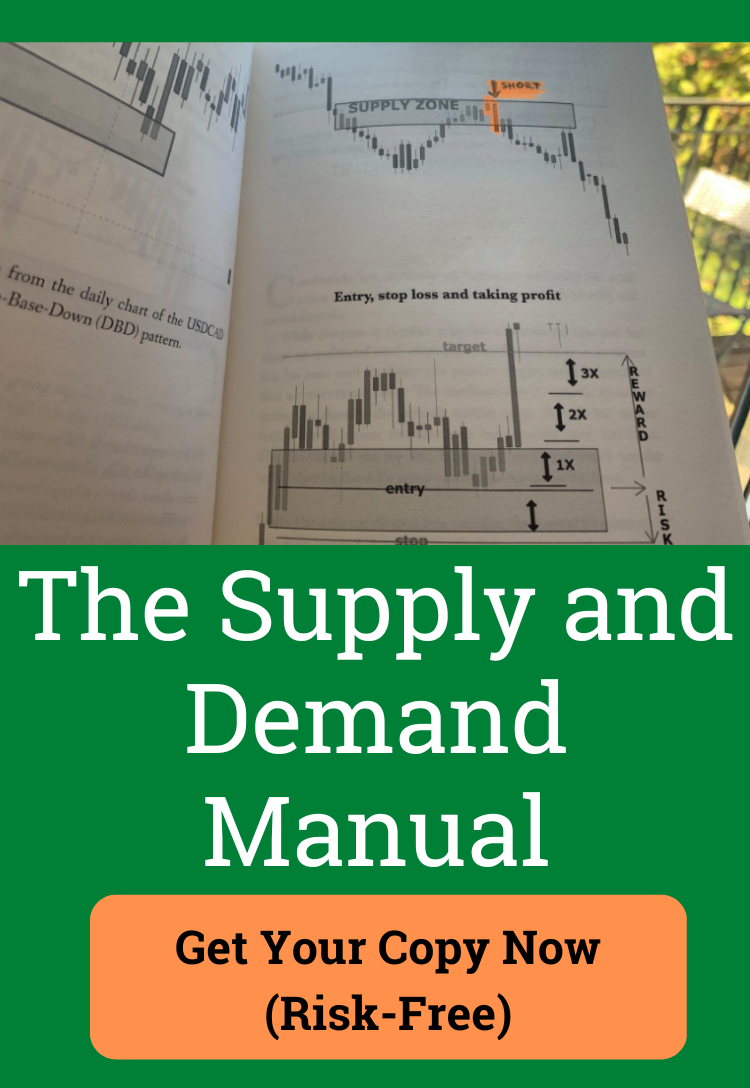
A price action approach fits these rules like a glove. When you can identify clear supply and demand zones on a chart, you can define your risk with incredible precision. Your entry goes at one level, and your stop-loss sits just on the other side of a nearby, opposing level.
This creates a crystal-clear, pre-defined risk on the trade. It takes the guesswork out of the equation and physically prevents you from getting carried away with too much leverage.
History gives us a brutal lesson on the dangers of getting too comfortable with leverage. During market manias, everyone from giant hedge funds to retail traders starts borrowing heavily. We've seen data showing hedge funds pushing their gross leverage to all-time highs right before major market downturns, with retail margin debt following the same scary path.
These borrowing peaks have almost always come right before big market tops. It's a powerful argument for why disciplined trading beats chasing maximum returns with maximum margin every time. Understanding the inherent dangers of various leveraged instruments, such as how the recent Leveraged ETF boom signals hidden risks in retirement accounts, is crucial for effective risk management.
How to Start Margin Trading Responsibly
Jumping straight into margin trading without a solid plan is a fast track to blowing up your account. The key to using this powerful tool is not to borrow the maximum you can, but to approach it with a disciplined, step-by-step strategy.
Your first move isn't even a trade. It's education and paper trading. Before a single real dollar is on the line, you must understand the mechanics inside and out. Use a trading simulator or a "paper trading" account to practice with virtual money. This is your risk-free sandbox to see how leverage can magnify gains and accelerate losses, and to test your strategies without any financial consequences.
Choosing Your Platform
Once you've got the hang of the process in a simulated environment, it's time to select a reputable broker. This decision is critical, as not all brokers are built the same, and the right partner can make all the difference for a margin trader.
When you're comparing your options, keep an eye on these factors:
- Margin Rates: This is the interest you'll be paying on what you borrow. Lower rates mean lower costs, which has a direct and significant impact on your profitability.
- Platform Stability: In a fast-moving market, the last thing you want is a platform that crashes or lags. You need a stable, reliable system that lets you get in and out of trades exactly when you need to.
- Customer Support: When an urgent question about your account or a margin issue pops up, you need responsive and knowledgeable support—not a chatbot.
Start Small and Scale Your Success
This is the most important rule of all: start small. Never, ever jump in by maxing out your available leverage. Instead, you should think of margin as a way to gradually scale up a strategy that is already working.
Margin should be used to amplify a proven, profitable strategy, not to chase a lottery-ticket win. Its purpose is to scale consistent success, not to gamble on a single big outcome.
Start with a tiny amount of leverage, maybe just 2:1, on small positions. You can use a dedicated position size calculator to ensure your risk per trade stays within your predefined limits, like the classic 1-2% rule. Your focus should be on mastering your trading strategy and becoming consistently profitable with your own capital first.
Only after you've shown consistent discipline and have the results to prove it should you even consider slowly increasing your leverage. This patient, methodical approach is what turns margin trading from a high-stakes gamble into a calculated business tool.
Frequently Asked Questions About Margin Trading
As you start to wrap your head around margin, a few questions always pop up. Let's tackle the most common ones head-on so you can approach this tool with your eyes wide open.
Is Margin Trading Suitable for Beginners?
The short answer is no. Margin trading is a powerful tool, but it's absolutely not for beginners. Think of it this way: you wouldn't get into a Formula 1 car the day you get your driver's license.
You should only even consider margin after you’ve mastered a trading strategy and proven you can be consistently profitable with your own money. The leverage involved can wipe out an inexperienced trader who hasn’t built rock-solid discipline and risk management skills.
Key Takeaway: Treat margin as a tool to scale proven success, not as a shortcut to get there. Master the basics first.
What Are the Interest Costs on a Margin Loan?
When you trade on margin, you're borrowing money from your broker. It’s a loan, and like any loan, it comes with interest. This is known as the "margin interest rate."
This cost is usually calculated daily and billed to your account every month. It’s a real cost that chips away at your profits. If a trade just breaks even, you've actually lost money because of the interest you paid. You have to account for this expense in every single trade calculation.
Can You Use Margin for All Types of Securities?
Not necessarily. It all comes down to your broker and the specific market you want to trade. Brokers have their own rules.
For example, a broker might offer plenty of margin for major stocks like Apple or Google but give you none for highly volatile penny stocks. The rules for crypto or futures will be completely different from equities, too. Always, always check your broker's specific margin list and requirements for any asset you plan on trading.
At Colibri Trader, we teach you the price action strategies to build a profitable foundation before you ever need to consider advanced tools like margin. Start your journey with our proven trading programs today.