




Can You Short Bitcoin? a Trader’s Guide to Profit & Risk
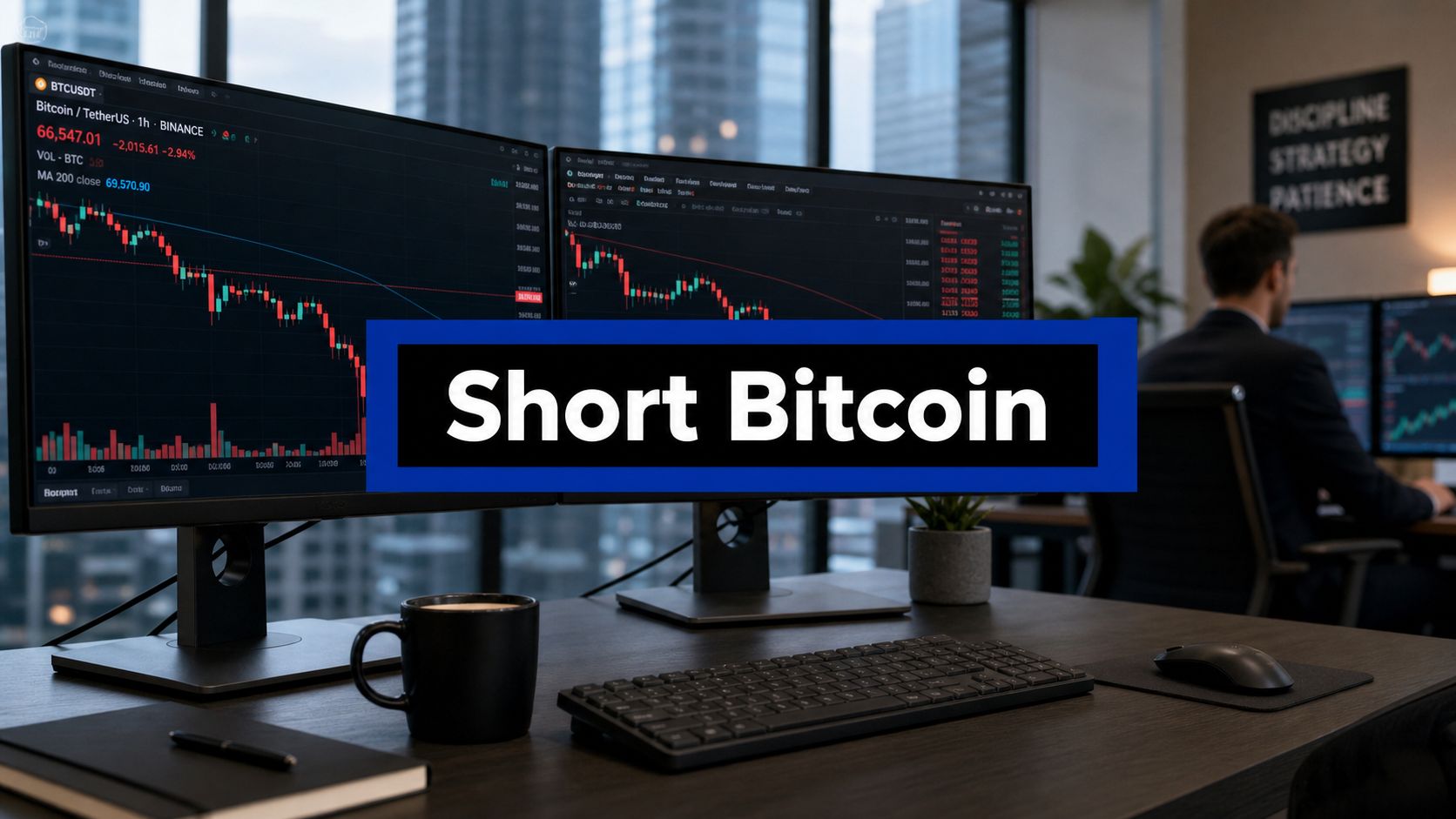
Yes, you can short Bitcoin through several instruments, and the most liquid route for many traders is perpetual futures, while U.S. retail traders often use inverse ETFs or futures. But shorting Bitcoin is one of the highest-risk moves in trading, because losses aren't capped and even a 10% move against a 50x short can trigger liquidation.
A lot of traders reach this question at the same moment. Bitcoin has run hard into resistance, sentiment feels overheated, and the chart finally shows the kind of rejection candle that makes a short look obvious. That's exactly when people get hurt.
The problem isn't access. It's behavior. Most traders asking can you short Bitcoin really mean something deeper: can you short it without getting squeezed out, financially overextended, or emotionally wrecked by a violent reversal? That's the core question, and it deserves a trader's answer, not a product brochure.
Shorting Bitcoin can be useful. It lets you hedge downside risk, trade bearish momentum, and profit in markets that aren't trending up. It also punishes hesitation, poor sizing, and ego faster than almost any other setup. If you approach it with a price-action mindset, strict risk limits, and short holding periods, it can be part of a professional playbook. If you approach it like a shortcut, it becomes tuition.
What Is Short Selling Bitcoin
Short selling Bitcoin means you profit if the price falls.
The easiest way to understand it is through a borrowed item. Say you borrow a rare book from a friend because you think a reprint is coming and the resale price will drop. You sell the borrowed book today while it's expensive. Later, when the price falls, you buy the same book back more cheaply, return it to your friend, and keep the difference.
That's the core logic of a Bitcoin short. You sell first, then buy back later.

How the short actually works
With Bitcoin, you usually aren't borrowing coins from a friend. You're using a trading platform, broker, or derivatives venue that gives you a way to take the opposite side of price.
The sequence is simple:
- Borrow or synthetically access Bitcoin exposure
- Sell at the current price
- Wait for a drop
- Buy it back at a lower price
- Return the borrowed exposure or close the derivative position
If price falls after your entry, the trade works. If price rises, your short loses money.
Practical rule: A long position uses "buy low, sell high." A short uses "sell high, buy low."
Why this matters to a price-action trader
Most beginners think shorting is a special advanced trick. It isn't. Mechanically, it's just another directional trade. The difference is psychological and structural. On a long trade, the asset can only fall to zero. On a short trade, price can keep rising and force losses to grow.
That changes how you must think about entries.
A clean short isn't "Bitcoin looks expensive." That's an opinion. A better short is price rejecting a known supply zone, failing to break resistance, or printing a bearish pattern that shows sellers stepped in. If you trade with margin, it helps to understand the mechanics first, and a primer on margin trading basics is useful before you even think about pressing sell.
What short selling is not
It isn't a prediction contest. It isn't a moral stance against Bitcoin. And it definitely isn't a way to get rich from every red candle.
A good short is a structured bet on weakness. You define the level that proves you wrong before you enter. If that level breaks, you get out. That's the mindset shift many retail traders miss.
Four Main Ways to Short Bitcoin
There isn't one universal method. The right instrument depends on where you live, how active you are, and whether you're trading inside a crypto platform or a traditional brokerage account.
Bitcoin can be shorted through five primary financial mechanisms, with perpetual futures on exchanges such as Binance, Bybit, and the CME described as the most liquid route for global traders, while inverse ETFs such as ProShares Short Bitcoin Strategy ETF (BITI) are presented as the simplest entry point for many U.S. retail investors. The same overview notes that availability is jurisdiction-dependent, with CFDs common outside the U.S. but prohibited for retail traders within it, as explained in this breakdown of ways to short crypto.

A trader's comparison
| Method | Best for | Main strength | Main drawback |
|---|---|---|---|
| Perpetual futures | Active traders | Deep liquidity and direct bearish exposure | Fast liquidation if you're sloppy |
| Spot margin shorting | Traders who understand borrowing | Familiar setup on some exchanges | Borrowing costs and platform restrictions |
| CFDs | Traders outside the U.S. on regulated brokers | Simple directional access | Not available to U.S. retail traders |
| Inverse ETFs | Traditional brokerage users | Easy access through stock accounts | Less flexible than active derivatives trading |
Perpetual futures
Many serious short sellers operate within this framework. You don't need to hold spot Bitcoin. You open a derivatives position that gains if price falls.
For active traders, futures are practical because execution is fast, position management is straightforward, and you can work directly from chart structure. If Bitcoin rejects a daily supply zone or loses an intraday support shelf, futures let you act immediately.
The trade-off is obvious. Futures punish bad timing. They also tempt traders to take on greater financial exposure than their skill supports.
Spot margin shorting
Some platforms allow you to borrow Bitcoin, sell it, then repurchase it later. This is the classic short-selling model.
It sounds simpler than futures, but the risk discipline is the same. You're still using borrowed exposure. You're still vulnerable if Bitcoin spikes into your stop. And if you're new to using borrowed exposure, don't confuse "simpler to explain" with "safer to trade."
CFDs
Contracts for Difference are common with many brokers outside the U.S. They let you speculate on price direction without owning the asset. For some traders, CFDs are convenient because they sit inside a familiar brokerage interface.
If you're still learning the product category, this guide to CFD trading for beginners gives useful context on how these instruments behave.
Inverse ETFs
For stock-market investors who don't want a crypto exchange account, inverse ETFs are the easiest conceptual bridge. You buy a fund designed to move opposite Bitcoin exposure.
That doesn't make them ideal for everyone. They fit better for investors who want simple access, not for traders who need precise entries, active stop management, and flexible execution around fast-moving price action.
Futures are usually best for skilled active traders. Inverse ETFs are usually best for people who want convenience more than tactical precision.
The Unforgiving Risks of Shorting Crypto
Most traders don't blow up because they couldn't find a shorting method. They blow up because they underestimate what a Bitcoin rally can do to a short position.
Shorting Bitcoin is high-risk because of extreme volatility and unlimited loss potential. Losses on a short aren't capped the way they are on a long, and Bitcoin's explosive upside has repeatedly punished bearish traders. During the 2020 to 2021 bull run, Bitcoin reached $69,000, and that kind of move caused massive liquidations for short sellers. The same discussion warns that shorts are generally better kept open for short durations because of short squeezes and funding-fee pressure, as outlined in this guide to whether you can short crypto.
Unlimited loss changes everything
When you buy Bitcoin, the worst-case outcome is straightforward. The asset falls toward zero and your loss is capped by what you put in.
When you short Bitcoin, the opposite is true. If price rises sharply, your loss keeps expanding. That's why a short can't be managed casually. "I'll just wait for it to come back" works right up to the moment your account gets forced out.
If you can't define your invalidation level before entry, you shouldn't be short.
The chart isn't the only risk
Bitcoin shorting combines market risk with structural risk. Volatility is the obvious one. A sudden upside spike can tear through weak stops, trigger liquidations, and create a chain reaction.
Then there are platform and product risks. Some traders use lightly regulated venues, assume order execution will be smooth, and only discover the operational risk when volatility surges. That's one reason it's smart to understand broader crypto spending and pricing behavior too. This crypto card volatility guide is useful because it frames how quickly crypto price swings affect real-world usage and expectations.
If you're not already clear on what happens when collateral starts running thin, review how a margin call works before shorting anything this volatile.
The psychological trap
Shorting feels clever. That's dangerous.
A lot of traders identify one overextended move and start believing they can call the top. Then price squeezes higher, they add to the loser, and what started as a tactical trade turns into an ego battle. Bitcoin is especially good at exposing that weakness because it can stay irrational longer than an undercapitalized trader can stay calm.
The professional mindset is less dramatic. You're not trying to win an argument with the market. You're trying to execute a defined setup, with defined risk, and walk away if price proves you wrong.
How to Manage Risk and Avoid Liquidation
If you're going to short Bitcoin, your first job is survival.
That starts with a harsh fact. A 10% price increase against a 50x magnified short can trigger automatic liquidation, and short positions face a 3 to 5x higher liquidation rate than longs during sharp upward spikes. The same source explains that when funding rates are positive, shorts may have to pay longs every 8 hours, which can erode the position even if price goes nowhere. These mechanics are discussed in this video on Bitcoin short liquidation risk.
The practical lesson is simple. Bad short management doesn't fail slowly. It fails fast.

Use price action to place the stop
Don't place a stop where it feels comfortable. Place it where the trade idea is invalid.
For a short, that usually means above a clear resistance level, above the wick that rejected higher prices, or above the supply zone that triggered your setup. If price pushes through that area with intent, your read was wrong or early. Either way, the job is to exit cleanly.
A stop-loss on a short is not optional. It is the price of admission.
Keep leverage boring
Many traders ask whether they can short Bitcoin "without multiplied financial exposure." In practice, shorting by its nature involves borrowing exposure, so the safer question isn't whether such amplified financial positioning is present. It's how much embedded risk you're carrying and whether you understand the liquidation mechanics.
Here are the rules that keep traders in the game:
- Size small enough to think clearly. If one candle against you makes you panic, the position is too large.
- Avoid oversized exposure via borrowed funds. Taking on too much borrowed capital narrows your margin for error and makes normal volatility feel fatal.
- Respect funding costs. A short can lose money from carrying costs even when price stalls.
- Don't turn a trade into a hold. Short setups are often tactical, not investments.
Non-negotiable: Every short needs a preplanned stop, a defined invalidation level, and a position size small enough that you can obey both.
A good companion resource on this topic is this guide on how to handle crypto margin calls, especially if you're still learning how collateral pressure escalates during fast markets.
Watch the hidden drains
Many traders only monitor price. Professionals monitor the trade's structure too.
That means checking:
- Funding so you know whether the position is costing you to hold
- Liquidity so you don't short into thin conditions that can whip violently
- Time in trade because a short that lingers often becomes more dangerous, not less
For visual learners, this breakdown helps clarify how to think about risk before and during the trade:
A simple survival framework
| Question | Good answer | Dangerous answer |
|---|---|---|
| Where is my stop? | Above a clear invalidation level | "I'll decide later" |
| Why this entry? | Rejection from structure | "It feels overbought" |
| How long will I hold? | Short and tactical | "Until it comes back" |
| What if price spikes? | Loss is predefined | "I'll add more" |
That's how you stay alive long enough to improve.
A Practical Bitcoin Shorting Scenario
A workable short starts before the entry. The chart has to offer a reason.
Say Bitcoin rallies into a well-defined supply zone that has already produced a sharp selloff in the past. Price pushes into that area again, tags the zone, and prints a bearish rejection candle. The next candle fails to continue higher. Then lower highs begin to form on the lower timeframe. That's the kind of structure a price-action trader pays attention to.

The setup
The short thesis isn't "Bitcoin has gone up too much." It's tighter than that.
The thesis is:
- Price reached a known supply area
- Buyers failed to break through
- A bearish candle confirmed rejection
- The next move showed loss of bullish control
That combination matters because it gives the trade structure. You know where the idea came from, and just as important, you know where it fails.
The execution
A disciplined trader enters only after confirmation. That might mean waiting for the rejection candle to close, then entering on a break of its low or on a small retest that holds below resistance.
The stop goes above the invalidation point. Not far away out of fear, and not so tight that normal noise takes you out. If price trades back above the rejection area and accepts there, the short premise is damaged.
The target isn't chosen at random either. A reasonable take-profit area sits near the next demand zone, prior support, or a clean downside objective visible on the chart. The trade has a planned exit before it starts.
Good short trades feel controlled at entry. Desperate short trades usually start with chasing.
The mindset during the trade
Once the trade is live, the work becomes defensive. You don't need to predict every candle. You need to protect capital and avoid emotional decisions.
If price drops cleanly, you manage according to plan. If it stalls and starts reclaiming broken structure, you reduce risk or get out. If it squeezes higher and tags the stop, you accept the loss and move on.
That last part matters. A professional short seller doesn't need to be right often enough to feel smart. The trader needs a process that keeps losses small and lets clean setups pay for the mistakes.
Key Legal and Tax Considerations
The legal side of Bitcoin shorting isn't universal. Your available tools depend heavily on your jurisdiction.
Your instrument depends on where you live
Outside the U.S., some traders can access CFDs through regulated brokers. In the U.S., retail access is typically narrower, which often pushes traders toward futures or certain exchange-traded products. That's not just a platform preference. It's a regulatory constraint.
The practical takeaway is simple. Don't start with "what's the best shorting method?" Start with "what's legally available where I trade?"
Taxes usually don't care that the trade was short
In many places, profits from short-term trading activity are taxed differently than long-term investing, and shorting can add extra record-keeping complexity because you're using derivatives, borrowing, or specialized products.
That means you should keep records for:
- Entries and exits
- Platform statements
- Fees and funding charges
- Product type used for the trade
If you actively trade Bitcoin shorts, clean records matter almost as much as good entries.
Platform quality matters
A short trade already carries enough market risk. You don't need unnecessary counterparty risk on top of it.
Choose venues with a strong reputation, clear product terms, and risk controls you understand. Read the margin rules. Read the liquidation rules. Read how funding works. If you can't explain the product mechanics in plain English, you shouldn't trade it with size.
This article isn't legal or tax advice. It's a reminder that profitable trading isn't just chart reading. It's also operating inside the rules that apply to your account, your country, and your chosen instrument.
Your Checklist Before Placing a Short Trade
Shorting Bitcoin isn't a beginner milestone. It's a readiness test.
If you're asking can you short Bitcoin, the mechanical answer is yes. The better question is whether you've earned the right to do it with real money. Before placing a short, run through this checklist thoroughly.
Skill checklist
- Can you read price action cleanly. You should be able to identify resistance, supply, rejection, failed breakouts, and bearish continuation without guessing.
- Do you have a written plan. Entry, stop, target, size, and invalidation should already exist before the order goes live.
- Have you practiced the setup. If you haven't tested the pattern in replay or demo conditions, you're improvising.
- Do you understand the instrument. Futures, margin, CFDs, and inverse ETFs don't behave the same way.
Risk checklist
Ask yourself these questions:
- Where exactly is my stop?
- How much am I willing to lose on this trade?
- What event would make me exit early?
- Am I paying to hold this position?
- What happens if Bitcoin spikes against me fast?
If any answer is vague, you're not ready.
Psychological checklist
Here, most traders fail.
- Can you take a small loss without revenge trading?
- Can you avoid adding to a losing short just because price moved higher?
- Can you stay patient and wait for structure instead of forcing a top call?
- Can you close the trade when your plan says exit, even if you still "feel" bearish?
Short selling rewards discipline more than conviction. The traders who last aren't the boldest. They're the ones who can stay small, stay patient, and stay objective when Bitcoin does what it often does best, which is move harder and faster than expected.
If you want to build that kind of discipline with a clean price-action framework, Colibri Trader is a strong place to start. Their training focuses on structure, risk management, and practical trade execution, which is exactly the foundation you need before attempting high-risk trades like Bitcoin shorts.