
Losing Money in the Stock Market: Causes and Recovery
You check your account after another difficult week. The balance is lower, yet the stocks you bought still seem reasonable. You followed the news, studied the charts, and tried not to chase. Somehow, you're still losing money in the stock market, and you can't tell whether to change your strategy or stop touching it.
Why Smart Traders Still Lose Money
The frustrating part isn't always the loss. It's watching a stock move in your expected direction after you've already sold it, or realizing that your biggest position caused most of the damage.
Those situations can look identical on an account statement. They aren't the same problem, and they don't need the same fix.
This scene may feel familiar if you've started checking your balance more often than your trading plan.

A reasonable idea can become a poorly executed trade
Consider a hypothetical purchase near support, an area where buyers previously stepped in. Your original idea allows for some movement around that level, but you buy a position so large that every downward tick feels threatening.
You exit before your planned invalidation point. Later, the stock recovers, and you conclude that you should've held on.
That conclusion misses the underlying issue. Your position size made your trading plan difficult to follow. Buying another stock won't necessarily solve that problem.
A losing trade tells you what happened to your money. It doesn't, by itself, tell you whether your decision was wrong.
Separate the decision from the outcome
A useful review asks different questions than an anxious account check:
- Market conditions: Did the broader market move against the position?
- Execution: Did you enter, manage, and exit according to your written rules?
- Exposure: Was the possible loss appropriate for your account and circumstances?
- Trade selection: Was there a repeatable setup, or just a persuasive story?
You might discover that you followed a reasonable plan and accepted a normal losing trade. You might instead find that you changed the plan once money was at risk.
Neither finding is a judgment about your intelligence. Treat the review like troubleshooting equipment: identify the faulty component before replacing the whole machine.
The useful goal is better decisions, not a spotless trading record. Some losses are unavoidable. Others give you a specific behavior to change.
Separating Market Losses from Trading Mistakes
Market risk is like weather on a sailing trip. You can't control the storm, but you can choose your boat, your route, and whether to leave the harbor.
In trading, you don't control the next wave of selling. You do control the exposure you take into it, subject to the practical limits of order execution.
What a broad market decline looks like
On October 19, 1987, the S&P 500 fell approximately 20%, while the Dow Jones Industrial Average dropped 22.6%; the selling also spread internationally, according to the Federal Reserve's examination of the 1987 crash. That episode illustrates why owning different stocks doesn't eliminate risk when the underlying market falls broadly.
The distinction matters when reviewing your account. If unrelated holdings declined together, don't automatically conclude that every stock-selection decision was flawed. Start by asking whether you were carrying too much exposure to the same broad market move.
Then examine your response. Investors who sold near the crash low realized losses and no longer held those positions for the subsequent rebound, as documented in the Federal Reserve account cited above.
That isn't an argument for holding every losing position indefinitely. An individual stock isn't a diversified index, and neither has a guaranteed recovery timetable.
Realized losses aren't automatically mistakes
An unrealized loss is still an economic loss. Selling changes your exposure and records the result; it doesn't magically create damage that wasn't already present.
Use this distinction during a review:
| What happened | What to examine |
|---|---|
| The market fell and you followed your exit plan | Whether the original exposure was appropriate |
| You sold because the trade's premise failed | Whether the invalidation rule was clear and consistently applied |
| You abandoned a valid plan because the loss felt unbearable | Whether sizing or emotional execution caused the deviation |
| You held only because you couldn't accept being wrong | Whether you replaced analysis with hope |
A disciplined exit can protect capital even if the stock later rebounds. Judge the decision using information available at the time, not the chart that appeared afterward.
Taxes deserve a separate review from trade quality. If you're considering realizing losses for tax purposes, Wealth Collective's tax loss harvesting guide is a resource to consult alongside advice relevant to your jurisdiction. Don't let a possible tax benefit become the reason to keep an unsuitable position.
The Four Causes Behind Most Trading Losses
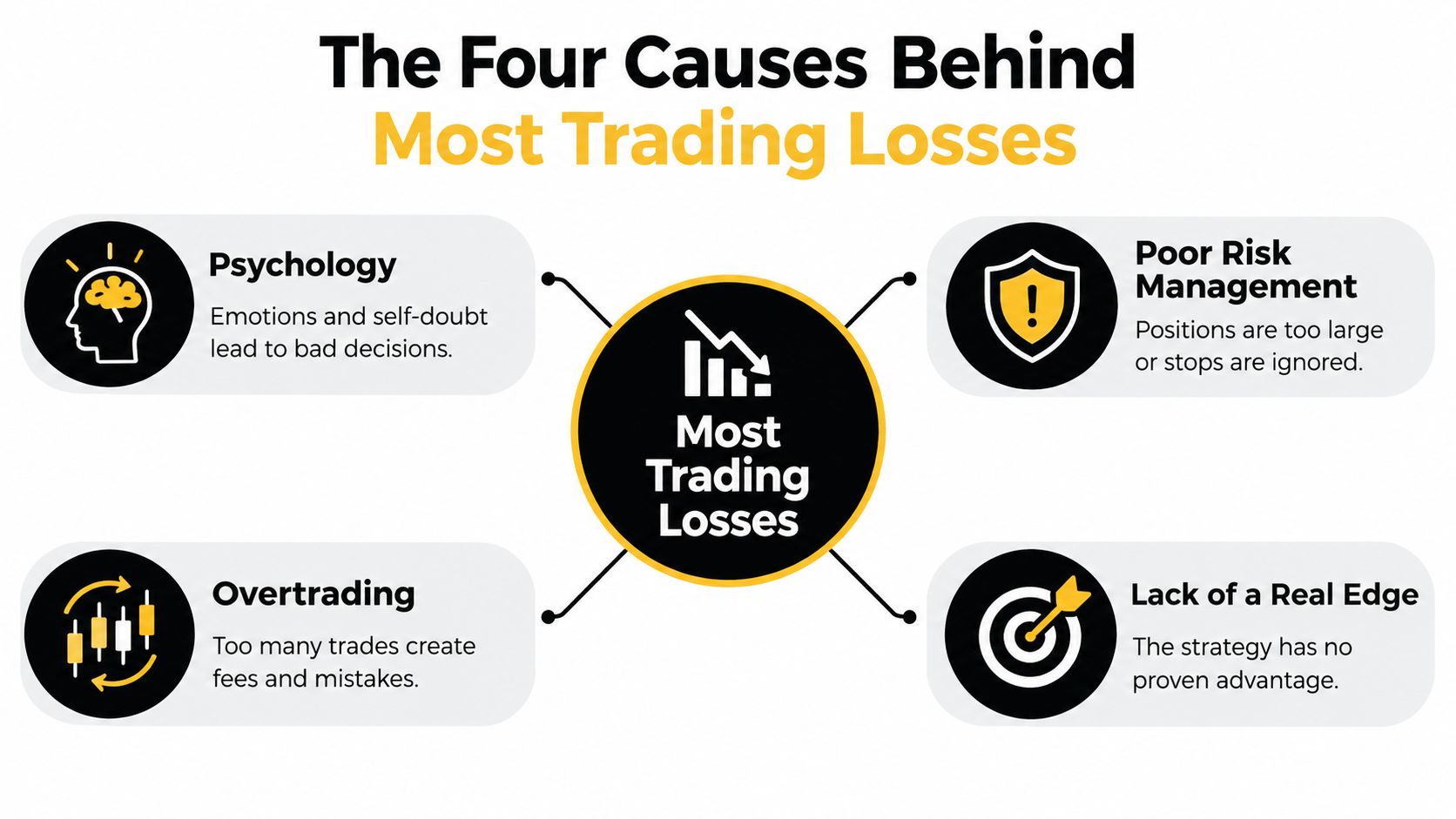
For a practical review, group avoidable losses under psychology, poor risk management, overtrading, and lack of a real edge. These categories are diagnostic tools, not proof that every loss was preventable.
Use this overview to identify which part of your process needs attention.
Psychology and risk management
Psychology changes the plan after entry. You sell during a sudden decline because you want relief, then buy back after a rally because you're afraid of missing out. The problem isn't having emotions. It's allowing them to replace your decision rules.
The price action fix is to specify the evidence that would invalidate the trade before entering. A move below a meaningful support area might matter to your setup; an uncomfortable fluctuation might not.
Poor risk management is different. You may understand the chart correctly but commit too much money to the idea, like loading a small boat beyond its safe capacity.
Position size should follow the distance to your planned exit, not your confidence. For a broader perspective on exposure, consider the risk management insights from Everglow Prosperity alongside your trading rules.
Activity isn't the same as an edge
Overtrading means taking action because you want stimulation, relief, or a quick recovery rather than because your setup is present.
A 2025 study found that losing investors had a median actual excess return of -6.01%, with action bias and concentration bias significantly associated with outcomes, in its analysis of investor behavior and trading results. Excess return is a relative performance measure, not necessarily the same as an investor's raw account return.
The practical response is to define conditions under which you won't trade. If you're entering mainly to recover a previous loss, this guide on how to stop revenge trading addresses that specific behavior.
A lack of edge requires a different remedy:
- Psychology problem: You had rules but changed them under pressure.
- Risk problem: Your potential loss was inappropriate for the account.
- Overtrading problem: You traded when your setup wasn't present.
- Edge problem: You haven't established whether the setup is worthwhile after costs.
An edge doesn't require winning more often than losing. It requires a favorable relationship between how often you win, what you make when right, what you lose when wrong, and trading costs.
These problems can reinforce each other. An unclear setup leaves room for improvisation, an oversized position adds pressure, and a painful exit can trigger an unnecessary replacement trade. Diagnose the starting point rather than blaming everything on discipline.
Diagnosing Your Own Losing Pattern
Ask a more precise question than “Why am I losing?” Did the loss come from price movement, execution costs, or the product I chose?
A correct forecast isn't enough if the instrument behaves differently from what you expected. For an option buyer, direction, timing, and contract terms all deserve attention.
Follow the loss from idea to account statement
A 2025 retail options study found an average option-trade return of -0.9%, with typical bid-ask spreads of 5% to 10%, in its research on retail option trading. Those sample findings aren't a forecast for every options trade, but they show why product selection and trading friction need their own review.
For example, you might buy an option expecting an upward stock move. The stock rises, but not enough or soon enough to make the contract profitable after its changing value and execution costs.
Price action alone can't remove those mechanics. Sometimes the appropriate fix is choosing a simpler instrument or passing on the trade.
Loss Pattern Diagnostic
| Loss Pattern | Likely Root Cause | Price Action Fix |
|---|---|---|
| Exiting before the planned level, then watching a recovery | Discretionary exits driven by discomfort | Define invalidation using chart structure and size accordingly |
| Repeated stop-outs inside ordinary fluctuations | Stops placed without regard to the setup | Place the planned exit beyond meaningful invalidation, then reduce size |
| Numerous small trades without clear locations | Action bias or unclear selection rules | Require a marked level and a defined trigger |
| A single position dominates account damage | Excessive position size or concentration | Apply an exposure limit before entry |
| Buying immediately after an extended move | Chasing without an acceptable exit location | Wait for a qualifying pullback or skip the trade |
| Losing on expiring products despite a favorable stock move | Timing, contract selection, or friction | Review the instrument separately from the underlying chart |
| Different positions fail together | Shared market exposure | Assess combined exposure rather than counting positions |
Build a usable trade record
Review a recent batch of completed trades without excluding the embarrassing ones. For each, save the entry chart, planned exit, actual fill, position size, costs, and reason for closing.
Assign a primary cause and, where needed, a contributing cause. Don't label every loss emotional just because losing felt unpleasant.
A trading equity curve can help you examine when account declines occurred. Pair it with your journal to investigate whether those periods coincided with rule changes, greater exposure, or different instruments.
Look for recurring decisions, not isolated bad outcomes. A small sample can reveal a rule-following problem without establishing whether your strategy has a durable edge.
Building a Price Action Recovery Plan
Start with a plan you can execute at a manageable level of risk. Trying to win back a particular amount can push you toward trades that don't meet your criteria.
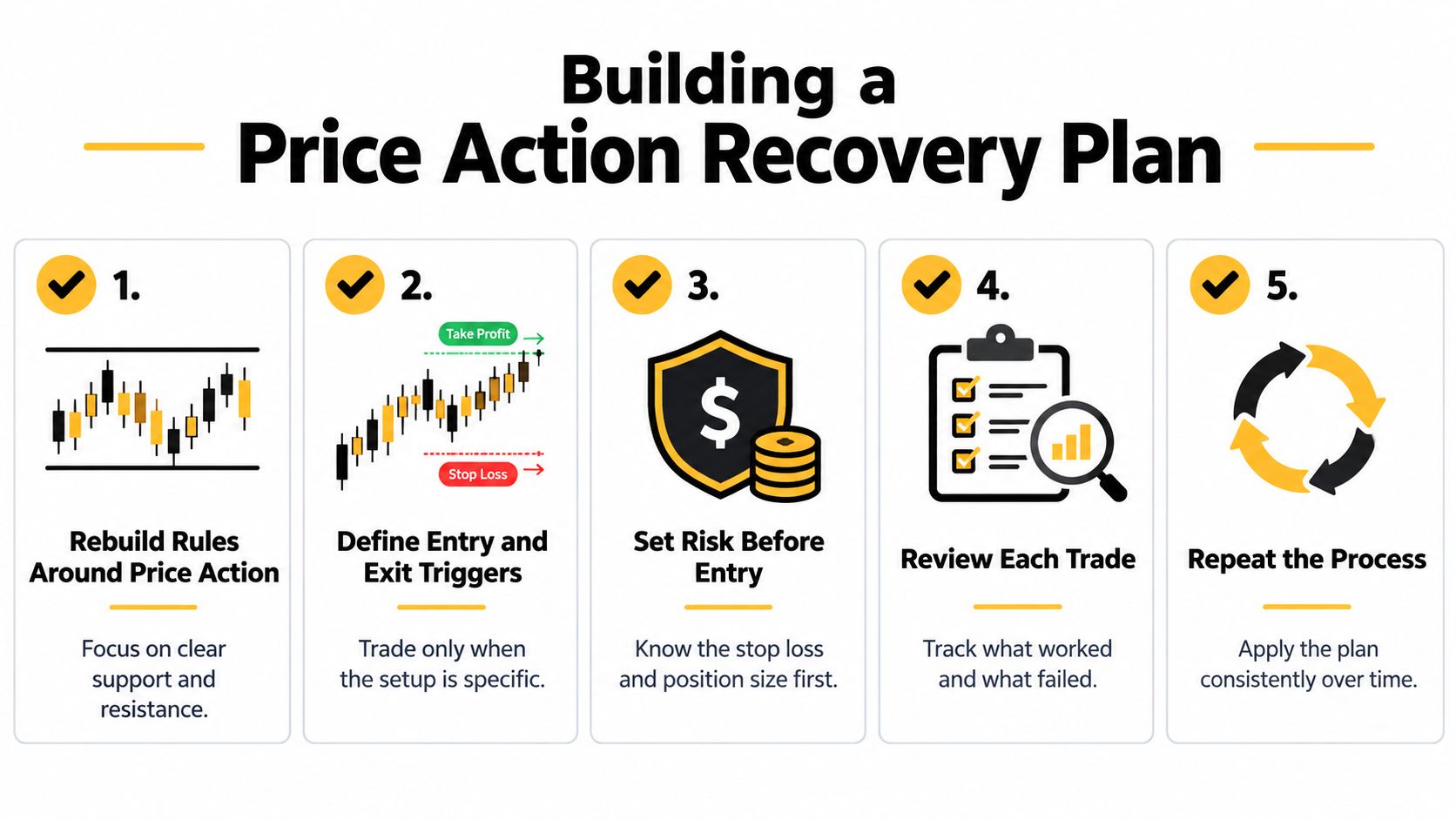
Keep the rebuilding process visible with a checklist.
Define the setup before discussing size
Mark support and resistance as areas of prior buying or selling interest, not precise lines that price must obey. Then choose an observable entry condition.
For a hypothetical long setup, your rule might require price to test support, move below it, and close back above the area. Describe what constitutes a rejection candle, where you would enter, and what would make the setup invalid.
That pattern is a candidate to test, not a promise of profit. Avoid rewriting its definition after seeing the outcome.
For additional work on making entry criteria explicit, use the guide to trading with precision.
Set exposure before placing the order
Choose a maximum planned loss that suits your financial circumstances and trading account. Then calculate size from the entry-to-stop distance, accounting for relevant costs.
Position size = planned monetary risk ÷ risk per share.
This calculation is a planning tool, not a guarantee. Gaps and unfavorable execution can make the actual loss larger than intended.
- Set the exit first: Don't tighten a stop to accommodate a larger position.
- Check combined exposure: Several similar trades may express the same underlying bet.
- Reduce learning risk: If execution is inconsistent, consider simulation or smaller live exposure rather than forcing recovery.
Make discipline observable
Write a pause rule for consecutive losses or a rule breach. The pause should create time to review decisions, not punish you for a normal losing trade.
For example, a trader rebuilding after an oversized loss could use smaller positions and restrict entries to a written rejection setup. This wouldn't establish profitability, but it would make the next review clearer: did the trader follow the setup, respect exposure limits, and execute the planned exit?
Practical rule: Don't increase size to repair the account. Consider increasing it only after reviewing evidence that your process and risk limits are being followed.
At the end of each session, record planned versus actual behavior. During a regular review, select a specific recurring error to address rather than changing every rule simultaneously.
Use the accompanying video as an additional learning resource, then compare any ideas you take from it against your written plan.
Comparing Ways to Rebuild Your Trading Skills
Choose a learning method based on the problem you've identified. Someone who can't define an entry needs different help from someone who understands a setup but repeatedly ignores its risk limits.
The important question isn't whether a method looks complex. It's whether you can explain its rules, test them, and see what happens when you follow them.
Compare the learning process
| Approach | Clarity of rules | Risk while learning | Coverage of behavioral and risk problems | Self-paced fit |
|---|---|---|---|---|
| Self-directed live trial and error | Depends on the trader's documentation | Real capital is exposed during experimentation | Depends on an honest review process | Flexible, but easy to make inconsistent |
| Indicator-heavy signal systems | Can be explicit, though settings may complicate decisions | Depends on sizing, execution, and whether practice precedes live use | Signals alone don't resolve sizing or discipline | Often possible, depending on the resources |
| Structured price action education | Should provide observable setup and invalidation criteria | Can include practice before meaningful live exposure | Can address selection, risk, and execution together | Depends on course access and feedback arrangements |
Indicators aren't automatically harmful, and price action isn't automatically superior. A clear indicator-based method can be more testable than a vague instruction to buy at support.
Likewise, live trading isn't proof that you're learning. Without records and defined questions, you may repeat the same decisions with money attached.
Evaluate education by what you'll practice
The structured learning options on this site include Basic and Premium plans, specialized Supply & Demand and Day Trading courses, and personalized mentorship. Evaluate those formats against the gap in your process, rather than treating enrollment as a recovery strategy by itself.
Before committing to education, ask practical questions:
- Setup definition: Will you learn what qualifies and what disqualifies a trade?
- Risk application: Does the material connect stop placement to position sizing?
- Review method: Can you compare your decisions with clear criteria?
- Feedback access: What support is available when your interpretation is uncertain?
- Learning pace: Can you practice thoroughly without feeling pressured to trade?
Self-directed study may suit you if you already have precise rules and can audit them rigorously. Structured feedback may be more useful if your journal repeatedly records uncertainty about whether a trade qualified.
No course, chart pattern, or mentor can remove market risk. Look for education that helps you make independently explainable decisions, not a promise that you'll never face another losing stretch.
Your Next Step Toward Consistent Results
You don't need to solve your entire trading history this week. You need a clear answer to a narrower question: which recurring decision can you change before your next trade?
Choose a recent set of completed trades and review them against the diagnostic table. Include winners as well as losers, because a profitable trade can still contain a rule breach that would be dangerous to repeat.
Turn the review into a decision
Write a short conclusion based on what you find. It might be that your entries meet your criteria, but your exits change whenever the position becomes uncomfortable.
Or you might discover that you've never defined a qualifying setup clearly enough to distinguish it from an impulse trade. That calls for further study and practice, not greater confidence.
Use your finding to choose an action:
- If rules are unclear: Write a complete setup definition before returning to live experimentation.
- If rules are repeatedly ignored: Reduce exposure or pause live trading while rebuilding execution.
- If product costs are unclear: Review the instrument and actual fills before placing another order.
- If the evidence is inconclusive: Keep collecting consistent records instead of forcing a verdict.
Give recovery a practical starting point
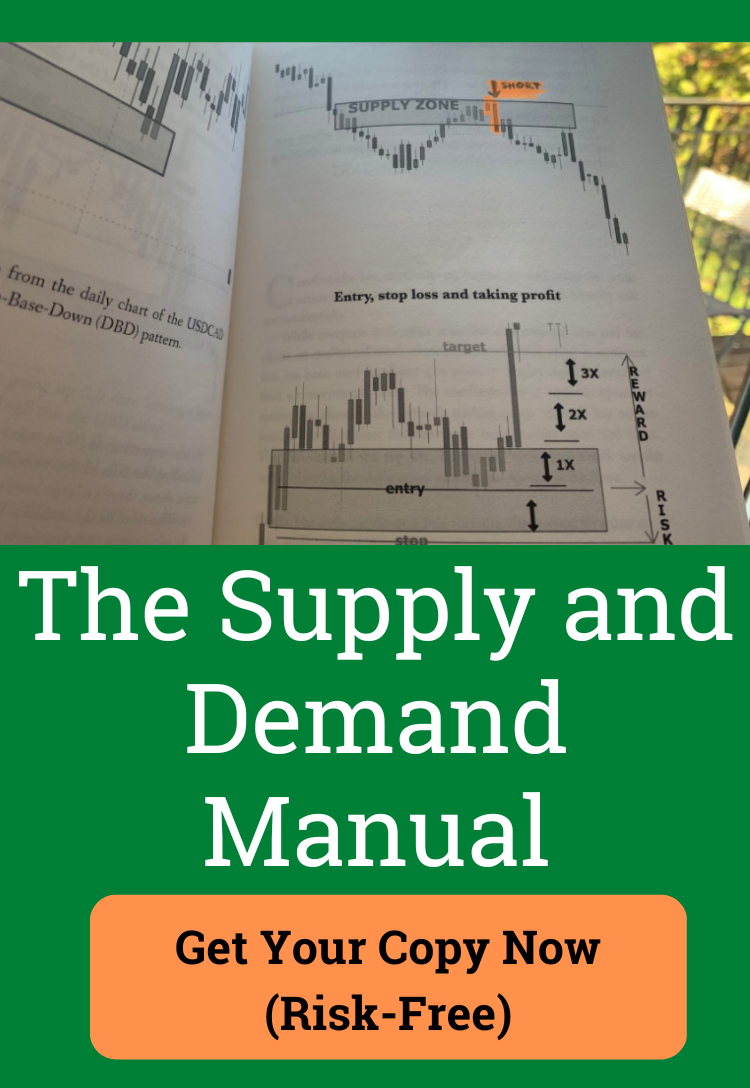
The free Trading Potential Quiz can serve as a starting point for reflecting on your current approach. The free opening chapters of the price action book offer another way to assess whether that teaching style matches how you learn.
Neither replaces a trade audit, and neither can predict your future returns. Use educational resources to sharpen the questions you ask about your own decisions.
Consistent execution means applying a defined process despite uncertain outcomes. It doesn't mean avoiding every loss, and it doesn't guarantee consistent profits. Start by making your next decision more deliberate than your last one.
Colibri Trader offers price action courses, money management lessons, and personalized mentorship for traders who want a more structured approach to reviewing losses. Visit Colibri Trader to take the free Trading Potential Quiz or access the first two free chapters of its price action book, then use your trade review to decide what you need to practice next.