How to Stop Revenge Trading: Proven Steps to Break the Cycle
You take a clean setup, place the stop, and watch price move straight through it. The loss is manageable, but the feeling isn't. Before you've reviewed what happened, you've opened another position, increased the size, and started telling yourself that one good trade will put you back where you were.
That second trade usually isn't based on a fresh opportunity. It's an attempt to reverse an emotional outcome. The market hasn't changed its obligation to you, because it never had one. If you want to learn how to stop revenge trading, start by treating the behavior as an operational risk, not a character flaw. The solution is a set of rules that makes impulsive decisions difficult when your judgment is under pressure.
Recognizing the Revenge Trading Trap
The pattern often begins with a normal losing trade. Your entry matched the plan, the stop was placed correctly, and the market invalidated the idea. Then the internal conversation changes: I can't finish down. I need to get that back. The next setup has to work.
You enter again before the first loss has settled. Perhaps the new position is larger, or perhaps the setup is merely “close enough.” Your heart rate rises, your attention narrows, and every small price movement feels personal. A second loss doesn't feel like independent information. It feels like confirmation that you must act again.
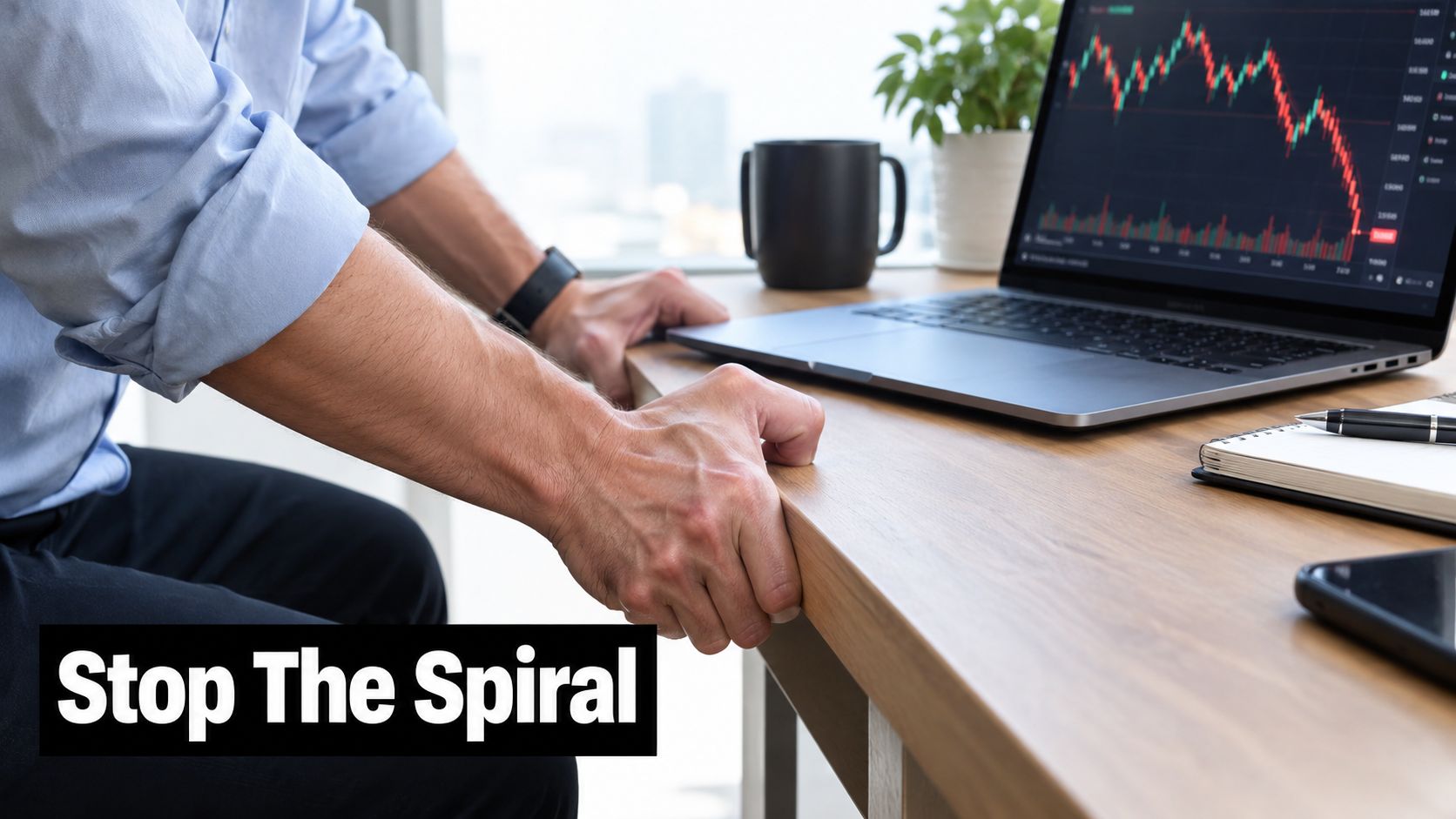
Revenge trading is a reaction to a previous loss, not a legitimate trading strategy. The defining question is simple: would you take this exact entry, with this exact size and timing, if you were flat on the day? If the answer is no, the previous result is influencing the current decision.
The signals that appear before the order
Look for the warning signs before you click buy or sell:
- Physical activation: Your breathing becomes shallow, your body feels tense, or you feel an urgent need to act.
- Tunnel vision: You stop scanning for all valid setups and focus only on recovering the last loss.
- Size changes: You increase exposure without a written reason connected to the setup.
- Lowered standards: You accept a weaker entry, move a stop, or switch instruments because your original market didn't provide what you wanted.
- Outcome-based thinking: You focus on returning to breakeven instead of assessing whether the current trade offers a valid opportunity.
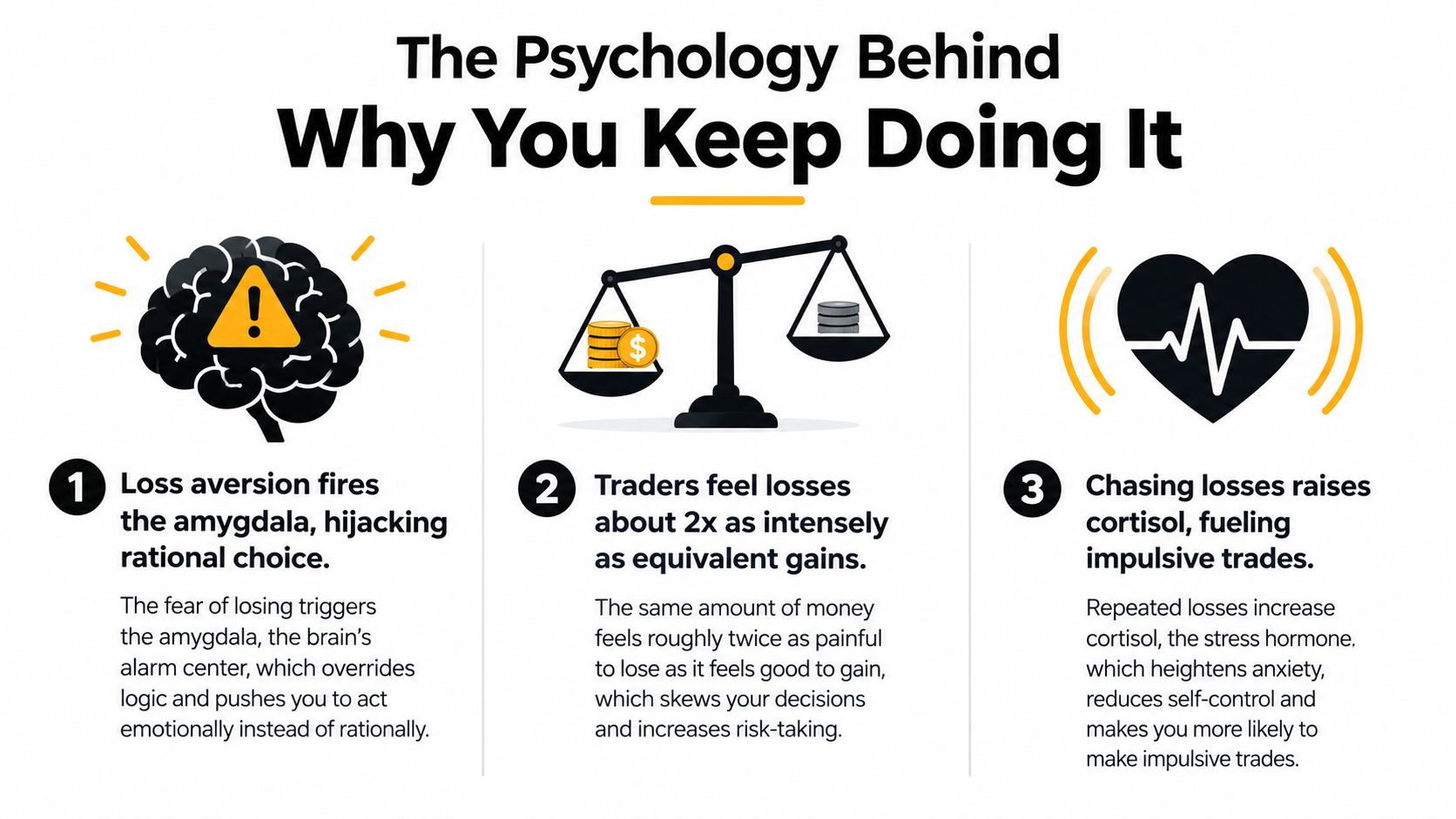
These signals matter because loss aversion makes an equivalent loss feel much more intense than a gain. The effect was formalized by Daniel Kahneman and Amos Tversky in 1979, and people typically experience losses about twice as intensely as equivalent gains, which can push traders to abandon their plan, increase size, and take lower-quality entries immediately after a loss. The Open University's overview of loss aversion and revenge trading provides the behavioral context behind this reaction.
Practical rule: The moment you hear yourself say “I need to win it back,” treat that thought as a stop signal, not a trade thesis.
The hidden cost is the sequence. One planned loss may be contained, while several emotionally driven trades can turn a routine setback into a much larger drawdown. You don't need to eliminate every losing trade. You need to prevent one loss from taking control of the next decision.
The Psychology Behind Why You Keep Doing It
Willpower fails here because the urge arrives before careful analysis. A loss creates discomfort, and the mind searches for a fast action that restores a sense of control. Opening another position offers immediate relief, even when the new trade has weak criteria.
Loss aversion explains why the original loss feels urgent. The trader isn't evaluating the next setup in isolation. They're comparing the current account balance with the balance they believe they should have, then trying to close that emotional gap. The market becomes a place where a personal score must be settled.
What the trading data reveals
A trading-psychology case study identified revenge trades as entries made within 15 minutes of a loss and at larger-than-normal size. Those trades had a 22% win rate, reportedly cost approximately $4,200 per month, and a 30-minute cooldown eliminated 93% of them when enforced through external restrictions rather than willpower. These figures are reported in a trading psychology guide from Quantum Algo.
The important lesson isn't that every trader will produce the same results. It's that revenge trading leaves a recognizable footprint: short timing, larger size, weaker execution, and repeated losses. Once the behavior has a footprint, you can design a barrier around it.
The same principle applies outside trading. People who struggle with immediate emotional reactions often benefit from writing down the trigger, the automatic thought, and the next action instead of relying on memory during stress. A practical guide for chronic procrastinators can help you think about the problem as delayed action and environmental design, rather than as a simple failure of motivation.
Why structural controls outperform motivation
Motivation asks you to make a better decision while your emotional state is deteriorating. A structural control makes the decision unavailable, delayed, or more difficult. That distinction is why a locked platform, a mandatory break, or a fixed order template can protect you when positive thinking cannot.
Use your journal to separate three questions:
- Was the original trade valid? A losing result doesn't automatically make a planned trade a mistake.
- Did the next trade meet the same criteria? Compare its setup, timing, and size with your normal process.
- What did the urge promise? Revenge trades often promise relief, certainty, or a quick return to breakeven.
For a broader framework on building emotional discipline around entries and exits, review this resource on mastering trading psychology. The aim isn't to suppress every reaction. It's to recognize the reaction early enough that it can't place the next order.
Implementing the Cooling-Off Circuit Breaker
The most effective first intervention is a pause that you can't negotiate with. After a loss, don't ask whether you feel calm enough to continue. Start a timer and follow the rule you wrote before the session began.
Use this exact protocol:
- After one losing trade, stop trading for 15 to 30 minutes.
- After two consecutive losing trades, pause for at least 30 minutes.
- During the pause, close the order-entry panel and leave the screen if possible.
- Before returning, review the original setup and write down whether the next trade still qualifies.
- If the next entry doesn't match the checklist exactly, don't take it.
This protocol interrupts the immediate-response cycle. The purpose of the pause isn't to make you feel positive. It gives the initial urge time to lose its authority, then forces the next decision through an objective process. The time windows and checklist pairing are recommended in this practical guide to preventing revenge trading.
Make the pause enforceable
A rule that exists only in your head is a preference. Use whatever restrictions your platform provides, such as disabling trading permissions, removing the order ticket from view, or setting a reminder that blocks the next action until the timer ends. If your platform can't enforce a lockout, create a physical barrier by signing out, moving away from the workstation, or handing the access decision to an accountability partner.
Write the rule in your plan using direct language:
After any loss, I will not open a new trade until the cooldown ends. After two consecutive losses, I will wait at least 30 minutes and will trade again only if the next setup passes every checklist item.
During the break, don't replay the candle-by-candle story in search of someone to blame. Record only the facts: entry, stop, planned risk, exit, and whether the trade followed the plan. If anger is the dominant response, structured writing methods such as thought records for anger control can help you identify the trigger and the automatic interpretation without turning the journal into another emotional argument.
The pause isn't punishment. It's a circuit breaker that protects the rest of the session from the first reactive decision. You can also review how to battle the temptation to overtrade for related methods that reduce unnecessary entries before they become a sequence.
Controlling Position Size After a Loss
Time controls stop the immediate re-entry. Position-size controls stop the escalation. A trader who waits briefly but then doubles the next position can still turn a contained loss into a serious drawdown.
Set the maximum size before the market opens. Experienced trading education sources recommend capping a single trade at 2% to 3% of account equity or three times base risk, whichever is lower, because revenge trading often appears as doubled or tripled exposure after a loss. The sizing guidance and its behavioral rationale are covered in this position-sizing discussion of revenge trading.
The “whichever is lower” condition matters. It prevents a trader from choosing the more generous limit when emotions are already pushing toward excess. If your normal risk is one fixed unit, the next trade shouldn't become a recovery attempt with a larger unit just because the previous one failed.
Remove size from the emotional decision
Pre-set your common order sizes and calculate them from the stop distance before you begin trading. Avoid typing a new quantity manually after a loss. A fixed order template won't determine whether the setup is valid, but it can remove the easiest way to express frustration through exposure.
Before every order, answer these questions:
- What is the account-equity cap? Confirm that the planned loss stays within your fixed limit.
- What is the base-risk cap? Confirm that the order doesn't exceed the permitted multiple of normal risk.
- Where is the invalidation point? The stop must be defined before entry, not adjusted to justify a larger position.
- Would this size be normal on a flat day? If not, cancel the order and restart the analysis.
- Has the cooldown ended? A correctly sized revenge trade is still a revenge trade.
A position-size calculator can help turn the stop distance and account risk into a preplanned order quantity. Use it before the session or before the setup appears, not while your attention is fixed on recovering money.
Pair risk limits with a written review
After a loss, write one sentence before considering a new trade: “The next position is allowed only if the setup is valid and the size remains within my cap.” That sentence separates trade quality from emotional recovery. If the setup is poor, no position size makes it acceptable. If the setup is valid, the size still has to respect the limit.
Your journal should also record when you changed size, widened a stop, or used a different instrument. These details show whether the problem is entry selection or the way you respond after the entry fails.
Building a Daily Routine That Prevents Impulse
A routine protects you before the loss occurs. Waiting until you're frustrated to decide what discipline means gives the emotional part of your mind too much influence.
Create a short pre-trade checklist and keep it visible beside the order panel. It should be easy to complete in under a minute, but specific enough to stop a vague impulse from masquerading as analysis.
Use four gates:
- Market context: Have you reviewed the current conditions before opening a position?
- Risk verification: Does the order remain within your written risk and size limits?
- Mental state: Are you calm enough to follow the plan, or are you trying to repair the last result?
- Trade record: Have you written the entry, invalidation point, target logic, and reason for taking the setup?
The checklist must apply after a winning trade too. A large win can create the same overconfidence and urgency that follows a loss, even if the emotional flavor is different.
Make the journal diagnostic
A useful journal records more than entry and exit. Add a short emotional note using plain language: “felt rushed,” “wanted to recover,” “missed the first move,” or “felt calm and selective.” Over time, these notes reveal the conditions that precede your worst decisions.
Tag any trade that was influenced by a previous result. At the end of the session, review the tags and ask what rule could have stopped the entry. Don't use the review to criticize yourself. Use it to improve the barrier.
A mandatory daily trade limit adds another layer of protection. Choose the limit while calm, write it into the plan, and stop when you reach it, whether the session is profitable or losing. The limit prevents the open-ended search for one final trade that will restore the day.
Patience isn't passive. It's a deliberate refusal to exchange a process-based decision for emotional relief. If distraction or task initiation makes routines difficult to maintain, a guide to ADHD procrastination offers useful ideas about external prompts and reducing friction. The same design principle applies to trading: make the correct action visible and the impulsive action inconvenient.
Common Mistakes That Keep Traders Stuck
The first mistake is treating the cooldown as advice. “I'll take a break if I need one” leaves the decision in the hands of the person most affected by the loss. Set the timer automatically and obey it even when the next chart appears to offer a perfect opportunity.
The second is journaling only the trades that feel important. Quiet rule breaks often reveal the pattern earlier than dramatic blowups. Record the rushed entries, size changes, instrument switches, and trades taken because you were tired of waiting.
Fast markets make these errors more dangerous because traders can increase size, loosen criteria, and re-enter repeatedly before they've evaluated the first loss. This operational discussion of revenge trading emphasizes why concrete session controls matter more than generic reminders to stay disciplined.
Use this action plan
- Before trading: Write your loss limit, cooldown rule, position-size cap, and maximum trade count.
- After one loss: Start the 15 to 30-minute pause, record the facts, and leave the order panel.
- After two losses: Extend the pause to at least 30 minutes and require a complete checklist review.
- Before re-entry: Ask whether you'd take the same trade while flat and whether the size is normal.
- At session end: Tag emotional trades and identify the rule that would have blocked each one.
Frequently asked questions
Is every trade after a loss revenge trading?
No. A valid setup can appear after a losing trade. The issue is whether the previous result changed your criteria, timing, size, or motivation. If you wouldn't take the same trade while flat, treat it as a potential revenge trade.
Why doesn't one big win solve the problem?
A winning recovery trade can reinforce the habit. It teaches your brain that emotional urgency sometimes produces relief, so the next loss may trigger the same behavior even more quickly. A controlled process is safer than an outcome that happens to reward a bad decision.
Should I switch instruments after a loss?
Switching instruments can hide the original problem while giving you fresh opportunities to take lower-quality trades. Keep the same pause, checklist, and size rules regardless of whether you're trading stocks, crypto, FX, or index futures.
What should I do if I break my rule?
Stop trading and record the exact moment the rule failed. Don't respond by creating an even more complicated plan. Strengthen the specific barrier that was missing, such as a platform lockout, a visible timer, or a smaller permitted order size.
Sustainable trading doesn't require perfect emotional control. It requires a process that assumes emotional reactions will occur and prevents those reactions from controlling the next order.
Colibri Trader offers practical price-action education, trading psychology guidance, structured programs, and tools such as a Trading Potential Quiz and position-sizing resources that can support a more disciplined routine. Visit Colibri Trader to explore its learning options and build a trading process that doesn't depend on revenge trades to recover from losses.