
Stop Limit vs Trailing Stop: A Practical Trader’s Guide
You're holding a profitable position, the chart is still constructive, and the next price move could decide whether an open gain becomes a realized result or disappears in a fast reversal. You can place a stop-limit order to control the worst acceptable exit price, or a trailing stop to let the order adjust as the trade moves in your favor. Those choices look similar on a trading platform, but they behave very differently when price gaps, liquidity disappears, or a reversal accelerates.
The practical question isn't which order is universally better. It's whether you value exit certainty or price control for this specific trade. A stop-limit protects the fill price but can remain unfilled. A trailing stop adapts to favorable movement and generally prioritizes getting you out, but the eventual fill can be worse than the trigger price.
A Trade Scenario That Shows Why the Choice Matters
You're long a volatile mid-cap stock after a strong move. The position is profitable, the trend is intact, and you don't want to close it just because the market has paused. Before the next session, you need protection.
With a trailing stop, the order follows the stock upward by a defined percentage or dollar distance. If the stock continues making new highs, the stop ratchets higher. When price reverses by the chosen distance, the trailing stop triggers an exit. You may not sell at the exact trailing level in a fast market, but the position has a mechanism designed to leave the trade as the move breaks.
A stop-limit produces a different outcome. You set a fixed stop and a separate limit price. If the stock opens below both levels after an overnight gap, the stop can activate the limit order, but the order may not find a buyer at your limit. You still own the position while the market trades lower.
| Dimension | Stop-Limit Order | Trailing Stop Order |
|---|---|---|
| Trigger | Fixed stop price | Dynamic stop based on a fixed dollar or percentage offset |
| Price behavior | Stop and limit remain fixed | Stop adjusts as price moves favorably |
| Main advantage | Controls the lowest acceptable fill price | Protects gains without repeated manual updates |
| Main risk | The order may trigger without filling | The order can fill with slippage |
| Best fit | A trade where price control matters most | A trend where you want to stay in while momentum holds |
The U.S. Securities and Exchange Commission explains that a stop-limit becomes a limit order after the stop price is reached, while a trailing stop uses a dollar or percentage offset that follows the market until a reversal occurs (SEC investor bulletin on stop and trailing stop orders). That mechanical difference can matter more than the entry signal.
Practical rule: If missing the exit would be more damaging than accepting a poor fill, favor execution certainty. If selling below a defined price would invalidate the trade plan, favor price control.
The right choice changes with volatility, market hours, liquidity, and position size. A calm, liquid market gives a stop-limit a better chance of filling. A fast trend often gives a trailing stop more room to manage the position.
How a Stop-Limit Order Actually Works
A stop-limit order has two separate prices, and confusing them is one of the quickest ways to misunderstand the risk.
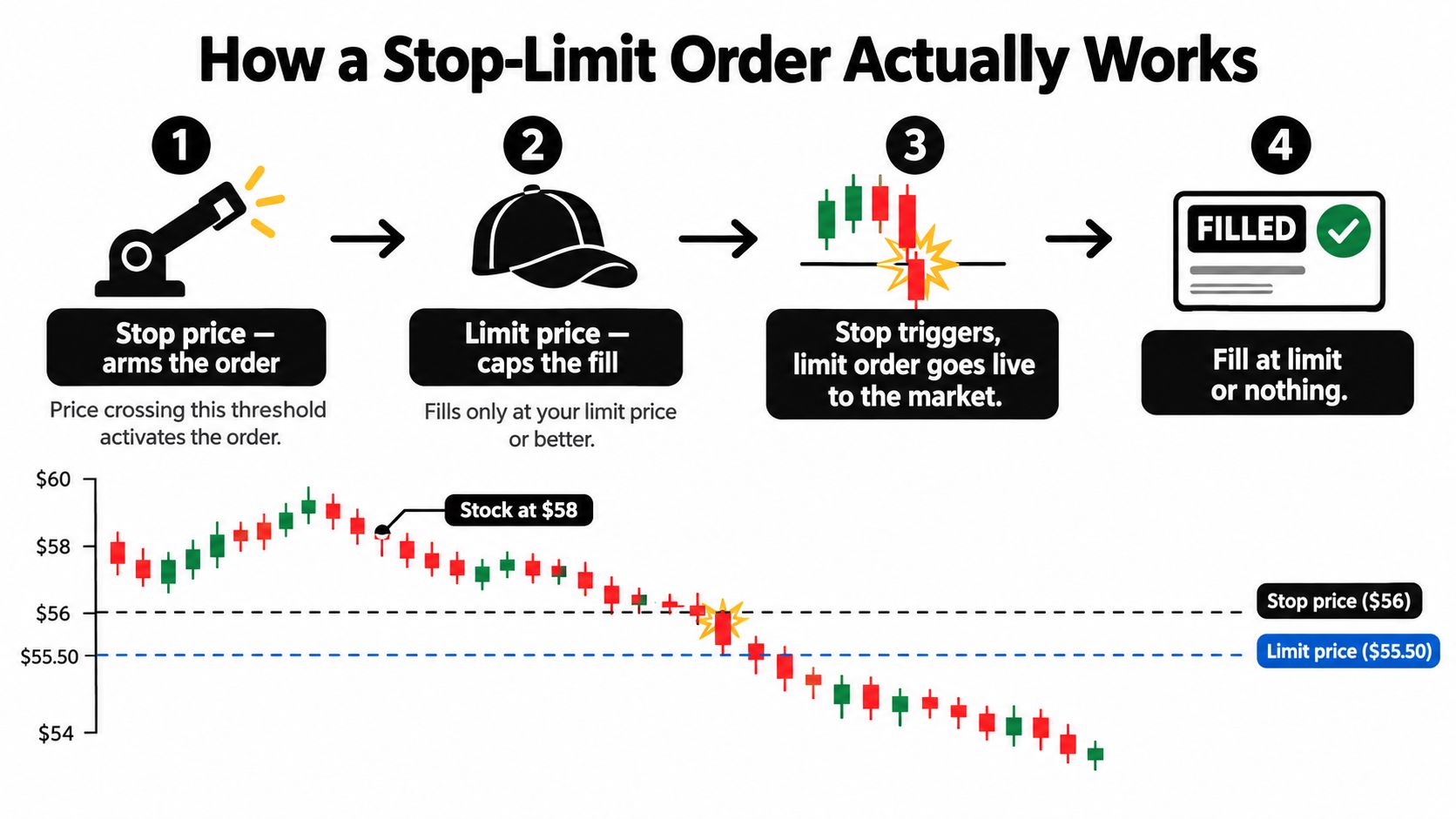
The stop price is the activation level. The limit price is the least favorable price you'll accept for the order. For a long position, the stop normally sits below the current market and the limit sits at or below the stop. Once the market reaches the stop, the broker submits a sell limit order. The order then waits for a buyer at the limit price or better.
The long-position sequence
Suppose you're long and choose a stop below the current price. The order follows this sequence:
- Price trades down into the stop level.
- The stop activates the order.
- The broker places the limit order in the market.
- The position closes only if buyers reach the limit price or offer a better price.
The stop doesn't guarantee a sale. It only changes the order from inactive protection into a live limit order. If the market moves through the limit too quickly, the order can remain open while the position continues losing value.
That's why the phrase “my stop-limit didn't trigger” is often inaccurate. The stop may have triggered perfectly. The failure occurred afterward, when the market didn't trade at an acceptable limit price.
The short-position sequence
For a short position, the structure reverses. You place a buy stop above the market and a buy limit at a price you're unwilling to exceed. If price rises into the stop, the broker submits the buy limit order. You cover only if the market offers that price or better.
This gives you price discipline, but it also creates stranded-position risk. A sharp upside move can pass through both levels, leaving the short open while the market continues higher.
The order stays anchored to the prices you entered. It doesn't move higher for a long position, lower for a short position, or adjust to new market extremes. Traders who want a fixed invalidation point may prefer that behavior. Traders managing a profitable trend often find it too rigid.
For a broker-specific explanation of how stop-limit and related stop orders are structured, see this guide to stop-limit and stop-loss orders. Always confirm how your broker handles triggers, sessions, and order duration before relying on the order in live trading.
How a Trailing Stop Order Actually Works
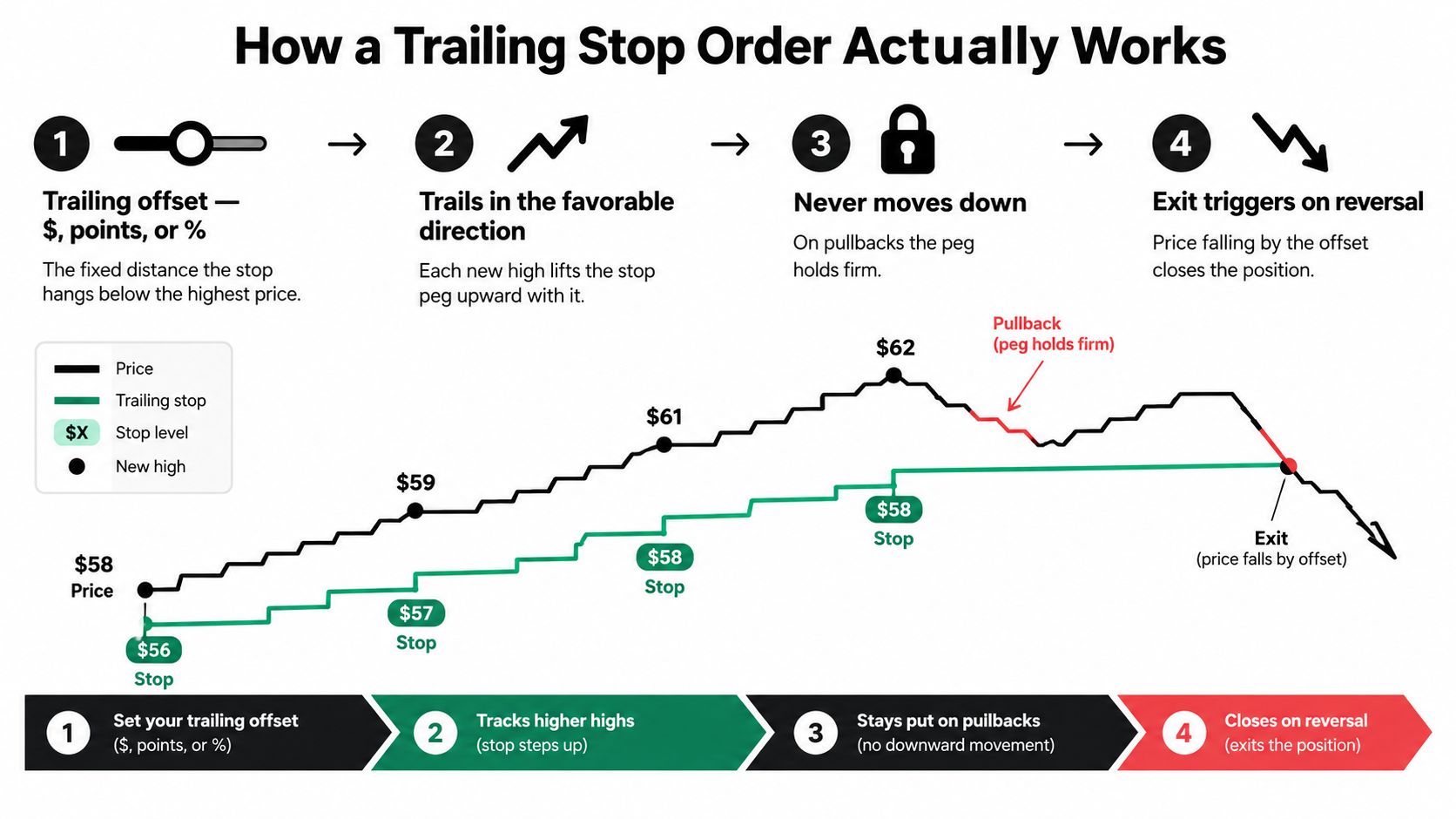
A trailing stop begins with a moving reference point, not a fixed exit price. You choose an offset, expressed as a dollar amount, points, or a percentage. For a long position, the stop follows the highest favorable price while maintaining that distance. For a short position, it follows the lowest favorable price.
The SEC describes the trailing stop as an order that adjusts its stop price as the security changes, reducing the need to cancel and resubmit the order. The SEC's market structure discussion also identifies percentage and dollar offsets as the basic parameters of the order (SEC Equity Market Structure Advisory Committee discussion).
The ratchet is the important part
For a long trade, the trailing stop rises when the stock establishes a new high. It doesn't fall when the stock pulls back. The reference price updates in the favorable direction, and the stop holds when price moves against you.
For a short trade, the process works in reverse. The trailing stop steps lower as the stock makes new lows, then remains at its most favorable level during a rebound.
Beginners often focus on the offset and overlook the reset mechanic. The stop isn't calculated only from the entry price. Each new favorable extreme can move the trigger, which is why the order can protect a growing open profit without manual amendments.
Market execution versus limit execution
A trailing stop-market prioritizes execution. Once the trail is breached, the broker sends a market order. That improves the likelihood of leaving the position, but the fill can differ from the trigger during a fast move.
A trailing stop-limit adds a limit price after activation. It can improve price control, but it also brings back the possibility that the position won't close if the market moves beyond the limit. Schwab notes that a trailing stop can remain on a broker or dealer server until triggered, after which it is sent to the market. The broker also warns that gaps and halted markets can prevent execution at the expected level (Charles Schwab overview of stock order types and conditions).
A trailing stop isn't a promise to sell at the displayed stop price. It's a rule for when the exit becomes active. The distinction matters most when the market is moving faster than available bids or offers.
For a detailed explanation of trailing behavior and setup choices, review what a trailing stop order is. The useful question is always whether the selected offset reflects the normal movement of the instrument, rather than whether the number looks comfortable on the order ticket.
Stop Limit vs Trailing Stop Side by Side
The core difference is fixed protection versus adaptive protection. A stop-limit uses a fixed activation price and a fixed acceptable fill price. A trailing stop uses a fixed distance, but the trigger itself changes when price moves favorably.
That creates different outcomes even when both orders appear to sit near the same part of the chart.
Trigger behavior and repricing
A stop-limit never reprices itself. If you place a sell stop below a long position, that level remains unchanged until you cancel or amend it. The limit also remains fixed.
A trailing stop reprices only in the favorable direction. On a long position, a new high can lift the stop. A pullback won't lower it. On a short position, a new low can lower the stop, but a rebound won't raise it.
Price control and execution
The stop-limit gives you a defined boundary for the fill. That's useful when a fill below a certain price would create an unacceptable result, especially in an illiquid position or a large order. The cost is that the market may never trade at your limit after activation.
The trailing stop-market takes the opposite stance. It accepts the market's available price after the trigger in exchange for a stronger focus on getting out. Its price control is weaker, but its operational purpose is clearer during a rapid reversal.
After-hours trading complicates both choices. A broker may use different trigger rules for regular and extended sessions, and thin trading can create prints that don't represent the liquidity available when you need to exit. Read the broker's order-condition rules instead of assuming the chart and order ticket use identical data.
For traders building a repeatable exit strategy for profitable trades, the decision should come from the trade thesis. A trend-following exit needs room to adapt. A hard price boundary needs a fixed level, even if that creates non-execution risk.
Slippage, Gaps, and the Risk of Not Filling
The most important trade-off in stop limit vs trailing stop is simple:
A stop-limit can protect your price and leave you in the trade. A trailing stop can get you out and give up price control.
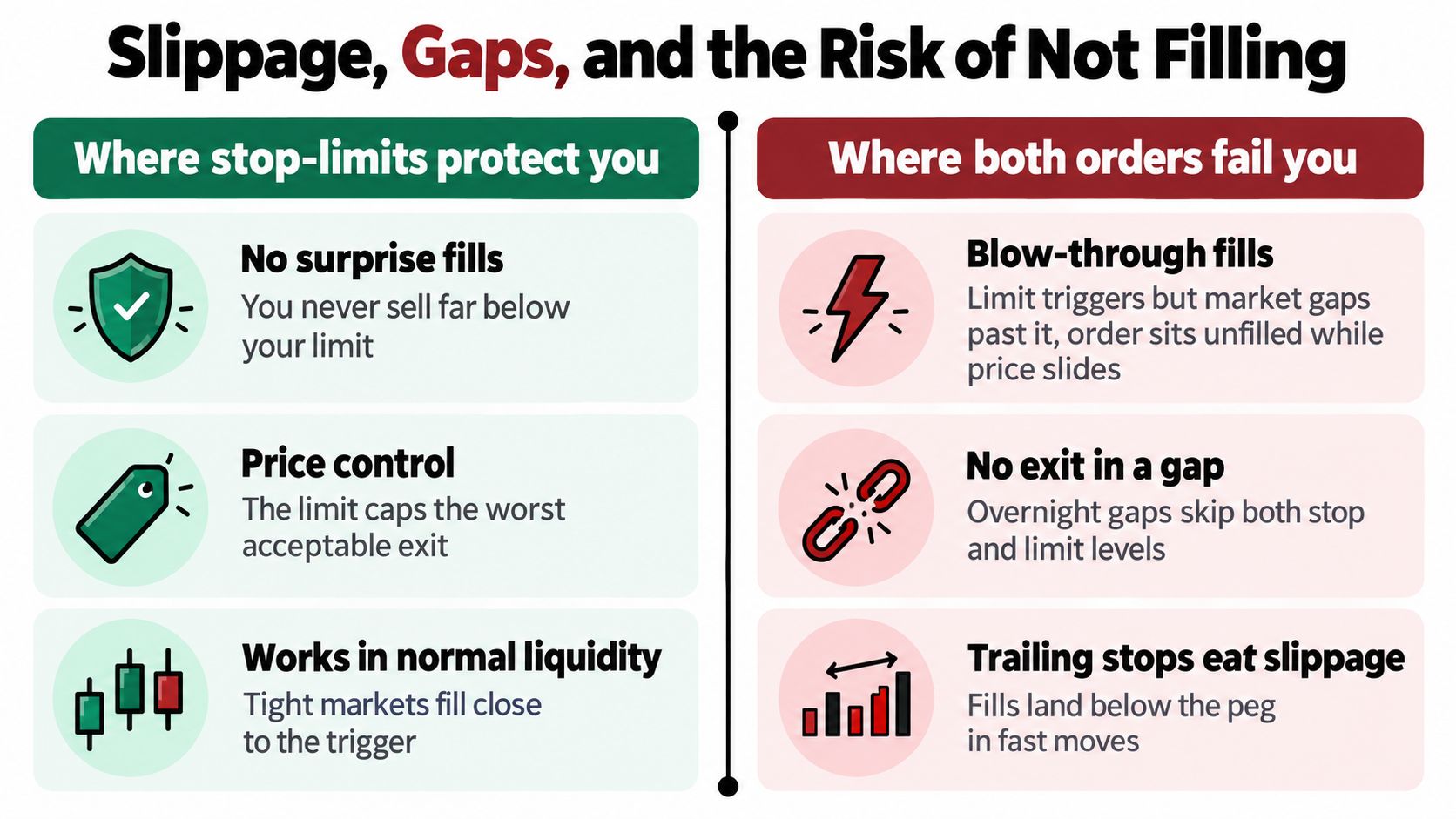
A gap exposes that trade-off immediately. If a long position closes before a stop-limit and opens below the limit, the market has skipped the acceptable fill zone. The stop can activate, but the limit order may sit unfilled while the stock trades lower. No amount of confidence in the original setup changes that mechanical outcome.
A trailing stop-market handles the same event differently. If the market breaches the trailing trigger, the broker sends a market order. You're more likely to exit, but the fill can occur below the trigger because the next available bids may be lower.
Three conditions that expose the difference
- Overnight gap: A stop-limit may activate without filling when price jumps through the limit. A trailing stop-market can fill into the gap, with slippage.
- Thin pre-market print: A brief trade can trigger an order when displayed liquidity is limited. Check whether your broker uses extended-session prices for activation.
- Fast intraday reversal: A trailing stop can exit quickly, while a stop-limit may remain active if the market blows through its acceptable price.
The same logic applies to a trailing stop-limit. It follows price as the position improves, but once triggered, it submits a limit order. That means it combines adaptive positioning with the same basic non-execution risk as a fixed stop-limit.
Matching the order to the market
A momentum continuation trade often benefits from a trailing stop because the trader wants the position to remain open while the trend continues. A fixed stop-limit forces the trader to predict the exact pullback zone in advance and may fail during a sharp but temporary move.
A range-bound exit presents a different problem. The trader may have a known price boundary and may prefer not to accept a materially worse fill. A stop-limit can fit that objective, provided the trader understands that a gap can leave the position open.
The difference between slippage and the expected trading price belongs in the plan before the order is placed. Don't treat slippage as an unusual broker error. In fast markets, it's the cost of prioritizing execution over price control.
Real Trade Scenarios and Which Order to Use
The choice becomes clearer when you start with the position's job. Is the order meant to stay with a developing trend, or is it meant to enforce a price boundary around a specific thesis?
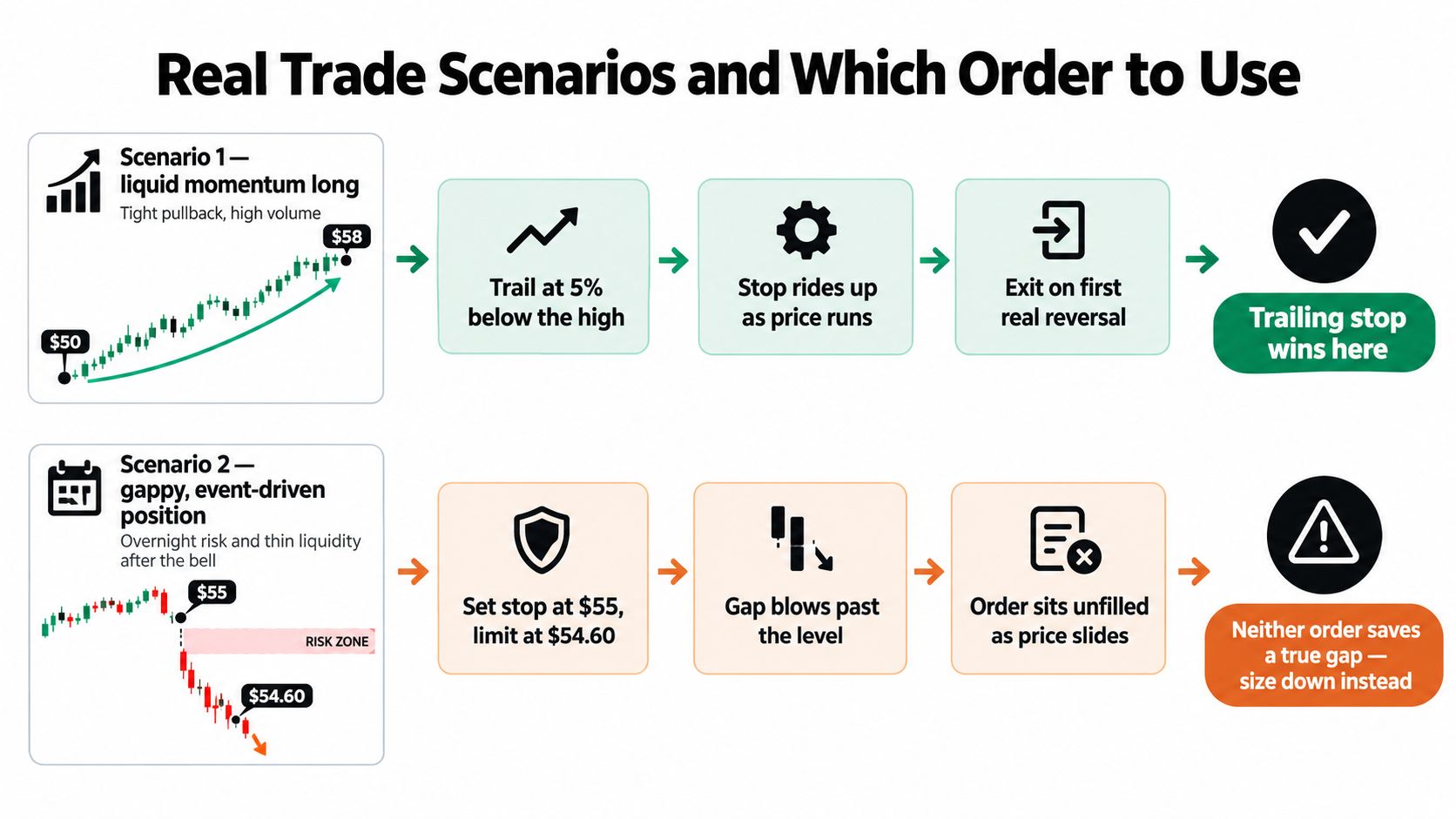
A momentum long that still has room to run
You buy a liquid momentum stock after a breakout and the price continues higher. The pullbacks are orderly, volume remains active, and your thesis depends on continuation rather than an immediate target.
A trailing stop is the more natural fit. It allows the stop to rise as the stock makes new highs and avoids forcing you to guess where the next pullback will end. A fixed stop-limit could be placed below a recent structure level, but it won't adjust if the stock trends far beyond that level.
The risk appears during a gap or abrupt reversal. The trailing stop can activate and fill below the visible trigger. That's acceptable only if your position size and original risk plan can absorb the uncertainty. A trailing stop doesn't remove risk. It changes the way the exit manages it.
A short position around a binary event
Now consider a short position held into a scheduled catalyst. You've identified a resistance area, and your thesis fails if price breaks decisively above it. You care more about not buying back above a defined price than you do about guaranteeing the exit.
A stop-limit can fit that objective. You set a buy stop above the invalidation area and a buy limit at the highest acceptable cover price. If price trades through the stop but never returns to the limit, the short remains open. That is the exact failure mode you must accept before placing the order.
A trailing stop may be less suitable if a brief upward wick can activate the exit before the larger pattern resolves. It offers adaptive protection, but it doesn't give the same fixed boundary. If the event creates a genuine gap, neither order guarantees a clean result. The stop-limit can remain unfilled, while the trailing stop can fill at a much worse level.
The fast decision rule
Ask three questions before you submit the order:
- Do I need the position closed, even if the fill is worse than expected? If yes, a trailing stop-market may better match the objective.
- Would a fill beyond a defined price damage the trade plan more than staying open? If yes, consider a stop-limit.
- Can the market gap beyond both levels? If yes, reduce the position or avoid carrying the trade through the event. Order selection can't solve a risk that the market skips entirely.
The order type should follow the scenario, not the trader's preferred platform setting.
Choosing the Right Order for Your Trading Plan
A stop-limit and a trailing stop solve different problems. Choosing between them isn't a contest between a complex order and a basic one. It's a decision about what failure you're willing to tolerate.
Choose a stop-limit when the exit price has a hard meaning in your plan. That might apply to an illiquid instrument, a large position, or a setup where selling below a particular level would produce an unacceptable result. Accept the possibility of non-execution, and decide in advance what you'll do if the order triggers but remains open.
Choose a trailing stop when the position is a developing winner and you want the trade to remain open while favorable price action continues. The trailing offset should reflect the instrument's normal movement. An overly tight trail can remove you during an ordinary pullback, while a wide trail can surrender more open profit before activation.
The middle case
Some trades sit between those objectives. The stock may be trending, but the next session carries gap risk. The position may be profitable, but the market is moving through a defined range. In that situation, a trader might use a trailing stop for the live position and keep a manual stop-limit as a contingency, provided the broker's rules and order interactions are fully understood.
That isn't a universal formula. Multiple orders can conflict, duplicate exposure, or behave differently across brokers. Test the setup in the platform's simulator and verify whether one order cancels another, whether extended hours count, and whether the trailing reference uses the last trade or another price source. Fidelity's published order-condition rules show that broker implementation matters, including how trailing orders for listed securities can be based on the last trade (Fidelity order types and conditions).
Colibri Trader offers price-action-based trading education that covers trailing stops, stop-limit mechanics, discipline, and money management. It can serve as one learning resource alongside broker documentation and simulated practice, particularly if you're trying to connect order selection with a broader trading plan.
The order is only one part of risk control. Position size, entry location, market liquidity, expected volatility, and the reason for the trade determine whether a failed fill or slippage creates a manageable inconvenience or a damaging loss.
Five-second rule: choose a stop-limit when price control matters more than getting out, choose a trailing stop when staying with the trend matters more than the exact fill, and reduce exposure when a gap could defeat either order.
If you want to connect these execution choices with practical price-action setups, Colibri Trader offers structured education on trading plans, trailing stops, supply and demand, day trading, and risk discipline. Review your next position with its exit objective first, then choose the order that matches the risk you're prepared to accept.