Trading Education Platform: Learn Price Action Trading
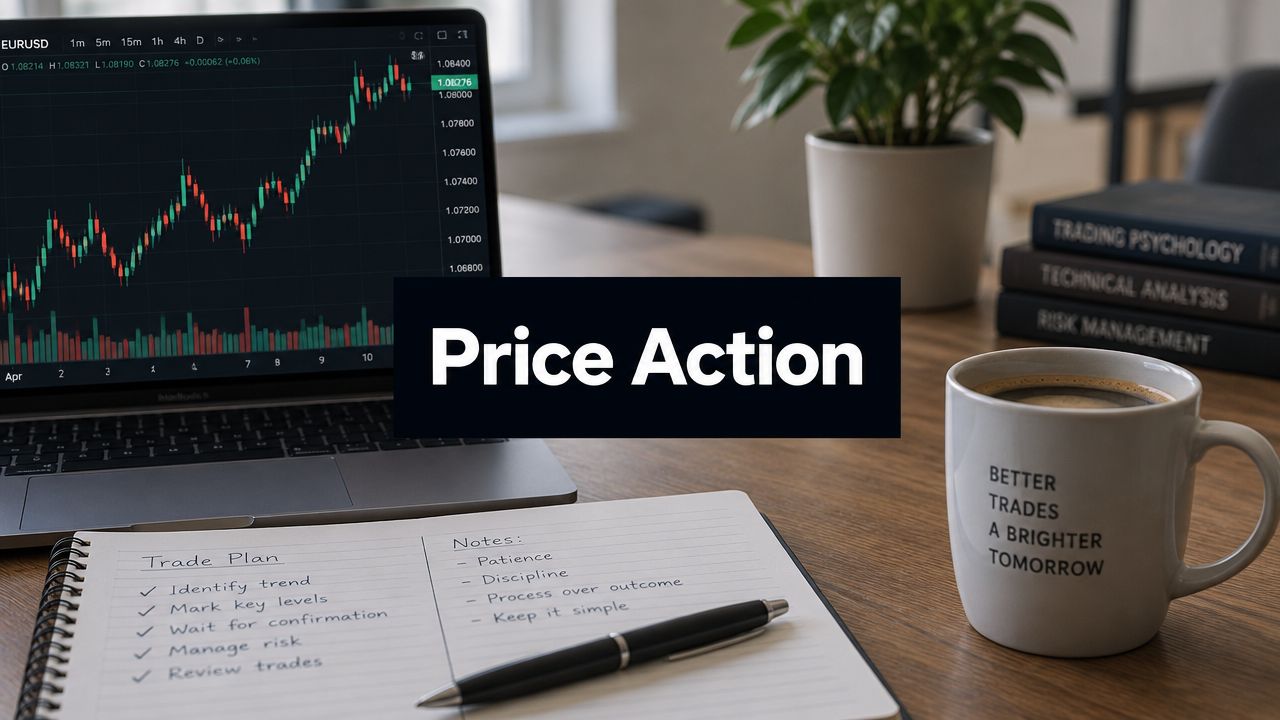
You're probably in one of two places right now. Either you've watched enough trading videos to feel informed but still can't execute a clean trade plan, or you've bought a course, filled a notebook with setups, and then frozen the moment real money was on the line.
That gap is where most traders stay stuck. They don't lack information. They lack a process they can repeat under pressure.
A good trading education platform should solve that problem. It should teach you how to read price, define risk, place orders correctly, respond to bad fills, and review mistakes without turning every losing trade into a personal crisis. Most platforms don't. They teach concepts, show examples, and leave the operational parts for later. Later is usually when a trader funds an account and learns the hard way.
What Is a Trading Education Platform
A trading education platform is supposed to be more than a video library. In practice, many traders first meet the market through fragments. One YouTube channel teaches breakouts. Another teaches supply and demand. A third insists indicators are enough if you “wait for confluence.” After a few weeks, the chart gets crowded and the trader gets less confident, not more.
That's why structure matters.
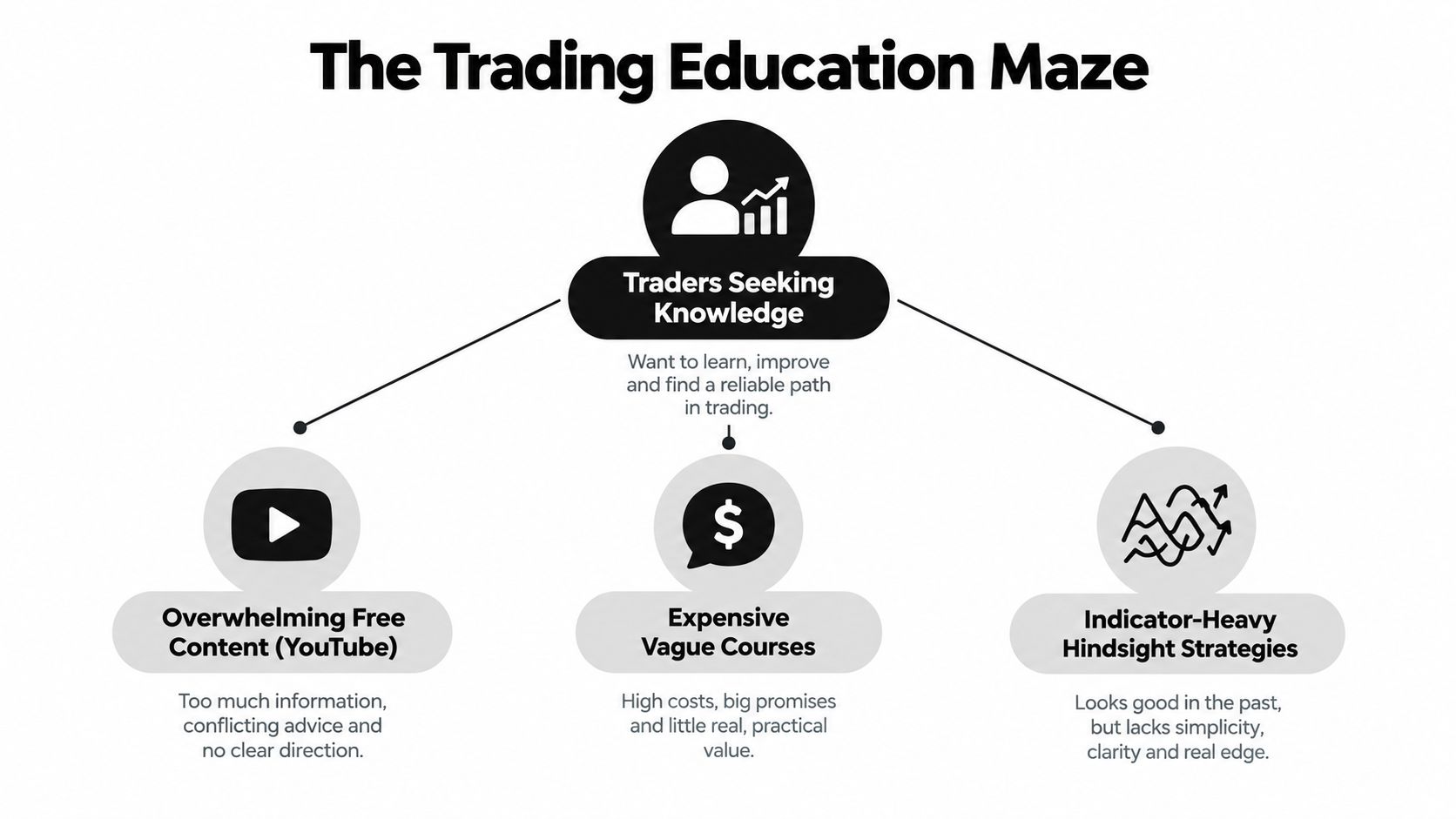
What separates a platform from random content
A real platform organizes learning in sequence. First market basics. Then chart reading. Then setup selection. Then risk management. Then execution. Then review. If a student doesn't know where to put stops, how to size positions, or when to stand aside, more strategy content won't help.
The market for this format is already digital first. The global trading education market was valued at $1.2 billion in 2025 and is projected to reach $2.3 billion by 2034, with online courses holding 42.3% of delivery share in 2025, or about $508 million, according to Market Intelo's trading education market report. That tells you where traders are learning. It doesn't tell you whether they're learning well.
A lot of platforms still confuse volume with value. Fifty modules sound impressive. They're useless if the student can't answer basic questions like these:
- Where is my invalidation point: What has to happen on the chart for the trade idea to be wrong?
- What's my order plan: Am I using market, limit, or stop orders, and why?
- What's the risk before the reward: How much am I prepared to lose if price moves against me immediately?
What the better platforms actually do
The useful ones reduce noise. They filter the endless stream of opinions and create a path. That's the same reason people use a focused learning hub in other fields, whether it's a chart-reading course or an SEO learning center that turns scattered tactics into a progression you can follow.
If you want to see how trading schools differ in structure and teaching style, this roundup of online trading schools is a practical starting point.
Practical rule: If a platform can't show you how a beginner becomes consistent step by step, it isn't a learning system. It's a content warehouse.
Why Structured Learning Beats Scattered Information
Access isn't the main problem anymore. Most traders can find endless market content in an hour. The harder part is turning that information into decisions that hold up in live conditions.
Information alone doesn't build trading behavior
There's a broad need for structured financial and trading education. In the OECD/INFE 2023 survey, the average digital financial literacy score across participating countries and economies was 53 out of 100, and only 29% of adults reached the minimum target score of at least 70. Among participating OECD countries, 34% reached that threshold, according to the OECD/INFE 2023 international survey of adult financial literacy. That matters because online trading platforms assume a level of digital finance competence many users don't have yet.
The next mistake is assuming education works the same way trading works. It doesn't. A meta-analysis of 126 impact-evaluation studies found that financial education has a statistically significant positive effect on financial literacy, with an average effect size of 0.26, and a smaller but still positive effect on financial behavior, according to the World Bank paper on financial education impact.
That result fits what traders experience every day. It's easier to understand a rule than to follow it when money is moving.
What a platform has to reinforce
A platform that works links every lesson to an action. If it teaches stop placement, it should immediately make the student mark invalidation on a chart. If it teaches position sizing, it should force the student to calculate risk before “entering” a setup, even in simulation.
That's why action-based learning matters more than passive consumption. This explanation of action-based learning in trading gets at the core issue. Traders improve when the lesson and the decision happen close together.
A structured platform usually needs these feedback loops:
- Concept to chart: Learn the setup, then identify it on clean historical charts.
- Chart to execution: Choose entry, stop, and target before seeing the outcome.
- Execution to review: Log why the trade qualified, not just whether it won.
- Review to adjustment: Change one rule at a time, instead of replacing the whole method.
The traders who improve fastest usually aren't the ones consuming the most information. They're the ones repeating the same decision framework until it becomes automatic.
What scattered learning gets wrong
Scattered learning creates false confidence. You recognize patterns, but you don't know which ones fit your plan. You know five entry techniques, but you don't know which order type protects you when price gaps or liquidity thins. You've heard “manage risk” a hundred times, but nobody showed you how to define risk before the click.
That's where structured platforms separate themselves. They don't just help you know more. They help you do less, with more consistency.
Price Action-Centered vs Indicator-Based Education
A lot of traders think they're learning trading when they're really learning how to wait for tools to agree with each other. That's not the same skill.
What price action teaches that indicators often hide
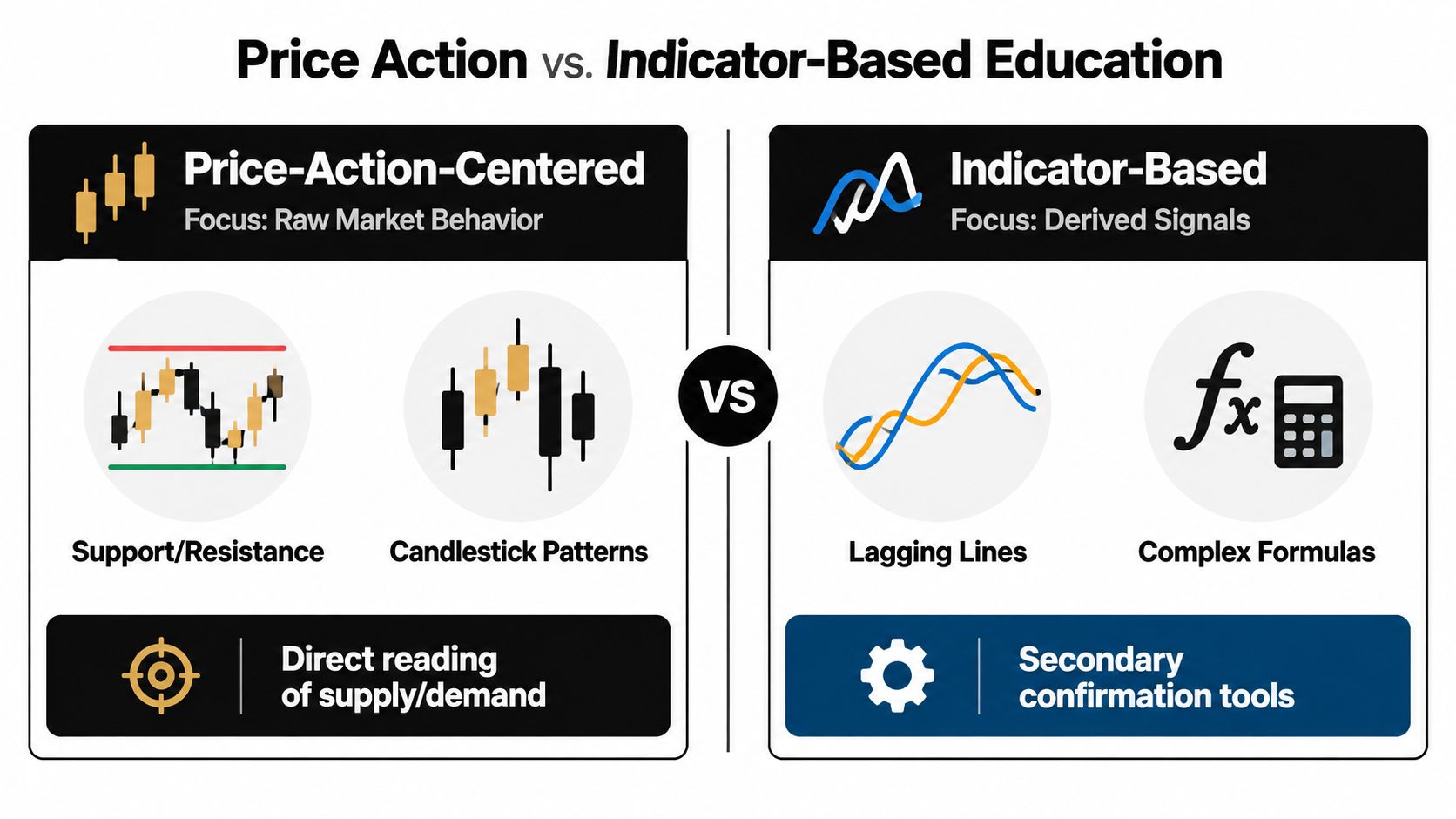
Price action-centered education trains you to read the chart itself. You focus on structure, momentum shifts, support and resistance, supply and demand, failed breaks, and how candles behave at meaningful areas.
Indicator-based education usually starts later in the chain. The indicator is derived from price, so you're reading a processed version of the move instead of the move itself.
That doesn't mean indicators are useless. It means they're secondary. If a platform teaches them as the main decision engine, students often become dependent on confirmation instead of developing chart judgment.
A stronger route is to study pure price action trading and learn how markets behave before adding any extra tool.
How to evaluate the teaching approach
Use a simple test when reviewing any platform.
| Teaching signal | Price action-centered | Indicator-based |
|---|---|---|
| Primary focus | Market structure and behavior | Derived signals |
| Student skill built | Independent chart reading | Tool dependence |
| Usual weakness | Requires patience and screen time | Can create lag and clutter |
If the examples always begin with an indicator crossing another line, the platform is probably teaching a trigger, not understanding.
Here's a practical video example that helps illustrate how traders interpret raw chart behavior in real conditions:
What to look for in the lessons
A price action-centered platform should teach at least four things clearly:
- Location matters: A bullish candle in the middle of nowhere means far less than a bullish rejection at a well-defined level.
- Context comes first: Is price trending, compressing, or reversing? The same pattern means different things in different conditions.
- Invalidation is specific: Every setup should come with a clear point where the trade idea fails.
- Execution is part of the setup: Entry style, stop location, and target logic are built into the lesson.
Most traders don't need more signals. They need cleaner reading.
If a strategy only makes sense after ten indicators line up, it usually won't feel clear when price starts moving fast.
Common Pitfalls When Choosing a Platform
The first trap is buying motivation instead of education. Fancy dashboards, badges, streaks, and certificates can make a student feel productive while avoiding the harder work of reading charts and managing risk.
What often looks better than it is
Independent commentary points to a major gap in trading education content. Many platforms still focus more on access to lessons than on turning information into a safe, repeatable process. Recent coverage also notes that platform lessons should explicitly address order types, margin alerts, gaps, and connection failures, while paid access should solve a specific learning problem instead of repackaging crowded free content, as discussed in this commentary on trading education gaps and safe practice.
That's a serious issue because execution mistakes don't care how many lessons you completed.
Another weak point is overreliance on engagement mechanics. Independent platform roundups show many competitors emphasize gamification, quizzes, broad catalogs, and simulated progress, while reviewers also note that interfaces can feel overwhelming and that practical value often comes from plain-language tutorials, simulated practice, and personalized feedback, as described in this discussion of gamification versus accountability in trading education.
Self-paced versus mentorship-led
Neither format is automatically better. It depends on the trader.
- Self-paced learning works well when you're disciplined, patient, and willing to review your own trades.
- Mentorship-led training works better when you keep repeating the same mistake, can't tell which variables matter, or need accountability to stay consistent.
- Hybrid models help most traders because they combine flexibility with correction.
The red flags tend to be obvious once you know what to watch for. If a platform sells speed, avoids risk discussion, or overwhelms you with content before you can define a simple setup, walk away.
Essential Criteria for Selecting the Right Platform
A useful trading education platform should make you more methodical, not more excited. Excitement fades fast when the first live trade slips, gaps, or stops you out by a few ticks before running in your original direction.
The criteria that matter most
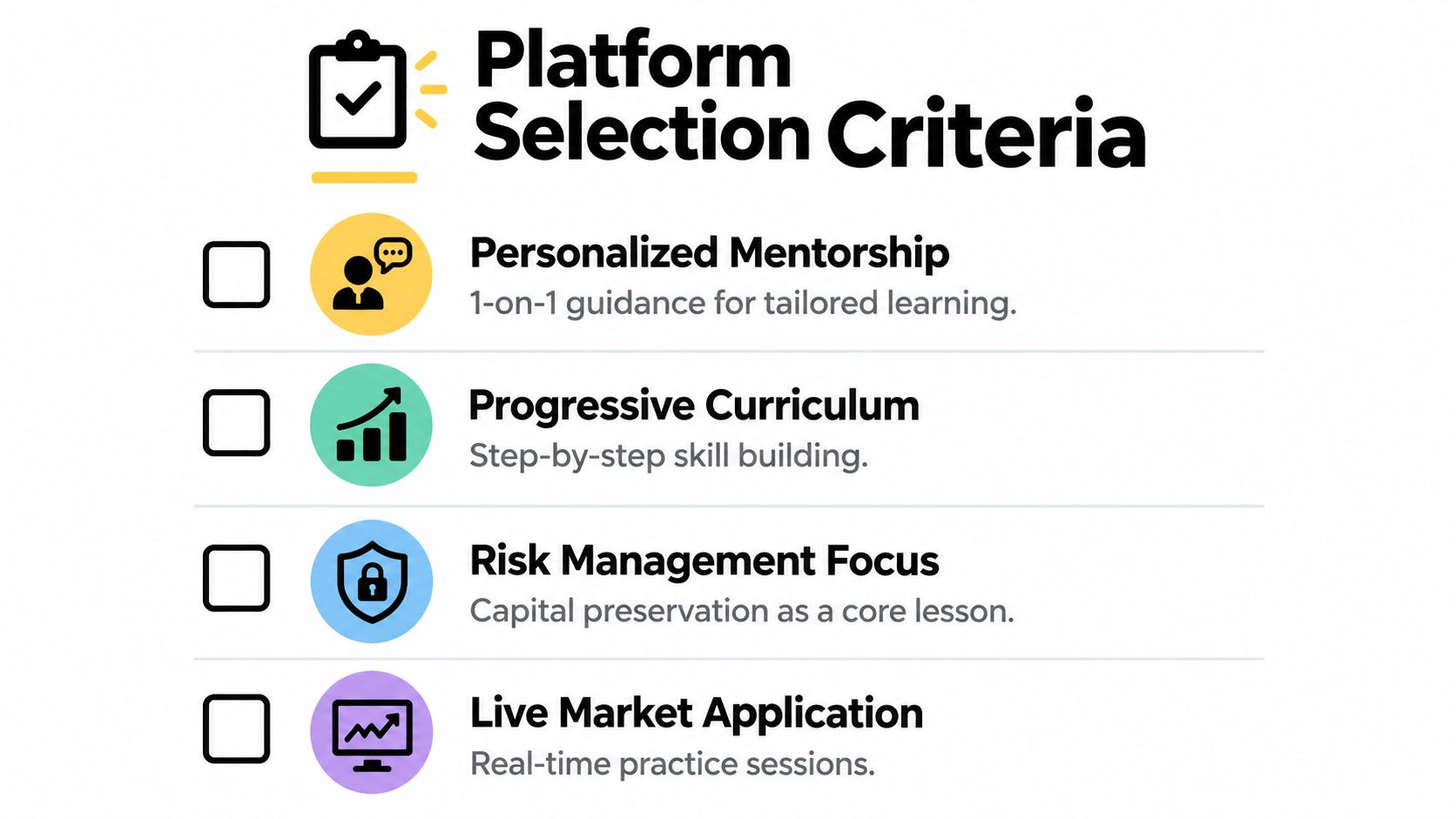
Start with process, not promises.
- Risk management before strategy depth: If the platform teaches entries first and risk later, the sequence is backward.
- A progressive curriculum: Beginners need clean foundations. Intermediate traders need filtering and review. Advanced traders need refinement, not more basics.
- Practical market application: Simulations, chart drills, post-trade review frameworks, and execution planning matter more than polished theory.
- Personalized correction: At some point, every trader needs feedback on what they're misreading.
An experimental study found that assigned trading activity improved financial literacy by 3.25 percentage points relative to a mean score of 70.9%, and the gain persisted months later, according to the GFLEC study on trading activity and financial literacy. That's one reason passive lessons aren't enough. Practice has to be built into the platform, not treated as homework the student may or may not do.
What to ask before enrolling
Use these questions when comparing options:
| Question | Why it matters |
|---|---|
| Does it teach order execution basics? | A setup is incomplete if you don't know how to enter it correctly. |
| Does it define failure conditions? | Good education shows when not to trade and when a thesis is invalid. |
| Does it include review habits? | Traders grow by diagnosing mistakes, not by collecting more concepts. |
A platform should also match your stage. New traders need clarity and repetition. Frustrated intermediate traders usually need simplification. Experienced traders often need to strip away clutter and tighten rules.
Don't choose the platform with the most features. Choose the one that makes your decisions simpler, safer, and easier to repeat.
What doesn't deserve much weight
Certificates don't help you execute under pressure. Badges don't teach you where to place a stop. Streaks don't prove you can avoid revenge trading after a loss.
The market doesn't reward completed coursework. It rewards disciplined execution.
How Colibri Trader Transforms Trading Skills
The gap most platforms leave open is the one that matters most. They help traders gather ideas, but they don't always help them build a repeatable operating process. That process has to include chart reading, trade qualification, risk limits, order planning, and post-trade review.
Where the approach is different
Colibri Trader addresses that gap with a price-action based educational model built around action-based training rather than indicators, certificates, or gamified progress. For traders who want to test fit before committing, the platform offers a free Trading Potential Quiz and access to the first two chapters of its Amazon bestselling price action book. That matters because many traders don't need another promise. They need an honest starting point.
The course lineup also reflects a practical progression. There are beginner-friendly Basic and Premium paths, plus more focused training in Supply and Demand and Day Trading. That makes the platform relevant to different stages without forcing every trader through the same broad curriculum.
How that helps in real trading
What matters is how the lessons translate once the chart is live.
A trader using a structured price action process should be able to answer these questions before entering:
- What level is price reacting from
- What confirms the setup versus weakens it
- Where is the trade wrong
- How much capital is at risk
- What will I do if price stalls, spikes, or partially fills
That's the language of execution. It's also the language many education products skip.
Colibri Trader's stated focus on discipline, money management, and proven price action patterns fits the bottleneck for most retail traders. The hard part isn't hearing about support and resistance. The hard part is applying those ideas consistently when one bad trade makes you want to change the whole plan.
Why this matters more than credentials
The publisher is explicit about not offering certificates or badges. That's a useful signal, not a missing feature. In trading, visible progress markers can become a distraction if they replace skill transfer.
What serious learners usually need is simpler:
- A method they can understand without indicator clutter.
- Repetition in live or simulated market conditions.
- Feedback that corrects preventable mistakes.
- Rules that survive stress.
That combination is what turns education into performance.
For beginners, that often means learning one setup family and one risk model instead of bouncing between systems. For intermediate traders, it usually means cutting unnecessary tools and refining execution. For more experienced traders, it means tightening context reading and reducing avoidable errors around entries, stops, and trade management.
A trading education platform earns its place when it closes the gap between “I know this pattern” and “I can trade this pattern with discipline.” That's the standard worth using.
If you want a trading education platform that focuses on price action, structured learning, and practical execution instead of badges or indicator overload, Colibri Trader is built for that job. You can start with the free Trading Potential Quiz, review the book preview, and see whether its action-based approach fits the way you want to trade.