

Money Management Online Course: A Trader’s Guide

You're probably here because something feels off in your trading.
You spot clean setups. You mark support and resistance correctly. You wait for a candle pattern you trust. Then you take the trade, the chart does something normal, and your account still takes a hit that feels bigger than it should. After a few rounds of that, the problem stops looking like strategy and starts looking personal.
Most of the time, it isn't personal. It's structural.
A money management online course matters because trading failure often happens in the gap between analysis and execution. That gap is where traders oversize, move stops, add to losers, skip loss limits, and try to win back a bad morning by lunchtime. If you want your chart reading to translate into account stability, you need rules that control the trade before the trade starts.
The wider need for better digital money education is real. In the OECD/INFE 2023 survey across 39 economies, the average digital financial literacy score was 53 out of 100, and only 29% of adults reached the minimum target score of 70 or higher. Even among adults who bought goods and services online, 40% did not reach the minimum target score, which shows how large the baseline gap still is in digital financial decision-making (OECD digital financial literacy findings).
For traders, that gap shows up in a familiar way. Many people learn entries first, but they never build a repeatable process for protecting capital.
Why Most Traders Lose Even With a Good Strategy
A trader I've seen many times in one form or another looks like this: she reads price action well. She waits for a retest after a breakout, enters near structure, and often gets the direction right. On paper, the setup has edge.
Her account still shrinks.
The reason usually sits in the decisions wrapped around the setup. One trade is too large because the candle “looks strong.” The next trade has no fixed stop because she wants to “give it room.” After two losses in a row, she doubles size on the third because she doesn't want to end the day red. The chart didn't break her account. Her money decisions did.
The strategy worked. The equity curve didn't
Many motivated traders get confused. They think a working setup should automatically produce a growing account. It won't. A setup only answers one question: Is there an opportunity here?
Money management answers the harder questions:
- How much capital is exposed
- Where the trade is proven wrong
- How much damage a bad day can do
- When trading stops
A trader can find valid setups all week and still lose money if each loss is too large, each winner is cut too early, or each emotional decision changes the original risk.
Practical rule: A good setup can survive a loss. A fragile account can't.
The missing layer sits between signal and execution
Think about a clean bearish rejection at resistance. The candle gives you a reason to watch. Structure gives you a location. But before you click sell, you still need a decision chain. Where is invalidation? How far is the stop? What size keeps the risk controlled? What happens if this is your third loss today?
That chain is money management.
Without it, trading becomes a series of unrelated bets. With it, every trade becomes one sample inside a controlled process. That's what a serious course should install. Not excitement. Not prediction. A repeatable decision framework that survives normal chart noise and your own worst impulses.
What Money Management Actually Means for Traders
In trading, people often lump everything under “risk management,” but that creates confusion. Three separate pieces matter on every trade: risk management, position sizing, and drawdown control. They work together, but they are not the same thing.
Risk management starts with the amount at stake
Risk management is your rule for how much account capital you're willing to lose if the trade fails. It also includes where the protective stop belongs on the chart.
For a price action trader, the stop doesn't go wherever feels comfortable. It goes where the setup is invalidated. If you buy a pullback into support and price closes cleanly through that support, the trade idea has changed. Your stop belongs beyond that level, not at a random distance.
Many traders need a practical bridge between trading and broader financial discipline. If your personal cash habits are unstable, your trading decisions often become unstable too. Resources that help you master cash flow for financial freedom can sharpen the same habit traders need most: making decisions from rules instead of from pressure.
Position sizing turns chart distance into trade size
Position sizing is the math that translates your chosen risk into shares, lots, or contracts.
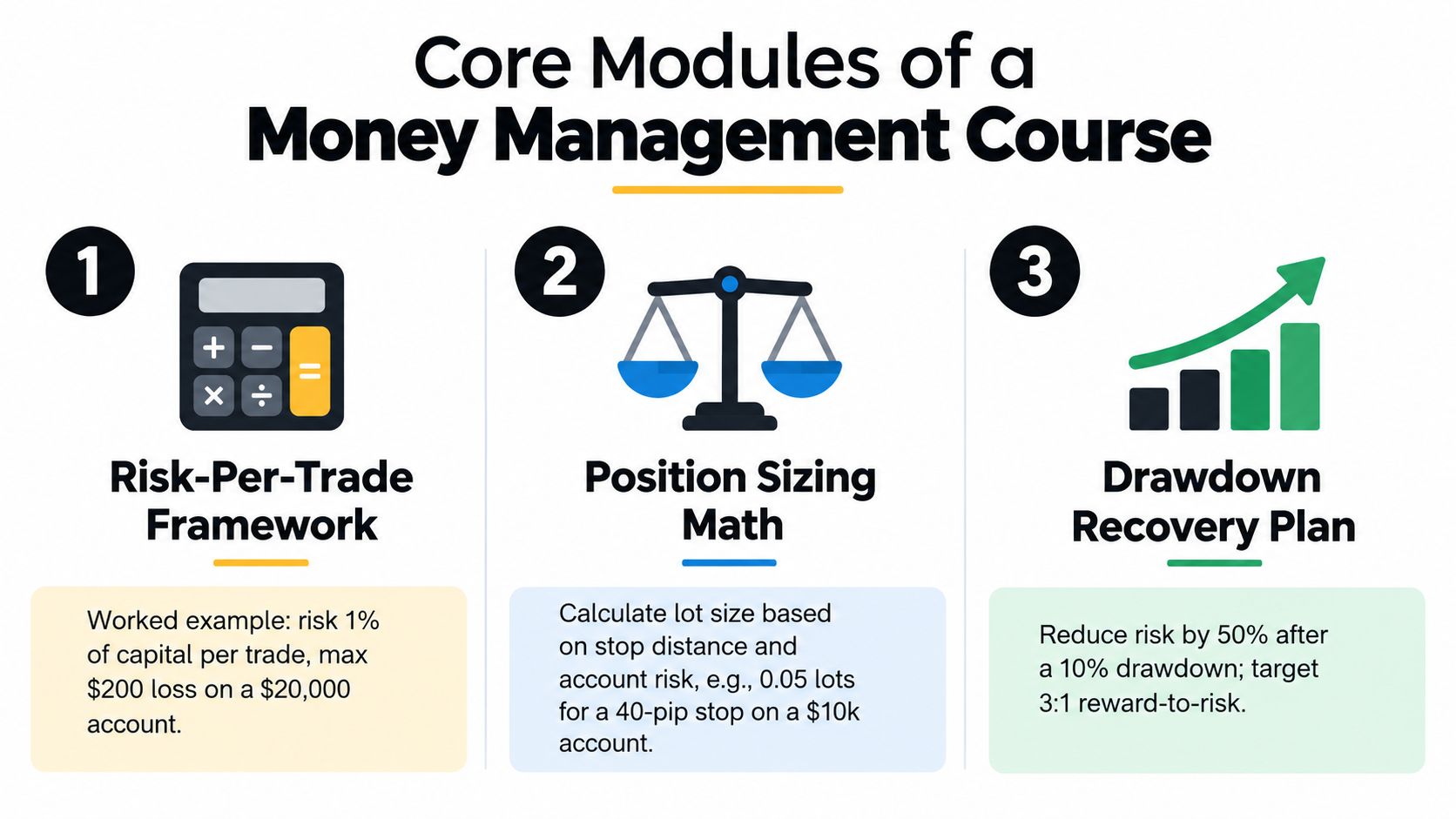
Say your account is $20,000. You decide to risk 1 percent, which means your maximum loss on the trade is $200. You want to buy a stock at $50, and the stop belongs 50 cents below entry. That means each share carries 50 cents of risk. Divide $200 by $0.50, and your size is 400 shares.
That's the point where the trade becomes real. The chart gave you location. The math gave you size.
For a deeper walk-through on applying these mechanics to live trading decisions, Colibri Trader's guide to money management in trading is a useful reference.
If you can't calculate size before entry, you're not managing risk. You're discovering it after the fact.
Drawdown control protects you from yourself
A single trade can hurt. A bad streak can distort your judgment.
Drawdown control sets the limits above the trade level. It answers questions like:
- What loss level ends the day
- When size gets reduced
- How many losing trades trigger a pause
- What conditions must be met before normal trading resumes
Without drawdown rules, traders treat every loss as a challenge to overcome immediately. That's where revenge sizing starts. With drawdown rules, you preserve capital and decision quality long enough for your edge to matter.
Core Modules a Serious Money Management Course Should Cover
A serious money management online course shouldn't stop at “be disciplined.” It should teach a working system you can apply on the next trading session. The best courses move from rule definition to chart application to review.
Module one builds the risk framework
The first module should teach how much you risk per trade and how that rule changes across instruments. Stocks, forex, and futures don't move the same way, but the framework still starts in the same place. You define the maximum account exposure first, then fit the trade inside it.
A strong lesson here uses worked examples, not vague advice. You should leave knowing how to set an account risk cap, how to place a stop based on invalidation, and how to reject trades that require too much room.
Module two teaches sizing from the chart
Many courses get thin, but it's the part traders need most. Position size should come from stop distance and volatility, not from confidence.
If average true range is wide, your stop may need more space. If your stop gets wider, your size has to get smaller to keep risk stable. That relationship needs to become automatic.
For traders who want examples of managing a position after entry, including scaling and exits, Colibri Trader's page on position management adds useful context.
Module three handles drawdown and recovery
This module should define what happens after losses. Not in theory. In writing.
A practical course teaches rules such as reducing size after a meaningful equity dip, pausing after a cluster of losses, and using a checklist before re-entry. Recovery isn't about making the money back quickly. It's about stopping account damage while your decision-making resets.
Modules four and five turn rules into habits
The next two pieces are where skill becomes behavior:
- Scaling rules: When to take partial profits, when to hold for structure, and when a breakeven stop helps or hurts.
- Journaling rules: What to record before the trade, during the trade, and after the trade so you can find behavioral leaks.
A course can also borrow from the strongest digital education methods. A randomized controlled trial of an online game-based financial education intervention across 2,220 students in four countries found a 0.313 standard-deviation increase in financial literacy, which supports the value of interactive, repeated, assessment-driven learning rather than passive reading alone (online financial education trial).
That finding matters for traders because money management is procedural. You don't internalize it by nodding along. You internalize it by sizing, reviewing, correcting, and repeating.
Self-Paced vs Cohort Learning Which Format Fits You
Some traders need flexibility. Others need pressure. The right course format depends less on intelligence and more on how you follow through.
Self-paced works when you already keep promises to yourself
If you learn best by replaying lessons, taking notes slowly, and fitting study around work or family, self-paced training makes sense. You can pause on a sizing example, rewatch a lesson on drawdown rules, and review journal templates before the next session.
This format tends to fit traders who are already consistent in other areas. They don't need a live class to make them show up.
Cohort learning works when deadlines improve your behavior
Some traders know the material but still drift. They postpone review, skip the math, and convince themselves they'll journal later. A cohort fixes that by adding a start date, a calendar, and often a layer of peer accountability.
That matters more than many people admit. If you're prone to improvising once the market opens, outside structure can help install the habit before bad impulses take over.

A useful way to compare learning environments is this breakdown of online learning vs classroom, especially if you're deciding how much live feedback you need.
A simple choice filter
Ask yourself:
- Do you finish courses without external deadlines
- Can you audit your own mistakes
- Do you learn better from repetition or discussion
- Will live feedback change your execution, or only your motivation
Choose the format that matches your behavior under pressure, not the format that sounds most ambitious.
Many serious traders use both. They install the rules in a structured setting, then use self-paced review to make those rules stick.
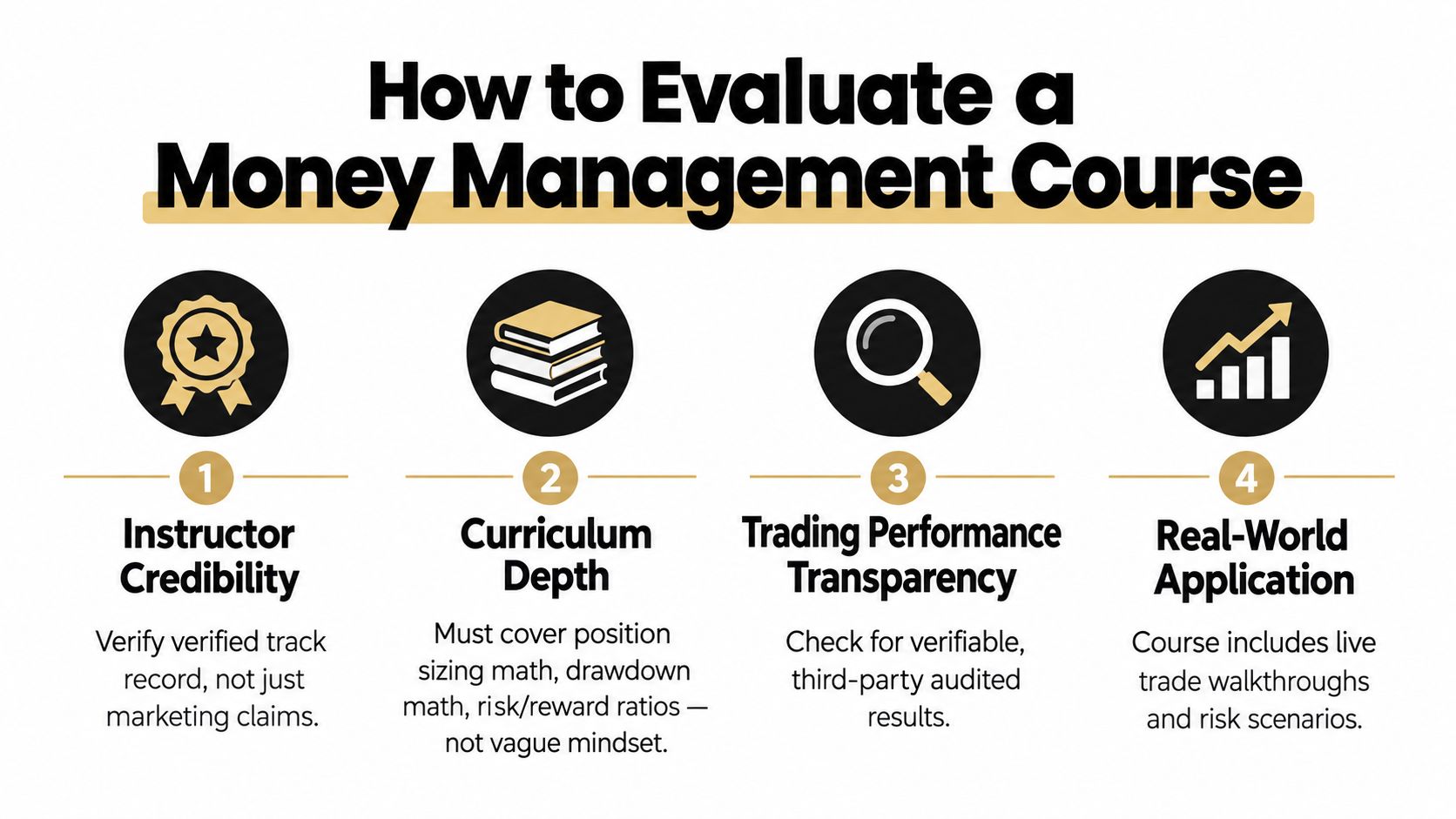
How to Evaluate a Money Management Online Course Before You Buy
A trading course can look polished and still leave you with nothing usable. Before you pay, check whether the course teaches actual decision rules or just wraps motivation in trading language.
Start with instructor credibility
You don't need a celebrity instructor. You do need a real educator whose identity, method, and teaching focus are clear.
Look for specifics. Does the instructor explain stop placement, sizing logic, and drawdown policy in plain language? Or do they mostly talk about freedom, mindset, and lifestyle? If the person selling the course avoids the operational side of risk, that's a warning sign.
Audit the syllabus for math, not slogans
A serious course should include topics like:
- Position sizing math: You should see examples, not just statements about “protecting capital.”
- Drawdown rules: The course should address when to stop trading and how to reduce exposure after losses.
- Scenario practice: Good training shows what happens when the chart almost works, then fails.
If you're also exploring alternative ways to follow market operators, it helps to understand the mechanics before you start copying top traders. Copy-based models still expose you to risk, so you need enough money management knowledge to judge what you're mirroring.
Check whether the course is built for online learning
Online delivery is no longer a compromise format. A 2026 study using 5,838 students from 354 schools in 42 U.S. states found that both in-person and online participants improved across all measured financial literacy categories, with no differences in effectiveness by delivery mode. The sample came from the 2022 to 2023 class year, showing digital programs were already operating at scale by then (evidence on online and in-person financial education).
That doesn't mean every course works. It means format alone isn't the issue. Design is.
Questions worth asking before checkout
Request concrete answers to these:
| What to ask | Why it matters |
|---|---|
| Can I see a sample lesson? | You'll see whether the teaching is practical or vague. |
| Is there a written syllabus? | A real curriculum shows sequence and depth. |
| Are calculators, templates, or journals included? | Traders need tools, not just videos. |
| What support exists after the course? | Habits often break after the final module. |
| What is the refund policy? | Serious providers state it clearly. |
Avoid courses that promise quick profits, hide the instructor's identity, or skip the mechanics behind risk. If the sales page is louder than the curriculum, keep moving.
How Colibri Trader Builds Money Management Into Price Action
Price action traders make one mistake often. They treat money management as a separate spreadsheet exercise instead of part of the setup itself.
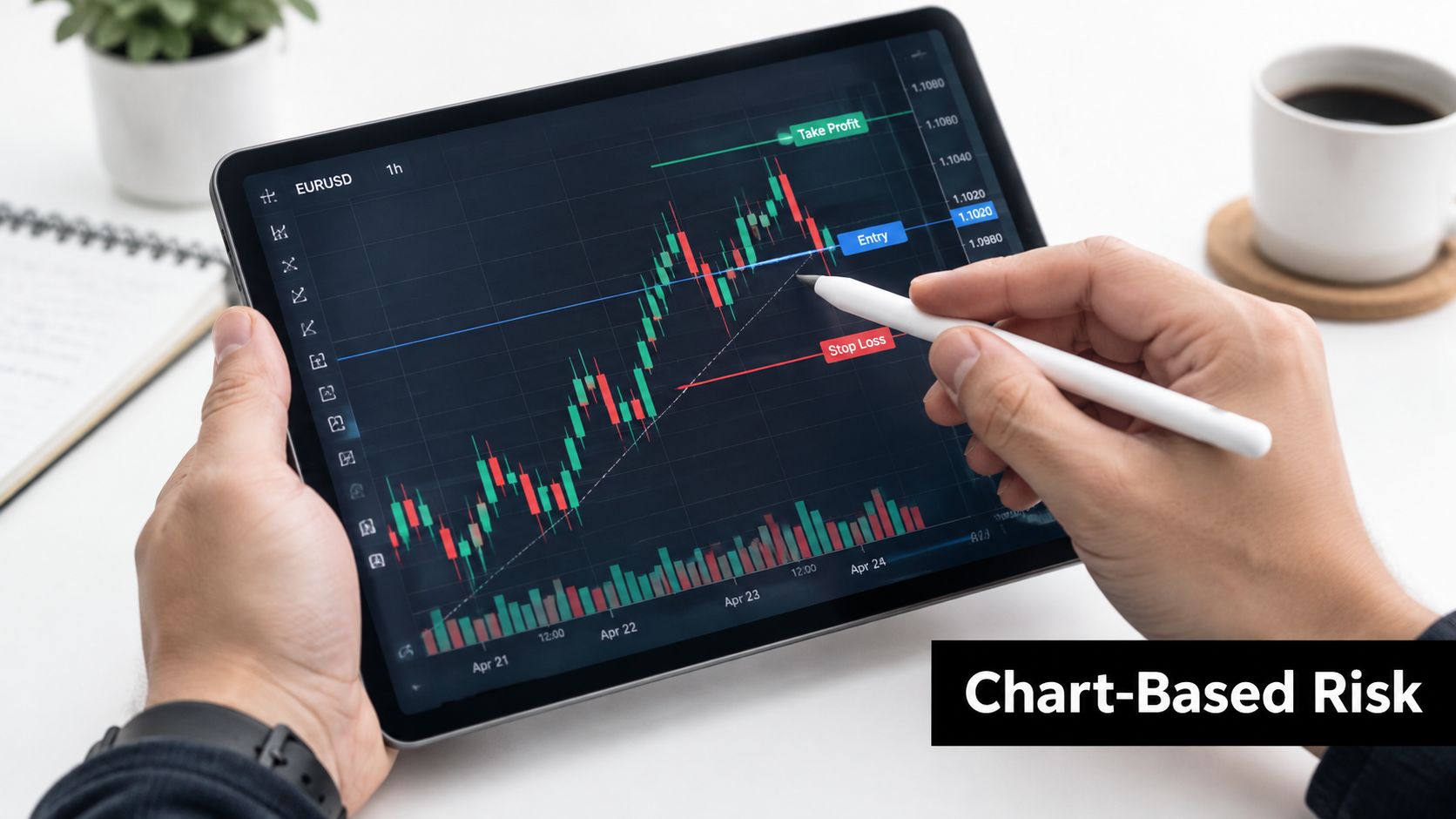
In a rule-based price action process, the chart defines the risk first. If price is rejecting a supply zone, the trade idea becomes invalid above that zone. If price is bouncing from support, the setup fails below it. That means stop placement starts with market structure, not emotion.
The chart gives the invalidation point
Suppose you're shorting after a lower high forms into resistance. The wrong way to size that trade is to decide your quantity first, then hunt for a stop that makes the loss feel acceptable.
The right way is to mark the level that proves the setup wrong. Once that distance is clear, position size follows from it. That sequence removes a lot of discretion from the riskiest part of the trade.
A trader who defines invalidation first usually stops arguing with the chart.
A price-action training model can be useful. Colibri Trader teaches a straightforward approach built around chart structure, supply and demand, and rule-based execution, which makes it easier to connect stop placement and sizing directly to the setup rather than to guesswork.
Each trade follows the same decision chain
A good process sounds repetitive because it is repetitive:
- Mark the zone or structure level
- Define where the setup is invalid
- Measure the distance from entry to stop
- Calculate size from fixed account risk
- Manage the trade according to prewritten rules
That chain matters most during rough periods. When a trader takes several losses, the temptation is to “make this next one count.” Rule-based sizing does the opposite. It keeps the next trade inside the same framework unless your written drawdown policy requires reduced risk.
A short video can help make this sequence more concrete in a chart-reading context:
When money management is built into the setup, traders stop treating risk control like a mood. It becomes part of how the trade is constructed.
Realistic Learning Outcomes at 30, 60, and 90 Days
The right outcome from a money management online course isn't “I feel more confident.” Confidence without process usually disappears after the next losing streak. What matters is what you can observe in your trade log and on your chart replay.
What changes first
In the first month, most traders can become mechanically consistent. They stop entering before calculating size. They write the invalidation level before the order. They review losses against a rule instead of against frustration.
By the second month, the process starts to hold up under stress. A losing run no longer changes size automatically. Pause rules begin to trigger without debate. Journal entries reveal whether one setup is carrying the results while another is draining the account.
What 90 days should produce
By the third month, a trader should be operating from a personal rulebook. Not a stack of ideas. A usable set of instructions.
That means you can explain your risk on any one trade, show why your stop belongs where it does, and manage a small account with the same discipline you'd use on a larger one. The biggest shift is behavioral. You stop improvising around pain.
| Timeframe | Core Skill | Observable Behavior | What Gets Measured |
|---|---|---|---|
| 30 days | Mechanical risk execution | Sizes every trade before entry and writes invalidation levels in advance | Trade plan completion and rule adherence |
| 60 days | Drawdown response | Cuts size or pauses after losses according to written rules | Loss streak handling and journal consistency |
| 90 days | Personal rulebook ownership | Explains risk, stop logic, and trade management without guessing | Repeatability across sessions and setups |
Checkpoint: If your journal still reads like emotions with chart screenshots attached, the habit isn't installed yet.
The goal at each stage is visible behavior change. A mentor, trading partner, or your own replay notes should be able to confirm it without needing to discuss profits at all.
Putting It All Together Your Next Step
A trader doesn't usually fail because of one terrible chart read. More often, the damage comes from ordinary trades managed badly. That's why money management is the critical point between a workable setup and a durable account.
If you're choosing a money management online course, keep three filters in front of you.
First, audit your current habits. Are you sizing from fixed rules, or from conviction? Do you know where your last few trades were invalidated, or did the stop move once price got uncomfortable?
Second, choose the learning format that matches your real behavior. If you finish what you start, self-paced learning may be enough. If you drift, delay, or avoid reviewing mistakes, get external accountability.
Third, only shortlist courses that show curriculum depth. You want risk math, stop logic, drawdown rules, and practice tools. You don't need louder promises. You need a process you can apply tomorrow morning.
A good next step is simple:
- Print a one-page risk template
- Journal your next ten trades against it
- Mark every place where you broke your own rule
- Compare those failures before buying any course
That exercise will tell you exactly what kind of training you need. It also prevents a common mistake: buying a course for motivation when what you need is procedure.
The traders who improve don't wait for discipline to appear. They build rules that make discipline easier to follow.
If you want a trading education environment built around chart structure, execution discipline, and practical risk rules, Colibri Trader offers price-action training designed for traders who want to turn analysis into a repeatable process. If your entries make sense but your account behavior doesn't, that's the kind of gap structured money management work is meant to close.