

What Is Lot Sizing in Trading?

When you boil it all down, what is lot sizing is really about one core idea: the size of your order. It’s the standardized quantity of whatever asset you're trading, whether you’re buying or selling.
Think of it as the most important control dial on your entire trading dashboard. It directly determines your financial exposure and is your number one tool for managing risk on any given setup.
The Foundation of Trading Risk Management
If your trade idea is the recipe, then your lot size is portion control. You might have the perfect ingredients (a solid price action signal), but you still have to decide how much to put on your plate. A small portion keeps the risk low, while a larger one opens the door for a bigger potential reward.
Mastering this concept is completely non-negotiable if you want to stick around in this game for the long haul.
This idea of standardizing quantities isn’t new. It’s the same principle that revolutionized manufacturing with the Economic Order Quantity (EOQ) model way back in 1913. That model helped factories figure out the perfect order size to slash inventory costs, sometimes by as much as 15-25%.
In trading, lot sizing does the exact same thing: it helps you optimize your "order" so it perfectly aligns with your trading capital and risk tolerance. It's the critical bridge between having a good trading idea and executing it with discipline. Without a firm handle on it, you're just guessing how much skin to put in the game, which is a fast track to blowing up your account.
Your lot size is the most direct expression of your risk management plan. Get it right, and you protect your capital; get it wrong, and even a winning strategy can lead to significant losses.
This isn't just another piece of jargon; it's a foundational skill for any serious trader. To really go deep on protecting your account, I recommend checking out this guide on the best practices for risk management.
A Quick Guide to Forex Lot Types
To get started, you'll constantly hear traders talk about "lots." In the forex market, this breaks down into three main categories that every trader needs to know.
| Lot Type | Units of Base Currency | Example Contract Value (EUR/USD at 1.08) |
|---|---|---|
| Standard Lot | 100,000 | $108,000 |
| Mini Lot | 10,000 | $10,800 |
| Micro Lot | 1,000 | $1,080 |
As you can see, the difference is huge. Trading one standard lot means controlling 100,000 units of currency, which is a world away from the 1,000 units in a micro lot. This is why understanding lot sizes is everything when it comes to controlling your risk.
Decoding the Different Types of Lots

Alright, so when you're ready to pull the trigger on a trade, you need to pick a lot size. The simplest way to think about lots is as pre-set order sizes. It's not so different from ordering a coffee in small, medium, or large—in trading, you’ll typically hear about micro, mini, and standard lots.
Your choice here is a big deal. It directly controls your financial exposure and is absolutely fundamental to protecting your account. Let’s break down the three main types you'll see everywhere.
The Building Blocks of Position Sizing
Each lot type represents a specific number of currency units. The bigger the lot, the more financial muscle you're flexing on that trade.
-
Standard Lot: This is the heavyweight champion, representing 100,000 units of the base currency. Because of the massive capital and risk involved per pip, standard lots are usually the territory of institutional traders or those with very large accounts.
-
Mini Lot: A solid middle ground, the mini lot is 10,000 units of the base currency. It's a popular choice for traders who have moved beyond the basics and are comfortable managing more significant risk without going all-in.
-
Micro Lot: The smallest of the big three, a micro lot represents just 1,000 units. This is the perfect place to start. It lets you trade with real money and feel the market's pulse while keeping the risk incredibly low and manageable.
The goal is to match your lot size to your account size and risk tolerance. A beginner with a $500 account using a standard lot is taking an enormous risk, while a professional with a $100,000 account trading micro lots is likely being too conservative.
Why This Choice Matters So Much
Let's make this real. Imagine you spot a great price action setup on EUR/USD. You think it could run 50 pips in your favor, and you've placed your stop-loss 25 pips away to protect yourself.
How does your lot size change the financial stakes of that exact same trade?
- With a Micro Lot: A 25-pip loss would cost you about $2.50.
- With a Mini Lot: That same 25-pip loss costs you $25.
- With a Standard Lot: Now that loss is a painful $250.
The trade setup, the entry point, the stop-loss—they are identical in all three cases. The only thing that changed was the lot size, yet the financial outcome is worlds apart. This really drives home the point: your lot size is the ultimate dial you can turn to control your profit or loss on any given trade.
How Lot Sizing Directly Controls Your Profit and Loss
The lot size you choose is the single most powerful lever you have over your financial exposure on any given trade. It's what directly sets the value of each pip—that tiny unit of price movement in a currency pair. A bigger lot means every pip that ticks in your favor—or against you—is worth a lot more money.
This isn't some minor technicality; it’s the engine that connects your trading ideas to your account balance. Getting this relationship right is absolutely critical. Why? Because great trading isn't just about guessing the market's direction. It's about having precise control over the financial outcome of those price moves through smart, deliberate lot sizing.
The Financial Impact of Different Lot Sizes
Let’s make this crystal clear with a side-by-side comparison. Imagine you've spotted a great setup on the EUR/USD and you're expecting a 50-pip move. You pull the trigger, and the market does exactly what you thought it would.
Here’s how your profit would look based only on the lot size you chose for that identical 50-pip gain:
- Trading a Micro Lot (1,000 units): With a pip value around $0.10, your 50-pip profit comes out to $5.
- Trading a Mini Lot (10,000 units): Now the pip value is roughly $1.00. That same move earns you $50.
- Trading a Standard Lot (100,000 units): At this size, the pip value jumps to about $10.00. Your 50-pip profit is now a much more significant $500.
The trade idea was the same. The market move was the same. The only thing that changed was the lot size, but the financial outcome swung by a factor of 100.
This shows you the most important principle of risk management: Your lot size is a multiplier on both your wins and your losses. It's the tool that scales your risk and reward to fit your specific account and strategy.
This direct control is what makes mastering lot sizing so essential. It’s also important to remember that this effect is amplified by another key trading concept. To get the complete picture, you should also learn about what leverage means in trading and how it interacts with your position size.
In the end, your success doesn't just hinge on being right; it hinges on being right with the right amount of risk. A winning trade with a lot size that's too big can still lead to a devastating loss if the market hiccups against you and hits your stop. On the flip side, a perfectly executed strategy with a lot size that’s too small will produce lackluster results that make growing your account feel like an uphill battle. Mastering what is lot sizing means you can finally align your financial exposure with your strategic goals.
How to Calculate Your Ideal Position Size
Making the leap from theory to real-world trading is what separates the wannabes from the consistently profitable. Guessing your lot size? That’s a fast track to blowing up an account. Calculating it with surgical precision—that’s the mark of a pro.
The good news is there’s a simple, universal formula that takes the emotion and guesswork out of the equation. It works for any trade, in any market, and ensures your risk is locked in before you ever hit the "buy" or "sell" button.
This isn’t about gambling; it's about making cold, calculated decisions based on a mechanical system.
The Universal Position Sizing Formula
At its heart, the calculation only needs three key pieces of information. Once you have these, you just plug them into the formula.
- Account Balance: The total capital you have in your trading account.
- Risk Percentage Per Trade: The maximum slice of your account you're willing to lose on a single trade. The 1% rule is a battle-tested standard for a reason.
- Stop-Loss in Pips: The distance, in pips, from your entry point to where you'll cut the trade if it goes against you.
With these variables, you can figure out the exact dollar amount you're putting on the line and convert that into the right lot size.
Position Size (in Lots) = (Account Balance × Risk Percentage) / (Stop-Loss in Pips × Pip Value)
What this formula does is brilliant in its simplicity. It guarantees that whether your stop-loss is tight or wide, the total dollar amount you stand to lose is always fixed at your chosen risk percentage.
Before we dive into the math, let's break down each piece of that formula. Understanding these components is critical to getting your position size right every single time.
Position Sizing Formula Components
| Variable | Description | Example Value |
|---|---|---|
| Account Balance | The total amount of money currently in your trading account. | $10,000 |
| Risk Percentage | The maximum percentage of your account you will risk on one trade. | 1% (or 0.01) |
| Stop-Loss (in Pips) | The distance between your entry price and your stop-loss price. | 50 pips |
| Pip Value | The monetary value of a single pip movement for a standard lot. | $10 (for most major pairs) |
Once you have these four values, the calculation becomes a simple mechanical step, removing all emotion from your risk management.
Putting the Formula Into Action with Examples
Let's walk through a couple of real-world scenarios to see how this plays out. To make things even easier, a lot of traders use a dedicated tool for this. You can follow along and check your own numbers with our free position size calculator.
Example 1 A Forex Trade on GBPUSD
Let's say you have a $10,000 trading account and stick to a firm 1% risk rule on every trade. You spot a long setup on GBP/USD and determine your stop-loss needs to be 50 pips below your entry. For a standard lot of GBP/USD, the pip value is typically $10.
- Step 1: Calculate Risk in Dollars: $10,000 (Account) × 0.01 (Risk %) = $100 Risk
- Step 2: Determine Stop-Loss Value: 50 pips × $10 (Pip Value) = $500 per standard lot
- Step 3: Calculate Position Size: $100 (Your Risk) / $500 (Value of Stop) = 0.20 lots
For this trade, your perfect position size is 0.20 standard lots (or two mini lots). If the trade hits your stop, you lose exactly $100—precisely 1% of your account. No surprises.
Example 2 A Commodity CFD Trade on Gold
Now let's apply the same logic to a commodity. You have the same $10,000 account and 1% risk rule. You see a short opportunity in Gold (XAU/USD) and place your stop-loss 200 pips away to give the trade room to breathe. The pip value for one standard lot of Gold is also $10.
- Step 1: Calculate Risk in Dollars: $10,000 (Account) × 0.01 (Risk %) = $100 Risk
- Step 2: Determine Stop-Loss Value: 200 pips × $10 (Pip Value) = $2,000 per standard lot
- Step 3: Calculate Position Size: $100 (Your Risk) / $2,000 (Value of Stop) = 0.05 lots
Your position size here should be 0.05 standard lots, which is equal to five micro lots. Notice how the wider stop-loss forced a much smaller lot size to keep your dollar risk locked at $100. This is risk management in action.
This diagram shows how everything flows together. Your chosen lot size sets the pip value, and that pip value directly translates price movements into your profit or loss.

It all starts with the lot size. Get that right, and you control your financial exposure from the very beginning.
Common Lot Sizing Mistakes to Avoid
Knowing how to punch the numbers into a position size calculator is one thing. Actually using it correctly on every single trade is a different beast entirely. It's where the theory of risk management meets the messy reality of the live market.
Plenty of new traders learn the formula but still fall into a few predictable and costly traps. Sidestepping these mistakes is just as critical as getting the math right in the first place.
The most common error I see is traders getting stuck on a single, fixed lot size. They decide, "I'm a 0.10 lot trader," and then slap that same size on everything they trade. But using 0.10 lots on a volatile pair with a wide 80-pip stop is a completely different dollar risk than using it on a quiet pair with a tight 20-pip stop. This approach totally ignores the unique risk of each setup, leading to wildly inconsistent exposure.
Over-Risking on a Single Trade
Another classic mistake is throwing the rules out the window for a "sure thing." You hear a hot tip or get a gut feeling about a trade that just can't lose, so you decide to risk 5%, maybe even 10% of your account on it.
This isn't trading; it's gambling, plain and simple. A short losing streak of just two or three trades like that can vaporize weeks of hard-earned gains and send you into a psychological tailspin.
A single oversized loss does more than just drain your account. It shatters your confidence and practically begs you to start "revenge trading" to win the money back—a vicious cycle that almost never ends well.
This is a game of probabilities, not certainties. To protect yourself from these impulsive decisions, you have to validate your approach with cold, hard data. That’s where tools like backtesting your strategies come in, helping you build trust in your system before real money is on the line.
Ignoring Your Stop-Loss Placement
Finally, a huge number of traders forget the unbreakable link between their stop-loss and their lot size. They might set a stop based on what feels right, then pick a lot size out of thin air without connecting the two.
Here’s how you stay out of these traps and protect your capital:
- Always Recalculate: Treat every trade as a completely new event. Your lot size must be calculated from scratch every single time based on your current account balance, risk percentage, and the specific stop-loss distance for that setup.
- Embrace Consistency: Your risk percentage is your shield. Stick to it no matter how good a trade looks. The 1% or 2% rule is there to protect you from the market's inherent randomness.
- Let Your Stop Dictate Your Size: Your stop-loss placement should always be based on the chart's technical landscape—maybe just below a key support level or above a recent swing high. Only after you've determined the logical place for your stop should you calculate the lot size that fits within your risk limit.
Making these principles a non-negotiable part of your routine is what separates the gamblers from the traders. It’s how you move from guessing to executing with a professional risk management plan.
A Complete Trade From Setup To Execution
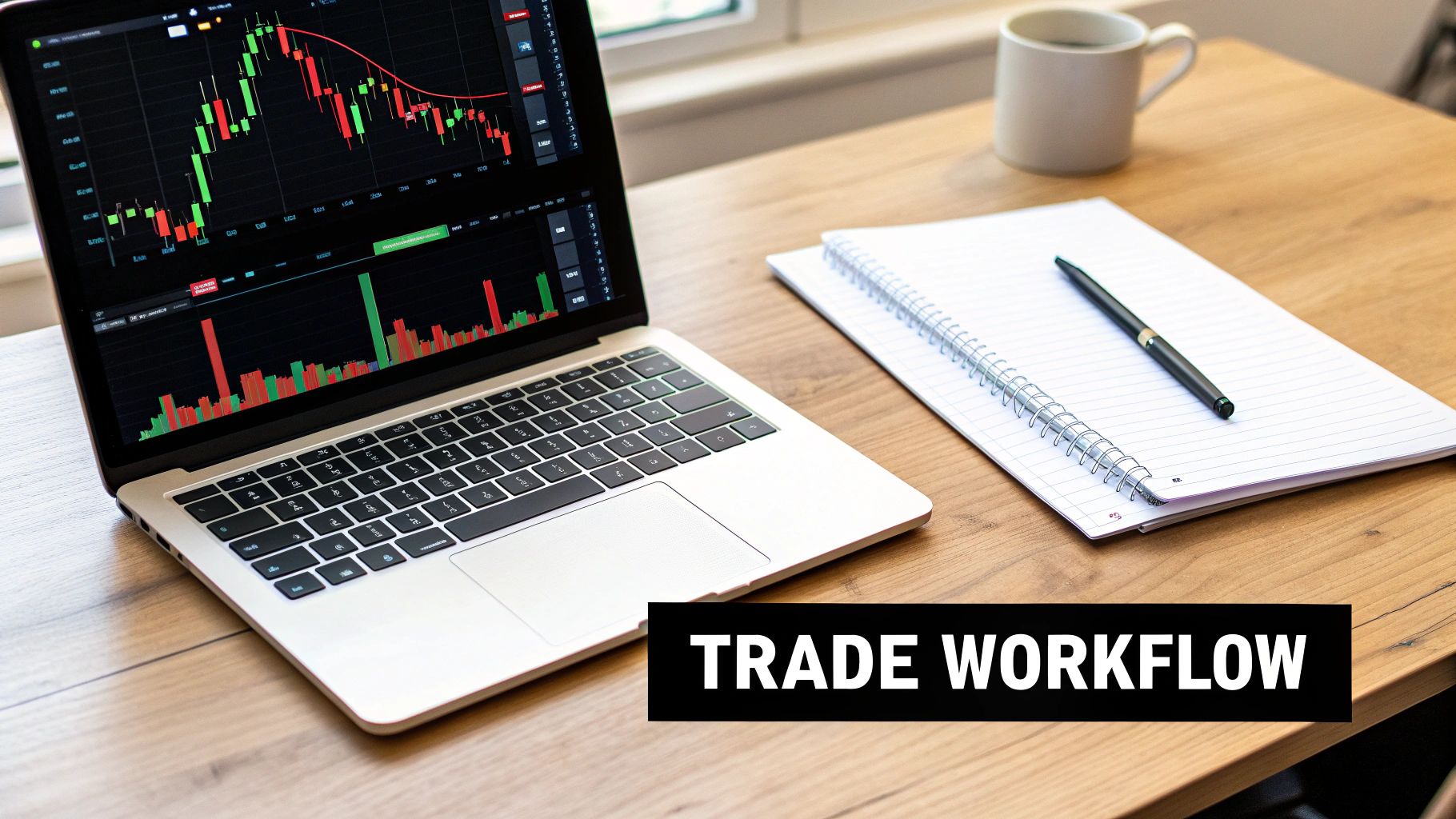
Watching a trade unfold from its first clue to the final exit transforms dry theory into real-world trading. Here, lot sizing isn’t just a footnote—it’s the thread that ties every decision together.
Let’s dive into a structured EUR/USD setup and see risk management and position sizing in action. You’ll notice how a disciplined process shields your capital and sharpens your edge.
Executing A Price Action Setup
Imagine the daily EUR/USD chart painted with a bullish engulfing candle at a solid support zone. That’s your signal—but before you pull the trigger, you map out risk.
- Identify the Trade Signal: A bullish engulfing candle forms at 1.0750, marking a strong support area.
- Define Entry and Stop-Loss: Plan your entry at the candle’s close, near 1.0780. Set a stop-loss just below at 1.0730, giving you a 50-pip buffer.
- Set Risk Parameters: With a $10,000 account and a 1% risk-per-trade rule, you can only lose $100 on this position.
Lot sizing is the final, critical step that connects your trade idea to your risk rules. It turns percentages into concrete position sizes so you never overextend.
With those guardrails in place, here’s how you calculate the precise lot size:
- Dollar Risk: $100
- Stop-Loss Distance: 50 pips
- Pip Value (Standard Lot): $10
- Risk Per Standard Lot: 50 pips × $10 = $500
The formula is straightforward:
$100 ÷ $500 = 0.20 lots
That means you trade 0.20 standard lots (or two mini lots). If price hits your stop, you’ll lose $100—exactly 1% of your account. This walk-through shows why lot sizing isn’t an afterthought; it’s a cornerstone of a professional trading routine.
A Few Lingering Questions on Lot Sizing
Once you get the basics down, a few practical questions almost always pop up. Let's tackle some of the most common ones I hear from traders. Getting these cleared up will help solidify your understanding and really boost your confidence.
Can You Trade Smaller Than a Micro Lot?
Yes, absolutely. While micro lots (1,000 units) are fantastic for getting started, some brokers go even smaller with what’s called a nano lot. This represents just 100 units of the base currency.
Nano lots are perfect for traders working with very small accounts. They're also an incredible tool for testing a new strategy with the absolute minimum financial risk, giving you the ultimate flexibility to fine-tune your exposure.
How Does Leverage Impact Lot Size Choice?
This is a big one, and it trips a lot of traders up. Leverage doesn't change how you calculate your lot size based on your risk rules. What it does change is whether you have enough margin in your account to actually open the position you've calculated.
High leverage means you can control a large position (like a standard lot) with a relatively small amount of capital. But this is a classic double-edged sword. It might make bigger positions accessible, but it does absolutely nothing to reduce the actual dollar amount you stand to lose if your stop-loss gets hit. Your risk calculation must always come first.
Think of it this way: Your risk-based calculation tells you the correct lot size for the trade. Leverage simply determines if your broker will let you afford to place that trade. Don't confuse the two.
Should Your Lot Size Change with Your Trading Style?
Without a doubt. Your lot size has to adapt not just to each individual trade setup, but to your overall strategy as well.
- Scalpers, for instance, often need wider stops (in terms of pips) to avoid being shaken out of a trade by the normal "noise" on very low timeframes. To keep their dollar risk fixed at, say, 1%, they are forced to use smaller lot sizes.
- Swing traders, on the other hand, might have a much wider stop placed strategically below a major support level. To maintain that same 1% risk rule, they will need to use a significantly smaller lot size than the scalper would on a trade with a tight stop.
At the end of the day, it's the distance to your stop-loss that dictates the final number.
At Colibri Trader, we teach traders how to master these core principles of risk management using proven, price-action strategies. It's time to stop guessing and start trading with a concrete plan. Learn more about our approach and unlock your trading potential today.