The Trading Plateau: Are You Improving or Just Busy?
There’s a stage in trading that almost everyone goes through and almost no one talks about.
It isn’t when you’re losing money.
It isn’t when you’re blowing up accounts.
In some ways, it’s worse than that.
It’s when you honestly can’t tell whether you’re getting better, or simply getting better at losing.
Over the last few years, I’ve spoken to traders with six months of experience and traders with more than six years. Surprisingly often, they arrive at the same place. They tell me they know more than ever, yet their results aren’t improving. Some say their results are getting worse.
Then comes the question underneath it all:
Am I actually improving?
Let me make that more specific. If you’ve been trading for two years, how do you know you’re a better trader than you were a year ago?
Not more knowledgeable. Actually better.
Those are two very different things.
Watch Part 1: The Invisible Plateau in Trading
How traders think improvement works
Most traders imagine progress as a nice, smooth line.
The longer you trade, the more experience you gain. The more experience you gain, the better your results become.
I thought that too.
Unfortunately, trading doesn’t work like that.
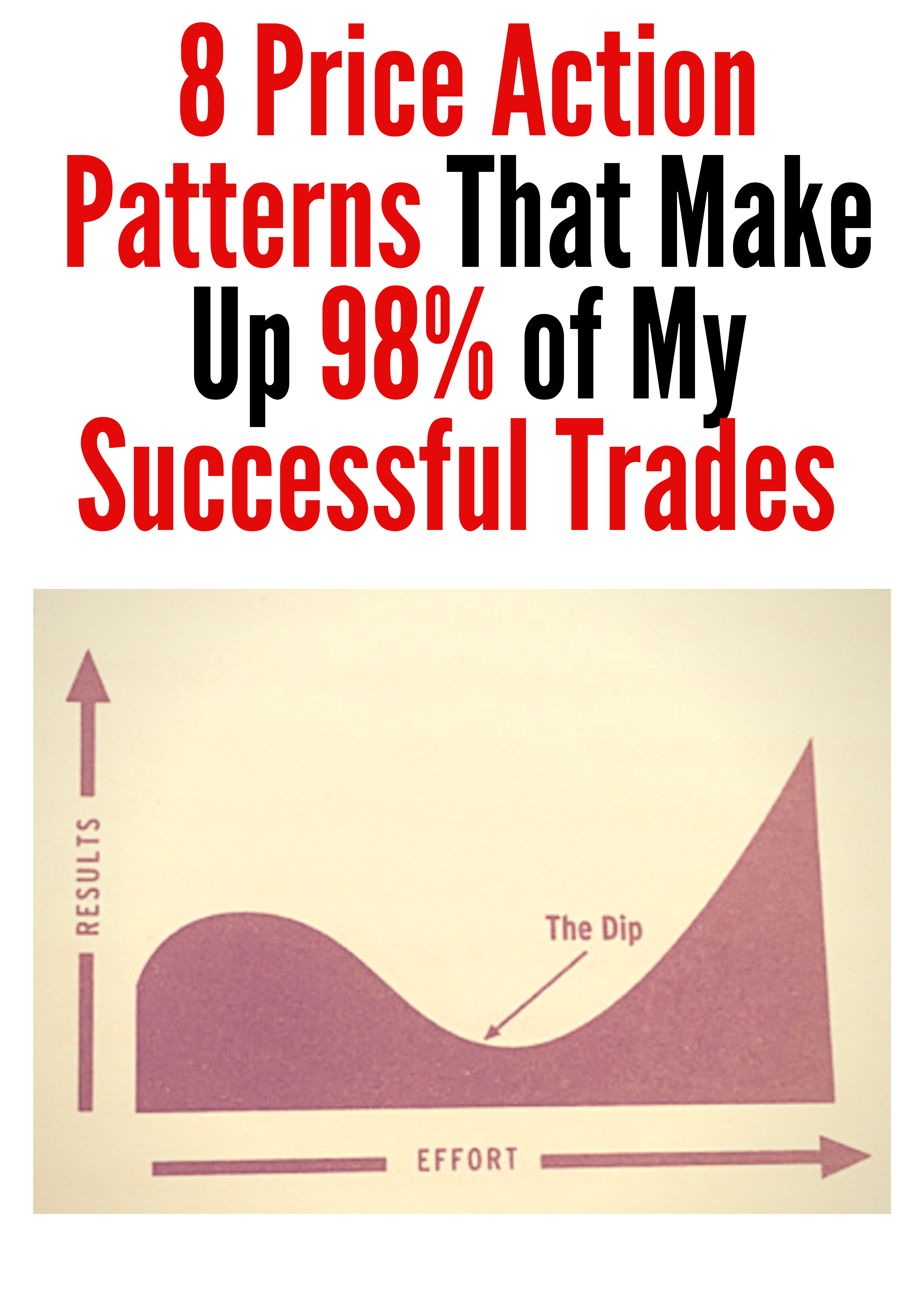
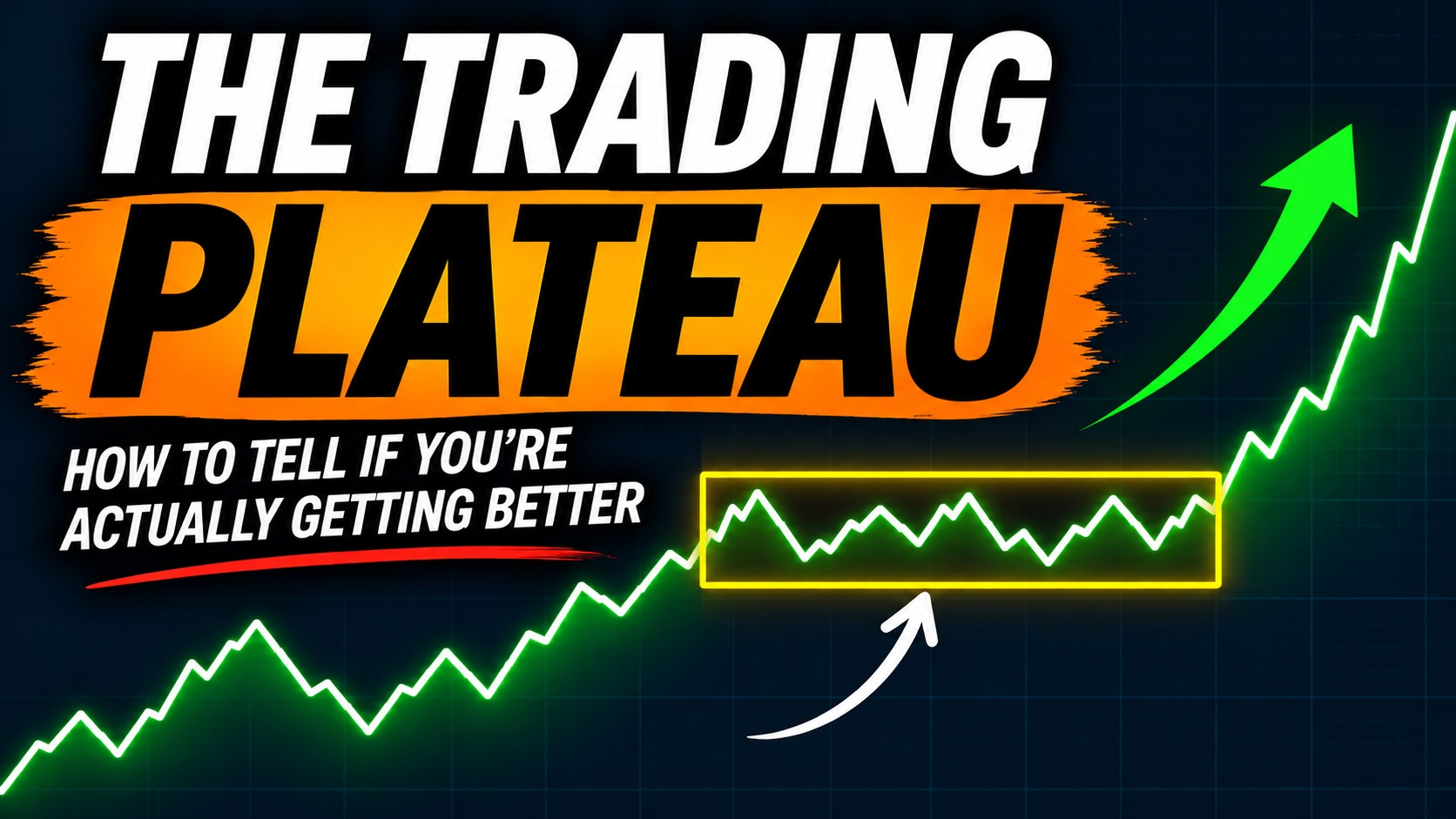
If you drew a more honest chart, with your results on one axis and your time trading on the other, you’d often see something very different: a long stretch where the line barely moves.
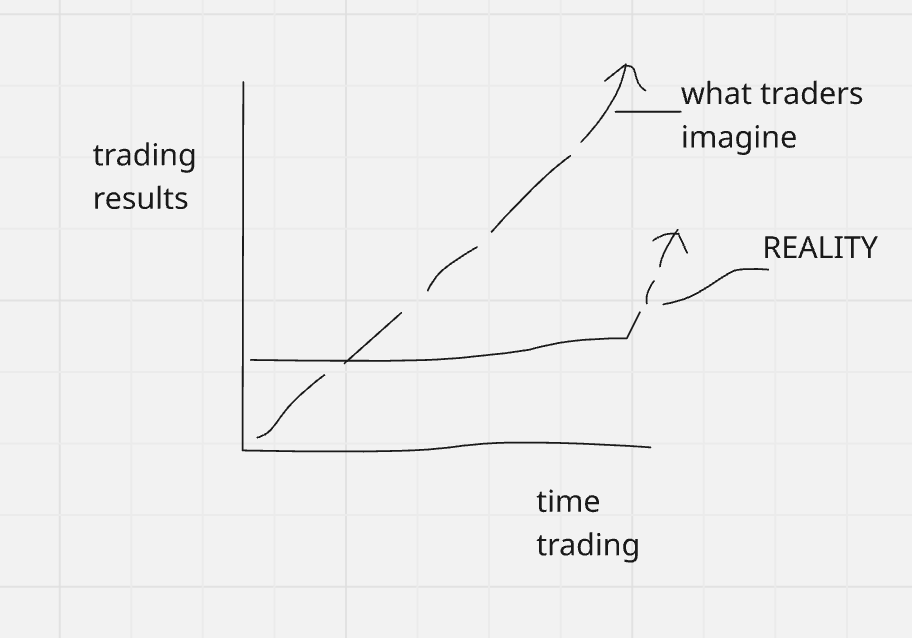
I call this the invisible plateau.
It’s where many traders spend years. One year. Two years. Sometimes five.
What is a trading plateau?
A trading plateau is a long period when a trader keeps learning and staying busy, but their results and decisions stop meaningfully improving. It’s hard to spot because it feels like progress from the inside.
That’s why I call it invisible.
When you’re a losing beginner, the problem is obvious. It’s far harder after three years, hundreds of videos and several courses, when you still can’t tell whether you’re improving. That’s often when people quietly give up.
Activity is not progress
This might be the biggest misconception in trading.
Activity is not the same as progress.
Traders on the plateau are rarely lazy. Most of them are working extremely hard. Every week, they’re:
- Studying charts
- Backtesting
- Watching more videos
- Adding new elements to their strategy
- Buying another course
All of that feels productive. Some of it may even be useful.
But being busy can hide an uncomfortable question:
Are you becoming a better decision-maker, or simply a more educated trader making exactly the same decisions?
Most traders spend years learning. Very few spend years improving.
The most expensive cycle in trading
Here’s the cycle I see again and again:
- You study and place a few trades.
- You lose.
- Instead of asking what you did wrong, you ask what the next strategy is.
- You watch another video, join another community or buy another course.
- You feel motivated again, trade for another week, and lose again.
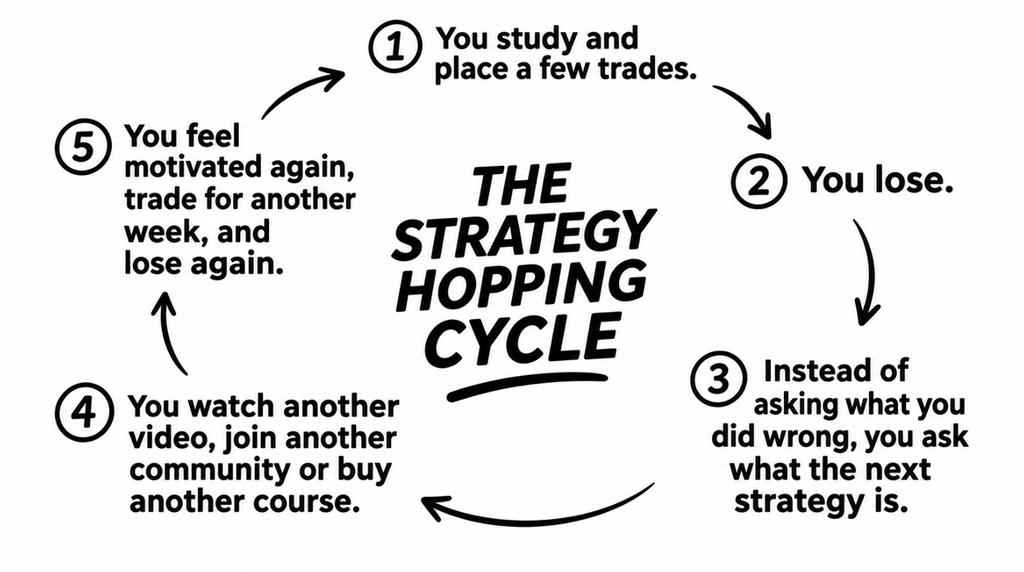
Then the whole thing repeats.
Notice what’s happening. You’re changing, but you’re not improving.
And changing isn’t the same as improving.
There’s a practical cost too. Every system goes through losing streaks. If you abandon each approach during its first difficult patch, you never collect enough trades to learn whether the strategy failed or your execution did.
That doesn’t mean you should never change anything. A strategy can genuinely stop suiting you or the market. The difference is whether you’re changing because of evidence, or because a drawdown has become uncomfortable.
The missing step between knowledge and results
Most traders believe the journey looks like this:
Knowledge → Results
Because they’re learning, they assume they’re improving. Their knowledge goes up every week, but their trading account doesn’t follow.
Why?
Because knowledge doesn’t make money. Execution does.
There’s something sitting in the middle:
Knowledge → Framework → Consistent execution → Results
Your framework is your decision-making process. It’s the rules you actually follow when money is on the line.
You can know everything about supply and demand, liquidity, market structure, psychology and risk management. But if your framework isn’t consistent, your execution will never be consistent.
And without consistent execution, consistent profits are impossible.
Watch Part 2: If You Only Fix One Thing in Your Trading, Make It This
What I got wrong
I spent time on this plateau too.
Years ago, I believed I needed more information. I thought I needed better indicators, better entries and better confirmations. So I read more books and kept adding to what I knew.
Looking back, none of those things was my real problem.
I wasn’t lacking information. I was lacking clarity.
My real problem was inconsistency. I kept changing things before I had enough evidence to know whether they actually worked.
The biggest improvement in my trading didn’t come from learning something new. It came from finally committing to one framework for long enough to refine it.
Professionals don’t restart. They refine.
Professionals aren’t trying to become 50% better tomorrow. They know improvement comes gradually, so they try to become 1% better today.
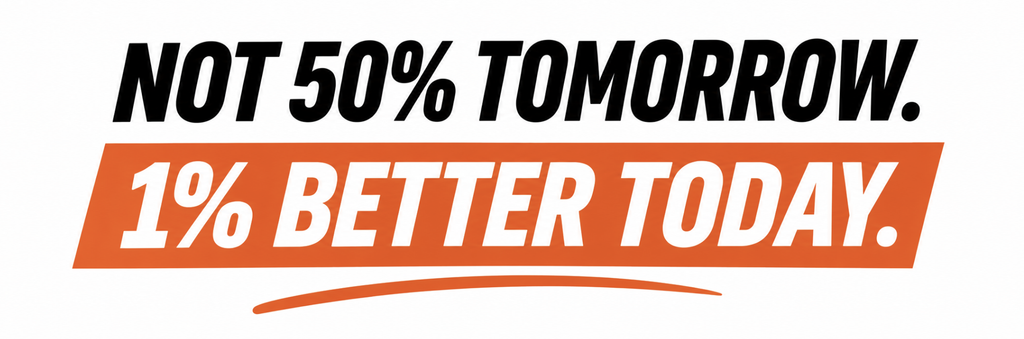
After a trading session, ask yourself:
- What was my biggest mistake?
- Which decision cost me the most?
- How do I stop making it tomorrow?
Then find that one mistake and fix it.
That’s how consistency is built: one improvement at a time.
Why the plateau makes so many traders quit
The plateau can feel as though nothing is happening.
So traders think: I’ve been doing this for months. Why aren’t I improving?
Here’s what many don’t realise. Improvement can begin long before it shows up in your results. You may be becoming a better trader before your account reflects it.
This is true in sports, in business and in trading. A breakthrough rarely comes from nowhere. It looks sudden because you couldn’t see all the work that came before it.
But time alone guarantees nothing. A flat line can mean you’re quietly improving, or that you’re repeating the same year over and over. You need a way to tell the difference.
How to tell if you’re actually improving
Your account balance alone won’t tell you. A few good weeks can come from favourable conditions, and a few bad weeks can happen while your decisions are improving.
Instead, look at your last few months of trades and ask five questions.
1. Have you traded one framework long enough to judge it?
If your rules changed three times this quarter, you don’t have one track record. You have three tiny ones.
Before judging your progress, you need a meaningful sample of trades taken under the same rules. Your journal should make it obvious which rules applied to which trades.
2. Is your expectancy improving, or only your win rate?
Win rate alone can mislead you. Look at it alongside the size of your winners and losers, measured in R.
Here’s a hypothetical example:
| Win rate | Average win | Average loss | Expectancy per trade | |
|---|---|---|---|---|
| Earlier period | 55% | 1R | 1R | +0.10R |
| Later period | 40% | 2R | 1R | +0.20R |
The trader’s win rate fell, yet their expectancy doubled.
The opposite can happen as well. A rising win rate can hide winners that are shrinking.
The formula is simple:
Expectancy = (win rate × average win) − (loss rate × average loss)
You can read more about how to calculate your win rate and why win rate became the wrong obsession for me.
Be careful with small samples. A change over 20 trades could easily be noise.
3. Are you making the same mistakes less often?
This is often the most revealing question.
Tag your mistakes in your journal: moving a stop, entering late, oversizing, taking a trade outside your rules. Then compare one period with the next.
If the same mistake appears just as often as it did six months ago, you may have gained knowledge without changing your behaviour.
4. Are you following your own rules more often?
Separate the quality of the decision from the result of the trade.
A trade can follow your plan and still lose. Another can break your plan and still win. Tracking how often you follow your rules shows you something your profit and loss can’t.
If this number isn’t rising, more information probably isn’t what you need next. It may be a discipline problem.
5. Can you explain your decision before you know the outcome?
Write down why you’re taking a trade before the result is known.
Looking back, can you see your reasoning getting clearer and simpler? Or does each week bring a new indicator and a new explanation for what went wrong?
Clarity is hard to measure, but this comes close.
The formula: Framework. Repeat. Refine.
If you take one thing from this article, let it be this:
More knowledge doesn’t automatically mean better results.
Knowledge has to become a framework. That framework has to become consistent execution. Only then can results follow.
The way I think about it is simple:
- Framework: commit to one clear set of rules.
- Repeat: apply those rules long enough to gather real evidence.
- Refine: find the biggest mistake and fix it, instead of starting again.
So instead of asking, “What else do I need to learn?”, ask yourself:
Which parts of my framework have I mastered?
Frequently asked questions
Why am I not improving at trading even though I keep learning?
Knowledge doesn’t automatically change your decisions. Many traders add new concepts while repeating the same habits under pressure. Knowledge needs to become a consistent framework and consistent execution. Tracking your rule-following, repeated mistakes and expectancy in R will show whether that’s happening.
How long does a trading plateau last?
There’s no fixed length. In my experience of speaking with traders, it can last anywhere from a year to five years or more. It tends to last longer when a trader keeps changing their approach, because they never build a large enough sample to learn from.
Is changing trading strategies bad?
Not always. Changing a strategy can be sensible when enough evidence shows it no longer suits you or the market. It becomes a problem when each losing period triggers a switch, because you never find out whether the strategy or your execution was at fault.
What is a trading framework?
A trading framework is your decision-making process: the rules you actually follow when money is on the line. It turns what you know into repeatable decisions, which makes your execution possible to measure and refine over time.
How do I know if I’m getting better at trading?
Compare periods traded under the same rules. Useful signs include improving expectancy in R, fewer repeated mistakes, and following your rules more often. Profit and loss still matters, but over a short period it can reflect market conditions as much as your skill.
Next year doesn’t have to look like last year
Profitable traders aren’t necessarily the ones who know the most.
They’re the ones who consistently execute what they already know.
The goal isn’t to spend another year trying to figure this out by yourself. It’s to make sure your next year doesn’t look exactly like your last one.
If you’d like to see how I approach decisions, risk and trade management, you can learn more about my Asymmetric Day Trading Programme.

Trading involves risk, and losses are possible. This article is for educational purposes only and isn’t financial advice.