Trading Mentor Near Me: How to Find and Vet One

“Find a trading mentor near me” sounds like sensible advice: choose someone nearby, meet face to face, and learn from a local trader. But proximity isn't a safety signal. A nearby mentor can still sell alerts, hide conflicts, or promise results they can't deliver. A remote teacher with a verifiable identity, clear terms, and sound risk instruction may be easier to assess.
The practical approach is to find a short list through one local search route, then apply the same evidence test to every candidate, local or online. Don't pay, share your account login, or hand over personal information until the person has answered your questions in writing.
Where to Search for a Trading Mentor Near You
A nearby mentor is easier to meet, not automatically safer to hire. Use one search route to build a short list, then judge local and online candidates by the same evidence.
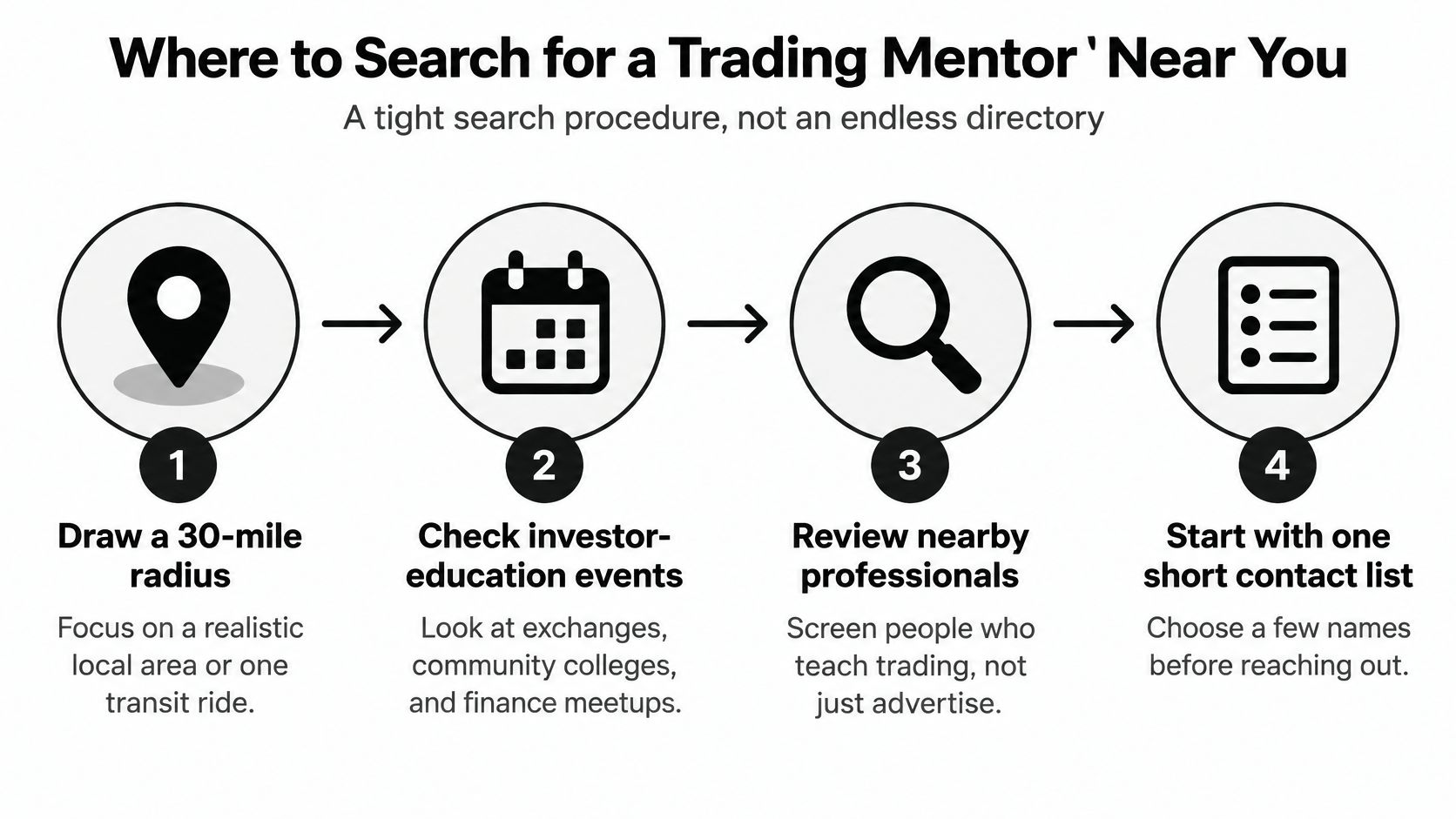
Set a practical radius. Choose an area you can reach consistently, then search local investor-education events, community-college finance clubs, and trader meetups. A convenient venue is useful only if you can attend regularly.
Search by city and teaching role. Look on LinkedIn and in local investor or trading groups for phrases such as “trading mentor” or “trading coach.” Compare whether names and work histories are consistent across profiles, and whether posts explain market mechanics or mainly promote paid access.
Use public events to assess the offer. If a proprietary trading firm hosts an open evening, ask who teaches, what the instruction covers, and whether the host or instructor earns money if you join or buy another service. Treat the event as a way to gather information, not proof of teaching quality.
Ask traders who have paid. A referral is more useful when the person recommending a mentor has bought the service directly. Ask what the instruction and support included, and whether the payment and refund terms matched what was promised.
Compare online options too. Add two structured online teachers to the shortlist. Remote instruction may be easier to schedule and compare, and it keeps the nearest candidate from winning on convenience alone. Self-directed investing material, including AI-assisted research for self-directed investors, can help you frame questions. It cannot verify a mentor's identity, teaching, or terms.
Record how each candidate came up. Note whether the name came from a recommendation, an event, a professional profile, or a search result. That context helps you compare candidates without mistaking visibility for evidence.
Broker education desks and paid signal rooms are marketing channels, not automatically mentorship. Include them only if you can assess what they teach and how they are paid. Stop when you have five names. A short list is easier to compare on equal terms.
What to Demand Before You Pay a Trading Mentor
A local meeting can feel reassuring, but a handshake and a familiar accent don't verify competence. The CFTC's warning on retail self-directed forex accounts reports disclosed loss rates ranging from 50.96% to 74% over the preceding four quarters. That's a reason to demand clear evidence, not to trust confident sales language. A mentor who promises easy income has already failed a basic check.
Use this table before paying, sharing personal information, or giving anyone access to your trading account.
| Check | Ask for | Pass | Fail |
|---|---|---|---|
| Identity | Legal name tied to a public bio, regulator file, or long-running site | Invoice name matches the record | New alias, stock photos, or no history |
| Registration or education limit | Written statement saying whether they advise, manage money, or only teach | Registered where required, or a clear education-only limit | Advice or account management claims with no verifiable record |
| Track record | Full broker statements that include losing months, fees, spreads, and financing | Complete statements you can review | Cropped wins or income screenshots |
| Teaching focus | Syllabus covering position size, stops, costs, and when not to trade | Risk rules come before entries | Signal room sold as mentoring |
| Payment and refunds | Written price, delivery terms, and refund rule | Traceable payment and dated refund terms | Crypto-only payment, personal wallet, or a fee to release withdrawals |
| Conflicts and access | Disclosure of broker or prop-firm referral fees, and whether they need your login | Written disclosure and no passwords | Hidden kickback or a request to trade your account |
Check who's responsible for the service
If someone gives individualized buy or sell advice, manages money, or trades for you, ask where they're registered and verify the claim using the public regulator register for the country where they operate. If they say they provide education only, get that limit in writing. Check that the contract names the same person or firm that takes your payment, and keep copies of the agreement and written claims.
Apply the same check to an overseas teacher. Confirm the claimed registration with the regulator in the country where they say they operate. A “trading mentor near me” can be hard to verify; distance itself doesn't settle the question either way.
Read performance and payment claims carefully
A profitable screenshot doesn't show whether a trader took hidden risk, omitted losing trades, or left out fees. Ask for complete broker statements, including losing periods, and don't accept an income image as proof of repeatable results.
The SEC has warned about scams in investment group chats that impersonate financial experts, show fake profits, and demand fees or taxes before withdrawals. Don't send an extra payment to release money you supposedly earned, and never share your brokerage password. Book a call only with candidates who pass every row.
Questions to Ask Before You Commit
Use the first call to test how the mentor teaches, not to negotiate a future trading result. Ask direct questions and listen for specific answers. If the person steers every question toward a paid room, an account referral, or a promise of quick returns, end the conversation.

Ask the mentor these questions out loud:
- “How many students are you teaching now, and what does a normal week of contact look like?” You're checking whether the support is real and predictable, not merely advertised.
- “What do you teach before entries?” Look for position sizing, a maximum daily loss, and trading costs before talk of setups.
- “Can I review a full month of your trading journal, including losing trades?” A journal should show decisions and risk, not just selected wins.
- “Do you recommend a broker, and do you receive money if I open an account?” A disclosed referral arrangement lets you judge the recommendation with its incentive in view.
- “What happens to my payment if I stop early?” Get the refund rule and any cancellation terms in writing.
- “What will you never do?” A responsible answer should rule out placing your trades, holding your password, and guaranteeing a return.
If you're comparing teaching with other forms of guidance, Colibri Trader's explanation of why mentoring is important can help clarify what useful support should accomplish: better understanding and more deliberate decisions, not dependence on someone else's calls.
Set the trial boundaries first
Run a short trial using paper trading or the smallest position size available. Agree on the risk per trade in writing before the first session, pay for one defined block of time, and refuse add-ons until the trial ends. Don't let a short introduction turn into an open-ended subscription.
Use one log throughout the trial. Record the date, setup, risk in currency, whether you followed the plan, and the mentor's comment. The useful question is whether the feedback changes your decisions. A profitable week can come from luck or favorable conditions, so it isn't evidence that the teaching works.
Set the exit conditions before you start. You should know the fee, the schedule, the risk rules, and how to stop before the mentor asks you to commit.
At the end of the trial, you should be able to point to an actual change in behavior, such as respecting a planned stop or avoiding a trade outside your setup. If the mentor can't explain how their comments are meant to improve a decision, don't extend the arrangement.
Mentorship Prices and What They Usually Cover
Compare what you're buying, not just the amount on the invoice. Prices aren't standardized, and the figures below are not verified market averages. Treat the table as a way to inspect the structure of a quote: ask what time, curriculum, feedback, and follow-up the fee covers.
| Model | Fee should include | Walk away if |
|---|---|---|
| Monthly group mentorship | Live review of your journal and a written risk plan | The room only sends trade alerts |
| One-to-one hourly | Recorded sessions and a set curriculum | Billing is open-ended with no syllabus |
| Local weekend intensive | Small group, materials, and a follow-up week | The weekend ends with a high-pressure upgrade pitch |
| Course plus mentor access | Lessons, community, and a stated reply time | Lifetime access means an unmoderated chat |
| Prop seat or profit split | A written split and no deposit to the mentor personally | You fund an account the mentor controls |
Match the fee to actual instruction
A group membership should include opportunities to review your own decisions, not just watch someone announce entries. One-to-one time is only useful if the session has a plan and a clear record of what you're supposed to practice. A weekend intensive needs a follow-up arrangement, otherwise you may leave with notes but no help applying them.
For any model, request the syllabus, the deliverables, and the expected response time in writing. Then compare the service with the sales pitch. A room that mainly pushes alerts isn't transformed into mentorship because it charges a monthly fee.
Watch for subscriptions and sales events
Some trading education businesses bill communities, mentorship access, and trading rooms as subscriptions rather than one-time courses. Colibri Trader offers some subscription-based services, including trading room memberships, mentorship communities, and educational memberships. Before enrolling in any recurring service, work out what you'll pay over the period you realistically expect to attend, and check how cancellation works.
Be cautious when a free seminar ends with pressure to buy an expensive “inner circle.” The question isn't whether the pitch sounds exclusive. It's whether the program provides a curriculum, review of your trades, and a written support commitment that match the fee. Don't pay more than one month or one trial block until the evidence checks are complete.
How to Judge Whether Mentoring Is Working
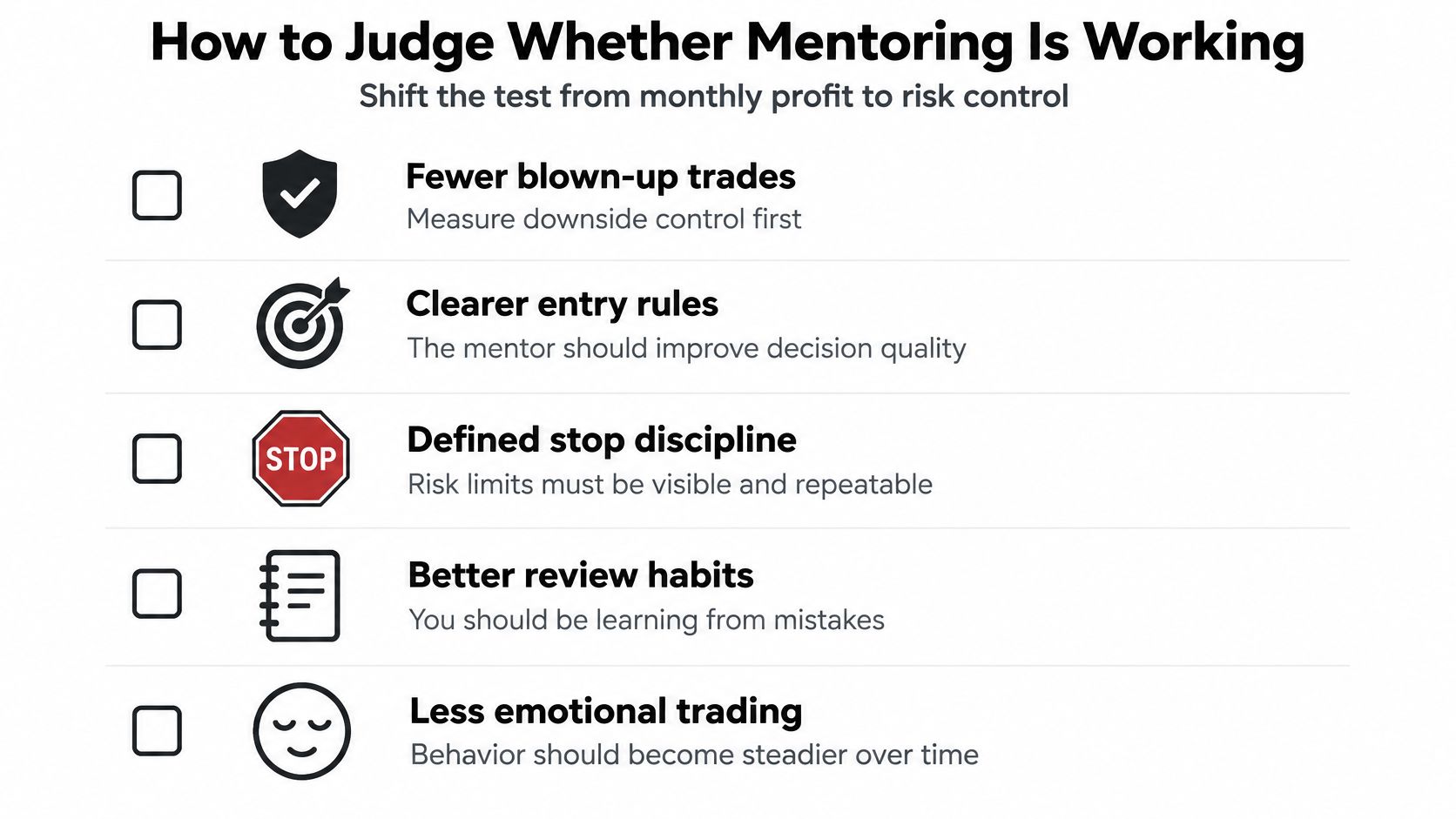
Proximity is not proof that a mentor can teach. Judge progress by whether your decisions are becoming more controlled, not by whether one month ends in profit. A mentor who reviews entries but ignores position sizing, stop discipline, and impulsive trades may increase your activity without improving how you handle risk.
The Hong Kong 2025 retail-investor study found that only 7% of stock investors always used stop-loss orders, down from 16% in 2023. The share who rarely or never used them rose from 48% to 57%, while 73% cited short-term trading for quick profits, up from 45%. Those figures describe Hong Kong investors, not every market. They still underline why more trade ideas won't fix weak risk habits.
Check what the syllabus teaches
Before expecting profitability, look for practical risk controls in the teaching: a fixed fraction of capital at risk per trade, a daily loss limit that ends the session, written position-sizing rules, and a journal that separates planned trades from impulsive ones. The syllabus should also explain what to do after a losing streak, such as reducing size or pausing. While learning, keep risk per trade well below 1% of capital so a mistake stays manageable.
A useful teacher should explain when not to trade. Be wary if the mentor celebrates constant activity, treats stops as optional, or urges you to increase size after losses. Those habits undermine disciplined decision-making.
Score the trial log, not the outcome
Use the log you kept during the trial. Score whether you followed the agreed process, not whether the trades made money.
| Metric | How to measure | Pass signal |
|---|---|---|
| Trades within risk cap | Trades at or under the set risk divided by all trades | Every trade |
| Daily-loss rule honored | Days the session stopped at the set maximum loss divided by days that hit it | Every day that hit the limit |
| Journal filled same day | Entries logged the day they were made divided by all entries | Every entry |
Take the scorecard to your next mentor call and discuss each missed rule. A guide to keeping a useful trading journal can help you record decisions consistently. For a separate example of professional guidance outside trading, see business coaching from Advisor Momentum.
A trial can show no profit and still show progress if you respected risk limits, stopped when required, and recorded decisions accurately. A winning result cannot make up for ignored rules.
Choose Local Coaching or a Structured Online Mentor
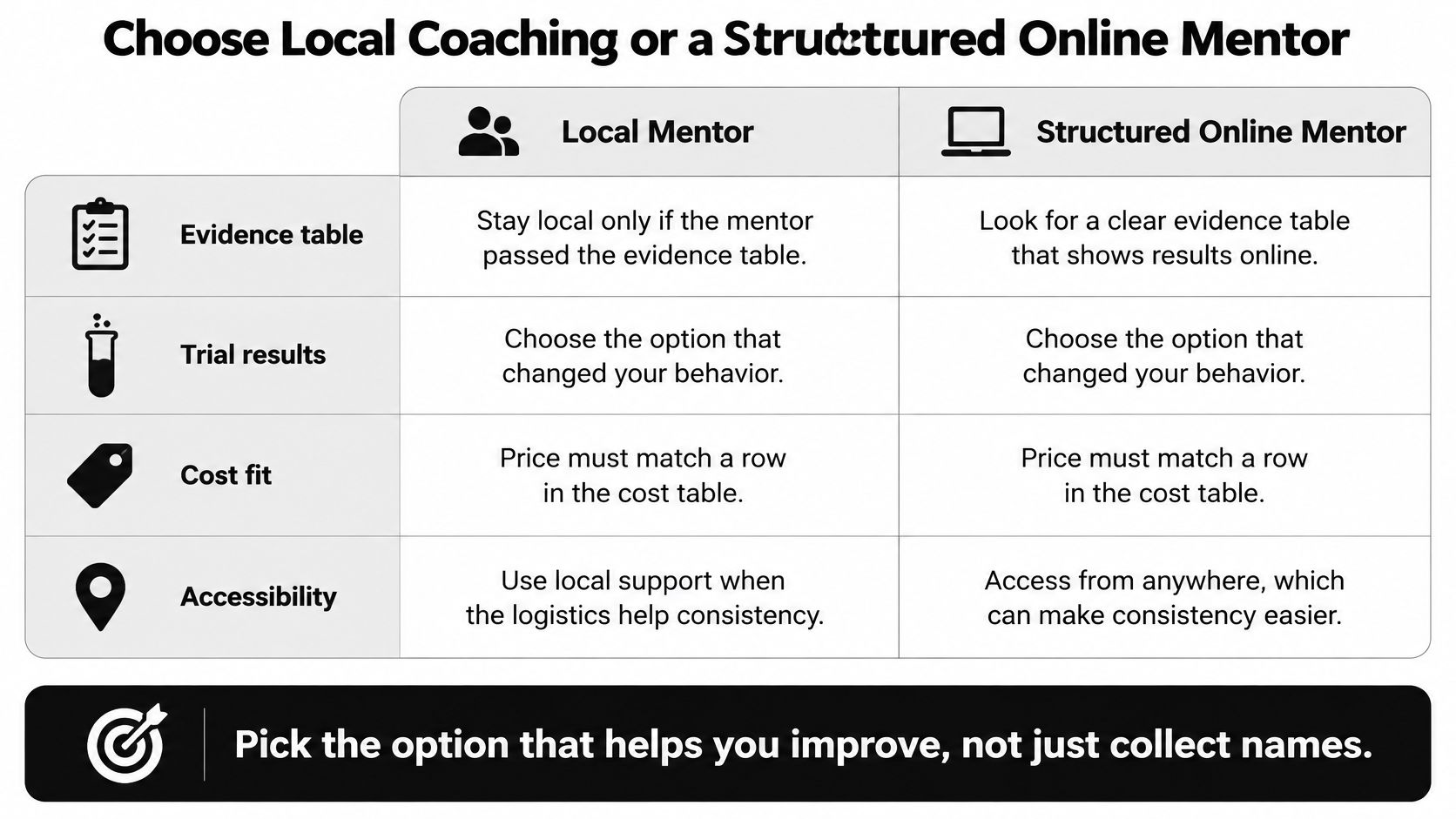
Stay with a local mentor only if they passed the evidence checks, the trial changed your behavior, and the fee matches the support you receive. Choose a structured online mentor if the local candidates fail those tests, travel makes regular sessions difficult, or you'd rather follow a written method than depend on someone's personality.
Let evidence decide, not distance
Local coaching can help when meeting in person makes it easier to maintain a schedule or ask questions. Online instruction can be a better fit when the teaching method, terms, identity, and feedback are clearer than what you've found nearby. Compare both options on the same points: does the instruction include risk management, can the teacher review your decisions, and can you stop without losing control of your account or your money?
Colibri Trader provides price-action education using a method that doesn't rely on indicators. It offers courses and mentorship communities, but it doesn't award certificates or badges. Its free trading potential quiz produces a custom report based on your strengths, and the first two chapters of The Ultimate Price Action Trading Guide are available free by email. Paid products, mentorship programs, and trading rooms are for adults aged eighteen or older.
For another perspective on choosing between classroom and remote study, a comparison of online learning and classroom learning can help you weigh structure and convenience against the practical benefits of meeting face to face. Whatever you choose, never send an account password to a mentor.
Score your local shortlist tonight. If no one clears the evidence test, start with free educational material and keep looking rather than paying for proximity alone.
Colibri Trader offers price-action courses, a free trading potential quiz with a custom report, and the first two chapters of The Ultimate Price Action Trading Guide at no cost by email. Use those resources to assess the teaching approach before committing to paid support, and visit Colibri Trader to explore the options.