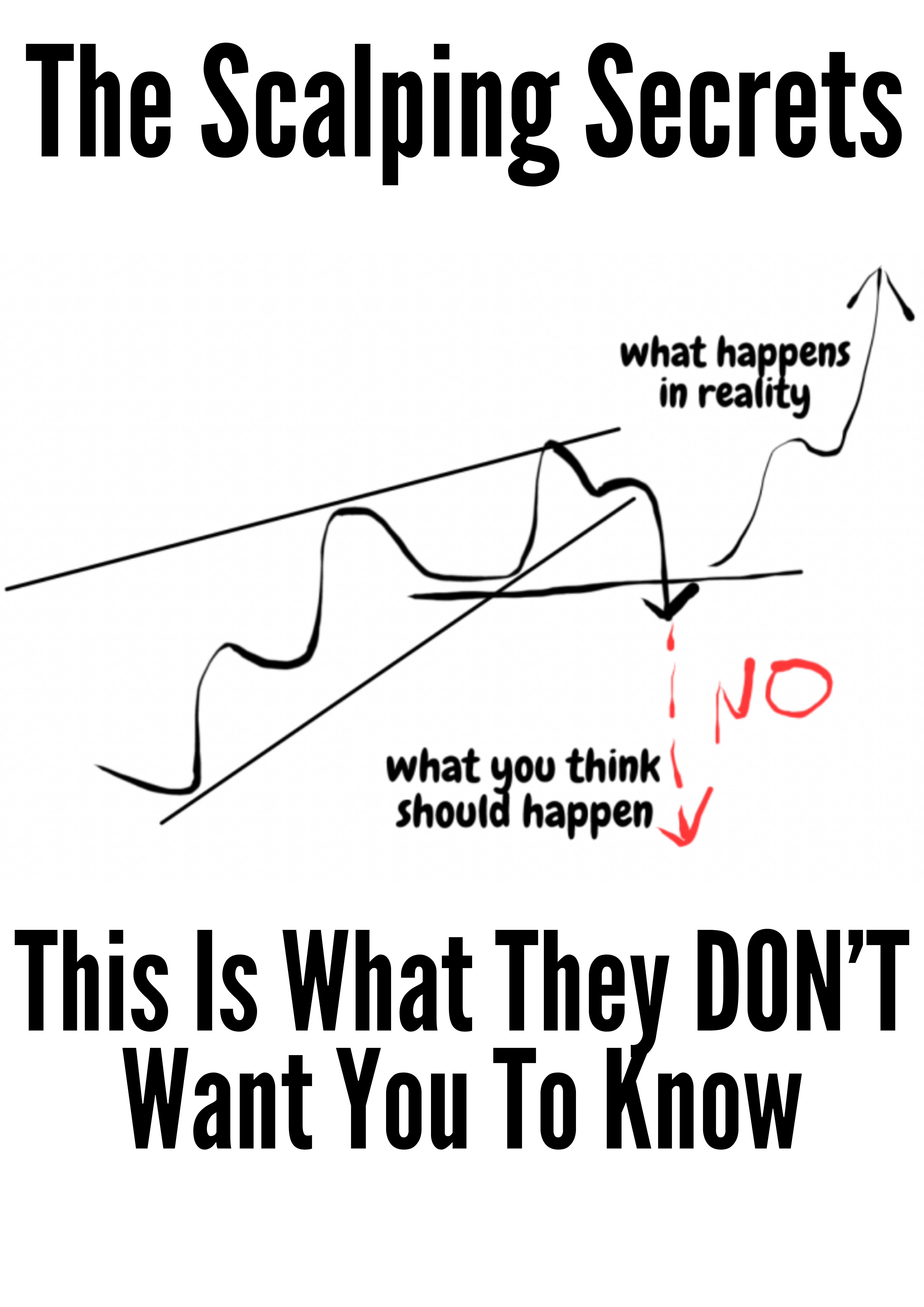
Trading Classes for Beginners A Guide to Building Real Skills
Trading classes for beginners offer a structured roadmap for navigating the financial markets. They teach the essential skills—like risk management and price action—that help you sidestep the expensive trial-and-error phase. For anyone serious about building long-term consistency, a good class is the most reliable place to start.
Why Trading Classes Are Your First Smart Move

On the surface, the idea of trading is simple: buy low and sell high. But once you start looking, you're hit with a flood of conflicting advice, get-rich-quick nonsense, and strategies that make your head spin. It’s this chaos that costs most new traders their capital and their confidence.
Jumping in without a clear plan is like trying to build a house without a blueprint—it’s just not going to be stable.
A proper class cuts straight through that noise. It gives you a methodical, step-by-step framework that puts real knowledge ahead of flashy promises. Instead of chasing random tips from social media, you learn a proven process from experienced mentors who’ve already navigated the market’s tricky waters.
Building a Foundation for Success
The real value of trading classes for beginners isn’t just memorizing chart patterns; it’s about building the right habits from day one. These courses are designed to instill the kind of discipline that a sustainable trading career demands.
Here’s what you really gain:
- A Structured Learning Path: A solid curriculum walks you from the absolute basics to advanced execution. You won't miss any of the critical building blocks along the way.
- Risk Management First: Quality courses teach you how to protect your capital before you even think about making a profit. This is the single most important skill for survival in the markets.
- Psychological Conditioning: You learn how to manage emotions like greed and fear—the very things that cause over 90% of new traders to fail.
A good trading class doesn't just give you a fish; it teaches you how to fish. The whole point is to develop your own analytical skills so you can read the markets and make independent decisions, not just blindly follow someone else's signals.
Ultimately, enrolling in a course is an investment in a skill set, not a lottery ticket. It sets the right expectation from the start: trading is a profession that requires dedication, practice, and a solid educational foundation to achieve any kind of lasting success.
The Essential Skills You Will Learn
A top-tier trading class won't just show you which buttons to click. That's the easy part. A real education builds a complete skill set from the ground up, giving you the tools to analyze markets on your own, protect your capital like a hawk, and make decisions with confidence.
Any effective trading class for beginners worth its salt is built on three foundational pillars. Let’s break them down.
Mastering Price Action Trading
Think of a seasoned tracker in the woods. They don't need a GPS; they can read the story of what happened by looking at broken twigs and footprints. That’s what price action trading is for the markets. It’s the art and science of reading the chart itself—the raw price movement—to figure out where the market might be heading next.
You're not cluttering your screen with a dozen confusing indicators that are always a step behind. Instead, you learn to interpret the "clean chart," identifying key patterns and levels where the battle between buyers and sellers is about to shift. A core part of this is technical analysis, which is all about understanding how to read cryptocurrency charts, stock charts, or any other chart you put in front of you.
Why trade this way? The benefits are huge:
- Clarity: You’re making decisions based on what the market is doing right now, not what some lagging indicator said it did ten minutes ago.
- Universality: These principles work everywhere. Stocks, forex, crypto, commodities—it doesn't matter. Price action is the universal language of the market.
- Empowerment: You stop relying on gurus or random tips. You develop the ability to form your own market opinions, the true hallmark of a self-sufficient trader.
Implementing Strict Risk and Money Management
If price action is the engine of your trading vehicle, then risk management is the brakes and seatbelt. Without it, even the most powerful engine will eventually lead you straight into a crash. Too many beginners obsess over finding the perfect entry signal, but the pros know the real secret: your long-term survival hinges entirely on how you manage your losses.
The cardinal rule taught in every reputable trading class is brutally simple and absolutely non-negotiable: never risk more than 1-2% of your trading capital on a single trade.
This single piece of discipline ensures that a string of losses—which will happen to every trader—doesn't wipe you out. This isn’t just about placing a stop-loss. It's a complete mindset focused on preserving your capital. You learn about position sizing, calculating risk-to-reward ratios, and internalizing the fact that your first job as a trader is to play defense.
Developing Unbreakable Trading Psychology
This is the final boss, the most challenging skill of all: mastering your own mind. You can have the world's best strategy and the tightest risk rules, but they’re completely useless if you can't control the primal emotions of greed and fear when your hard-earned money is on the line.
The markets are flooded with new participants. Since 2012, global stock market capitalization has rocketed 263% to reach an eye-watering $67.8 trillion. This flood of money means more emotional, knee-jerk reactions are driving prices, creating both incredible opportunities and devastating traps.
A solid trading class prepares you for this psychological battlefield. It teaches you how to build discipline, stick to your trading plan no matter what, and treat your trading like a business of probabilities, not a trip to the casino.
How to Choose the Right Trading Class
With a seemingly endless sea of trading courses online, picking the right one can feel just as daunting as placing your first trade. A lot of programs will promise you the moon, but only a handful actually deliver the real-world skills you need to succeed. To cut through all that noise, you need a solid game plan.
Think of it like hiring a personal trainer. You wouldn't sign up with someone who just throws heavy weights at you without ever teaching you proper form, right? In the same way, a truly great trading class teaches you how to think like a trader and analyze the market for yourself—not just blindly follow someone else's signals.
Focus on a Clean Strategy
The best trading classes I've seen for beginners are built around a single, proven strategy. A perfect example is price action trading, which is all about learning to read the market's story directly from a clean chart, without a bunch of confusing add-ons. This approach gives you the power to understand the why behind every price move.
Be very skeptical of courses that lean heavily on a complicated mix of lagging indicators. This usually just creates "analysis paralysis" and leaves you more confused than when you started. A simple, indicator-free method is a great sign that a course is focused on building genuine, lasting skill rather than just peddling a "secret system."
A quality trading education isn't about what it adds, but what it takes away: the noise, the clutter, and the dependency on others. Your goal is to become a self-sufficient trader, and that journey starts by learning a strategy that brings clarity and confidence to your own decisions.
Verify Social Proof and Mentorship
Honest student testimonials and a supportive community are absolutely non-negotiable. Look for verified reviews on third-party sites and check if the program has a community forum or group where students can actually talk to each other and share ideas. Trading can be a lonely road, and having a strong community to lean on is invaluable.
On top of that, access to a real mentor is a game-changer. Does the instructor actually engage with students, or are you just buying a library of pre-recorded videos? The chance to ask questions and get direct feedback from an experienced trader can slash your learning curve in half. It's also worth thinking about what kind of learning environment works for you; understanding the difference between online learning vs classroom settings will help you choose the format that fits your life.
Red Flags to Watch Out For
As you're sizing up your options, keep a sharp eye out for these common red flags. Spotting them early will save you a ton of time, money, and frustration.
Before we dive into the list, here’s a quick checklist you can use to compare different courses and find the one that truly fits your goals.
Evaluating Trading Classes: A Beginner's Checklist
Use this checklist to compare different trading courses and find the one that best fits your learning style and goals.
| Evaluation Criteria | What to Look For | Red Flags to Avoid |
|---|---|---|
| Strategy & Methodology | A single, clear, and proven strategy (like price action). Focus on skill-building. | Over-reliance on complex indicators or "secret" systems. |
| Instructor's Credibility | A real, practicing trader with a verifiable track record and teaching experience. | Vague credentials, no proof of trading success, focuses on lifestyle. |
| Curriculum Structure | A logical, step-by-step path from fundamentals to advanced concepts. | An unclear or disorganized syllabus. Jumps around without building knowledge. |
| Community & Support | An active student community (forum, chat group) and access to the instructor. | No community interaction. You're left on your own after purchase. |
| Social Proof | Verifiable, detailed reviews on independent platforms like Trustpilot or Google. | Only shows perfect, cherry-picked testimonials on their own website. |
| Marketing Message | Focuses on education, risk management, and discipline. Sets realistic expectations. | Guarantees of profit, displays of extreme wealth (cars, mansions). |
Now, let's look at those red flags in more detail. If you see any of these, it's a good idea to walk away.
- Guarantees of Profit: This is the biggest one. No one can guarantee profits in trading, period. Anyone promising "guaranteed daily returns" is likely running a scam.
- Emphasis on a Lavish Lifestyle: If the marketing is all Lamborghinis and exotic vacations instead of risk management and discipline, run. Real trading is a serious business, not a get-rich-quick fantasy.
- Lack of a Clear Curriculum: The course outline should show a structured, logical journey from basic ideas to advanced execution. If the syllabus is vague, the education probably is, too.
Ultimately, choosing the right class is your first real trade. Do your homework, prioritize skill over hype, and find an educator who is transparent and genuinely invested in your long-term success.
Your Realistic Path From Beginner to Consistent Trader
Let's get one thing straight: turning trading knowledge into a real, consistent skill doesn't happen overnight. It's a journey, not a sprint. Anyone who tells you otherwise is selling something. Most traders I've seen find their footing dedicate anywhere from 6 to 18 months to the process before they hit a steady rhythm.
The path forward is methodical. You can't just jump into the deep end. It starts with education, moves into controlled practice, and only then does it involve risking real money. Trying to skip a step is like attempting to run a marathon without ever training for a 5K—you're just setting yourself up for burnout and failure.
This simple infographic breaks down the three core stages every new trader has to move through.
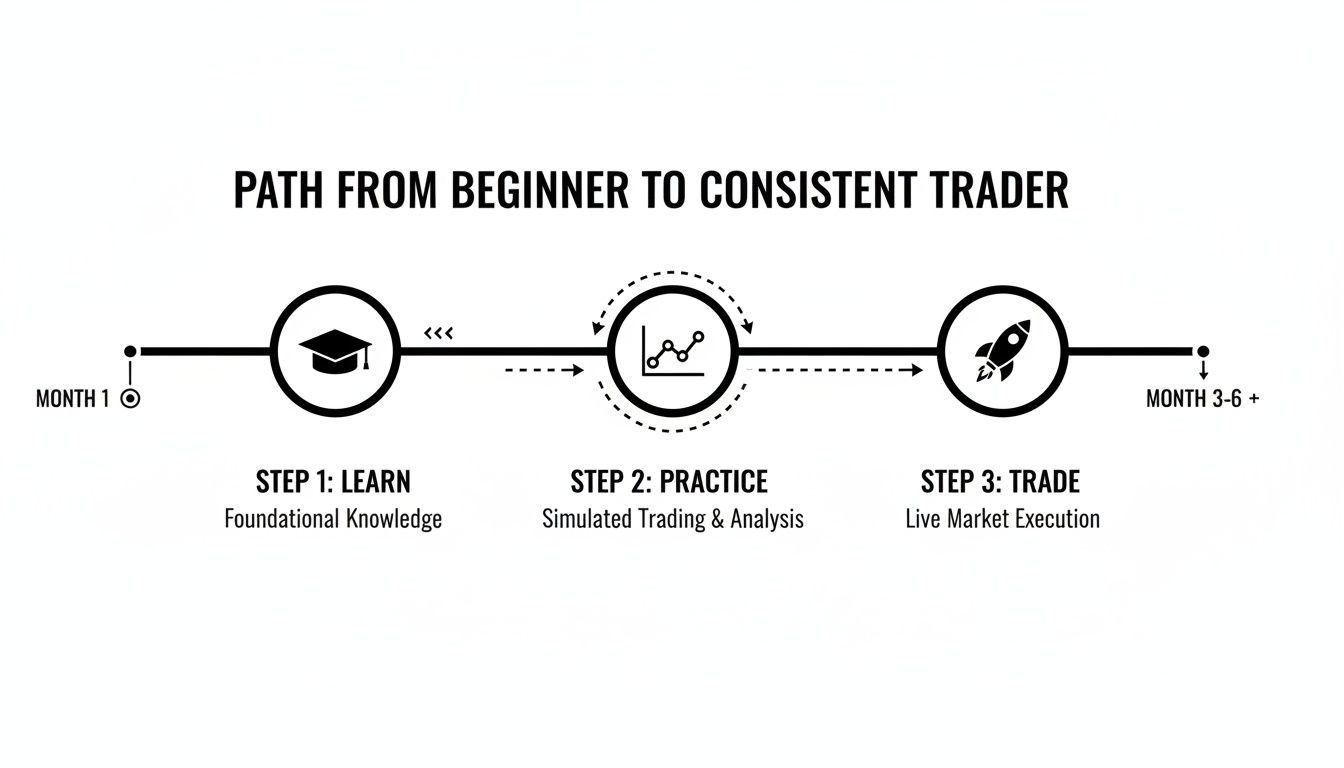
This isn't just a nice graphic; it's a roadmap. It reinforces a critical truth: successful trading is a skill built progressively on a solid foundation of learning and risk-free practice. Only then should you even think about putting real capital on the line.
Phase 1: The Knowledge Foundation
This first stage is all about education, and it's exactly where trading classes for beginners shine. Your only job right now is to absorb the core concepts without feeling the pressure to make money. This is the time to really get your head around price action, internalize risk management rules, and begin to understand the psychological game you're about to play.
Think of yourself as a student, not a trader. Your goal isn't to make a dime; it's to build a complete mental model of how your chosen strategy actually works.
Phase 2: The Practice Arena
Once you've got the theory down, it's time to step into the simulator. This is the paper trading phase, where you execute your strategy in a live market environment without risking a single dollar. Treat it like a flight simulator—it's your safe space to make all the rookie mistakes, test your plan until it's second nature, and build crucial muscle memory.
This is also where you absolutely must start a trade journal. A journal is your personal feedback loop, your coach. Document every single trade: why you got in, where you got out, what you did right, and especially where you went wrong. This disciplined record-keeping is what separates the amateurs from the professionals. It turns every trade, win or lose, into a priceless lesson.
Most new traders give up during this phase. Why? Because it doesn't feel like they're making progress. In reality, this is where the most critical progress happens. Flawless execution in a demo account isn't optional; it's the non-negotiable prerequisite for trading with real money.
Phase 3: The Live Proving Ground
So, you've achieved consistent results on a demo account for at least a few months. Great. Now you can consider trading with a small, live account. And I can't stress this enough: the key word here is small.
Your goal is not to get rich. It is to prove you can execute your plan when real, gut-wrenching emotions are involved.
The psychological pressure of having even a tiny amount of your own money on the line is a completely different beast. This final phase is all about managing your own head, sticking to your risk parameters no matter what, and continuing to learn from your trade journal. By building confidence with small, manageable stakes, you create a sustainable path toward long-term consistency.
Understanding Modern Market Dynamics
To trade well, you need to know who you’re up against. In other words, who’s actually moving the markets these days?
The trading world has changed a lot over the last decade. It’s no longer a game run exclusively by big Wall Street firms. A whole new generation of traders has entered the arena, and they've completely changed the market's rhythm.
This isn’t a small shift; it's a seismic one. A wave of younger traders, mostly Millennials, are now the main drivers in global markets. The numbers are staggering. Recent data shows this generation executed a massive 7,383,749 trades with a total value of £374.2 billion, blowing all other age groups out of the water.
This is exactly why trading classes for beginners are so critical right now. The most popular market, driven by this new wave, is global indices, with a combined traded value of £738.7 billion. The opportunity is immense, and you can see for yourself just how big these market trends are.
Why Indices Are a Smart Starting Point
So, what's the big deal with indices like the S&P 500 or the FTSE 100? Why are they such a magnet for new traders? It all comes down to their structure and stability.
- Inherent Diversification: Think of an index as a basket holding a country's top stocks. When you trade the S&P 500, you aren't just betting on Apple or Microsoft; you’re trading the overall health of the entire US tech sector and beyond. This built-in diversification helps smooth out the kind of wild, unpredictable swings you'd see in a single stock.
- Ideal for Learning: This relative stability creates a much cleaner, more predictable environment to practice your skills. It lets you focus on the essentials—like reading price action and understanding the fundamentals of market structure—without getting thrown off by the crazy volatility of other assets.
The popularity of index trading really hammers home a key principle: beginners do best in markets with clear price movements and lower volatility. Indices are the perfect training ground to practice risk management, build confidence, and get your feet wet before diving into more chaotic markets.
Understanding this gives you a real edge. You’re not just learning a random strategy; you’re learning how to apply it in a market that's packed with opportunity and driven by trends you can now see clearly.
If you’re curious about how technology is pushing trading even further, it might be worth looking into advanced topics like algorithmic scalping strategies.
Knowing who is moving the markets and where they are trading makes your decision to start learning right now a very logical—and timely—one.
Your First Actionable Steps to Start Trading
All the knowledge in the world won't make you a dime if you don't act on it. So, after learning what goes into a solid trading education, it’s time to take a few small, smart steps to get moving. This is how you shift from simply reading about trading to actually preparing to trade.
Your first move shouldn't be funding a live account. Not even close.
Instead, start with a quick, honest look at where you are right now. A free trading quiz is a great way to do this. It gives you a snapshot of your current mindset and shines a light on the areas you need to work on, all without any pressure.
From there, you can dive into some high-quality learning materials without spending a cent. A great way to do this is by reading the first few chapters of a best-selling book on price action. This lets you see a proven trading philosophy up close and decide if it clicks with you.
The goal is to start smart, not fast. By testing your mindset and exploring quality free materials, you build a solid foundation before ever risking a dollar. This is the same principle that helps traders capitalize on major market movements.
Look at what's happening in the markets right now. Global trade jumped 1.5% quarter-over-quarter in early 2025, and international stocks have returned an incredible 30% year-to-date—leaving the S&P 500 in the dust. For anyone in trading classes for beginners, this is a powerful reminder of why focusing on clean charts and key price levels is so critical for spotting massive trends. Complex indicators just create noise. You can see the full picture in these global trade insights from UNCTAD.
These initial steps are all about helping you make an informed decision about your next one. When you're ready to go a bit deeper, you can also explore some of our free online trading lessons that build on these core ideas.
Common Questions About Trading Classes
Stepping into the trading arena brings up a ton of questions. It’s totally normal. Getting clear, honest answers is the first step toward building real confidence. Let's tackle some of the most common things beginners ask about trading education.
How Long Does It Take to Become Profitable After a Class?
This is the big one, isn't it? A good class hands you the roadmap, but you still have to get in the car and drive. Think of it this way: the course teaches you what works and slashes your learning curve, but your discipline is the fuel.
For most traders, it takes a solid 6 to 18 months of consistent practice and live trading to find their footing. The course gets you to the starting line in record time, but the race to profitability is a marathon of applying what you've learned, day in and day out.
Can I Really Learn to Trade Without Using Indicators?
Absolutely. In fact, a lot of professional traders wouldn't have it any other way.
Learning pure price action is like learning to read the market’s story straight from the source. You see everything on a clean, simple chart, without the lag or confusing signals that dozens of indicators can throw at you. This method empowers you to make decisions based on what the market is doing right now, not what it did ten minutes ago.
Trading without indicators is like having a direct conversation with the market. You learn its language instead of relying on a slow, often inaccurate translator. This skill builds true self-sufficiency and clarity in your decision-making.
What Is the Most Important Skill a Beginner Class Should Teach?
While learning to read charts is obviously vital, the single most important skill you'll ever learn is disciplined risk management. It's not glamorous, but without it, even the world's best trading strategy will eventually blow up an account.
Any class worth its salt must hammer home the non-negotiable rules of protecting your capital. The entire foundation of a long-term trading career is built on one simple principle:
- Never risk more than 1-2% of your account on a single trade. This ensures that a losing streak—which is guaranteed to happen to everyone—stings a little, but never takes you out of the game.
Do I Need a Lot of Money to Start Trading?
Not at all. Once you finish a course, your first move should always be to open a demo account. This is your trading simulator, where you can practice and make mistakes without risking a single penny.
When you're ready to go live, you can start with a very small account. In the beginning, your goal isn't to make huge profits. It's to execute your strategy and your risk rules flawlessly. Nail that consistency first, and the growth will follow.
Ready to stop guessing and start learning a proven strategy from the ground up? Colibri Trader offers a clear path forward.
Take our free Trading Potential Quiz to see where you stand, and we'll give you instant access to the first two chapters of our Amazon bestselling book on price action.