

10 Share Market Tips for Beginners to Trade Profitably
The first surprise beginners need to hear is this. The share market has been generous over the long run and brutal in the short run. The S&P 500's average annual total return was about 10% over the long run, but it also suffered a maximum drawdown of roughly 57% during the 2007 to 2009 financial crisis, with more than 30% declines in multiple bear markets, as noted in NerdWallet's guide to interpreting stock charts and data. That single fact kills two bad beginner beliefs at once: stocks do create wealth over time, and careless traders still get punished.
Most new traders waste months bouncing between indicators, social media hot takes, and news headlines they don't know how to use. That's backwards. Price comes first. If you can read the chart, understand where buyers and sellers are likely to act, and manage your downside before you enter, you'll already be operating better than most beginners.
If you're also learning the broader basics of ownership, accounts, and portfolio setup, this beginner guide on how to invest in stocks is a useful companion. But for trading, the core skill is simpler and harder. Learn to read price action without leaning on clutter.
1. Understand Price Action Before Using Indicators

Indicators can help later. They shouldn't be your first teacher.
Most indicators are built from price anyway, which means they're reacting to information the chart already showed you. If you start with moving averages, oscillators, and signal mashups, you often end up reading a delayed version of the market instead of the market itself. A cleaner approach is to study price action trading first and learn how raw candles behave around obvious levels.
A beginner should get comfortable with three things early: support, resistance, and rejection. When price hits a level where it has turned before, watch how it behaves there. Long wicks, failed breakouts, sharp reversals, and repeated hesitation all tell you more than a screen full of indicators.
What to look for on the chart
A practical example is a stock that sells off into a prior floor, forms a double bottom, then closes back above that area. Another is a candle that pokes above resistance and snaps back below it, leaving a rejection wick. That often tells you sellers defended the level.
- Start on daily charts: Daily charts remove a lot of the noise that traps beginners on lower timeframes.
- Mark obvious zones: Draw the levels where price repeatedly stalled, bounced, or reversed.
- Study one pattern at a time: Don't try to master every candlestick pattern in one week.
- Pair price with volume: Strong reactions matter more when participation confirms them.
Practical rule: If you can't explain a trade using only price, level, and risk, you probably don't understand it well enough to take it.
And if you want a fast cross-market reality check while you practice chart reading, it can help to track Bitcoin on CoinStats and compare how pure price behaves in another liquid market.
2. Start with a Demo Account to Build Confidence
New traders love urgency. The market doesn't care.
A demo account slows you down in the right way. It lets you place orders, test your chart reading, and learn platform mechanics without paying tuition through avoidable mistakes. Before risking live capital, spend time on a demo trading account and treat every simulated trade as if the money were real.
The point isn't to pretend you've “made it” because your paper account had a good week. The point is to build repeatable behavior. Can you wait for your setup? Can you size correctly? Can you sit through a normal pullback without panicking? Demo trading exposes those habits fast.
Use demo trading the right way
A bad demo trader gets reckless because losses don't sting. A useful demo trader does the opposite. They trade the same way they intend to trade live, with the same entry rules, the same stop placement logic, and the same patience.
Here's a realistic scenario. A beginner thinks they're ready to buy every breakout they see. On demo, they quickly notice that many breakouts fail when the level isn't well established or the candle is already extended. That lesson is cheap in simulation and expensive in a live account.
- Practice order entry: Learn market, limit, and stop orders until using them feels routine.
- Record every trade: Screenshot the setup, note the reason for entry, and write down what happened.
- Watch your reactions: If you revenge trade in demo, you'll do it live too.
- Test one strategy repeatedly: Random trades teach almost nothing.
A demo account won't build full emotional pressure, but it will reveal whether your method has structure or whether you're just clicking around.
3. Develop a Solid Money Management Strategy
Most beginners ask, “Where should I enter?” Professionals ask, “How much am I risking if I'm wrong?”
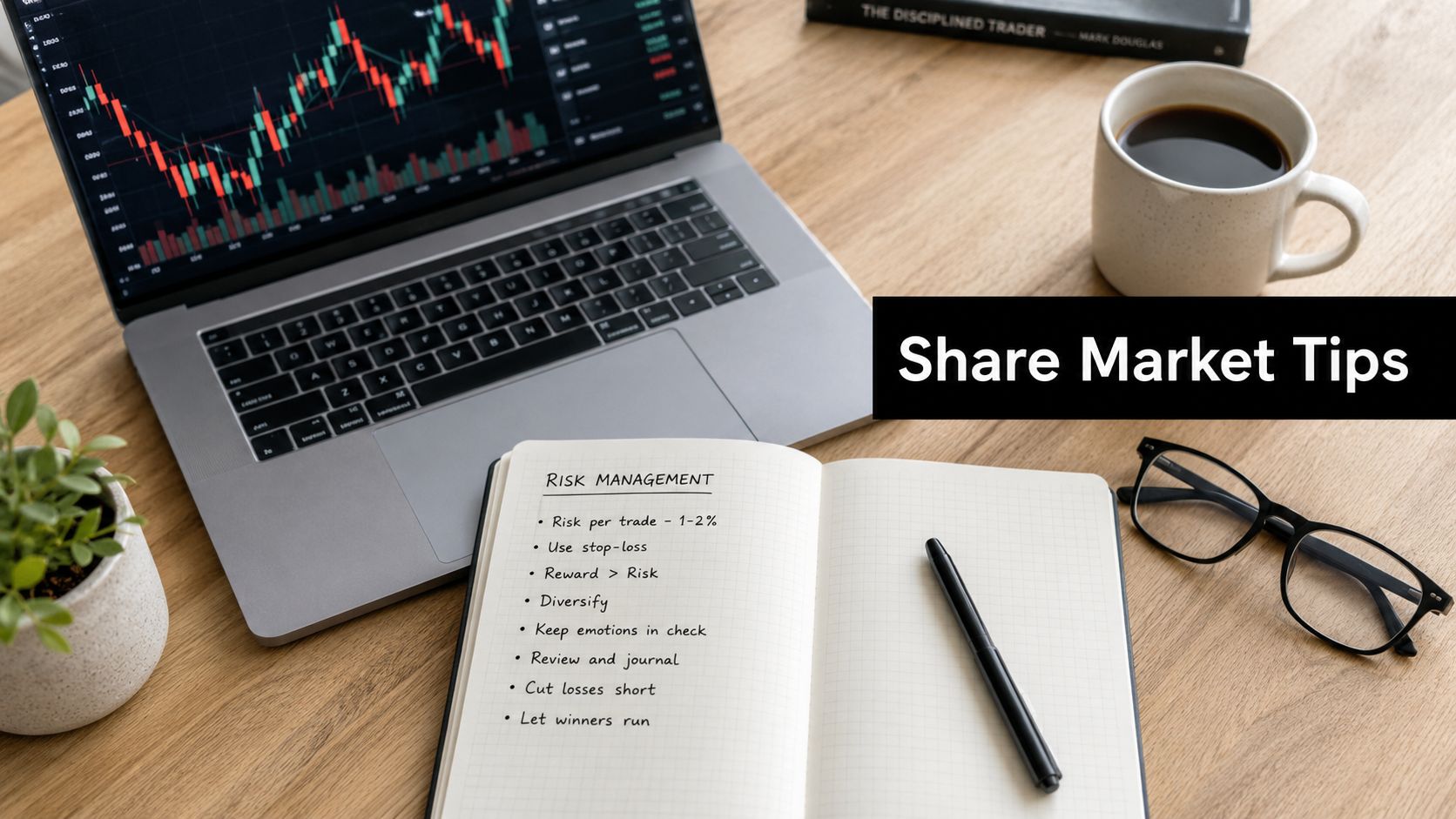
That question matters more. A weak setup with disciplined risk can be survivable. A strong setup with sloppy risk can still wreck you. This is why some of the best share market tips for beginners have less to do with prediction and more to do with protection.
Fidelity specifically recommends creating a trading plan and using stop-loss orders to automate the loss limit in its guide on what trading is and how to get started. That's practical advice, not theory. You should know your exit before you click buy or sell.
The rule beginners ignore
If your stop is “I'll decide later,” you don't have a stop. You have hope.
Good money management starts with position sizing. If the distance between your entry and invalidation point is wide, your size should be smaller. If the setup allows a tighter stop at a meaningful technical level, your size can be larger while keeping account risk controlled. The exact method can vary, but the principle never changes: risk is defined first, then position size follows.
- Set the loss first: Choose the price level that proves your idea is wrong.
- Use hard stops: Don't rely on mental exits when the market is moving fast.
- Cap exposure: If several trades depend on the same market theme, they can all lose together.
- Think in series, not single trades: One trade means little. Survival over many trades means everything.
You can go deeper into this with a focused guide on money management in trading. Beginners usually resist this topic because it feels boring. Then the first bad streak teaches them why it's not optional.
4. Learn Supply and Demand Zone Trading
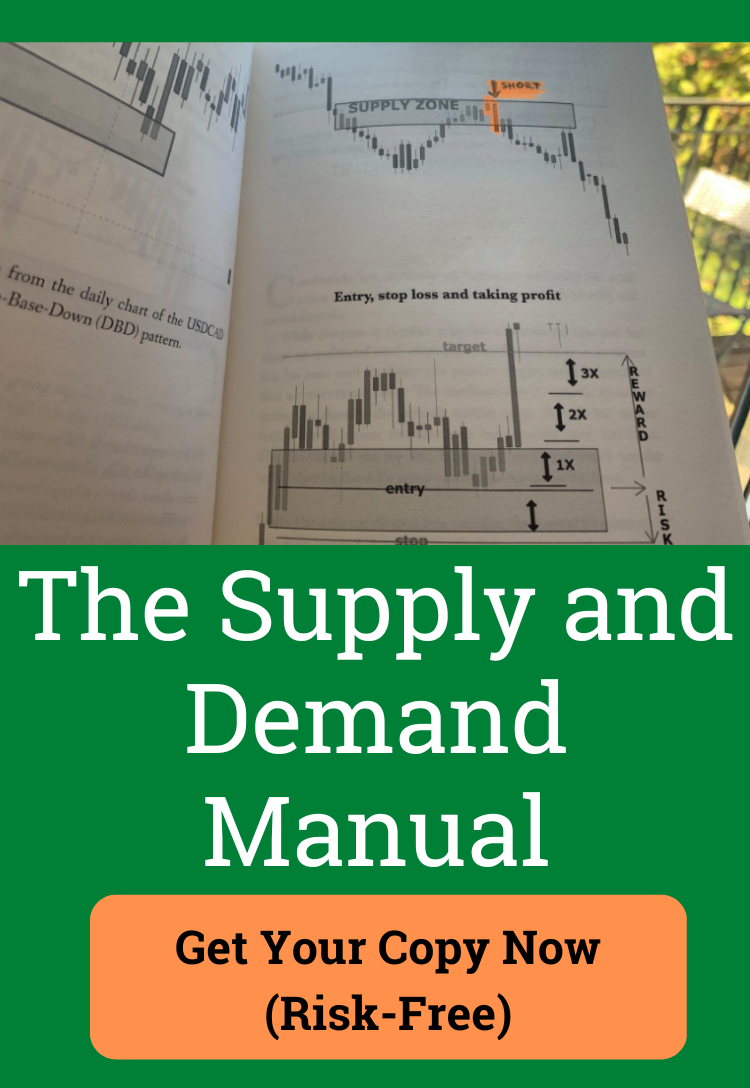
Supply and demand zones give price action context. They help you answer one of the hardest beginner questions: where is price likely to react?

A demand zone is an area where buyers previously stepped in with enough force to push price higher. A supply zone is where sellers previously hit back and drove price lower. You're not looking for exact single-price precision. You're identifying areas where order flow changed the market's direction in a visible way.
Beginners often chase candles in the middle of nowhere. Professionals prefer trading near levels where a reaction makes sense. If a stock pulls back into a clean demand zone that launched a prior rally, and price starts rejecting that area again, your trade has structure.
How to mark useful zones
Focus on areas where price left quickly after a short base or pause. Those zones often matter because they show imbalance. Then wait. Let price come back to the level and show you whether buyers or sellers still care.
A simple scenario is a stock rallying strongly from a base, then later revisiting that base. If buyers defend it and candles begin closing away from the zone, you have a cleaner long idea than buying after several big green candles.
Trade the return to the zone, not the emotional move after everyone has already noticed it.
If you want a visual lesson on how traders approach these areas, this video is a useful starting point.
Don't force zones onto every chart. Some charts are messy. Some levels are weak. Your job is to wait for the levels that stand out without argument.
5. Master Trade Psychology and Emotional Discipline
A beginner with average chart skills and strong discipline usually outlasts a beginner with great chart pattern knowledge and no self-control.
That's not a motivational line. It's how trading works in practice. Fear makes people cut winners too early. Greed makes them hold losers too long. Frustration makes them overtrade. Ego makes them ignore stops because they “know” price will come back.
What emotional mistakes look like in real time
You enter late because the move already started and you don't want to miss it. Then price pulls back normally, but you read that pullback as failure and exit. Minutes later, the trade works without you. The next setup appears, and now you're trading angry instead of focused.
That cycle is common. The fix is not more market opinions. The fix is process.
- Journal your emotions: Write down whether you felt calm, rushed, fearful, or stubborn.
- Create shutdown rules: If your mindset slips, stop trading for the session.
- Accept losses quickly: A normal loss taken according to plan is part of the job.
- Separate self-worth from P&L: A losing trade doesn't make you a bad trader.
Mindset check: If you need the next trade to fix your mood, you shouldn't be taking the next trade.
If you want a broader personal-development lens on behavior change, this guide to mindset transformation can complement the trading side. But in the market, emotional discipline comes from rules, repetition, and honest review.
6. Create a Trading Plan and Stick to It
Beginners usually think a trading plan is paperwork. It isn't. It's a decision filter.
Without a written plan, every chart looks tradable, every move feels urgent, and every exit becomes negotiable. With a plan, you know what qualifies, what doesn't, how much room the trade gets, and when you're done for the day. That structure is one reason modern stock analysis became more systematic. Public companies report earnings every quarter, and beginner stock guides commonly recommend checking revenue, EPS, and whether results beat or miss expectations before buying shares, while basic tools like the P/E ratio and comparisons between the 30-day simple moving average and the 10-day exponential moving average are widely used for context, as discussed in Schwab's article on stock investment tips for beginners.
You don't need a complicated plan. You need a usable one. It should fit on a page, and you should be able to follow it under pressure.
What belongs in the plan
Write down the market you trade, the timeframe you use, the patterns you allow, the levels you care about, and how you'll handle entries and exits. Also write down when you won't trade. News-heavy sessions, messy consolidations, and random impulse trades should all have a place in your “no” list.
A clean plan might include a price-action entry at support or resistance, a stop beyond the invalidation point, and a preplanned target based on the next key zone. It should also define whether you take partial profits or hold the full position to target.
- Entry criteria: What exact chart behavior triggers a trade?
- Exit criteria: Where is the stop, and where is the target?
- Risk rules: How do you size the trade?
- Session rules: When do you stop for the day?
If it isn't written down, it will drift.
7. Focus on High-Probability Setups and Wait for Confluence
You don't need more trades. You need better filters.
Confluence means several independent factors point in the same direction. Price is at a key level. The trend supports the idea. The candle shows rejection. Volume agrees. The setup isn't extended. That combination is stronger than taking a trade because one pattern appeared in isolation.
Beginners usually lose edge by forcing action during low-quality conditions. They trade the middle of ranges, chase candles after large moves, and ignore whether the level matters. Waiting for confluence fixes a lot of that without adding complexity.
What confluence looks like
Say a stock is trending up on the daily chart. It pulls back into prior support, which also lines up with a demand zone. Then the next session prints a strong rejection candle and closes off the lows. That's a far cleaner long than buying a random green candle in open space.
Use a checklist before every trade.
- Level: Is price reacting at a meaningful support or resistance area?
- Structure: Does the broader chart support the trade direction?
- Candle behavior: Did buyers or sellers show up at the level?
- Space to target: Is there enough room before the next obstacle?
Good traders miss plenty of moves. They just stop caring about the ones that didn't meet the standard.
The market always offers noise. Your edge comes from refusing to participate in most of it.
8. Understand Market Structure and Trade With Trends
Price action makes more sense once you stop seeing candles as isolated events and start seeing structure.
An uptrend prints higher highs and higher lows. A downtrend prints lower highs and lower lows. A range moves sideways and punishes traders who keep assuming a breakout is coming. That simple framework can clean up a huge amount of beginner confusion.
Stop fighting the chart
If the market is making higher lows and each pullback is being bought, shorting because price “feels too high” is usually a bad trade. If the market keeps failing at lower highs, buying every dip is often just catching a falling knife.
Trading with trend doesn't mean buying late after a huge run or shorting after a collapse. It means waiting for pullbacks, watching how price reacts at structure, and entering where the trade still has room to work. Britannica also notes that modern stock analysis increasingly uses AI tools to process data, news, and market trends faster than humans. That's useful context, but beginners still need to learn the basic chart logic first.
A practical scenario is a stock in an uptrend pulling back to a prior swing low area that held before. If buyers defend that area again, the trend remains intact. If price breaks that structure decisively and fails to reclaim it, your bias should change.
- Mark swing points: They tell you whether structure is healthy or failing.
- Trade pullbacks: They usually offer cleaner entries than emotional breakouts.
- Reduce size in ranges: Choppy conditions often punish trend assumptions.
- Respect structure breaks: Don't keep forcing the old bias after the chart changes.
The trend won't guarantee profit. It does improve the logic behind your trade.
9. Keep a Detailed Trading Journal and Review Performance
Most traders want better setups. What they need is better feedback.
A trading journal shows you what your memory hides. You'll think you're patient until the journal shows repeated impulsive entries. You'll think your strategy is fine until the screenshots reveal that your best trades all came from one pattern and most losses came from another. At this point, a trader starts improving on purpose instead of by accident.
What to record every time
At minimum, log the chart, the setup, the level, the reason for entry, the stop placement, the exit, and your mental state. Keep it simple enough that you'll do it. The best journal is the one you maintain consistently.
Reviewing matters as much as recording. A journal that never gets reviewed is just storage. At the end of each week, scan for repeated mistakes. At the end of each month, ask which setups deserve more attention and which ones should be cut.
- Save chart images: You'll spot pattern quality much faster visually.
- Note execution errors: Distinguish a bad trade idea from a bad trade execution.
- Track rule breaks: These often cost more than the strategy itself.
- Write one lesson per session: Keep the learning loop active.
The journal doesn't care about your excuses. That's why it's useful.
If you're serious about applying share market tips for beginners, that is when theory turns into personal evidence.
10. Start Small and Scale Gradually as You Improve
Small size is not a sign of weakness. It's how competent traders buy themselves room to learn.
A new trader with real money on the line is dealing with pressure they've never felt in demo. Entries feel heavier. Stops feel personal. Tiny losses feel larger than they are. Starting small keeps that pressure survivable while you learn to execute.
How gradual scaling should work
Your first live phase should be about clean execution, not income. Use the smallest practical size your broker allows. If your platform offers fractional shares, use them. If your usual setup still rattles you emotionally, your size is too big.
As you get more consistent, scale gradually. Not because you “feel ready,” but because your journal shows stable execution and discipline. Increase only when you're following your rules, accepting losses properly, and avoiding the emotional spikes that lead to account damage.
Here's a realistic progression. A beginner starts by taking very small positions in a handful of familiar names. They focus on one setup near obvious levels and keep risk tight. After enough clean repetitions, they scale modestly and keep reviewing whether behavior changed under larger size.
- Treat early trading as training: Skill comes before meaningful size.
- Increase slowly: A jump in size changes psychology fast.
- Watch for behavior shifts: If bigger size makes you sloppy, step back down.
- Protect confidence: A manageable loss teaches. A large one can derail progress.
Live trading should feel controlled, not thrilling. If it feels like gambling, your size is wrong or your plan is missing.
10-Point Comparison: Share Market Tips for Beginners
| Item | 🔄 Implementation complexity | ⚡ Resource & time requirements | ⭐ Expected effectiveness | 📊 Ideal use cases | 💡 Key advantage / tip |
|---|---|---|---|---|---|
| Understand Price Action Before Using Indicators | High, steep learning curve, lots of chart practice | Low capital, high time commitment; needs charting tools & historical data | ⭐⭐⭐⭐, strong long-term edge once mastered | All markets (stocks, forex, crypto); foundational for swing & intraday | 💡 Start on daily charts; journal patterns and volume confirmations |
| Start with a Demo Account to Build Confidence | Low, simple setup and low barrier to entry | Minimal cost; recommend 1–3 months of regular practice | ⭐⭐⭐, effective for skill building; limited emotional realism | Beginners testing platform mechanics and strategies before live trading | 💡 Use real position sizing and treat demo money as real |
| Develop a Solid Money Management Strategy | Medium, requires rules, math, and discipline | Low tool needs (calculator/journal); ongoing recalculation as account grows | ⭐⭐⭐⭐, essential for longevity; prevents catastrophic losses | All traders; critical for account survival and compounding | 💡 Risk 1–2% per trade; use position size formula and daily loss limits |
| Learn Supply and Demand Zone Trading | Medium–High, precision needed in zone identification | Low financial cost; requires time to mark higher timeframe zones | ⭐⭐⭐⭐, objective entries, aligns with institutional flow | Swing traders and those trading zone bounces or reversals | 💡 Prefer higher-timeframe zones; trade confirmed bounces for defined risk |
| Master Trade Psychology and Emotional Discipline | High, long-term personal development and habit change | Time, journaling, possible coaching or mentorship | ⭐⭐⭐⭐⭐, often the biggest determinant of consistent results | Traders struggling with fear, greed, impulse or inconsistent execution | 💡 Keep an emotional journal; implement rules (e.g., skip trades after losses) |
| Create a Trading Plan and Stick to It | Medium, upfront work and regular updates | Low tools; time to document and monthly reviews | ⭐⭐⭐⭐, reduces emotional decisions and enables backtesting | All traders; especially those needing structure and accountability | 💡 Write the plan before trading and review monthly with performance data |
| Focus on High-Probability Setups and Wait for Confluence | Medium, requires multi-factor checks and patience | Time for multi-timeframe analysis; fewer trades but higher prep time | ⭐⭐⭐⭐, higher win rates and better risk-reward per trade | Swing and selective intraday traders prioritizing quality over quantity | 💡 Use a checklist (pattern + zone + volume + timeframe) and accept missed trades |
| Understand Market Structure and Trade With Trends | Medium, learn swing highs/lows and structure breaks | Low tools; time to mark trendlines and watch pullbacks | ⭐⭐⭐⭐, higher probability when trading with trend direction | Trend-following strategies, pullback entries, avoiding counter-trend trades | 💡 Trade pullbacks in trend; exit or reduce on structure breaks |
| Keep a Detailed Trading Journal and Review Performance | Low–Medium, consistent discipline required | Time to record trades and weekly/monthly reviews; chart attachments | ⭐⭐⭐⭐, provides objective insights and accelerates improvement | All traders aiming to identify weaknesses and refine strategies | 💡 Record trades immediately; track win rate, avg win/loss, and emotions |
| Start Small and Scale Gradually as You Improve | Low, straightforward rules but requires patience | Low initial capital (micro/fractional); scaling metrics and tracking | ⭐⭐⭐⭐, preserves capital and enables sustainable growth | Beginners and traders growing accounts responsibly over time | 💡 Define clear scaling metrics (e.g., fixed number of profitable trades) and stick to them |
Your Next Trade: Putting These Tips into Action
Profitable trading doesn't start with a secret indicator, a chat room, or a perfect market call. It starts with learning to read price accurately, define risk before entry, and act the same way on your tenth trade as you did on your first. That's the essential edge behind strong share market tips for beginners. Not complexity. Consistency.
If you take only a few lessons from this guide, take these. Read the chart before you read opinions. Trade at levels, not in the middle of noise. Use stops because being wrong is normal. Keep size small until your behavior is stable. Write everything down so your mistakes stop hiding behind memory. Those habits sound simple, but they're the difference between a beginner who lasts and one who burns out.
A lot of new traders make the same mistake. They try to win immediately instead of trying to become competent. The market usually punishes that mindset. Competence comes first. Once you can identify clean price action, wait for confluence, and execute a written plan without improvising, you're building something durable. That's when confidence becomes earned instead of emotional.
There's also a practical reason to stay grounded. Trading will test you in ways investing often doesn't. You'll deal with uncertainty, second-guessing, temptation to chase, and the urge to move stops when the trade turns against you. Those impulses never disappear completely. What changes is your ability to handle them with structure. That's why the basics in this article matter more than flashy strategies. They're the habits you'll still rely on when conditions get difficult.
If you want guided help applying a price-action-first method, Colibri Trader is one relevant option in this space. Its focus is on straightforward trading education around price action, discipline, money management, and structured execution. That fits naturally with everything covered here.
The next useful step is simple. Pick one market, one timeframe, and one setup. Practice it in demo. Journal it. Then trade it small and review hard. If you want extra direction, take the free Trading Potential Quiz from Colibri Trader and use it to identify your current strengths and weak points. You can also get instant access to the first two chapters of an Amazon bestseller on price action and start building your process with a clearer framework.
If you want a straightforward path into price-action trading, explore Colibri Trader. You can take the free Trading Potential Quiz, review beginner-friendly training options, and dig into practical lessons built around chart reading, discipline, and risk control.