

RSI Bearish Divergence: Predict Market Reversals
You buy the breakout. The market looks strong, the candles are clean, headlines are bullish, and price is printing fresh highs. Then the move stalls. A few candles later, the rally rolls over and your “strong” setup becomes a trapped long.
That mistake frustrates traders because it feels irrational in the moment. Price looked healthy. The chart looked clean. But momentum had already started fading before price admitted it.
That's where rsi bearish divergence earns its place. Not as a magic entry signal. Not as a reason to short every new high. It works better as a warning light. It tells you that price is still moving up, but the force behind that move may be weakening.
Used properly, it can stop you from buying the top of an exhausted leg. Used poorly, it can get you run over by a strong trend that keeps grinding higher despite the divergence. That trade-off matters.
Professional traders learn this early. Indicators can point to a problem, but they rarely give the full answer on their own. RSI divergence is useful because it highlights a mismatch between price and momentum. Your actual edge comes from what you do next. You wait for confirmation. You check where the pattern forms. You read the structure around it.
That's the practical lens worth using. Start with RSI bearish divergence as a warning. Then move toward the thing that moves markets, price itself.
Introduction Trading's Most Frustrating Mistake
The painful version of this trade is always the same. Price breaks to a new high, you assume strength will continue, and then sellers hit the market almost immediately. You didn't buy a healthy trend. You bought the last push of an aging move.
That happens because traders often confuse price extension with real momentum. A market can still print a higher high even while the buying pressure underneath is thinning out. The chart looks bullish on the surface, but the internals are getting weaker.
RSI bearish divergence helps flag that mismatch before the reversal becomes obvious. It gives you an early clue that the latest push higher may not have the same conviction as the previous one. That matters most when traders are tempted to chase.
Why this mistake keeps repeating
Most traders enter too early for one simple reason. They react to the new high itself instead of asking what supported it.
A clean higher high can hide several problems:
- Weaker momentum: The move can continue upward while the speed of the advance slows down.
- Poor participation: Fewer buyers may be driving the final stretch of the rally.
- Bad location: The market may be pushing into resistance, prior highs, or an area where sellers have acted before.
Practical rule: A market making a new high doesn't automatically mean it's offering a fresh long. Sometimes it's only finishing the previous move.
RSI bearish divergence won't solve bad trading habits by itself. It won't replace patience, context, or risk control. What it can do is interrupt that impulsive urge to buy strength blindly.
The better use of the signal
The cleanest way to think about this pattern is simple. Treat it as a heads-up, not a trigger. If price reaches higher highs while RSI doesn't confirm the move, your job isn't to jump in. Your job is to slow down and watch for proof.
That shift in mindset changes everything. Instead of asking, “Can I short this now?” ask, “Is the market showing the first signs that buyers are losing control?” That question leads to better decisions because it pushes you toward confirmation, structure, and eventually price action itself.
What Is RSI Bearish Divergence Explained
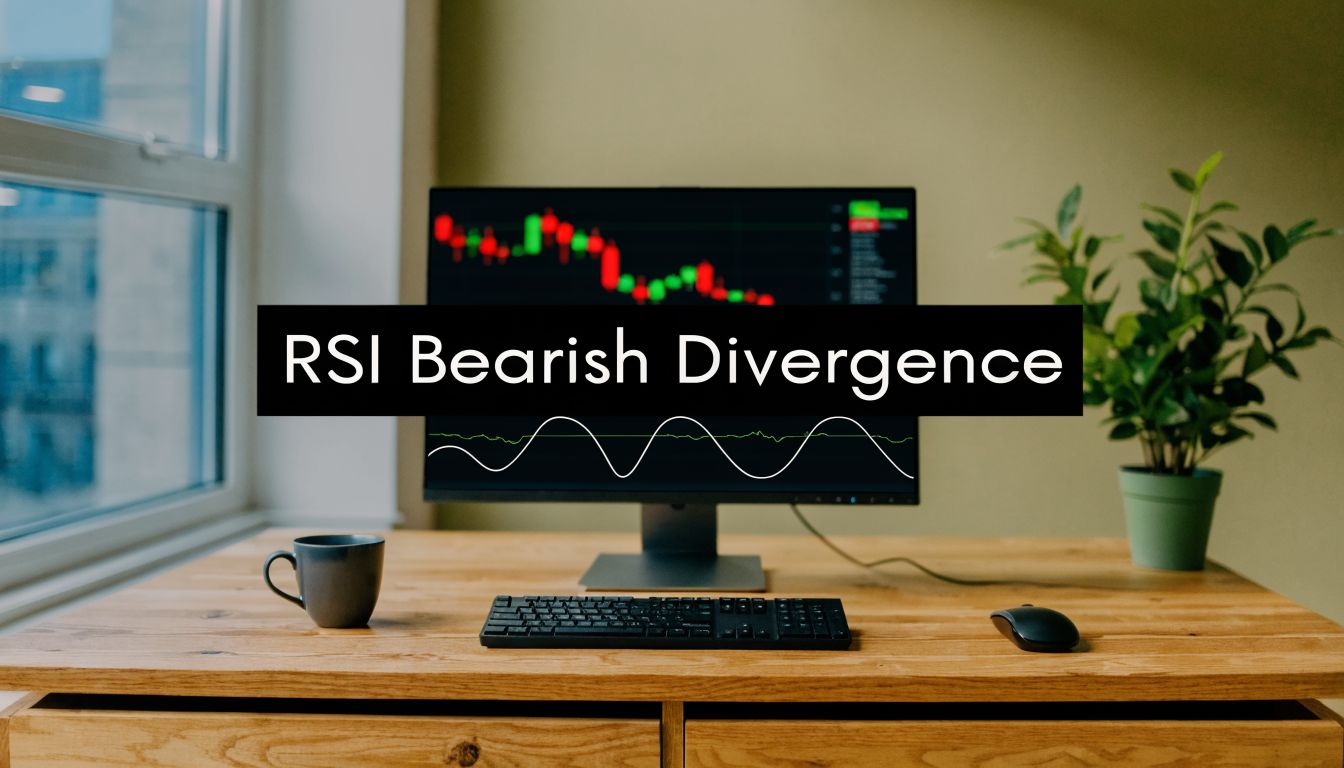
RSI bearish divergence happens when price makes a higher high while the RSI makes a lower high. Price says strength. RSI says momentum is fading. That conflict is the whole pattern.
RSI, or Relative Strength Index, is a momentum oscillator. In simple terms, it measures how strong recent buying has been compared with recent selling. When traders use the standard version, they usually look at a 14-period RSI. If you want a basic refresher on how the indicator itself works, this guide on the RSI indicator explained covers the mechanics clearly.

The simple analogy that makes it click
Think of a car climbing a hill. The car is still moving upward, but the engine is losing power. It sputters, strains, and keeps advancing only because momentum from the earlier push is still carrying it forward.
That's what bearish divergence looks like on a chart. Price keeps rising, but the engine behind the move is weakening.
The technical definition is straightforward. RSI bearish divergence is a momentum signal where price forms a higher high while the RSI, typically 14-period, forms a lower high. It points to fading bullish momentum, and Kavout's explanation of RSI divergence notes that backtests on major forex pairs showed this pattern often preceded price breakdowns by 2 to 5 bars on average on the H1 timeframe.
Why traders care about it
The pattern matters because momentum often weakens before price visibly reverses. Buyers don't disappear all at once. Their conviction usually fades first.
That's why traders pay closest attention when divergence appears under these conditions:
- An existing uptrend: Divergence means more when price has already traveled for a while.
- A stretched market: The classic setup becomes more meaningful when RSI has been in overbought territory above 70.
- A visible swing structure: You need two clear highs on price and two corresponding highs on RSI.
A divergence is not the reversal. It's the market whispering that the last push may be tired.
What it does and does not tell you
It does tell you the latest high isn't being confirmed by momentum.
It does not tell you that price must reverse immediately. Traders get into trouble when they confuse warning signs with execution signals. A market can show bearish divergence and still squeeze higher before it turns. That's why divergence works best when it pushes you to inspect price action more closely, not when it convinces you to fight a trend on faith.
How to Spot RSI Bearish Divergence on Your Charts
The pattern is easy to understand and surprisingly easy to misread. Traders often force it onto charts because they want a reversal. The fix is to use a simple checklist and stay strict.

If you want a broader primer on divergence types before drilling into this one pattern, Colibri Trader's guide to trading with divergences is a useful companion.
The chart-reading sequence
Start with price, not the indicator. That one habit keeps you from overvaluing RSI.
Find an uptrend
You want a market that has been making higher highs and higher lows. If price is chopping sideways, the signal loses clarity fast.
Mark the two swing highs on price
Don't use tiny intrabar blips. Use obvious highs that most traders would identify on the same chart.
Check the corresponding highs on RSI
Look directly below those price peaks in the RSI pane. If the first RSI peak is higher than the second one while price made a higher second high, you have bearish divergence.
Draw the lines
Connect the highs on price with an upward-sloping line. Connect the highs on RSI with a downward-sloping line. Opposing slopes make the divergence visual and objective.
What a clean pattern looks like
A clean setup has symmetry. The price highs are obvious. The RSI highs line up with those same swing points. There's no need to squint or invent the pattern.
Use this quick filter:
| Check | What you want to see |
|---|---|
| Trend context | Clear prior uptrend |
| Price structure | Second swing high above the first |
| RSI structure | Second RSI high below the first |
| Location | Near resistance or after an extended push |
| Confirmation | Some sign that buyers are losing control |
The location matters more than most traders think. Divergence in the middle of nowhere is far less compelling than divergence forming into a meaningful chart area.
One reason index traders watch this closely is market breadth. In one 2025 market analysis on RSI bearish divergence, about 50% of individual stocks were trading below their 200-day moving averages even while major indices pushed to record highs. That kind of breadth deterioration makes a new high look less healthy, even before price turns.
A small detail that improves accuracy
Don't scan for divergence on every candle. Wait for the second high to complete. Premature pattern spotting creates fake setups.
If you need to argue with the chart to prove the divergence is there, it probably isn't there.
Also, compare like with like. A meaningful swing high on price should match a meaningful swing high on RSI. Randomly pairing peaks is one of the fastest ways to turn a decent concept into noise.
A Practical Trading Setup for Bearish Divergence
Spotting divergence is analysis. Trading it requires a plan. The plan should answer three questions before you place any order. Where do you enter, where are you wrong, and where do you get paid?

Entry should come after proof
The most common mistake is shorting the moment divergence appears. That's aggressive, and aggressive usually means expensive.
A more conservative setup looks like this:
- First condition: Price prints the higher high while RSI prints the lower high.
- Second condition: Price shows a bearish reaction, such as rejection from the high or a weak close.
- Third condition: The market breaks a nearby support level or a short-term swing low.
That sequence matters because divergence alone only tells you momentum has weakened. It doesn't prove sellers have taken control yet.
Stop-loss placement and target logic
Your stop should sit where the trade idea is invalidated, not where it merely feels uncomfortable. In this setup, that usually means above the swing high that created the divergence. If price pushes cleanly above that high and holds, the bearish idea is likely early or wrong.
Targets should come from structure, not hope. Logical objectives include:
- The next support zone
- A prior consolidation area
- A major swing low inside the current trend
This is a practical way to frame the trade:
| Trade element | Conservative approach |
|---|---|
| Entry | After bearish confirmation and a support break |
| Stop-loss | Above the divergence swing high |
| First target | Nearest clear support |
| Trade management | Reduce risk if price hesitates into support |
Here's a visual walkthrough that complements the setup:
What works better in real trading
The strongest divergence trades usually share a few traits. They don't appear in random spots, and they don't rely on RSI alone.
Look for confluence such as:
- Resistance overhead: Prior highs or a supply area add meaning to the signal.
- Weak closing candles: Rejection at the top often tells you more than the RSI itself.
- Structure damage: Once price breaks the last higher low, the trade has a stronger foundation.
A disciplined trader can use RSI bearish divergence well. But the indicator is still secondary. The actual decision quality comes from waiting for price to confirm the story.
Common Pitfalls and How to Avoid False Signals
Most RSI divergence advice gets too optimistic at this stage. The setup can work, but it fails often enough that blind trust is costly.

A 2025 forex study summarized by Benzinga found that 58% of RSI bearish divergences failed to produce a significant reversal. The same study reported that filtering for signals where ADX was above 25 improved the win rate from 42% to 67%. The practical takeaway is simple. Context and filters matter more than the raw pattern.
Why the signal fails
The biggest reason is trend strength. A market can be overextended, show divergence, and still keep pushing because buyers remain in control. In that situation, divergence often leads to a pause or a shallow pullback, not a full reversal.
Traders also sabotage themselves by taking low-quality setups:
- Middle-of-the-range signals: Divergence away from resistance often has little weight.
- No structure break: If price never breaks support, sellers haven't proven anything.
- Forced readings: Traders often connect peaks that don't belong together.
Bearish divergence in a strong uptrend is often a warning of reduced momentum, not automatic proof of a top.
Filters that actually help
You don't need a huge indicator stack. You need a few decision rules.
Consider this hierarchy:
Location first
A pattern near prior highs, supply, or a clear rejection zone is more meaningful than one in open space.
Structure second
If the market closes below a prior higher low, the idea improves. If that never happens, the setup remains fragile.
Trend pressure third
If the broader move is still aggressive, don't expect every divergence to produce a major reversal.
A practical pass or trade decision
Use this quick comparison before acting:
| Situation | Better response |
|---|---|
| Divergence forms into resistance with bearish price reaction | Worth watching for entry |
| Divergence forms during a steep trend with no breakdown | Pass or wait |
| RSI diverges but candles remain strong and orderly | Don't force the short |
| Price breaks structure after divergence | Signal quality improves |
The hard truth is that many traders want indicators to remove uncertainty. They don't. They only organize it. RSI bearish divergence becomes useful when you stop asking it to predict the future and start using it to flag conditions that deserve closer price-action analysis.
Beyond Indicators The Price Action Alternative
RSI is derived from price. That fact should shape how you use it. The indicator is a translation, not the original language.
That's why many experienced traders eventually move toward a cleaner approach. They stop treating indicators as decision-makers and start treating them as supporting evidence. Price action gives the signal earlier, more directly, and with less interpretation.
What price action shows that RSI can only hint at
A bearish divergence suggests buyers are tiring. Price action can show you where that fatigue matters.
For example, if a market pushes into a supply zone, prints a weak rejection candle, and then breaks the prior higher low, you already have a full story:
- buyers reached an area where sellers were likely active
- the market rejected higher prices
- structure shifted against the uptrend
That sequence is clearer than an oscillator line bending lower.
Advanced traders often separate regular bearish divergence from hidden bearish divergence. The former points to possible reversal. The latter points to continuation. A Binance Square explanation of divergence structure notes that traders improve reliability by confirming regular bearish divergence with a break of market structure, defined as a close below the prior higher low, and by combining it with MACD histogram contraction, which can push confluence win rates as high as 78% in trending forex pairs.
That's useful, but there's also a deeper lesson in it. Even the more advanced indicator-based methods still need structure. Structure is price action.
The cleaner framework
If you want a more reliable way to trade reversals, shift your focus to these three elements:
Supply and demand zones
When price returns to an area where heavy selling previously entered, you don't need RSI to tell you the location matters. The zone itself gives context. Divergence can support the read, but the zone does the heavy lifting.
Break of market structure
A reversal idea becomes stronger when price closes below the prior higher low. That's one of the clearest objective signs that the uptrend is no longer intact. It's also more actionable than trying to short solely because RSI failed to confirm a higher high.
Candlestick behavior at key levels
A weak close, upper wick rejection, or failed breakout near resistance often tells you more than the oscillator pane below the chart. Price is where buyers and sellers show their hand.
The indicator can alert you. Price action tells you whether the market has actually changed.
Where indicator users usually evolve
Most traders don't abandon indicators in one step. They usually go through a progression:
- Stage one: Use RSI bearish divergence as a standalone signal and get mixed results.
- Stage two: Add confirmations like structure breaks, candle patterns, or another indicator.
- Stage three: Realize the most important information was on the price chart all along.
That final stage is where a lot of consistency starts. For traders who want to study a chart-led approach in more depth, Colibri Trader offers training focused on trading without indicators, centered on price action, supply and demand, and market structure.
The mature view isn't that RSI is useless. It isn't. RSI bearish divergence can be a solid warning sign. It can keep you from buying into exhausted highs. It can help you prepare for a reversal before it becomes obvious.
But if you want cleaner execution, fewer conflicting signals, and more direct reads on market intent, price action is the stronger foundation. Indicators summarize what happened. Price shows you what traders are doing right now.
If you want to build that foundation, explore Colibri Trader. The platform teaches a price-action based approach built around structure, supply and demand, and disciplined trade management, which is a practical next step if you're ready to move beyond indicator-heavy trading.