

Price Action Trading PDF: Find Your Pro Guide
You're probably doing what most traders do at the start. You search for a price action trading PDF because you want one clean resource that cuts through the noise. Instead, you find recycled ebooks, pirated course files, vague pattern lists, and pages that promise mastery but teach almost nothing.
That frustration is valid. Most traders aren't looking for “more content.” They're looking for a framework they can trust. A file they can study without wondering if it's outdated, incomplete, or written by someone who has never managed risk on a live chart.
A good PDF can help. A bad one will waste months.
The primary challenge isn't just finding a price action trading PDF. It's learning how to judge one fast, reject junk, and use the right material to build actual chart-reading skill. That means understanding what price action is, what a serious educational PDF should contain, how to avoid scam downloads, and how to turn reading into structured practice.
Your Search for a Price Action Trading PDF Ends Here
Most traders start with indicators because they seem easier. Signals feel concrete. Colored arrows feel helpful. Then the chart gets crowded, the entries get late, and every new loss creates another search for the “real” setup.
That's usually when the search for a price action trading PDF begins.
You're not really hunting for a document. You're hunting for simplicity. You want one guide that explains what matters, what to ignore, and how to stop bouncing between random strategies. That's a smart move, but only if you know how to separate a serious educational resource from a lead magnet dressed up as trading education.
A lot of PDFs in this space fail for the same reasons. They're too broad, too shallow, or too disconnected from execution. They dump pattern names on you without showing context. They talk about candles without talking about structure. They give you entries without explaining why bad location ruins otherwise clean setups.
A PDF is useful only if it helps you make better decisions on a live chart.
That's the standard to use.
The traders who improve aren't the ones who collect the most files. They're the ones who find one coherent method, study it properly, and test it until they know where it works and where it breaks. If you approach your search that way, you won't need a folder full of downloads. You'll need one resource worth your time.
What Is Price Action Trading Really
Price action trading is the practice of reading the chart directly, without leaning on layers of lagging indicators to tell you what just happened. You're reading movement, reactions, and structure. Think of it as reading the market's footprints instead of waiting for a tool to summarize them after the move.
A clean chart does more than look simple. It forces you to pay attention to the only thing that pays or punishes you. Price.

Market structure comes first
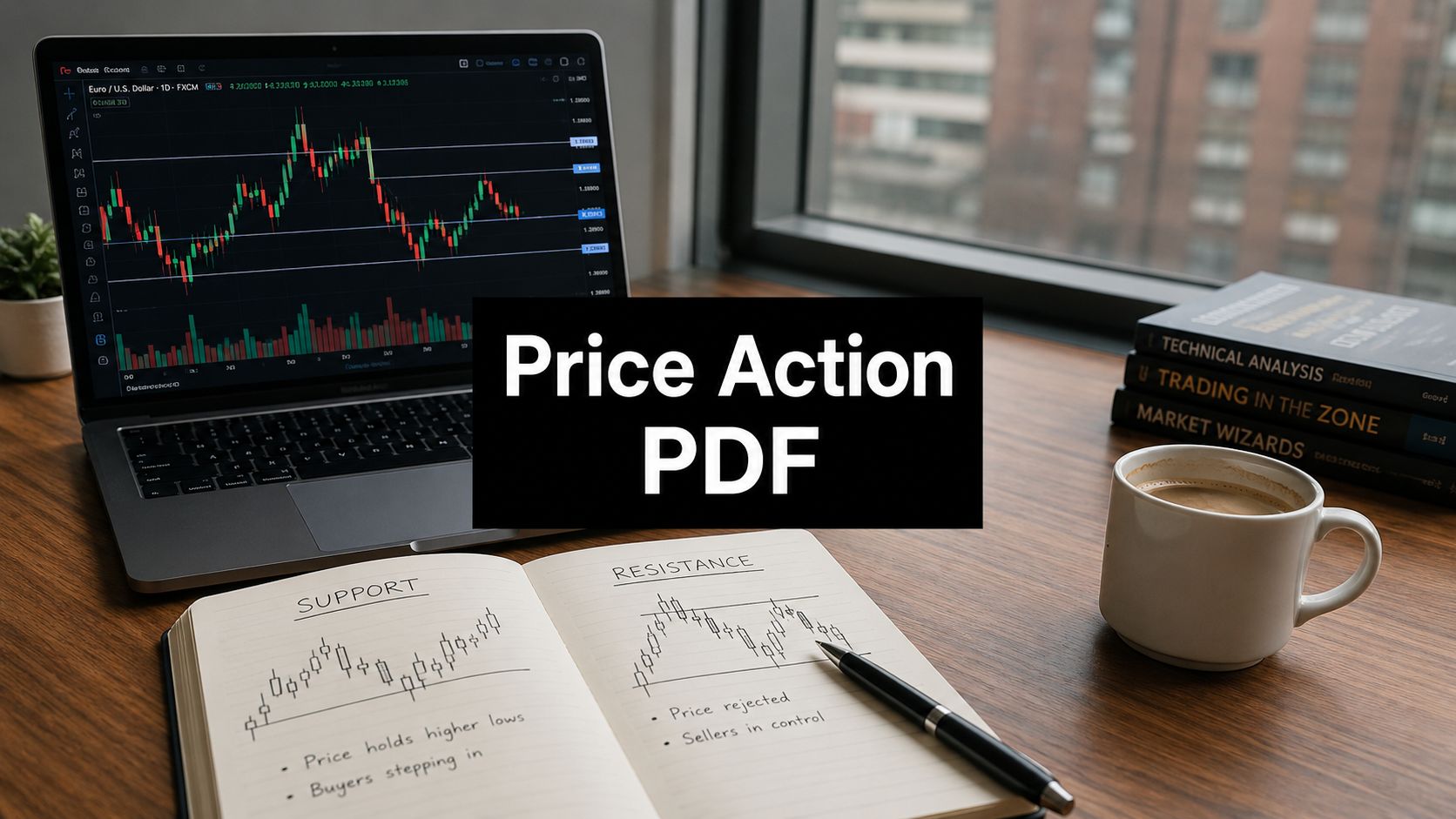
The foundation is market structure. A practical edge in price action is to classify the chart using higher highs and higher lows in an uptrend, and lower highs and lower lows in a downtrend, then only take patterns that appear at structurally important levels. That “where before what” principle matters because the same candle pattern can behave very differently depending on whether it forms at support, resistance, or inside trend continuation space, as explained in this price action trading guide on structural context.
That one idea eliminates a lot of bad trades.
A pin bar in the middle of nowhere is just a shape. A rejection candle at a meaningful level inside a clear trend is a trade idea. New traders often reverse those priorities. They memorize candles first and context second. Professionals do the opposite.
The three things you should read on every chart
If a PDF can't teach these clearly, put it aside.
- Structure: Is the market advancing, declining, or chopping sideways?
- Levels: Where have buyers or sellers defended price before?
- Trigger: What pattern or reaction confirms the idea at that location?
Those are the basic pillars. You don't need fifty patterns. You need to read how price behaves around important areas.
For an easy grasp of the idea, consider:
| Chart element | What you're asking |
|---|---|
| Structure | Who is in control right now? |
| Support and resistance | Where is that control likely to be challenged? |
| Candlestick behavior | Is price accepting or rejecting that area? |
Naked charts are not simplistic
Some traders assume price action is vague because it doesn't depend on complicated formulas. That's backwards. Reading a naked chart demands more skill, not less. You have to judge location, momentum, failed pushes, and how price reacts when it reaches a level that matters.
Practical rule: Don't study candlestick patterns in isolation. Study what happens when they form at decision points.
That's why the better price action PDFs spend less time naming patterns and more time showing chart context. They teach you to see a market as an auction between buyers and sellers, not as a collection of disconnected candle shapes.
When you understand that, a price action trading PDF stops being an ebook about candles. It becomes a manual for reading behavior.
The Anatomy of a High-Value Price Action PDF
Most traders use the phrase “price action trading PDF” loosely. That's part of the problem. Some people want a beginner handbook. Others want a one-page cheat sheet. Others want a deeper playbook with examples, rules, and review drills. The confusion gets worse because terminology varies. In some material, gaps are called windows, and fair value gaps may also be described as imbalance, inefficiency, or liquidity voids, as shown in this fair value gap trading PDF. If you don't know what type of document you need, you'll download a lot of things that don't solve your actual problem.

What a serious PDF includes
A useful PDF should narrow your focus, not expand your confusion.
Look for these signs of quality:
- One coherent method: The best guides don't throw every concept into one file. They focus on a clear framework, such as structure plus support and resistance plus a small set of repeatable triggers.
- Real chart examples: You want annotated charts that show setup location, invalidation, and outcome. General theory isn't enough.
- Risk rules: If the document explains entries but barely mentions stops, targets, or trade selection, it's incomplete.
- Language you can test: Good education gives you rules you can replay on old charts, not motivational fluff.
- Clear market context: The guide should explain when a setup fits trend continuation, reversal, or range conditions.
- Readable progression: A strong PDF builds from basics to application. It doesn't dump advanced terminology on page one.
Red flags that tell you to move on
A weak PDF usually exposes itself fast.
Here's what I'd reject:
- Pattern overload: If it lists dozens of formations with no hierarchy, you won't build skill. You'll build hesitation.
- No discussion of trade-offs: Every real method has conditions where it performs better and conditions where it gets messy.
- No author accountability: If there's no sense of who wrote it, how they trade, or what approach they employ, be cautious.
- Glossy claims with no process: A polished layout can hide shallow thinking.
- Old jargon with no modern context: Markets evolve, and so does the language around price action.
If a PDF leaves you impressed but not more precise, it failed.
Use a quick grading filter
When I review any trading PDF, I ask four blunt questions:
- Can I identify the setup in under a minute?
- Can I explain why the location matters?
- Can I define invalidation clearly?
- Can I test this on historical charts without guessing?
If the answer is “no” to even two of those, the material probably isn't ready for serious study.
For traders who want another example of structured chart education, this chart patterns PDF collection is useful as a comparison point because it shows how educational material can be organized around recognition and application rather than random theory.
The best PDFs reduce decision fatigue
A high-value price action trading PDF should make your trading world smaller in a good way. Fewer patterns. Fewer variables. Better chart selection. Clearer reasons to stay out.
That's what beginners often miss. Good trading education doesn't give you more to think about. It gives you fewer things to think about, at a higher standard.
Your Path to Vetted Resources and Avoiding Scams
You find a “free price action trading PDF,” enter your email, download the file, and within five minutes you can tell something is off. The charts are blurry. The terminology shifts from page to page. The examples look copied from different sources. That happens a lot in trading education, and it wastes more than time. It trains bad judgment.
Some PDFs are scraped from old blog posts. Some are recycled course notes with the context stripped out. Some exist mainly to push you into an aggressive sales funnel. A few downloads also raise the same concerns you would have when protecting sensitive digital files, especially if the file comes from an unknown archive site or a page that gives you no reason to trust the source.
The fix is simple. Judge the publisher before you judge the pattern.
The safer way to judge a download
A serious educational resource usually makes its intent obvious. You can see who wrote it, what method it teaches, and how the PDF fits into a broader body of work. Scammy material hides that. It relies on mystery, borrowed credibility, and pressure.
Use this filter before you download anything:
- Is the PDF hosted on a real trading education site with a visible brand and track record?
- Can you read a clear description of what the file teaches before giving up your email?
- Does the PDF match the educator's stated method, or does it feel stitched together from random trading ideas?
- Are there sample pages, chapter previews, or published articles that let you inspect the quality first?
- Would you trust this source enough to study from it for the next 30 days?
That last question matters. A weak PDF does not just give you bad information. It pushes you into fragmented study, and fragmented study is how traders stay confused for months.

What a legitimate starting point looks like
A credible starting point gives you enough material to evaluate the teaching, not just admire the packaging. Sample chapters do that well because you can inspect the logic, the chart selection, and the level of precision before you commit serious time.
That is why I put more weight on free chapters from a known educator than on random PDFs passed around in forums. Colibri Trader's introductory material works well as a benchmark for this. The point is not to treat any brand as above criticism. The point is to compare what you read against a higher standard of structure and clarity. If you want another vetted reference point, these price action trading books worth studying help you cross-check whether the PDF in front of you teaches a real process or just repackages vague trading clichés.
A good resource should let you answer practical questions fast. What market condition is it trying to trade? Where is entry? Where is invalidation? What setup gets ignored? If the material cannot answer those cleanly, it is not ready for your screen time.
Scams show their hand in small details
Bad actors rarely fail in one obvious way. They usually leave a trail of smaller problems.
- Heavy urgency with thin education: Countdown timers, limited spots, vague promises.
- No preview material: You are asked to download first and inspect later.
- No author accountability: No clear trader, no method, no consistent voice.
- Recycled presentation: Mixed branding, uneven formatting, borrowed screenshots.
- Fast upsell sequence: The PDF exists to sell the next thing, not to teach the first thing well.
Good material is inspectable. You can read it, mark up charts, test the ideas, and decide whether the framework fits your temperament and risk tolerance.
That is the advantage here. You are not just trying to find a free PDF. You are building a filter that keeps junk, scams, and shallow teaching out of your trading process.
How to Study and Apply Your Price Action PDF
Reading isn't the hard part. Turning information into execution is where most traders break down. They read ten PDFs, remember fragments, and never stay with one setup long enough to develop pattern recognition.
You need a process.

Step one and step two
Start by reading the PDF once for understanding, not memorization. You're looking for the core model. What market condition does it target? What setup does it prefer? What filters matter?
Then pick one setup only.
Not three. Not a menu.
Maybe it's a rejection pattern at support in an uptrend. Maybe it's a pullback entry after a break of structure. The point is to isolate one repeatable idea and give it room to become familiar.
A lot of online education fails because it forgets how people learn. If you want a useful framework for unlock student success online, the principle applies here too. Clear progression beats information overload.
Step three with manual chart work
Now go to historical charts and mark examples by hand. Don't optimize. Don't cherry-pick. Just apply the rules exactly as written.
Many traders finally understand risk through a practical benchmark in price action: placing the stop-loss just beyond the structural level that invalidates the setup, below support for longs and above resistance for shorts. Reward-to-risk is then measured from that stop to the nearest opposing structure, because support and resistance act as decision boundaries, as described in this price action risk management guide.
That gives you a concrete review exercise:
- Mark the level.
- Mark the entry trigger.
- Mark the invalidation point.
- Mark the nearest opposing structure.
If the target is too close relative to the stop, skip the trade in your notes. That alone will teach you why location matters.
Here's a useful video companion while you work through examples:
Step four on replay or demo
After manual review, move to forward testing on replay or demo. Here, you learn timing, patience, and what the setup feels like before the outcome is obvious.
Use a simple journal with these columns:
| Item | What to record |
|---|---|
| Market condition | Trend, range, or transition |
| Setup location | Support, resistance, pullback zone |
| Trigger | Candle behavior or structural confirmation |
| Invalidation | Where the idea fails |
| Outcome notes | Followed plan or not |
Most trading mistakes don't come from bad PDFs. They come from traders abandoning the rules before they've gathered enough clean observations.
If you want more depth after your first PDF, this list of books on price action trading can help you build a study stack without drifting back into random strategy hopping.
From PDF to Profitable Practice
You finish a PDF, mark up a few charts, take two trades, and then start hunting for another guide because the first setup did not work immediately. That cycle keeps traders busy, but it does not build skill.
A price action trading PDF is a tool. Your results come from what you do after reading it. The actual work is repetition, review, and learning to separate a clean setup from a chart that only looks clean in hindsight.
The traders I see improve fastest stop treating education like collecting files. They pick one vetted framework, keep their charts clean, define invalidation before entry, and review the same patterns until recognition becomes automatic. They also accept the trade-off. Fewer setups usually means better decisions, but it also means long stretches of doing nothing.
That part matters.
Patience is expensive psychologically. You will feel the urge to force trades just to prove you learned something. Structured practice inside a demo trading account for price action testing gives you a place to test entries, stops, and trade selection without paying tuition to the market for every mistake.
Use the PDF like a workbook, not a trophy. Mark charts by hand. Log why a setup qualified, where it failed, and whether the loss came from the method or from your execution. If you cannot explain the trade in plain language, you are not ready to size it with real money.
Stop collecting PDFs. Work one method until you can recognize it in real time, pass on weak locations, and execute it without second-guessing every candle.
If you want a practical starting point, begin with Colibri Trader's free chapters and study one clear price action framework all the way through before adding anything else.