
Mastering Trading Psychology for Consistent Profits

The real fight in trading isn't with the market—it’s the one happening between your ears. Getting your head right is the key to unlocking consistent profitability, and it’s not about ignoring your emotions. Not at all. It’s about building a solid system to manage them.
To get there, you need a disciplined framework built on self-awareness, iron-clad risk management, and an unwavering commitment to your plan.
Your Foundation for Elite Trading Psychology
So many traders get stuck chasing the perfect indicator or a magical entry signal. They burn years looking for a secret formula, only to find out the biggest hurdle wasn't the market—it was their own decision-making when the pressure was on.
Let's be clear: a winning strategy is worthless if you don't have the mental game to execute it when it counts.
This is where the real work starts. Success in trading is less of an intellectual puzzle and more of a psychological battle. It’s about mastering those gut reactions—fear, greed, the need to be right—that make us dump a perfectly good plan at the very worst moment.
The Four Pillars of Mental Discipline
Building this kind of mental fortress requires a structured approach. It all comes down to four core pillars. These aren't just fluffy ideas; they're skills you can build through practice. They give you a framework to manage your internal state so you can react to the market with logic, not emotion.
- Honest Self-Diagnosis: Figure out what specifically throws you off your game. Are you a revenge trader? Do you jump on trades because of FOMO? This step is all about brutal honesty.
- Structured Routines: Develop non-negotiable checklists for your pre-market prep and in-trade execution. Routines create consistency and take the emotional guesswork out of the equation.
- Data-Driven Journaling: Your journal isn't just for logging P&L. Use it to analyze your mental performance, spot psychological patterns, and make targeted improvements.
- Professional Risk Management: Your number one job is to manage risk. No single trade should ever have the power to cause catastrophic emotional or financial damage. Period.
“The psychological game is as crucial as the market analysis. A trader with a mediocre strategy but elite psychology will always outperform a trader with an elite strategy and poor psychology.”
The flowchart below shows how these pieces fit together. It's a continuous loop of self-improvement.
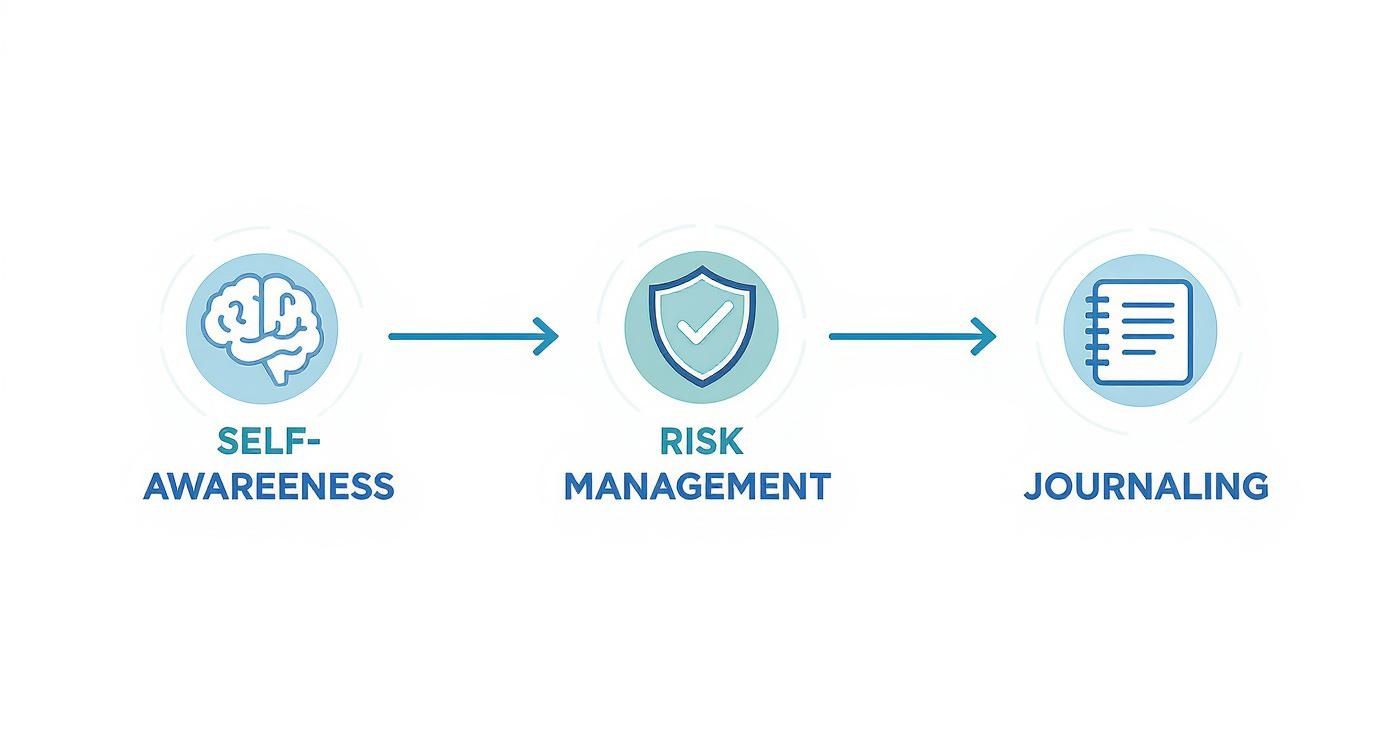
As you can see, it all starts with self-awareness. That understanding informs how you manage risk, which in turn gives you valuable data to put in your journal. Understanding the core tenets of the psychology of trading is the first step toward building this unbreakable foundation.
The table below breaks down these four essential pillars. Think of it as your roadmap to building a resilient trading mindset.
The Four Pillars of Trading Psychology Mastery
| Pillar | Why It Matters (The Problem It Solves) | How to Implement It (First Steps) |
|---|---|---|
| Self-Awareness | Stops you from repeating the same mistakes by identifying why you make them (e.g., FOMO, revenge trading, impatience). | Start a simple journal. After each session, ask: "What was my emotional state?" and "Did I follow my rules?" |
| Structured Routines | Eliminates emotional decision-making in the heat of the moment by creating a consistent, logical process. | Create a 3-point pre-trade checklist. Example: 1. Is the setup valid? 2. Is my risk defined? 3. Am I calm? |
| Data-Driven Journaling | Turns your experiences into actionable insights, helping you see patterns in your behavior you'd otherwise miss. | Log every trade with your setup, entry, exit, P&L, and one sentence on your mindset during the trade. |
| Risk Management | Protects your capital and your mental state, ensuring you can survive losing streaks to trade another day. | Define your max risk per trade (1-2% of your account is standard) and your max daily loss. Write it down. |
Mastering these pillars isn't a one-and-done task; it's an ongoing practice. Now, let’s dig into how to put each of these into action.
Pinpointing Your Psychological Weaknesses
You can't fix a problem you refuse to see. The first real step toward mastering trading psychology isn’t about reading another book; it’s about taking an honest, hard look in the mirror to identify the habits that are quietly sabotaging your trades.
Think of yourself as a detective arriving at a crime scene. Your trading history is that scene, littered with clues. Your job is to find the fingerprints left behind by your psychological culprits. Were you chasing breakouts out of FOMO? Revenge trading after a stinging loss? Or maybe you were cutting winners short because anxiety got the best of you?
This is about moving past theory and into practical diagnosis.
From Generic Habits to Specific Triggers
Just saying you have "bad habits" is far too vague to be useful. To make any real progress, you need to get specific. Pinpoint the exact situations, market conditions, and emotional states that trigger your worst decisions. This is where the heavy lifting of mastering your psychology begins.
To get there, you have to ask targeted, sometimes uncomfortable, questions as you review your past trades. This isn't about beating yourself up over past mistakes; it's about gathering cold, hard data to build a better future.
Here are a few diagnostic questions to get you started:
- For Losing Trades: Did I double down on this trade because my ego couldn't admit I was wrong?
- For Impulsive Entries: Did I jump into this trade without a valid signal just because the candle was moving fast?
- For Early Exits: Did I close this profitable trade way too soon because I was terrified of giving back my gains?
- For Missed Opportunities: Did I hesitate on this perfect setup because I was still reeling from my last loss?
By digging into the "why" behind your actions, you can stop fighting generic demons and start building targeted solutions. For instance, if you consistently see a pattern of revenge trading, the solution isn't to just "be more disciplined." A real solution is a hard rule, like a mandatory one-hour break from the charts after any significant loss. No exceptions.
Identifying Common Cognitive Biases in Your Trading
Our brains are wired with mental shortcuts, or cognitive biases, that can be absolutely disastrous in the markets. These biases are the invisible puppet masters pulling the strings, often leading us to act directly against our own best interests. Spotting them in your own behavior is a massive leap forward.
These biases are a cornerstone of behavioral finance, a field that explains why traders so often act irrationally. One of the biggest culprits is confirmation bias, where you actively search for information that confirms your trade idea while conveniently ignoring any evidence to the contrary. Emotions like fear and greed are also huge influencers; fear causes panic selling, while greed drives overtrading and insane risk-taking. You can explore more about how these psychological factors shape market behavior on tiomarkets.com.
Here are a few key biases to look for in your trade journal:
- Confirmation Bias: You bought a stock, and now you only read the news articles and analyst reports that say it's going to the moon. You dismiss anything negative as "market noise."
- Herd Mentality: A stock is trending on social media, so you jump in without doing a shred of your own analysis. You just assume the crowd knows something you don't.
- Loss Aversion: You're holding a losing trade far below your stop-loss, praying it will come back. The pain of taking a small, defined loss feels worse than the risk of a catastrophic one.
The goal of this self-audit isn't to feel bad about your mistakes. It's to create a "psychological profile" of yourself as a trader—your strengths, your weaknesses, and your most common unforced errors.
This profile becomes your personal roadmap for improvement. Once you know exactly what needs fixing, you can build the specific routines and systems designed to counteract those weaknesses. This is how you turn self-awareness into a real, tangible edge in the market.
Building Routines That Reinforce Discipline
Let’s get one thing straight: discipline isn't some magical trait you’re either born with or not. It's a muscle. And just like any muscle, you build it through consistent, deliberate action. The most elite performers in any high-stakes field, from surgeons to professional athletes, don't just wing it. They lean on structured processes to deliver consistent results when the pressure is on.
Trading is no different. This is where we stop relying on willpower and start building practical routines that shield our decision-making from the chaos of the market and our own emotional whims.
When you trade without a routine, every single action requires a fresh decision. It's mentally exhausting, and it cracks the door open for fear and greed to come rushing in. A solid routine automates your best practices, freeing up precious mental energy to focus on what actually matters: analyzing the market and executing your plan flawlessly.
This isn’t about being robotic. It’s about creating a dependable framework that keeps you grounded when the market is trying its best to throw you off balance.
Designing Your Pre-Market Checklist
Your trading day doesn't kick off with your first trade. It begins long before the opening bell with a non-negotiable pre-market checklist. This ritual is what separates the proactive professional from the reactive gambler. It prepares you mentally and strategically for the day ahead.
Think of it like a pilot’s pre-flight check. You wouldn't want them firing up the engines without making sure every system is a go, would you? Your pre-market routine is the same thing—it ensures you're ready for takeoff.
Here are a few essential components I recommend building into your own checklist:
- Mindfulness and Mental Prep: Take just five minutes for yourself. This could be a mindfulness app, some deep breathing exercises, or just sitting in silence. The goal is to quiet your nervous system and approach the screen with a clear, focused mind, not a frantic one.
- Review Your Trading Plan: Actually read your core trading rules out loud. Seriously. Voice your risk parameters, your exact entry criteria, and your exit strategies. This simple act reinforces your commitment to your system before the emotional pull of live prices takes hold.
- Scan the Economic Calendar: What landmines are on the schedule today? Identify any major news events or data releases that could inject serious volatility into the market. Knowing what’s coming helps you avoid getting steamrolled by a sudden, violent price swing.
- Identify Key Levels: Before the market opens, mark up your charts. Where are the critical support and resistance levels you'll be watching? This prep work means you're not scrambling to find opportunities once the action heats up; you’re waiting for the market to come to your predefined zones.
The purpose of a pre-market routine is to eliminate as many in-the-moment decisions as possible. When you have a plan, you follow the plan. When you don't, you follow your emotions.
This structured approach is a cornerstone of success. If you're looking for more ways to build this critical skill, our guide on improving your discipline in trading provides deeper insights into making it an unbreakable habit.
Creating Your In-Trade Protocol
Once the market opens, the psychological pressure ramps up—fast. This is where an "in-trade" protocol becomes your lifeline. What is your exact process when a trade starts moving against you? Instead of feeling the heat and panicking, you need a defined procedure to follow.
This protocol transfers control from your unpredictable emotions to a reliable, pre-planned system. It’s your if-then playbook for managing active trades.
For example, your protocol might state that when a trade hits 50% of your stop-loss, you don't just stare at the screen in fear. You pause and re-evaluate by asking a set of predefined questions:
- Is my original thesis still valid? Has anything fundamentally changed the setup?
- Has price broken a critical support or resistance level that invalidates the trade?
- Am I following my plan, or am I letting hope dictate my actions?
This systematic check brings logic right back into the driver's seat. It's what stops you from holding onto a loser "just in case it turns around," and it prevents you from bailing on a good trade at the first normal pullback.
The Power of Post-Market Review
Your trading day isn't over when you close your last position. The post-market review is arguably where the most valuable learning happens. This is your chance to analyze your performance—both strategic and psychological—away from the heat of the battle.
Keep the routine here simple but consistent. Just 15-20 minutes is all you need to review your trades and journal your thoughts and feelings. To really lock in these habits, structured journaling is key. For those looking to deepen this practice, resources like these 10 Journaling Tips to Build Self-Discipline can provide an excellent framework.
Your post-market checklist might look something like this:
| Task | Purpose | Time Allotment |
|---|---|---|
| Log All Trades | Record entry, exit, P&L, and the setup for objective data collection. | 5 Minutes |
| Journal Emotional State | Note your feelings during each trade. Were you calm, anxious, greedy? | 5 Minutes |
| Grade Your Execution | Give yourself a score (A-F) on how well you followed your rules. | 5 Minutes |
| Identify One Improvement | Find one small, actionable thing you can do better tomorrow. | 5 Minutes |
This end-of-day ritual is what closes the feedback loop. It cements the day's lessons and prepares you to start fresh the next morning, reinforcing the very discipline you need for long-term, sustainable success.
Using a Journal to Sharpen Your Mental Edge
Your trading journal is probably the most powerful psychological tool you have, but I'm constantly surprised by how many traders misuse it. They treat it like some boring accounting ledger—a simple log of entries, exits, and profit or loss.
That completely misses the point. A real trading journal is a mirror. It reflects your raw mental and emotional state back at you with unflinching honesty.
This is where we reframe the journal from a passive logbook into an active tool for mental growth. The key to mastering your trading psychology is turning subjective feelings into objective, measurable data. It's the only way to spot the destructive patterns that are secretly sabotaging your performance.

Let's be clear: this isn't about shaming yourself for mistakes. It’s about systematically finding the root causes of your unforced errors so you can build specific, targeted solutions.
Moving Beyond Profit and Loss
To really sharpen your mental edge, you have to track metrics that go way beyond your P&L. Your final profit or loss is just the outcome; the gold is in the decision-making process that got you there. Your journal needs to become a detailed record of your psychological performance.
Here are the critical data points you should start tracking immediately:
- Pre-Trade Mindset: On a scale of 1-5, how calm and focused were you before entering? Were you feeling patient, or were you itching to "make something happen"?
- Rationale for Entry: In a sentence or two, why did you take this trade? Did it meet every single rule in your trading plan, or did you bend one just a little? Be honest.
- In-Trade Emotions: What did you feel when the trade moved against you? Fear? Panic? What about when it moved in your favor? Greed? Overconfidence? Write it down.
- Execution Grade: Give yourself a letter grade (A–F) based only on how well you followed your plan, regardless of the outcome. A profitable trade where you broke the rules is an "F." A losing trade executed flawlessly is an "A."
This method forces you to confront what’s actually happening. Soon, you'll have hard evidence of your triggers. You might discover that 80% of your impulsive trades happen right after two consecutive losses, or that you consistently cut winners short on Fridays before the weekend.
Using Prompts to Uncover Hidden Patterns
Sometimes, staring at a blank page is intimidating. It's hard to know what to write. This is where structured prompts become incredibly effective—they guide your self-reflection and force you to dig deeper than you otherwise would.
Instead of just jotting down "felt anxious," use targeted questions to really explore that feeling. This turns a vague emotion into actionable data.
The goal is to create a feedback loop: identify a psychological weakness, implement a corrective action, and then use the journal to measure if that action is actually working.
Here are a few powerful prompts you can include in your daily review:
- What was my immediate impulse when the trade started moving against me? Did I follow it?
- Did I hesitate on the entry? If so, what was the real source of that hesitation?
- Was my position size based on my plan, or was it influenced by my P&L from the last trade?
- Did I find myself checking my phone or social media during the trade? How did it impact my focus?
This kind of systematic practice is exactly what top performers do in other high-stakes fields. For a closer look at these structured techniques, exploring resources on mental skills training for athletes can offer some great systematic approaches.
From Raw Data to Actionable Insights
Your journal is completely worthless if you don't actually review it. You have to set aside time each weekend to read through your entries and look for patterns.
As you do, the trends will start jumping off the page, giving you a clear roadmap for what to fix.
You might notice a pattern of over-trading on days you skip your pre-market routine. The solution becomes obvious: make that routine non-negotiable. Or maybe you'll see that your worst losses come from widening your stop-loss mid-trade. The fix is a hard rule: once a stop is set, it only moves in the direction of the trade to lock in profit. Never the other way.
Here’s a simple template to get you started on tracking what matters.
Psychological Trading Journal Template
| Metric to Track | Example Entry | Psychological Insight Gained |
|---|---|---|
| Emotional State (1-5) | 3 – A bit anxious after yesterday's loss. | Tendency to be less objective after a losing day, looking for a "rebound" trade. |
| Reason for Entry | "Setup met all criteria, but I entered 5 pips early out of FOMO." | Impatience is a key trigger. FOMO causes me to jump the gun instead of waiting for the ideal entry. |
| In-Trade Thoughts | "Price pulled back 50% and I wanted to close it immediately to avoid a loss." | Fear of giving back profits leads to cutting winners short. Need to trust the plan. |
| Execution Grade | C+ | I followed most rules but my entry was sloppy and driven by emotion, not my plan. |
This kind of structured data is what separates guessing from knowing.
Building a journal from scratch can feel like a lot of work, which is why a good template is a great starting point. To help you put these ideas into practice, check out our guide on creating a powerful trading journal in Excel. You can customize it with these exact psychological prompts.
Ultimately, journaling is the work. It’s the deliberate practice that turns a reactive gambler into a proactive, process-driven trader. It’s not glamorous, but it is the foundation on which all lasting profitability is built.
Tuning Out Market Noise and Social Pressure
In today's world, the market isn't just the charts on your screen. It's a relentless storm of breaking news, confident predictions from "gurus," and a constant stream of other traders' biggest wins plastered all over social media.
This non-stop flood of information is a direct threat to your psychological stability—and your capital.
It creates a potent psychological cocktail. Seeing someone else post a massive win can trigger intense fear of missing out (FOMO), pushing you to abandon your well-researched plan to chase a volatile move. On the flip side, sensationalist headlines can spark pure panic, causing you to exit a perfectly valid trade way too early.
Mastering your trading psychology means building a powerful filter to protect yourself from all this noise.
The Danger of Social Comparison
One of the most destructive forces a trader can face is social comparison. It’s a natural human tendency, but in the trading arena, it’s poison.
When you see another trader’s highlight reel, you're only getting a tiny, curated piece of their story. You don’t see their losses, their struggles, or the hours of work they put in. It's a recipe for disaster.
This kind of exposure can derail even the most disciplined traders. Research offers a critical insight here, showing that investors exposed to "upward social comparison"—where they see others as more successful—tend to trade more frequently and take on way more risk.
This behavior stems from a mix of emotional and cognitive triggers. While the initial excitement from this social influence might fade, the increased risk-taking often sticks around, rewriting a trader's approach for the worse. You can read more about these findings on persistent risk-taking from PMC.
Curating Your Information Diet
The solution isn't to trade in a vacuum. It’s to become an intentional curator of your information diet. You have to consciously decide what information serves your strategy and what is simply distracting, emotion-fueling noise.
It's about taking back control.
Start by auditing your information sources. Unfollow any social media accounts that just post P&L screenshots or make bombastic, high-certainty predictions. Mute news channels that thrive on sensationalism. Your goal is to create an environment that supports calm, rational analysis, not one that encourages impulsive reactions.
Here are a few actionable steps to clean up your intake:
- Limit Screen Time: Set specific times to check market news—maybe once in the morning and once midday. Avoid keeping a news feed running constantly.
- Focus on Process, Not Personalities: Follow analysts who explain their process and reasoning, not just those who give out "hot tips."
- Unsubscribe and Unfollow: Be ruthless. If a source consistently makes you feel anxious, greedy, or envious, it has to go.
"Your focus must be on executing your own plan flawlessly. The opinions and results of others are irrelevant noise that will only pull you off course."
This process of elimination is absolutely crucial. It creates the mental space you need to actually hear your own analysis and trust your own system.
Using Market Sentiment as a Contrarian Tool
Instead of being a victim of market sentiment, you can learn to use it as a powerful contrarian indicator. Tools like the Fear and Greed Index, which measures investor emotion, can be incredibly valuable when you look at them through the right lens.
Most amateurs see "Extreme Greed" and immediately feel FOMO, thinking they need to jump in. A professional sees it as a warning sign that the market might be overextended and ripe for a reversal.
They see "Extreme Fear" not as a reason to panic sell, but as a potential opportunity to buy when everyone else is capitulating.
By developing this contrarian mindset, you flip the script. You're no longer reacting to the herd's emotions; you're using their predictable behavior as just another data point in your analysis. This is a hallmark of traders who have truly mastered their psychology. They have an unshakable conviction in their system because they've done the hard work to build a process that filters out the noise and focuses only on what actually matters.
Common Questions on Trading Psychology
As you start to really dig into your trading mindset, you're bound to run into some roadblocks. It happens to everyone. Here are some of the most common questions I get from traders, along with some straight-to-the-point answers to help you stay on track.
How Long Until I Master Trading Psychology?
This is probably the number one question traders ask, but it's not quite the right way to think about it. Mastering your psychology isn't like finishing a course where you get a certificate at the end. It's an ongoing practice, a skill you sharpen for your entire career. The market changes, and so do you.
That said, traders who genuinely commit to the process—journaling every trade, sticking to their routines, and being brutally honest with themselves—usually see a major drop in emotional mistakes within three to six months.
It's not about the clock. It's about consistent, deliberate effort. Just 20-30 minutes a day reviewing your mindset and your trades will compound into something powerful. You're building habits that last, not just learning ideas from a book.
Is It Possible to Trade Without Any Emotion?
Nope. And honestly, you wouldn't want to. Emotions are part of being human; they're not going anywhere. The mission isn't to become a trading robot. It's to build such a solid framework of rules and routines that your emotions can't take the driver's seat.
Professional traders feel fear during a drawdown. They feel the temptation of greed after a string of winners. The crucial difference is they don't act on those feelings. They act on their pre-defined, back-tested trading plan. The emotion is just a piece of information to acknowledge, not a command to obey.
What’s the Biggest Psychological Mistake New Traders Make?
Easy. It's revenge trading. I've seen it destroy more accounts than anything else.
Revenge trading is when you take a loss and, fueled by frustration and a bruised ego, immediately jump back into the market to try and "make it back." It’s a pure, gut-level reaction, and it has nothing to do with a valid trading setup.
When you do this, you throw your strategy, your risk management, and any sense of clear analysis right out the window. You’re trading from a place of desperation, not logic. It’s the fastest way to turn a small, manageable loss into a catastrophic one.
How Do I Survive a Losing Streak Without Crushing My Confidence?
First, accept that losing streaks are inevitable. They are a mathematical certainty for every trading strategy, no matter how good it is. Your job isn't to avoid them but to manage them professionally. Here’s how:
- Walk Away. Seriously. The moment you feel yourself getting tilted, shut down the charts. Take at least a day off to break the emotional spiral and get your head straight.
- Open Your Journal. This is where your hard work pays off. Go back and see if you followed your plan to the letter. If you did, then the losses are just the cost of doing business—a normal statistical outcome. This should actually boost your confidence in your discipline.
- Find the Leaks. If your journal shows you were bending the rules, then it has done its job perfectly. It has pinpointed exactly what you need to fix. The problem isn't the market; it's your execution.
- Cut Your Size. The best way to get your footing back is to lower the emotional stakes. Slice your position size in half, or even more, until you string together a few winning trades where you follow your plan perfectly.
Should I Use Market Sentiment Indicators?
Yes, but probably not how you think. A tool like the Fear and Greed Index is fantastic, but most people use it backward. This index gives a score from 0 to 100 to show whether the market is in a state of extreme fear or extreme greed.
Instead of getting scared when the index is low, a disciplined trader sees a potential opportunity. They’re guided by Warren Buffett’s classic line: be "fearful when others are greedy and greedy when others are fearful."
The professional trader uses widespread fear as a signal to start looking for bargains and extreme greed as a warning that things might be getting overheated. You’re using the crowd’s emotion as another data point, not as your trading signal.
Ready to stop letting emotions sabotage your trading results? At Colibri Trader, we teach a simple, price-action-based approach that helps build the discipline and psychological strength you need for long-term success. See what you're capable of and start your journey with a proven system today. https://www.colibritrader.com