

Futures and Forex: Which Market Is Right for Your Strategy?
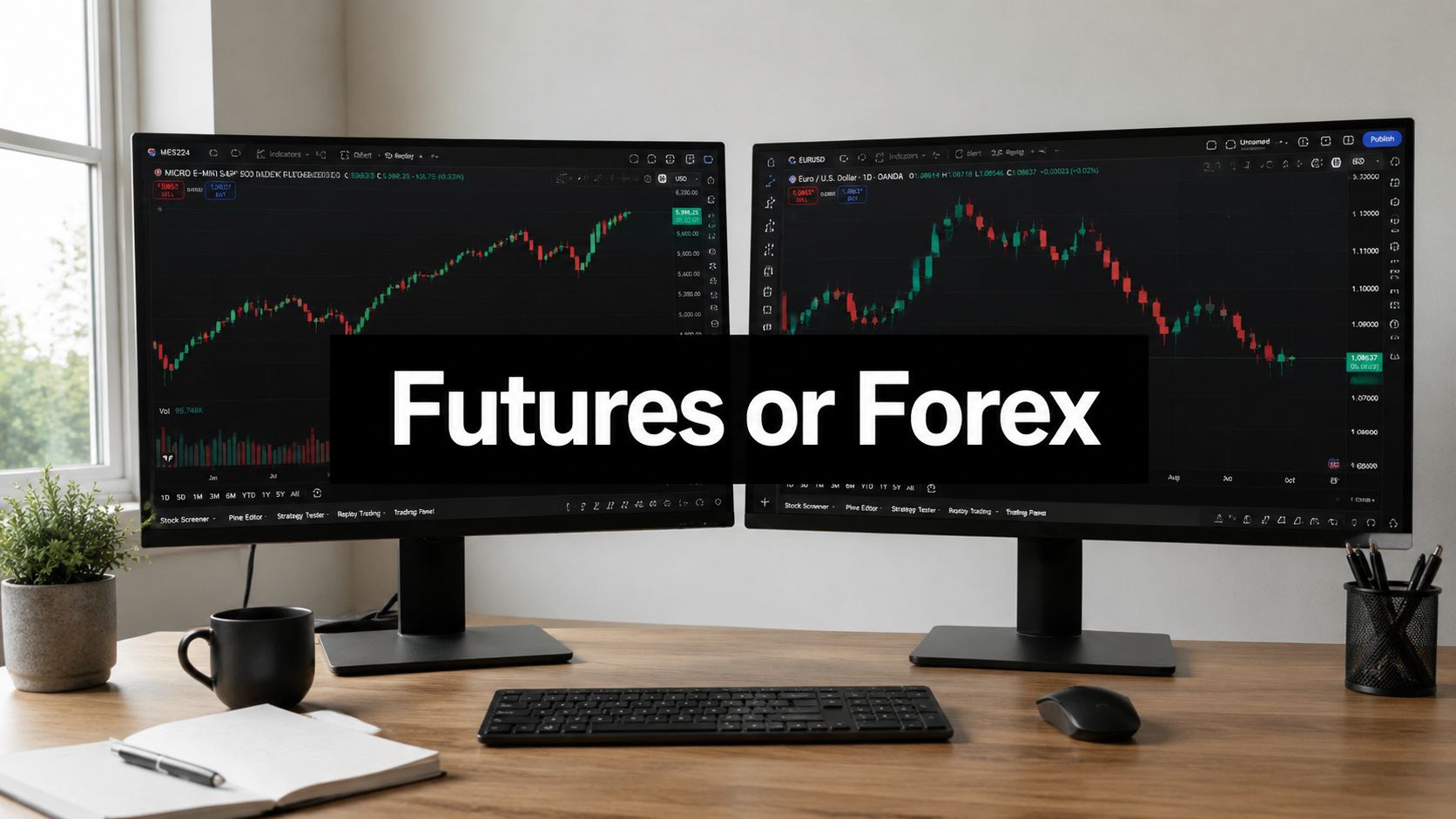
You're probably in the same spot most developing traders hit sooner or later. You've spent time on charts, learned basic support and resistance, maybe started spotting cleaner supply and demand zones, and now one question keeps getting louder. Should you focus on futures or forex?
That choice matters more than most beginners think. Not because one market is magically easier, but because the structure of the market changes how your price-action reads behave, how your risk behaves, and how disciplined you need to be to survive bad stretches.
A lot of comparisons miss that point. They talk about hours, capital efficiency, and fees in broad terms, then leave you to connect the dots yourself. For a price-action trader, those dots are everything. A clean pin bar means one thing in a centralized market with reliable volume, and something a bit different in a decentralized market where your broker's feed is only part of the picture.
Starting Your Journey in Futures and Forex
Most traders don't choose between futures and forex with a clear framework. They choose based on what they see first. One broker pushes low barriers to entry. Another trader talks about exchange transparency. A YouTube video says forex is flexible. A forum post says futures are more professional.
That usually creates confusion, not clarity.
The better question isn't “Which market is better?” It's which market fits the way you read price, control risk, and build consistency. If your method is based on candlestick structure, trend behavior, swing points, and supply and demand, then the details of market structure are not side notes. They shape your entire process.
For a newer trader, forex often feels more approachable because position sizing can be very flexible. If you're still getting your feet under you, a practical starting point is learning the mechanics first through a guide like how to start forex trading. That lets you understand order placement, sessions, and pair behavior without immediately dealing with contract specifications.
What actually matters
A useful decision framework comes down to a few practical questions:
- How do you confirm a trade idea? If you rely heavily on volume context, futures gives you cleaner information.
- How much sizing flexibility do you need? Forex usually gives smaller and more adjustable trade sizing.
- When can you trade? Some traders need the broader schedule forex offers.
- How much structure helps your discipline? Futures tends to force more precision.
Practical rule: Pick the market that makes it easier to follow your rules, not the one that makes it easier to place a trade.
That distinction saves traders a lot of pain. Easy access is often mistaken for a good fit. They are not the same thing.
Futures and Forex Understanding the Arena
The biggest difference between futures and forex is market structure.
Futures trade on a centralized exchange. Forex is an over-the-counter market, which means it's decentralized. That single difference affects how price forms, how volume is reported, and how much trust you can place in the data on your screen.

What a centralized futures market changes
In futures, traders interact through an exchange. That matters because everyone is working from the same core pricing environment. You're not trying to interpret a chart built from one broker's private stream of quotes. You're seeing a market with a unified order book and official traded volume.
For a price-action trader, that gives useful context.
If price reaches a supply zone and stalls, you can study that reaction with more confidence in the surrounding participation data. If a breakout fails, you can evaluate whether the move lacked commitment or ran into opposing flow. Even if you don't use advanced order flow tools, the environment itself is more transparent.
What a decentralized forex market changes
Forex works differently. There is no single exchange where all retail and institutional participants meet in one visible order book. Banks, brokers, funds, and traders operate through a network of counterparties. Your chart reflects the feed your broker provides.
That doesn't mean forex price action is unusable. Far from it. Major pairs often move cleanly, respect structure well, and provide excellent opportunities. It does mean you need to build your read around price itself, not around the idea that your platform is showing a complete view of global volume.
Here's the practical consequence:
| Feature | Futures | Forex |
|---|---|---|
| Market structure | Centralized exchange | Decentralized OTC network |
| Price visibility | Shared exchange-based pricing | Broker-dependent quotes |
| Volume data | Official traded volume | Partial or proxy volume |
| Best use for price action | Structure plus participation context | Pure structure and reaction reading |
| Discipline pressure | More standardized environment | More broker and platform variation |
In futures, volume can support the story. In forex, price has to tell the whole story.
That's why experienced supply and demand traders often gravitate toward futures after spending time in forex. Not because forex stops working, but because futures provides another layer of confirmation. If you're already skilled at reading rejection, momentum loss, and market structure shifts, that extra clarity can be valuable.
A Core Comparison of Futures vs Forex
The practical differences between futures and forex show up in your routine. They affect how you size trades, how you plan sessions, and how much friction sits between your idea and the actual execution.

Trading hours and daily rhythm
Forex trades across the global business week, which gives you broad access. That suits traders in different time zones and traders who need flexibility around work or family. If you want to review charts in the evening and still find active markets, forex can be easier to fit into real life.
Futures also offer broad access, but the practical rhythm depends on the specific contract. Liquidity tends to concentrate around the main session for each instrument. That can be a strength. Many traders perform better when there's a clearer window to prepare, execute, and then stop.
A market that never seems to sleep can become a problem if you already struggle with overtrading.
Leverage and margin behavior
Forex often attracts traders because brokers can make the market look very accessible. Small account, flexible sizing, quick entry. The danger is obvious to anyone who has been around long enough. When position size is too easy to inflate, discipline usually breaks before the strategy does.
Futures margin feels more mechanical. You trade a standardized contract, and the margin framework is clearer. That doesn't make futures safer by default. A contract can still move hard against you. It does remove some of the illusion that you can ignore risk because your platform lets you click larger size.
For price-action traders, that matters because a good setup still fails sometimes. If your market makes oversizing easy, one failed breakout or one fakeout at a demand zone can do more damage than it should.
Costs and where they hide
Forex trading costs are often embedded in the spread, and sometimes in commissions depending on the broker and account type. Futures usually show costs more explicitly through commissions and exchange-related fees.
Neither model is automatically better. The important part is whether you understand your all-in cost before you trade.
Here's the practical difference:
- Forex spreads can distort very short-term entries. If you scalp around tight intraday levels, spread behavior matters a lot.
- Futures costs are easier to separate from the chart. You can usually assess the market move and the transaction cost as distinct parts of the trade.
- Execution quality matters more than advertised cheapness. A “low cost” market that slips badly around your setup isn't cheap.
Regulation and trust
This issue gets ignored until a trader has a bad broker experience.
Futures generally operate inside a more standardized and regulated framework tied to exchange-traded products. Forex quality varies more by broker and jurisdiction. There are reputable forex brokers, but there's also more variation in execution, pricing, and trading conditions across firms.
If you're still choosing your market for trading, it helps to look at the decision through the lens of trust and process, not just opportunity. A market you trust is easier to trade with consistency because you spend less mental energy second-guessing fills, spikes, or spread behavior.
Before watching someone else compare the two, look at this quick walkthrough first.
Standardization versus flexibility
This is one of the genuine trade-offs.
Forex lets you fine-tune position size with a lot of flexibility. That's useful for small accounts and for traders who want extremely precise scaling. Futures contracts are standardized, which reduces flexibility but increases clarity.
That clarity helps more than most traders expect. When your instrument has defined contract behavior, tick structure, and expiration rules, you stop guessing and start planning.
Traders often say they want flexibility. What they usually need is a framework that stops them from improvising.
Instrument breadth
Forex is focused on currency pairs. Futures span currencies, indices, commodities, and rates. If your edge is heavily tied to one type of movement, this matters.
A trader who likes clean reactions around macro session opens may prefer index futures. A trader who understands currency relationships may prefer forex pairs. Neither choice is superior on its own. The right choice is the one that lines up with how you already read movement and manage risk.
Instruments and Contracts What You Actually Trade
Forex traders buy and sell currency pairs. Futures traders buy and sell standardized contracts. That sounds simple, but the trading experience feels different once you start managing real risk.
In forex, your unit is usually expressed in lots or fractional lot sizing. That gives you flexibility. You can reduce size very precisely, which is useful when your account is small or you're still learning to keep losses controlled.
In futures, every contract has fixed specifications. The instrument tells you what you're trading, how it moves, and what the minimum price increment is. If you're not used to that structure, studying a futures contract example helps because contract mechanics are not optional details. They shape your stop placement, target logic, and trade selection.
Why standardized contracts help some traders
A standardized contract creates boundaries. That's often good for traders who need more structure.
With futures, you don't just see price moving. You know the instrument has a specific tick size, an expiry cycle, and a defined contract model. That makes risk mapping more straightforward. A move from entry to stop has a clearer monetary meaning before you place the trade.
For many price-action traders, that reduces mental noise.
Why forex sizing feels easier at first
Forex often feels friendlier in the beginning because you can scale down aggressively. If your setup requires a wider stop because the pair is volatile, you can often reduce size in a very fine way. That flexibility can support disciplined risk control.
It can also become a trap.
Because trade sizing is so adjustable, traders sometimes stop respecting the relationship between structure and risk. They take weak setups because they can make the position tiny. That usually leads to too many trades, not better trades.
A trader's-eye view
Think of it this way:
- Forex asks whether the pair is moving cleanly enough for your setup.
- Futures asks whether this specific contract is worth the fixed commitment your rules allow.
- Both ask whether the level is real, the reaction is clean, and the reward justifies the risk.
That last point matters most. Good traders don't pick a market because it seems advanced. They pick a market where their execution stays disciplined.
Price Action Strategies in Each Market
Moving beyond theory, the choice between futures and forex reveals its practical distinctions. Your charts may look similar at first glance, but the way you confirm levels, judge conviction, and handle failed setups changes with the market.

Trading supply and demand in futures
A supply zone in futures can carry more context because the market gives you centralized volume information. That doesn't mean every high-volume level matters, or that volume turns a bad zone into a good one. It means you have another way to judge whether a reaction area attracted real participation.
If price drives into a prior supply area and stalls, you can study whether the move is slowing, whether participation expands on rejection, and whether the auction is being accepted or rejected. For a trader who already uses raw price first, that's a useful filter.
The strongest futures price-action work usually combines:
- Structure first: clear swing highs, swing lows, trend shifts, and level integrity
- Reaction quality: strong rejection, failed continuation, or momentum loss
- Volume context: participation that supports the move or the rejection
- Execution discipline: entries taken only when the market confirms the idea
That's why many intermediate traders find futures attractive once they've built a base in naked chart reading. The market lets them add context without abandoning price action.
Trading supply and demand in forex
Forex price action leans more heavily on clean chart reading. You're reading rejection candles, breakout failures, compression, session behavior, and level responses without relying on official centralized volume.
That doesn't weaken the method. It sharpens the need for precision.
In forex, your best zones tend to be the ones that stand out clearly on structure alone. You want obvious imbalance, strong displacement away from a level, and clean revisits. You also need to respect session timing because the same zone can behave differently depending on when price returns to it.
A forex zone that looks good in isolation may be mediocre once you factor in session context and the quality of the approach.
What works and what tends to fail
Some tactics transfer well between futures and forex. Others don't.
What usually works in both:
- Waiting for price to reach a meaningful area
- Using market structure shifts as confirmation
- Trading clean rejection instead of predicting blindly
- Keeping risk fixed before the trade is live
What often fails in both, but especially in forex:
- Forcing trades in the middle of a range
- Using low-quality broker volume as if it were complete market truth
- Chasing candles after impulsive moves
- Treating every support or resistance line as tradable
A practical adjustment by market
If you trade futures, let price lead and use volume as confirmation.
If you trade forex, let price lead and accept that price may be your only reliable confirmation.
That distinction sounds small. It isn't. Traders get into trouble when they copy tactics from one environment into the other without adjusting their expectations.
For traders who want one framework across both markets, a straightforward path is to build the method around structure, candle behavior, and supply and demand first, then add market-specific context second. Some traders use platforms and training environments such as Colibri Trader to keep that process centered on price action rather than indicator stacking. That matters because the core skill should travel across instruments, even when the supporting data differs.
Managing Risk in Futures and Forex
Risk management changes shape depending on the market. The rules are still the same. Define the loss, size correctly, and avoid emotional decisions. But the friction points are different.
Forex exposes traders to a broad weekly cycle that can punish loose risk habits. If you hold positions through the weekend, price can reopen away from where you expected. A stop is still necessary, but traders need to understand that the market doesn't always move in a smooth line from Friday close to Monday open.
That matters for swing traders who think a small position automatically means small risk. It doesn't, not if you're carrying exposure through uncertain periods.
Where futures can help discipline
Futures often creates a more structured routine around session behavior and overnight decisions. That won't protect you from poor judgment, but it does force more deliberate planning. You're less likely to drift into random holding if your entire workflow is built around session preparation, execution, and review.
Read this alongside a solid process for managing trading risk if your main problem isn't finding setups but controlling what happens after entry.
Rules that need to match the market
Use market-specific rules instead of generic ones:
- For forex swing trades: decide in advance whether weekend exposure is allowed at all.
- For futures day trades: define when the trade must be closed if the setup hasn't followed through.
- For both markets: place the stop where the setup is invalidated, not where the loss feels emotionally comfortable.
The fastest way to damage a good strategy is to use the same risk habits in two different market structures.
Your Trading Path Which Market to Choose
The right answer depends less on hype and more on your stage as a trader.

If you're new
Start where you can practice execution without constant pressure. For many traders, that means forex because sizing can be more forgiving and access is simple. If you go this route, keep the focus narrow. Trade a small watchlist of major pairs, stick to one session, and learn how levels behave before adding complexity.
Micro futures can also be a solid fit if you want a more structured environment from the start.
If you're stuck in inconsistency
This is the group that often benefits most from futures. If you already understand support and resistance, basic trend logic, and candlestick rejection, but you're frustrated by noisy execution or incomplete context, futures may fit your next stage better.
The structure tends to reward traders who are ready to become more selective.
If you're experienced
Choose based on how your edge forms.
If your strategy depends on session movement, cleaner centralized context, and more formalized execution, futures usually makes sense. If your edge comes from reading currency behavior, holding through broader time windows, or needing flexibility across the global trading week, forex may stay the better home.
A simple decision filter
Use this filter judiciously:
- Choose forex if you need flexible sizing, broad access, and you're comfortable relying mostly on pure price action.
- Choose futures if you want centralized structure, more transparent context, and stricter boundaries around execution.
- Choose one first if you're still developing consistency. Divided focus usually delays progress.
If you want a price-action framework that can help you evaluate both futures and forex without burying the process under indicators, Colibri Trader offers education built around supply and demand, discipline, and practical trade execution.