
Cut My Losses Meaning: A Trader’s Guide to Risk Control
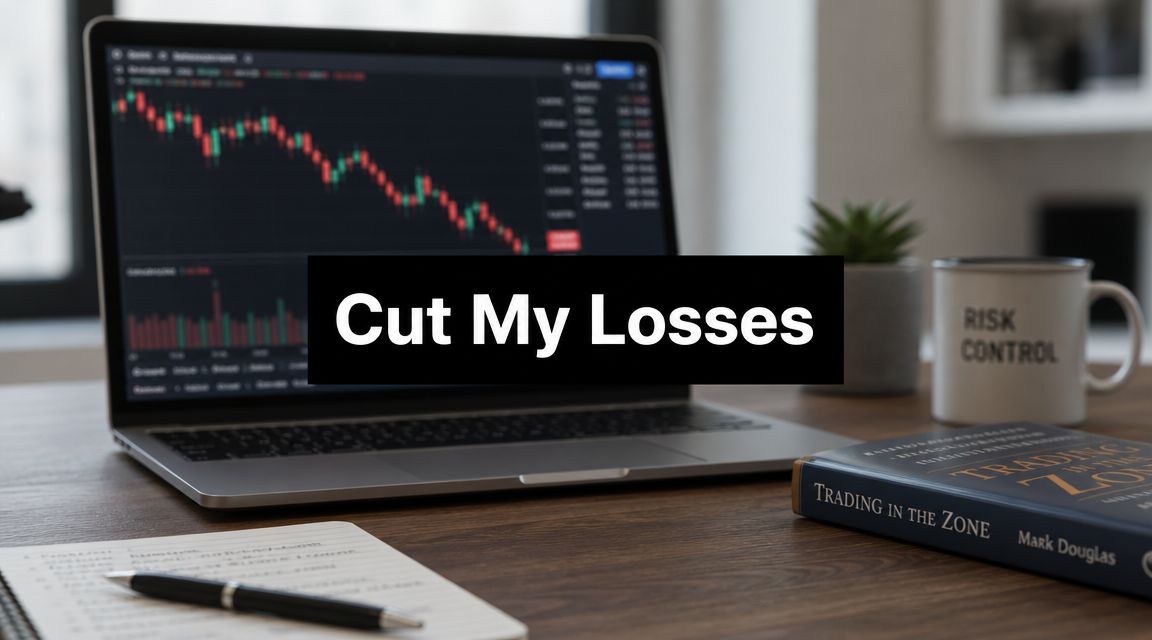
You're probably in this spot right now. You bought a setup that looked clean, price moved against you, and now you're staring at the chart trying to decide whether to hold, hope, or get out.
That's where the true cut my losses meaning shows up in trading. Not in a dictionary. On a live chart, when your original idea starts to fail and your emotions start arguing with your plan.
Most new traders think cutting a loss means they were wrong. Professionals treat it as routine. A losing trade isn't the problem. Refusing to manage it is.
What It Really Means to Cut Your Losses in Trading
You buy a breakout, price stalls, then slips back under the level that justified the trade. At that point, cutting the loss does not mean reacting to discomfort. It means accepting that the setup is no longer doing what it needed to do.
In plain English, cut your losses means ending a bad situation before it becomes more expensive. In trading, the idea is tighter than that. You exit when price action invalidates the trade, not just because the position is red on your screen.
That distinction matters. A trader who exits every time a trade dips a little gets chopped up by normal volatility. A trader who gives every losing position "more room" usually turns a small mistake into account damage. The job is to separate normal noise from a true failure of the setup.

What it means on a live chart
Say you buy at $100 because buyers held support and printed a strong bullish rejection. If price later closes below that support and fails to reclaim it, the trade idea has changed. Exiting at $95 is not weakness. It is a decision based on the chart.
If you hold while price keeps sliding to $80, the problem is no longer the original trade. The problem is that you stayed after the market told you your read was wrong.
That is the part new traders miss. The loss often comes from a valid setup that failed. The larger loss comes from ignoring the point of invalidation.
Practical rule: Cut the trade when the reason for entry is gone, not when your emotions finally give up.
Why cutting losses is a skill, not a slogan
"Cut your losses" gets repeated so often that traders treat it like a motivational line. It is not. It is an execution skill tied to trade location, structure, and timing.
I look at one question first. What specific price action would prove my idea wrong?
For a support bounce, that may be a close below the swing low. For a breakout, it may be a failed hold above resistance. For a trend continuation entry, it may be a break of the prior higher low or lower high. The exit has to match the setup. If it does not, the stop is arbitrary.
This is also why simple loss-cutting can underperform. Traders who use the same fixed stop on every pattern often get pushed out by routine movement, then watch price run without them. Traders who never define invalidation do the opposite and hold far too long. Good risk management sits between those two mistakes.
Why this matters for your account
Trading is not about avoiding losses. It is about keeping losses small enough that you can keep executing clearly on the next opportunity.
A controlled loss preserves capital, but it also preserves decision quality. Once a manageable loss turns into a painful one, traders start forcing entries, skipping rules, or hesitating on good setups. That cycle is part of why trading psychology breaks down under pressure.
Use this framework:
- A loss is acceptable when the setup is invalidated
- A loss is avoidable when poor planning caused it to grow
- Capital must stay available for the next clean trade
Cutting losses in trading means closing the position at the point where price action proves your original idea is no longer valid. That is how you protect both capital and consistency.
The Psychology Why It's Hard to Let Go of a Losing Trade
The logic is simple. The execution isn't.
Once you're in a losing trade, your brain starts trying to protect your ego before it protects your capital. That's why traders who understand stop-losses still fail to use them properly.

The three traps that keep traders stuck
The first trap is sunk cost thinking. You've already committed money, time, and emotional energy to the setup, so closing it feels like making the loss real. It isn't rational, but it's common. Traders start saying things like, “I've held this long, I might as well give it more room.”
The second trap is regret aversion. You don't want to exit and then watch price reverse without you. That fear is powerful because every trader has lived through it. One painful scratch followed by a rally can make a novice hold the next five bad trades too long.
The third trap is hope disguised as analysis. This one is the most dangerous. Traders stop reading price objectively and start inventing reasons the market “should” turn.
Hope has no edge. Price does.
What this looks like in real trading
A novice sees a candle push through their stop area and thinks, “It's just a shakeout.” Then price closes beyond structure, retests, and keeps going. At that point the trade isn't under pressure. The trade idea is breaking.
That's why emotional discipline matters as much as chart reading. If you can't separate normal discomfort from actual chart information, you'll keep feeding losing positions.
One useful habit is to review your trades away from the market and write down the exact thought that kept you in too long. Most traders find the same patterns repeat. If you want to work on that side of execution, Colibri Trader has a useful piece on mastering trading psychology.
A better internal script
When a trade moves against you, replace emotional questions with better ones:
- Not this: “What if it comes back?”
- Ask this instead: “Has price violated the reason I entered?”
- Not this: “Can I avoid taking the loss?”
- Ask this instead: “What does my plan require now?”
That shift sounds small. In practice, it's the difference between trading a chart and defending an opinion.
How to Cut Losses with Price Action Rules
The cleanest way to cut losses is to decide before entry what price must not do if your trade idea is valid. That level is your invalidation point.
Price action traders don't place stops based on fear or random percentages. They place them where the market would prove the setup wrong. Below support. Above resistance. Beyond the swing that defines the structure. If price breaks that level with intent, the trade no longer matches the original thesis.

Start with invalidation, not entry
Many traders often get the order backward. They find an entry first, then guess at a stop. That usually leads to cramped stops in noisy areas or wide stops that don't fit the account.
Use this sequence instead:
Mark the structure
Identify the level that must hold for your trade to make sense. On a long trade, that might be a support zone or the low that confirms the current swing.
Define the failure point
Ask one question. If price trades beyond this area, would I still want this position? If the answer is no, that's your stop location.
Size the trade around the stop
Don't move the stop to fit the position size you want. Reduce the position so the planned loss stays manageable.
Execute without negotiation
If price invalidates the setup, exit. No widening. No “just one more candle.”
For a practical breakdown of stop placement around market structure, see Colibri Trader's guide on how to set stop loss.
The difference between a real break and normal noise
Price action skill matters. Markets test levels. A brief poke into support isn't automatically a failed long, and a wick above resistance isn't automatically a failed short.
Look for context:
| Price behavior | What it usually suggests |
|---|---|
| Fast rejection from level | The zone may still be valid |
| Close beyond structure | The trade idea is weakening |
| Break and hold beyond level | Invalidation is more credible |
| Retest that fails | Exit becomes clearer |
A stop should sit beyond the point where normal noise ends and trade failure begins. That line won't be identical on every chart. It depends on structure.
Later in the decision process, it helps to study systematic thinking too. One study of a rule that exited the S&P 500 when the trailing 12 month return fell below -5% found materially lower crisis drawdowns. During 2007 to 2009, a static portfolio had a 41% drawdown versus 21% for the dynamic rule, according to Elm Wealth's summary of the research. Different timeframe, same core lesson. A predefined exit can preserve capital when conditions break down.
Here's a short visual walkthrough of the same principle in action.
If you don't know where you're wrong before you enter, you're not managing risk. You're improvising.
Avoiding Common Mistakes When Cutting Losses
A lot of traders hear “cut losses fast” and turn it into a blunt habit. That creates a new problem. They exit every uncomfortable move, get chopped up, and then conclude that stop-losses don't work.
The issue usually isn't the stop itself. It's poor placement and poor interpretation.
Mistake one is treating noise like failure
A healthy trend often pulls back, tests a zone, and shakes out weak hands before continuing. If your stop sits inside obvious traffic, price can hit it without invalidating the broader setup.
That's one reason a generic loss-cutting rule can disappoint. Research summarized by Alpha Architect notes that a broad “cut your losses” approach often underperformed a buy-and-hold benchmark because premature exits can miss positive momentum and add turnover costs. Their key point is the one traders need most. The edge comes from cutting invalidated trades, not bailing out of every adverse move, as discussed in Alpha Architect's review of the adage.
Mistake two is widening the stop after entry
This is the classic amateur move. Price gets close to the stop, fear rises, and the trader slides the stop farther away to “give it room.” That doesn't improve the trade. It changes the risk after the fact.
If the chart needed a wider stop, that should've been built into the plan before entry. Once you widen it in the moment, you're no longer trading your setup. You're reacting to pain.
Mistake three is revenge trading after a clean exit
A disciplined stop-out can still trigger frustration. The next bad move is often emotional re-entry. Traders jump back in to “win it back,” usually without a fresh signal.
Use a pause routine after any stop-out:
- Check structure again: Is there a new setup, or just unfinished emotion?
- Review the original thesis: Did the market invalidate it, or did you dislike the pullback?
- Stand aside if needed: Flat is a position.
If you tend to repeat these patterns, this roundup of trading mistakes to avoid is a useful companion.
A stopped-out trade isn't proof your method failed. Sometimes it only proves your level was too tight, your timing was poor, or the market was messy.
A Trader's Checklist for Cutting Losses Systematically
A checklist matters because traders break rules in small, expensive ways. The market moves close to the stop, the story in your head changes, and a planned exit turns into hope. A written process cuts that drift.
The goal is not to exit every trade at the first sign of heat. The goal is to know the difference between normal noise and a level that tells you the setup no longer makes sense.

Before the trade
- Structure is clear: I can mark the swing high, swing low, support, or resistance that gives the trade its logic.
- Invalidation is specific: I know the exact price behavior that proves the idea is wrong, not just the dollar amount I dislike losing.
- Size fits the setup: Position size is based on the stop the chart requires.
- The loss is accepted in advance: If price reaches that level, the trade comes off. No debate in real time.
During the trade
- Watch how price behaves at the level: A brief probe into support or resistance is different from a clean break and close through it.
- Hold the original risk line: Do not move the stop farther just because the trade feels uncomfortable.
- Separate noise from failure: A choppy retest can still be valid. A loss of structure usually is not.
- Exit on invalidation: Once the market breaks the condition your setup depended on, get out.
After the trade
Review execution first. Did you follow your level, your stop, and your sizing plan?
Then ask one useful question. Was the exit triggered by true invalidation, or did you bail out because the pullback felt painful? That review is what sharpens judgment over time. It teaches you where your setups fail and where you need to tolerate normal price action.
Conclusion Protecting Your Capital Is Your First Job
The meaning of cut my losses in trading has nothing to do with quitting too soon out of fear. It means closing a trade when the market has invalidated the idea behind it.
That's a professional skill. It separates traders who survive long enough to improve from traders who let one stubborn position wreck weeks or months of work.
The hard truth is that you won't control outcomes. You will control exits. That's why loss management matters so much. It's one of the few parts of trading that sits fully inside your process.
The old rule to cut losses early and let profits run has historical backing as a capital-preservation idea. Systematic exit rules have shown they can reduce severe drawdowns in crisis conditions, which is why the principle remains relevant in real market practice, as noted earlier from Elm Wealth's research summary.
A controlled loss is not a failed day. It's a successful act of discipline. You paid a small cost to protect your financial capital and your mental capital. That keeps you ready for the next clean setup instead of trapped in the last bad one.
Trade long enough, and you'll notice something simple. Traders rarely get taken out by one normal stop. They get taken out by the loss they refused to cut.
If you want a structured way to build this discipline, Colibri Trader teaches a price-action approach centered on market structure, stop placement, and execution rules that help traders define invalidation before they enter a trade.