



10 Best Careers for Working Remotely in 2025
The traditional 9-to-5 office model is no longer the only path to a successful and fulfilling professional life. For many, the ability to work from anywhere isn't a temporary perk; it's a fundamental requirement for achieving a better work-life balance, reducing commute stress, and gaining autonomy over their schedules. The demand for location independence has skyrocketed, and fortunately, the number of viable, high-paying remote careers has grown to meet it. This shift empowers professionals to build a career that fits their lifestyle, not the other way around.
If you're seeking a transition away from the physical office, you need more than just a list of job titles. You need a practical, actionable roadmap. This guide is designed to provide exactly that. We will explore ten of the best careers for working remotely, breaking down what it truly takes to succeed in each. Instead of generic advice, you'll find concrete details tailored for aspiring remote professionals, regardless of your current experience level.
This comprehensive roundup goes beyond surface-level descriptions. For each career path, we will meticulously detail:
- Typical Salary Ranges: Understand your potential earnings.
- Essential Skills & Certifications: Know what qualifications are truly required.
- Actionable Steps to Get Started: Follow a clear, step-by-step plan.
- Realistic Transition Timelines: Set achievable goals for your career change.
- Top Job Boards & Platforms: Discover where to find legitimate opportunities.
Whether you're a creative professional, a tech-savvy problem-solver, a strategic thinker, or someone seeking a completely new direction, your ideal remote career is within reach. Let's explore the options and build your plan for a location-independent future.
1. Software Developer/Engineer
Software development is consistently ranked among the best careers for working remotely due to its inherently digital and project-based nature. Developers write, test, and maintain the code that powers everything from mobile apps to large-scale enterprise systems. The role is perfectly suited for a remote setup, requiring little more than a powerful computer, a stable internet connection, and the right development tools.
Companies like GitLab and Automattic (the creators of WordPress) have built their entire organizational structures around distributed engineering teams, proving that high-level collaboration doesn't require a shared office. Developers use platforms like GitHub for version control and asynchronous work, while tools like Slack and VS Code Live Share facilitate real-time communication and pair programming.
Actionable Steps to Get Started
To transition into a remote software development role, focus on building tangible proof of your abilities. Your portfolio is often more impactful than your formal education.
- Build a Strong GitHub Portfolio: Create a GitHub profile and fill it with personal projects. This is your digital resume, showcasing your coding style, problem-solving skills, and ability to complete a project from start to finish.
- Contribute to Open-Source: Find an open-source project you admire and contribute. This demonstrates your ability to collaborate on an existing codebase, work with a team, and follow established coding standards.
- Master In-Demand Technologies: Focus on learning modern frameworks and languages that are popular in remote-first companies, such as React, Node.js, Python, or Go.
- Craft a Compelling Resume: For aspiring Software Developers and Engineers, mastering how to write a software engineer resume that lands interviews is a crucial step towards securing a remote role. Tailor it to highlight projects and skills relevant to the job description.
Key Insight: The ability to communicate effectively through writing is a superpower for remote developers. Clear documentation, well-written pull requests, and concise status updates are essential for team alignment and project success in a distributed environment.
2. Virtual Assistant
The role of a Virtual Assistant (VA) is one of the most accessible and rapidly growing careers for working remotely. VAs provide professional administrative, creative, and technical assistance to clients remotely from a home office. Their tasks can range from managing email inboxes and scheduling appointments to social media management and bookkeeping, making it a highly versatile career path.
The business model is proven by companies like BELAY, which has built a massive team of over 1,500 remote assistants, and Zirtual, which uses AI to match clients with the right VAs. This structure allows businesses to access top-tier administrative support without the overhead of a full-time employee, creating a high-demand market for skilled, reliable virtual professionals.
Actionable Steps to Get Started
Becoming a successful VA involves positioning yourself as a business owner, not just a freelancer. Building a reputation for reliability and expertise is key to attracting and retaining high-value clients.
- Define Your Niche: Instead of offering every service, specialize in an in-demand area like social media management for real estate agents or bookkeeping for e-commerce stores. This allows you to command higher rates.
- Create Service Packages: Bundle common tasks into tiered packages (e.g., Basic, Pro, Premium) with set monthly prices. This simplifies your offerings and provides clients with predictable costs.
- Master Essential Tools: Gain proficiency in key software suites that clients use daily, such as Asana or Trello for project management, QuickBooks for accounting, and a CRM like HubSpot or Salesforce.
- Build a Portfolio and Gather Testimonials: Start with 2-3 initial clients, even at a reduced rate, to build case studies and testimonials. This social proof is crucial for demonstrating your value and securing future work.
Key Insight: Successful Virtual Assistants operate as strategic partners rather than just task-doers. Proactively identifying opportunities for process improvement and efficiency for your clients will make you an indispensable asset, transitioning your service from a cost into an investment.
3. Content Writer/Copywriter
Content and copywriting roles are mainstays in any list of the best careers for working remotely because they revolve around a single, location-independent deliverable: the written word. Writers create the text that fuels websites, blogs, email marketing, and social media, crafting compelling narratives to inform, engage, or persuade a target audience. The only essentials are a computer, reliable internet, and a strong command of language.
Organizations like HubSpot have built their entire marketing strategy around high-quality content produced by a mix of in-house and freelance writers. Similarly, influential figures like Neil Patel and platforms like Copyblogger have demonstrated that effective writing is a cornerstone of digital business, creating a massive demand for skilled writers who can work from anywhere. This makes it a highly accessible and flexible remote career path.
Actionable Steps to Get Started
To become a remote writer, your portfolio of work is your most powerful asset. It provides concrete proof of your skill and is often valued more than formal credentials.
- Build a Professional Portfolio: Create a dedicated website or use a platform like Clippings.me to showcase your best writing samples. If you're new, write sample pieces for fictional clients to demonstrate your abilities in different formats.
- Start on Freelance Platforms: Use sites like Upwork or Fiverr to gain initial experience, testimonials, and published work. These platforms are excellent for building momentum and understanding client needs.
- Learn SEO Fundamentals: Understanding search engine optimization (SEO) is no longer optional. Knowing how to write content that ranks on Google makes you significantly more valuable to clients and employers.
- Specialize in a High-Value Niche: Instead of being a generalist, specialize in a specific industry like finance, healthcare, or SaaS technology. Niche specialists can command much higher rates due to their expert knowledge.
Key Insight: Successful remote writers are not just wordsmiths; they are strategic thinkers. Understanding the business goal behind each piece of content, whether it's driving traffic, generating leads, or increasing sales, is what separates a good writer from a highly paid one.
4. Graphic Designer
Graphic design has long been one of the best careers for working remotely, as creativity and digital tools are its primary requirements. Designers create visual concepts to communicate ideas that inspire, inform, and captivate consumers, working on everything from logos and branding packages to website layouts and social media advertisements. The nature of this work is highly conducive to a remote setup, demanding only design software, a capable computer, and strong communication skills.

The success of remote-first design agencies like MetaLab and the thriving communities on Dribbble and Behance demonstrate that world-class design work can be produced from anywhere. Designers use collaboration tools like Figma for real-time teamwork and asset management, while platforms like 99designs connect them with a global client base, making remote work more accessible than ever.
Actionable Steps to Get Started
For a graphic designer, a visually compelling portfolio is paramount. It serves as direct evidence of your skills, style, and ability to deliver professional-grade work for clients.
- Master Industry-Standard Tools: Gain proficiency in the Adobe Creative Suite (Illustrator, Photoshop, InDesign) and modern UI/UX tools like Figma or Adobe XD. These are the expected toolkit for most professional roles.
- Build an Impressive Portfolio: Create a portfolio on a platform like Behance or Dribbble. Showcase 5-10 of your best projects, detailing your creative process and the problems you solved for each.
- Specialize in a High-Demand Niche: Focus on a specific area like branding, UI/UX design for SaaS companies, or marketing graphics for e-commerce. Specialization allows you to command higher rates and attract better clients.
- Gain Experience on Marketplaces: Start on platforms like Upwork or Fiverr to build a client history and gather testimonials. Use these initial projects to refine your workflow and communication skills before seeking higher-paying, long-term contracts.
Key Insight: Your ability to interpret a creative brief and translate abstract ideas into concrete visuals is your most valuable asset as a remote designer. Excellent communication and a clear understanding of client goals are just as important as your technical design skills.
5. Digital Marketing Specialist
Digital marketing is one of the best careers for working remotely because its success is measured by data and results, not physical presence. Specialists create, manage, and optimize online campaigns across channels like SEO, social media, paid advertising (PPC), and email to drive brand awareness and business growth. The role is inherently digital, requiring only a laptop, internet access, and a suite of powerful analytics and management tools.

Remote-first companies like Buffer and HubSpot have built globally distributed marketing teams, demonstrating that impactful campaigns can be executed from anywhere. Digital marketers use platforms like Google Analytics to track performance, SEMrush for SEO insights, and project management tools like Asana or Trello to coordinate campaigns. This results-driven environment makes it an ideal fit for a flexible work arrangement.
Actionable Steps to Get Started
To become a remote digital marketing specialist, you must prove you can deliver measurable results. A portfolio of successful campaigns is more valuable than a traditional resume.
- Master Key Platforms: Become proficient in essential tools like Google Analytics, Google Ads, and Facebook Ads Manager. Understanding the data and how to act on it is non-negotiable.
- Get Certified: Earn certifications from reputable sources like Google Digital Garage, HubSpot Academy, or Meta Blueprint. These validate your skills to potential employers and clients.
- Build a Portfolio: Offer your services for free or at a low cost to a local business or non-profit. Document the process and results (e.g., increased website traffic by X%, generated Y leads) to create compelling case studies.
- Specialize, Then Broaden: Start by mastering one specific channel, such as social media management or SEO. Once you can consistently deliver results in one area, expand your expertise to other channels.
Key Insight: In remote digital marketing, your ability to translate data into a compelling story is paramount. Clearly communicating campaign performance, insights, and next steps through reports and presentations is what separates a good marketer from a great one.
6. Freelance Translator
For individuals fluent in multiple languages, freelance translation is one of the best careers for working remotely, offering incredible flexibility and a direct connection to the global economy. Translators bridge communication gaps by converting written content from a source language to a target language, ensuring the original meaning, style, and cultural context are perfectly preserved. The work is entirely digital, requiring only a computer, reliable internet, and specialized software.
The demand for skilled translators is driven by globalization, with businesses needing to localize websites, marketing materials, legal documents, and technical manuals. Platforms like Proz.com and Gengo have created massive online marketplaces connecting tens of thousands of translators with clients worldwide. This model allows translators to work with diverse clients on a project-by-project basis, setting their own schedules and rates from anywhere in the world.
Actionable Steps to Get Started
To build a successful remote translation career, you need to establish credibility and specialize in high-value areas. Your expertise is your primary asset.
- Specialize in a Niche: Command higher rates by becoming an expert in a specific field like legal, medical, financial, or technical translation. Subject-matter expertise is a major differentiator.
- Master CAT Tools: Become proficient with Computer-Assisted Translation (CAT) tools like SDL Trados, memoQ, or Smartcat. These tools improve consistency and efficiency, and most agencies require their use.
- Build a Presence on Marketplaces: Create detailed profiles on major translation platforms like Proz.com, Gengo, and Upwork. Highlight your language pairs, specializations, and any relevant certifications to attract clients.
- Consider Formal Certification: While not always required, a certification from an organization like the American Translators Association (ATA) can significantly boost your credibility and earning potential.
Key Insight: Your most valuable skill beyond language proficiency is cultural fluency. The best translators don't just convert words; they adapt idioms, humor, and context so the message resonates authentically with the target audience. This is a uniquely human skill that AI struggles to replicate.
7. Online Tutor/Educator
The rise of digital learning has cemented online tutoring as one of the best careers for working remotely, offering flexibility and global reach. Online tutors provide one-on-one or group instruction to students across various subjects, from academic topics and language learning to standardized test preparation. This role leverages expertise in a specific area, requiring only a computer, a reliable internet connection, and strong communication skills to connect with learners worldwide.
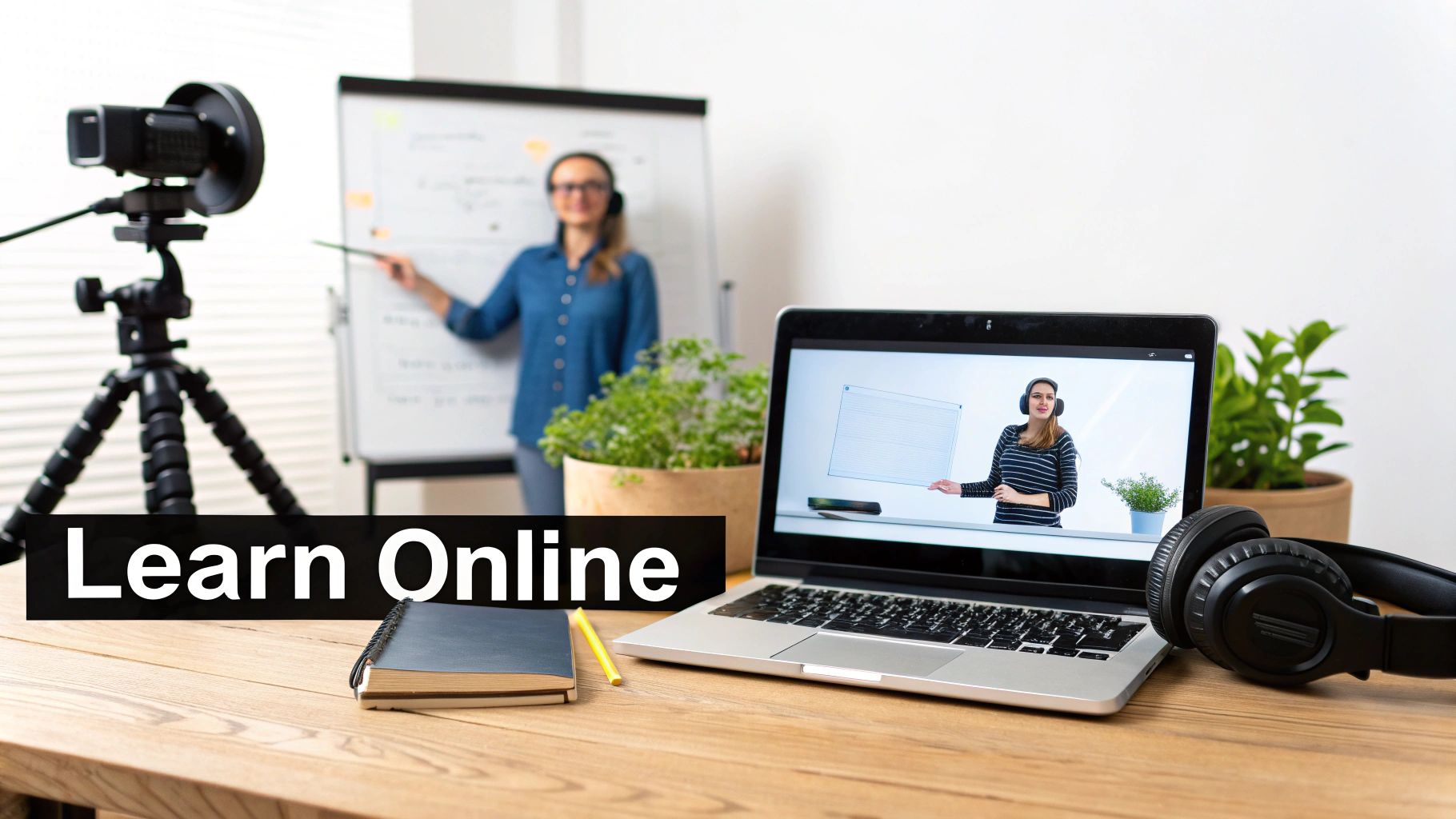
Platforms like Preply and Chegg Tutors have created vast marketplaces connecting tens of thousands of educators with students seeking personalized help. This model allows tutors to set their own hours and rates, making it an ideal career for those needing a flexible schedule. Success in this field depends on the ability to create engaging, effective lesson plans and adapt teaching styles to individual student needs in a virtual environment.
Actionable Steps to Get Started
To become a successful online tutor, focus on establishing credibility and leveraging the right platforms to find students. Your subject matter expertise is your primary asset.
- Choose Your Niche: Specialize in a high-demand area where you have proven expertise. Popular niches include STEM subjects, business English, and test preparation for exams like the SAT, GMAT, or IELTS.
- Join Established Platforms: Start by building a profile on reputable sites like Tutor.com or Preply. These platforms provide access to a large student base, secure payment processing, and built-in scheduling tools, which simplifies getting your first clients.
- Obtain Relevant Credentials: While not always required, certifications or a degree in your chosen subject can significantly boost your credibility and allow you to command higher rates.
- Master Educational Technology: Become proficient with tools like interactive whiteboards (e.g., Miro), Google Classroom, and video conferencing software to create a dynamic and effective learning experience for your students. Just as traders use specialized tools, educators leverage technology to enhance their craft, a principle also found in top-tier self-paced online trading courses.
Key Insight: The most successful online tutors build strong relationships with their students. Personalized learning plans, regular feedback, and genuine encouragement are key to retaining clients and generating positive reviews, which are crucial for attracting new learners.
8. UX/UI Designer
User Experience (UX) and User Interface (UI) design have emerged as some of the best careers for working remotely, focusing on creating intuitive and visually appealing digital products. UX designers research user needs to map out seamless product flows, while UI designers craft the look and feel, from buttons to typography. This field is highly collaborative yet asynchronous-friendly, making it ideal for a remote setup where design files and feedback are shared digitally.
The industry standard for collaboration is cloud-based tools like Figma, which allow entire teams to work on the same design file in real-time, regardless of location. Companies like Airbnb and Spotify have built world-class products with distributed design teams, proving that creativity and innovation thrive in a remote environment. Platforms like Dribbble further support this by providing a global stage for designers to showcase their work and connect with opportunities.
Actionable Steps to Get Started
Breaking into remote UX/UI design requires a portfolio that demonstrates not just final designs, but a deep understanding of the problem-solving process.
- Build a Process-Oriented Portfolio: Your portfolio should tell a story. For each project, detail the problem, your research process, wireframing, user testing, and the final design solution. This showcases your thinking, not just your aesthetic skills.
- Master Industry-Standard Tools: Become proficient in Figma. Its collaborative features are a non-negotiable skill for remote design teams. Also, familiarize yourself with prototyping tools like ProtoPie and research platforms like UserTesting.
- Complete a Reputable Bootcamp or Certification: Programs from institutions like General Assembly or CareerFoundry provide structured learning and a valuable network. They offer a focused path to acquiring the foundational skills needed for the job.
- Study Design Principles and Psychology: Understand the "why" behind good design. Learn about cognitive biases, usability heuristics from leaders like the Nielsen Norman Group, and established design systems like Google's Material Design.
Key Insight: In remote UX/UI design, your ability to articulate and defend your design decisions through clear, written communication is as important as your visual skills. Well-documented design files and persuasive presentations are crucial for gaining stakeholder buy-in.
9. SEO Specialist
As a discipline centered entirely on digital platforms, the role of an SEO Specialist is one of the best careers for working remotely. These professionals are responsible for optimizing websites and content to improve their visibility and ranking on search engines like Google. Their work involves a mix of technical analysis, content strategy, and market research, all of which can be performed effectively from any location with an internet connection.
The success of an SEO campaign is measured by data-driven results such as organic traffic, keyword rankings, and conversion rates, making it a highly accountable and transparent remote profession. Companies like Moz and Ahrefs not only provide the essential tools for the job but also operate with significant remote workforces. Freelance SEO specialists thrive on platforms like Upwork, building entire agencies by demonstrating measurable ROI for clients without ever needing a physical office.
Actionable Steps to Get Started
To become a remote SEO Specialist, you must demonstrate a clear understanding of search engine algorithms and a proven ability to generate results. Building a portfolio of successful case studies is paramount.
- Master the Fundamentals: Begin by studying foundational concepts from trusted resources like Moz's "Beginner's Guide to SEO" or the SEMrush Academy. Focus on understanding on-page, off-page, and technical SEO.
- Get Certified: Earn certifications from Google Analytics and Google Search Console. These free qualifications are industry-standard and prove your proficiency with essential analytics tools.
- Build Your Own Project: Create a personal blog or affiliate site and use it as a laboratory. Practice keyword research, content creation, and link-building to rank it for specific terms. Document your process and results to create your first case study.
- Learn Technical SEO: Go beyond keywords and content by learning about site speed, schema markup, and Core Web Vitals. To understand what it truly takes to succeed as an SEO Specialist, explore the essential SEO Specialist job requirements to ensure you are well-prepared.
Key Insight: SEO is a field of constant change. A top-tier remote SEO Specialist isn’t just someone who knows the current rules but someone who is relentlessly curious, constantly testing new theories, and actively participating in SEO communities to stay ahead of algorithm updates.
10. Project Manager (Remote)
A remote project manager is the digital-first conductor of an orchestra, ensuring every instrument plays in harmony to create a masterpiece. They are the central hub for planning, executing, and closing projects, all while coordinating a distributed team scattered across different locations and time zones. This role is crucial in a remote-first world, as it requires an expert in communication, organization, and digital collaboration to keep projects on track.
The success of remote project management is proven daily by companies managing complex initiatives without a central office. Tech companies use tools like Jira to run Agile sprints with international teams, while digital agencies rely on platforms like Asana and Monday.com to manage client deliverables and creative workflows. A skilled remote PM ensures that timelines are met, budgets are respected, and communication flows seamlessly, making them indispensable.
Actionable Steps to Get Started
To become a successful remote Project Manager, you need to combine formal knowledge with a mastery of digital collaboration tools. Your ability to create clarity and drive momentum from a distance is your key selling point.
- Earn a Key Certification: Obtain a globally recognized certification like the Project Management Professional (PMP) or a Certified ScrumMaster (CSM). These credentials immediately signal your expertise and commitment to the profession.
- Master Project Management Software: Gain deep, hands-on experience with popular tools like Asana, Monday.com, Trello, and Jira. Showcase your ability to build transparent project dashboards and automated workflows in your portfolio.
- Learn Agile and Scrum: Most modern, remote-first companies operate using Agile or Scrum methodologies. Understanding sprints, stand-ups, and retrospectives is non-negotiable for effective leadership in these environments.
- Develop Strong Communication Skills: Focus on your ability to over-communicate with clarity and empathy. Practice running efficient virtual meetings, resolving conflicts via chat, and creating comprehensive project documentation that leaves no room for ambiguity. Project management is one of the most in-demand work-from-anywhere jobs precisely because it bridges communication gaps.
Key Insight: In a remote setting, a Project Manager's primary role shifts from "overseeing" to "empowering." Your goal is not to micromanage tasks but to remove roadblocks, clarify objectives, and provide the team with the tools and trust they need to succeed autonomously.
Top 10 Remote Careers Comparison
| Role | 🔄 Implementation Complexity | ⚡ Resource Requirements | 📊 Expected Outcomes | Ideal Use Cases | ⭐ Key Advantages / 💡 Tips |
|---|---|---|---|---|---|
| Software Developer/Engineer | High — complex architecture, debugging & continuous learning | Powerful PC, IDEs, cloud services, version control (Git) | Production-ready apps, frequent feature releases, scalable systems | SaaS, product teams, backend/frontend systems | High pay & career growth; build portfolio & contribute to OSS |
| Virtual Assistant | Low — routine admin, scheduling, basic processes | Basic computer, internet, CRM/PM tools (Asana, Slack, Zoom) | Improved admin efficiency and time savings for clients | Entrepreneurs, small businesses, busy executives | Low barrier & flexible; package services and specialize |
| Content Writer/Copywriter | Medium — research, SEO, tone adaptation | Computer, CMS, SEO tools (Ahrefs/SEM), research resources | Increased traffic, engagement, conversions via content | Blogs, email campaigns, marketing teams, agencies | Portfolio-driven income; niche to command higher rates |
| Graphic Designer | Medium — creative workflow, client revisions | Design software (Adobe/Figma/Canva), tablet optional | Visual assets, brand identity, marketing collateral | Branding, UI assets, marketing creatives | Visible portfolio; sell templates for passive income |
| Digital Marketing Specialist | High — multi-channel strategies & analytics | Ad budgets, analytics & ad platforms (GA, FB Ads, SEMrush) | Leads, conversions, measurable ROI and growth metrics | E‑commerce, growth campaigns, lead generation | Highly transferable skills; get certified and track ROI |
| Freelance Translator | Medium — language nuance & domain expertise | CAT tools (Trados/Smartcat), reference materials | Accurate localized content, culturally appropriate messaging | Legal, medical, technical documents, localization projects | High demand for languages; specialize to increase rates |
| Online Tutor/Educator | Low–Medium — lesson planning & pedagogy | Video conferencing, whiteboard tools, curriculum materials | Improved student outcomes, retention, skill mastery | Test prep, language lessons, subject tutoring | Rewarding impact & flexible schedule; join platforms to scale |
| UX/UI Designer | High — user research, prototyping & iteration | Figma/Adobe XD, user testing tools, analytics access | Better usability, higher engagement & conversion rates | Product design, apps, website redesigns | Strong demand & pay; showcase process-driven portfolio |
| SEO Specialist | High — technical, content & link-building expertise | SEO tools (SEMrush/Ahrefs/Moz), analytics, technical access | Organic traffic growth (often 3–6+ months), improved rankings | Content sites, e‑commerce, local businesses | Measurable long-term value; specialize (local/technical) |
| Project Manager (Remote) | High — coordination, risk & stakeholder management | PM tools (Jira/Asana/Monday), communication platforms, docs | On-time delivery, budget control, aligned distributed teams | Cross-functional projects, remote product development | Strong job security & leadership path; get PMP/Scrum certs |
Take the Leap: Your Future in Remote Work Starts Now
The journey to a fulfilling, location-independent career is no longer a distant dream; it's an achievable reality. Throughout this guide, we’ve explored some of the best careers for working remotely, from the technical precision of software engineering and UX/UI design to the creative demands of content writing and digital marketing. Each path offers a unique blend of autonomy, flexibility, and opportunity, proving that professional success doesn't have to be tethered to a physical office.
We've broken down the essential components for each role: the skills you need to cultivate, the typical timelines for a transition, and the exact platforms where you can find your first clients or land that dream job. The common thread connecting all these opportunities is the empowerment that comes from taking control of your professional life. Whether you are building an app, managing a project, or crafting a marketing campaign, the modern workplace rewards those who are proactive, adaptable, and self-motivated.
Charting Your Unique Course to Freedom
The key takeaway is that your ideal remote career is a deeply personal choice, dependent on your skills, passions, and lifestyle goals. There is no one-size-fits-all answer. Your perfect fit might be found in the structured, collaborative environment of a remote project manager or the solitary focus required of a freelance translator.
To make your transition successful, consider these final, actionable steps:
- Conduct a Self-Audit: Revisit the careers we've discussed. Which one genuinely aligns with your innate talents and interests? Where do you see yourself not just working, but thriving? Be honest about the skills you have and the ones you are willing to learn.
- Create a Skill-Building Roadmap: Once you've identified a path, break down the learning process into manageable steps. Don’t just think about "learning to code"; instead, set a goal to complete a specific Python course on Coursera by next month or build a small portfolio project within the next quarter.
- Network with Intention: Join online communities, forums, and LinkedIn groups dedicated to your chosen field. Don't just be a passive observer; ask questions, offer insights, and connect with professionals who are already where you want to be. Their experience is an invaluable resource.
The Ultimate Frontier: Financial Self-Mastery Through Trading
While roles like virtual assistance and SEO specialization offer incredible flexibility, the path of an independent trader represents the pinnacle of autonomy. It’s a career where you are not just an employee or a freelancer but the CEO of your own financial destiny. This path transcends the traditional client-provider relationship, offering uncapped earning potential limited only by your discipline and strategy.
It's one of the few professions where your success is a direct reflection of your psychological resilience and strategic execution, free from office politics or client demands. You answer to the market and, most importantly, to yourself. This level of self-reliance is the ultimate expression of the freedom that defines the best careers for working remotely. Making this your reality requires a proven framework, a mentor to guide you, and an unwavering commitment to mastering a specific, effective methodology.
Ready to build a career with unparalleled freedom and earning potential? At Colibri Trader, we provide the exact price action strategies and mentorship to help you become a consistently profitable independent trader, making it one of the most rewarding remote careers available. Visit Colibri Trader to discover our proven system and start your journey toward true financial independence today.