


What Is Technical Analysis A Trader’s Guide to Market Patterns
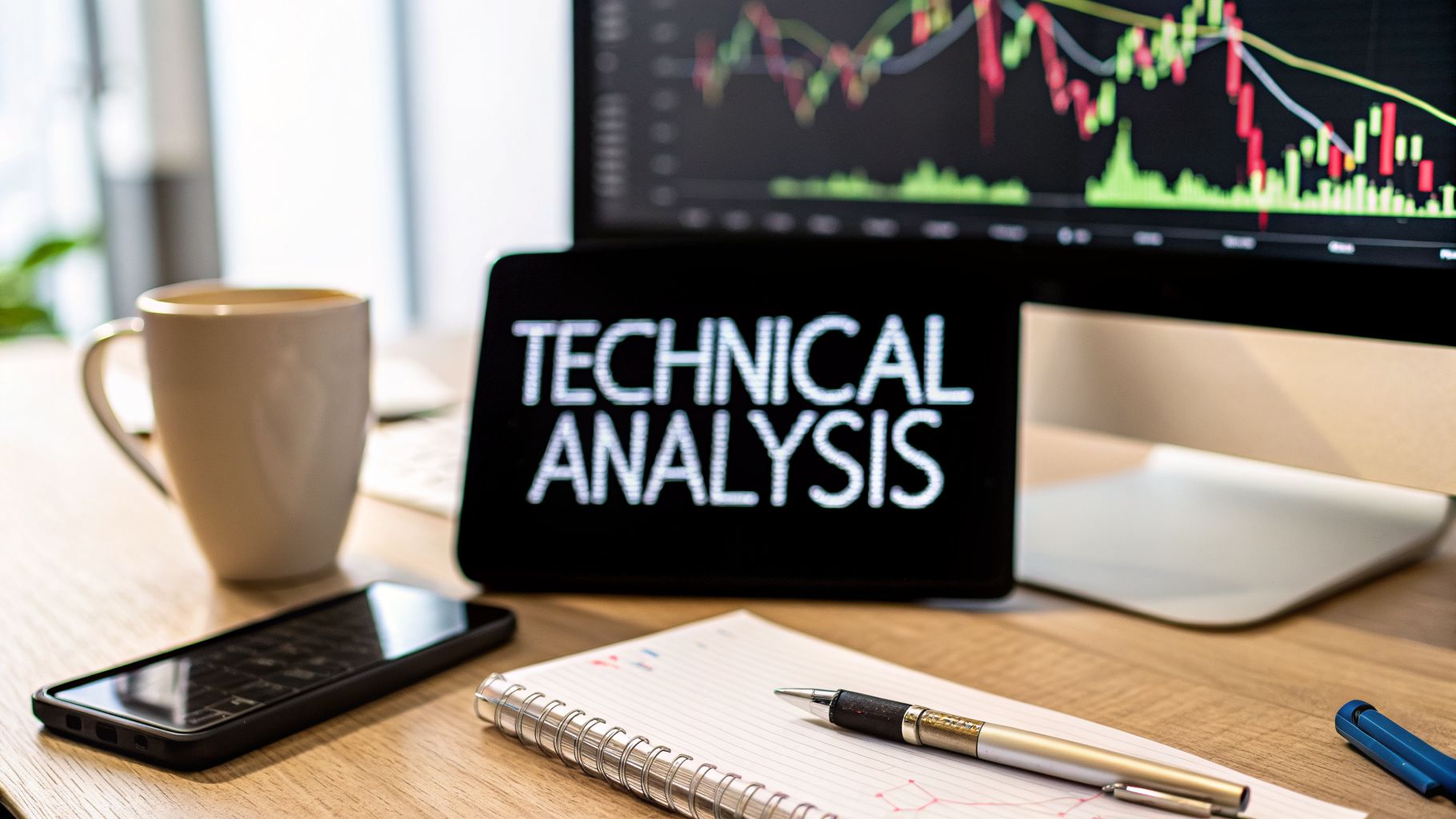
At its core, technical analysis is all about reading the story the market is telling us through charts. We’re looking at past market data, mainly price and volume, to get a feel for where prices might head next.
It's a bit like trying to predict a crowd's next move. Instead of interviewing every single person, you just watch their collective behavior—where they’re going and how quickly they’re getting there.
What Is Technical Analysis Really
Think of a meteorologist who studies weather charts to forecast storms or sunny skies. They aren't digging into the complex chemistry of the atmosphere. They're looking for patterns, pressure systems, and historical data to predict what the weather will do.
That's exactly what a technical analyst does, but for financial markets.
The fundamental idea here is that all the public information out there—company earnings, news headlines, economic reports—is already baked into an asset's price. The chart, in essence, becomes a visual record of the constant tug-of-war between buyers (the bulls) and sellers (the bears).
The Three Foundational Pillars
Technical analysis isn't built on complicated academic theories. It stands on three simple, powerful observations about how markets actually work. For anyone just starting out, getting a handle on different investing strategies for beginners can provide some great context before you dive deep into the charts.
The goal of a technical analyst is not to predict the future with 100% certainty, but to manage probabilities and identify scenarios where the potential for reward outweighs the risk.
This approach is grounded in three core principles that guide every chart I look at.

These three ideas—that the market discounts everything, that prices move in trends, and that history repeats itself—are the bedrock of chart interpretation.
Let's break down what each of these pillars really means for a trader in the trenches.
The Three Foundational Pillars of Technical Analysis
These are the core assumptions that form the foundation of all technical analysis.
| Core Assumption | What It Means for a Trader |
|---|---|
| The Market Discounts Everything | You don't need to get lost in news reports or financial statements. The price chart already reflects all the known information and market sentiment. It's all right there. |
| Prices Move in Trends | Price movement isn't random chaos. Assets follow identifiable trends—up, down, or sideways. Our job is to spot these trends and trade with them, not against them. |
| History Tends to Repeat Itself | Human psychology doesn't change much. The same patterns of fear and greed that drove markets in the past show up again and again, creating repeatable chart patterns we can learn to recognize. |
Once you internalize these three pillars, you'll start to see market charts in a completely new light. They stop being just squiggly lines and start telling a story you can understand and act on.
Your Core Tools: Charts, Trends, and Volume

With the core principles covered, it’s time to open up the toolbox. These are the instruments you’ll use day-in and day-out to make sense of the market. First up, you have to learn how to read the canvas where all the action happens—the price chart.
You’ll see different types out there, like line or bar charts, but most traders I know live and die by candlestick charts. Why? Because every single candle tells a rich, immediate story of the battle between buyers and sellers over a set period. In one glance, you see the open, high, low, and close prices.
Getting fluent in reading these visual clues is a massive advantage. If you want to dig deeper, I've put together a full guide on how to read market charts that breaks it all down.
Uncovering Market Direction With Trends
Once you can read the chart, your next job is to figure out which way the herd is moving. Prices rarely move in a straight, random line; they form trends. A huge part of technical analysis is learning to analyze market trends and ride their momentum.
You'll quickly learn to spot three main types of trends:
- Uptrend: A clear pattern of higher highs and higher lows. This is your sign that buyers are in charge, pushing the price up.
- Downtrend: The exact opposite. You'll see a series of lower highs and lower lows as sellers dominate and drive the price down.
- Sideways Trend (Consolidation): Price gets stuck moving in a range, not really making new highs or lows. This signals a stalemate, a moment of indecision between buyers and sellers.
Spotting the main trend is probably the single most important skill you can develop. There's an old saying, "the trend is your friend," and it’s stuck around for a reason. It is almost always easier to trade with the market's flow than to fight against it.
Confirming Moves With Trading Volume
The last core tool in our starting kit is trading volume. This simply shows you how many shares or contracts were traded in a given period. I like to think of volume as the fuel behind a price move. It reveals the level of conviction backing a trend.
A price surge on massive volume is like a deafening roar from a packed stadium—it has weight and shows widespread agreement. On the other hand, the same price move on whisper-thin volume is like a single person cheering in an empty arena. It lacks power and is far more likely to be unsustainable noise.
"A market trend is confirmed by volume. A trend in motion is more likely to remain in motion when volume increases in the direction of the trend."
This link between price and volume isn't a new idea; it’s a cornerstone concept from the early days of technical analysis. Charles Dow himself stressed that volume must confirm the trend. Later studies have backed this up. For instance, one analysis of S&P 500 data from 1962-1998 found that breakouts on strong volume followed through 72% of the time, compared to just 55% for breakouts without it.
Finding Trading Opportunities with Indicators and Patterns

Once you've got a feel for charts, trends, and volume, the real work begins: spotting actual trading setups. For technical analysts, this usually comes down to two main tools: mathematical formulas we call indicators, and repeating shapes known as chart patterns.
Think of these tools as ways to translate the raw noise of the market into signals you can actually use.
You can imagine technical indicators as special lenses you place over your chart. They take all the price and volume data, run it through a formula, and give you a completely different perspective on the market's behavior. Some are great for clarifying the trend, while others signal when a market is stretched too thin and might be ready to snap back.
A lot of new traders think indicators predict the future. They don't. What they do is simplify price action, helping you organize the chaos into a more structured, rules-based approach. This is a huge part of understanding what is technical analysis in the real world.
Using Indicators to Interpret Price Action
There are hundreds, if not thousands, of indicators out there. But honestly, they mostly fall into two camps. Knowing the difference is what separates traders who use them well from those who just clutter their charts.
- Trend-Following Indicators: These tools, like the classic Moving Average (MA), are built to smooth out choppy price data so you can see the real underlying trend. A moving average is simple: it just calculates the average price over a set number of periods, giving you a clean, flowing line that cuts through the market noise.
- Oscillators: These indicators bounce back and forth between two extremes. Their main job is to flag potential "overbought" or "oversold" conditions. The Relative Strength Index (RSI) is a perfect example. It measures the velocity of price moves on a scale of 0 to 100, helping you see when a trend might be running out of steam.
While these can be useful, many experienced traders—and I include myself here—find they often tell you what’s happening a little too late. The price has already moved.
The most powerful indicator is and always will be the price itself. Indicators are derivatives of price; they are a step removed from the real-time battle between buyers and sellers.
This built-in lag is exactly why many of us eventually move to a purer form of analysis. If you're curious about reading the market without all the extra lines, our complete guide on price action patterns shows you how to do just that.
Reading the Story of Chart Patterns
Chart patterns are the other core tool in the technical analyst's kit. These are simply recognizable formations that show up again and again on charts, often leading to very predictable results.
At their core, patterns are a visual diary of market psychology. They are the graphic representation of greed and fear playing out bar by bar.
For example, a Head and Shoulders pattern is a classic sign that an uptrend might be about to fail. On the flip side, a Triangle pattern usually tells you the market is just taking a breather before continuing in the same direction.
For decades, people argued about whether these patterns actually worked. But the data is getting harder to ignore. A landmark MIT study from 2000 looked at decades of stock data and found that strategies based on common technical signals delivered statistically significant returns. It showed that technical analysis "may well be an effective means for extracting useful information from market prices."
Technical Analysis Compared to Other Trading Styles
To really get what technical analysis is, you first have to understand what it isn't. The trading world has always been split into two major camps. Figuring out which one you belong to is one of the first big steps in finding your edge.
Think of it like two detectives trying to figure out where a company’s stock is headed next.
The first detective is a fundamental analyst. They go deep undercover, investigating the company itself. They'll pour over balance sheets, grill the CEO on earnings calls, and analyze the health of the entire industry. Their goal is to calculate a stock's "true" value and figure out the why behind a potential price move.
The second detective is a technical analyst. They don't care about the company's backstory. They head straight to the scene of the crime—the price chart. For them, every clue needed is right there in the price and volume data. They aren't interested in the "why"; they focus completely on the what. What is the price doing right now, and what happened the last time it did this?
Technical vs Fundamental Analysis at a Glance
For most traders, it boils down to one school of thought or the other. This table puts their core differences side-by-side.
| Aspect | Technical Analysis | Fundamental Analysis |
|---|---|---|
| Primary Focus | Price charts and market data | Company financials and economic health |
| Core Question | What is the price doing? | Why should the price move? |
| Key Tools | Charts, trends, indicators, patterns | Earnings reports, P/E ratios, debt levels |
| Time Horizon | Mostly short to medium-term | Mostly medium to long-term |
In the end, neither approach is "better"—they’re just different tools for different jobs. Some traders even try to blend them. But for those of us who need to make quick, clear decisions based on what the market is doing today, technical analysis is the far more direct path.
Price Action A Refined Approach
Now, inside the world of technical analysis, there's a purer, more minimalist approach called price action trading. This is the camp I'm in.
While a lot of technical traders clutter their charts with a dozen different indicators—RSI, MACD, Bollinger Bands, you name it—price action traders strip all of that away.
We focus only on the most essential data on the screen: the candlesticks themselves.
Here’s another way to think about it. A standard technical analyst is like a meteorologist using a complex computer model with dozens of variables to predict if it will rain. A price action trader just looks out the window to see if dark clouds are rolling in.
We believe indicators are all "lagging" anyway because they are just mathematical formulas based on past price. By learning to read the price action directly, we can make faster, cleaner decisions without the "analysis paralysis" that a messy chart creates.
By mastering support, resistance, and key candlestick patterns, you're practicing a powerful and refined form of technical analysis. If you're still figuring out where you fit in, exploring the different types of traders can help you match a style to your own personality.
A Long History of Reading Market Psychology on a Chart
You might think technical analysis is a modern invention, a product of computers and high-speed internet. But the truth is, the core idea—studying charts to get a read on market psychology—is centuries old.
This isn't new. It’s a timeless art. Long before we had glowing screens, traders were sketching out price movements, looking for the same patterns we hunt for today. Why? Because human behavior in the markets is remarkably consistent.
The story really gets going not on Wall Street, but in 18th-century Japan with a legendary rice trader named Munehisa Homma. He wasn’t just watching prices go up and down; he was tracking the emotions driving those moves. He figured out that price action was tied directly to the collective fear and greed of buyers and sellers. For his time, this was a massive insight.
From Ancient Japan to Modern Markets
To map this market sentiment, Homma came up with a visual system we all know and use today: candlestick charting. It was a brilliant way to see the entire story of a trading day in a single shape, turning raw data into an intuitive map of the battle between bulls and bears.
And boy, did it work. His success was staggering.
While some principles go back even further to the 17th-century Amsterdam stock market, it was Homma who created one of trading's most enduring tools around 1710. His methods, which he laid out in his 1755 book, reportedly helped him amass a fortune equal to over $10 billion in today's money. If you want to dig deeper, the history of technical analysis is a fascinating rabbit hole.
What Homma figured out back then is just as true today: markets are driven by people, and people are driven by emotion. A chart is just a picture of that human drama playing out.
The Foundation of Modern Trend Following
Fast forward to the late 19th century in the United States. A man named Charles Dow, co-founder of The Wall Street Journal, started writing about how the market behaved. He saw that stock prices didn't just bounce around randomly; they moved in clear trends, like the tides of an ocean.
Dow never bundled his ideas into a book, but his editorials became the bedrock for what we now call Dow Theory. He was the one who first articulated that markets have primary, secondary, and minor trends, and that volume should always confirm what the price is doing.
His work gave a formal structure to the study of trends, providing the intellectual backbone for so much of modern technical analysis. It just goes to show, reading mass psychology through price charts has been a winning game for a very, very long time.
Putting Technical Analysis into Practice
Alright, we've walked through the concepts—the charts, trends, and patterns. But knowing the theory is one thing; applying it in a live market, with real money on the line, is a completely different ballgame.
This is where we need to be brutally honest about what technical analysis is. It is not a crystal ball. It’s a tool for managing probabilities. Its real power is in helping you spot setups where the potential reward stacks up favorably against the risk you're taking.
But you have to accept its limits. Interpreting patterns has a degree of subjectivity, and false signals are just part of the cost of doing business. A picture-perfect "head and shoulders" pattern can, and often will, fail. An indicator can scream "buy" just moments before the floor drops out. It happens.
A Practical Path Forward
This is exactly why so many seasoned traders strip everything back and focus purely on price action. Why? Because it’s the most direct way to read the market without the noise.
Instead of plastering your charts with a dozen lagging indicators that often contradict each other, you learn to read the story the candlesticks are telling you. You're getting your information straight from the source.
The ultimate goal isn't to find a magic system that never loses. It's to build a consistent, repeatable process that gives you an edge over the long run.
This is about moving from theory to a structured, real-world skill. It's about developing the discipline to read what the market is doing right now and act on it decisively, without second-guessing yourself.
For anyone serious about bridging that gap, the most effective next step is a focused program designed to build that tangible skill. By mastering price action, you learn to trade with clarity and confidence—building a foundation that will serve you in any market condition.
Frequently Asked Questions About Technical Analysis
Even after you get the hang of the basics, it's natural to have some questions about what technical analysis can really do for you. Let's clear up a few of the most common ones I hear from new traders.
Can Technical Analysis Predict the Future with 100% Accuracy?
Absolutely not. Any trader or course that tells you otherwise is selling you a fantasy.
Technical analysis is a game of probabilities, not certainties. It's all about finding setups where the odds are stacked in your favour—where the potential reward is worth the risk. The goal isn't to win every single trade. It's to find a consistent edge that pays off over hundreds of trades.
This is why risk management is so crucial. It's what keeps you in the game when a high-probability setup just doesn't work out.
How Long Does It Take to Learn Technical Analysis?
You can learn the basics, like spotting a simple trend or a common pattern, in a few weeks if you put your mind to it. But turning that knowledge into consistent profit? That's a completely different animal. It takes months, and more often years, of dedicated screen time and practice.
The fastest way to get good isn't to learn a hundred different indicators. It's to master one single strategy, like pure price action, until you know it inside and out.
This is how you build real, practical skill, not just a surface-level understanding of a dozen different tools.
Is Technical Analysis Better for Short-Term or Long-Term Trading?
Here’s one of its biggest strengths: technical analysis works on all timeframes. The patterns you see are often described as "fractal."
What that means is the same patterns, driven by human psychology, show up on a one-minute chart for a day trader and on a weekly chart for a long-term investor. You can find a head and shoulders pattern playing out over a few hours or over a few years.
Which timeframe you choose comes down to your personality, your trading goals, and how much time you can dedicate to the charts.
At Colibri Trader, we teach traders how to cut through the noise by focusing only on the proven, no-nonsense principles of price action. If you're ready to build a real trading skill without getting lost in lagging indicators, check out our action-based programs.