
What Is Scalping A Trader’s Guide to High-Speed Profits
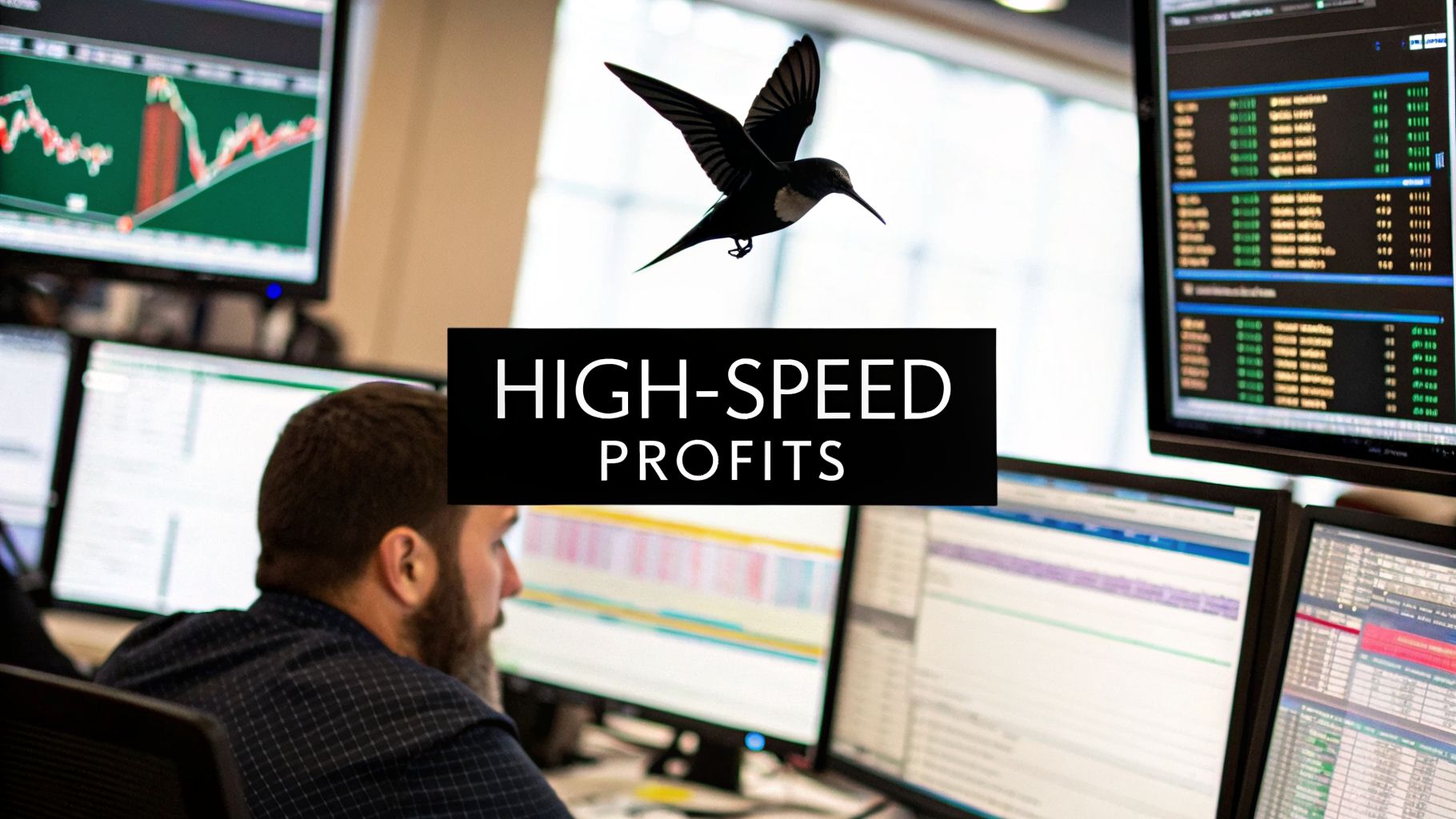
Scalping is a trading style built for speed. It’s all about capturing tiny, consistent profits from dozens, sometimes even hundreds, of trades in a single day. Instead of waiting for that one big home run, a scalper is happy to accumulate a lot of small wins that add up over time.
The Philosophy of a Scalper
Think of a hummingbird zipping from flower to flower, taking just a small sip of nectar from each one. By the end of the day, all those little sips make for a full meal. That's the essence of scalping in trading.
A scalper isn’t interested in holding a position for hours or days, hoping for a major market trend to develop. Their world moves in minutes, sometimes even seconds. The goal is simple: get in, grab a few pips or cents from a small price move, and get out.
A single trade might not look like much, but when you execute 50-100 of these quick-fire trades in a session, those small gains can compound into a significant profit. This high-volume approach is what truly sets scalping apart.
At its heart, scalping is a game of probability and volume. A scalper’s success isn't defined by one big win, but by a high win rate across a huge number of small, disciplined trades.
Before we dive deeper, let's quickly summarize what makes scalping unique.
Scalping at a Glance
This table breaks down the core characteristics of the scalping trading style for a quick overview.
| Characteristic | Description |
|---|---|
| Trade Frequency | Extremely high; dozens or hundreds of trades per day. |
| Holding Period | Very short; from a few seconds to a few minutes. |
| Profit Targets | Small and realistic; aiming for minimal price fluctuations. |
| Timeframes | Lowest available; typically 1-minute and 5-minute charts. |
| Risk per Trade | Extremely small; tight stop-losses are mandatory. |
| Psychology | Requires intense focus, discipline, and quick decision-making. |
As you can see, this style demands a very specific mindset and a robust set of tools, which we'll cover later in this guide.
From Trading Pits to Digital Platforms
Scalping isn't a new idea. It has a rich history that goes back to the bustling trading floors. Originally, it was an intense, physical job where traders shouted orders and used hand signals to execute trades in seconds. Their edge was being right there in the middle of the action.
The rise of electronic trading changed everything. Suddenly, the markets were accessible to retail traders sitting at home with a good internet connection. This digital shift levelled the playing field. For a deeper look into this high-speed approach, a detailed guide on a scalping trading strategy can offer some great insights.
Today, technology allows us to execute orders in milliseconds—a speed once reserved only for the big financial institutions. This is the environment where the modern scalper thrives.
The Mechanics of a High-Speed Trade
So, how does a scalper actually pull off these lightning-fast trades? To really grasp what is scalping, you have to understand the engine room. It’s a mix of using the right charts, having razor-sharp execution, and knowing the market’s inner workings.
Scalpers live on the lowest timeframes. Forget the hourly or 15-minute charts that a day trader might use. A scalper’s entire world is on the one-minute (M1) and five-minute (M5) charts.
Looking at the market this way lets you see tiny price jitters that are completely invisible on higher timeframes. For a scalper, this market "noise" isn't noise at all—it’s a field of opportunity.
The Need for Speed and Precision
Executing trades this quickly is more than just clicking a mouse fast. You need the right tools to get in and out of the market with almost zero delay. Think of it like a Formula 1 pit stop—every single millisecond counts. That tiny fraction of a second can be the difference between a small win and a frustrating loss.
This is why your relationship with your broker is so important. Scalpers need a direct-access broker who can offer extremely fast, low-latency execution. This is critical to minimize slippage, which is the difference between the price you expect and the price you actually get.
A delay of even a few hundred milliseconds can completely erase a scalper's potential profit on a trade. In this high-speed environment, technology and execution quality are just as important as the trading strategy itself.
Order Types and Execution Flow
Scalpers don't just blindly hit the "buy" or "sell" button. They use specific order types to control their trades with surgical precision.
- Limit Orders: These are essential for entering or exiting at a specific price. A scalper might set a buy limit order just a tick below the current price to catch a tiny dip, or a sell limit order (their take-profit) just a few pips above their entry.
- Stop-Loss Orders: This is a scalper’s most important safety net, period. It’s an order you set in advance to automatically close your trade if the market moves against you, capping your loss on that one trade.
The whole thing is a quick, repetitive cycle: spot a setup, enter the trade, and get out—often within just a few minutes. This image perfectly shows the core idea of stacking up small, frequent profits to build a much larger gain over time.

As you can see, scalping is a game of volume, not size. The goal is to rack up a high number of small wins, which add up to a solid profit by the end of the day.
Scalping vs Day Trading vs Swing Trading
To really get a feel for what scalping is, it helps to see how it stacks up against other ways traders approach the markets. Scalping, day trading, and swing trading are all active styles, but they couldn't be more different in their timelines and what they're trying to achieve.
I like to think of them as different races at a track meet. Each one demands a completely unique skill set and mindset from the athlete.
Scalping is the 100-meter sprint. It's all about explosive, high-intensity bursts of activity. You're in and out of the market in seconds or maybe a few minutes, grabbing tiny profits along the way. A scalper’s success isn't built on one big win; it's the result of a high volume of small, consistent trades.
Day trading is more like a middle-distance race, maybe the 800-meter. A day trader might hold a position for several minutes or even a few hours, trying to ride an intraday trend. The key rule is that they close out everything by the end of the day, but they're making far fewer trades than a scalper.
The Key Differences in Time and Mentality
Swing trading, on the other hand, is the marathon. This is a multi-day endurance event. A swing trader will hold positions for several days, sometimes even weeks, trying to capture a much larger "swing" in price. They're focused on the bigger picture and might only place a handful of trades a month.
The psychological pressure of each style is also worlds apart. Scalping demands intense focus, lightning-fast decision-making, and the emotional steel to cut a small loss without a second thought. A swing trader needs a different kind of strength: patience and the nerve to stay calm while a trade plays out over several days of ups and downs.
Each trading style attracts a different personality. Fast-paced, decisive individuals often gravitate toward scalping, while those who prefer a slower, more analytical approach might find swing trading a better fit.
Comparison of Short-Term Trading Styles
To make it even clearer, I've put together a simple table that highlights the major differences between these approaches. You can see at a glance how things like holding time and trade frequency change dramatically from one style to the next.
For an even deeper dive, I've written a whole guide on swing trading vs scalping that you might find useful.
| Trading Style | Typical Holding Time | Trade Frequency | Typical Profit Target (per trade) |
|---|---|---|---|
| Scalping | Seconds to a few minutes | Very High (20-100+ trades/day) | Very Small (pips or cents) |
| Day Trading | Minutes to a few hours | Moderate (1-10 trades/day) | Small to Medium |
| Swing Trading | Several days to weeks | Low (a few trades/month) | Large |
Understanding these distinctions is one of the most important first steps for any new trader. So many people get frustrated because they try to force a style that just doesn't match their personality or daily schedule.
By seeing exactly where scalping fits on this spectrum, you can start to make an honest assessment of whether this high-speed style is the right path for you.
Actionable Scalping Strategies Using Price Action

Alright, we've covered the mechanics and the mindset. Now it’s time to get practical and look at some actual strategies you can use. Forget about cluttering your charts with a dozen indicators. In my experience, the most successful scalpers I know rely on the purest data there is: price action.
This means learning to read the story the market is telling you, candle by candle, without the lag that comes with most indicators.
Price action scalping is all about spotting high-probability patterns as they form and acting decisively. The entire game is about finding those key levels where buyers or sellers are likely to show up in force, which creates those quick, predictable pops in price. Your job is to jump in and grab a small slice of that move.
The Support and Resistance Flip
One of the most reliable price action setups you'll ever find is the support and resistance (S/R) flip. This strategy is built on a simple, timeless market principle: a price ceiling (resistance) often becomes a price floor (support) once it's decisively broken. The same is true in reverse.
Imagine a price level that has repeatedly stopped an asset from moving higher. That’s your resistance. When the price finally punches through that level with some real power, the market's psychology shifts. Traders who were selling at that level might start buying, and new buyers jump in, believing the path is clear. That old resistance now becomes new support.
The scalping opportunity comes on the retest. After the initial breakout, price will often drift back down to "test" that old resistance level. As a scalper, you’re patiently waiting for this retest. You're looking for a sign that the level is holding—like a bullish pin bar or an engulfing candle—to jump into a long position.
Your trade would look something like this:
- Entry: Go long as soon as you see the price bounce off that newly formed support.
- Stop-Loss: Place a very tight stop-loss just a few pips below the new support level.
- Take-Profit: Aim for a quick, small gain. Often, you’ll target the most recent micro-high created during the breakout.
Scalping Breakouts and Micro-Trends
Another classic price action strategy is trading breakouts from tight consolidation patterns. On a one-minute or five-minute chart, you'll see this all the time. The price will get stuck trading inside a narrow range or a small triangle. This coiling action is like a spring being compressed; energy is building up for the next move.
A scalper watches this pattern form and gets ready to pounce the moment price breaks out. A breakout that happens with a sudden spike in volume is an excellent signal that a fast, directional move is getting started.
The key to scalping breakouts is speed. You absolutely cannot wait for a lagging indicator to give you confirmation. By then, the initial momentum is gone. The real money is made in the first few candles right after the break.
For example, if the price breaks above the top of a one-minute range:
- You could enter a buy order the moment that breakout candle closes.
- Your stop-loss would be placed just back inside the old range.
- You’d take your profit after a small, predetermined number of pips, or as soon as you see the momentum start to fade.
Learning to spot these setups takes screen time and practice, there’s no way around it. But by focusing only on what the price itself is doing, you can make faster and much more informed decisions. For anyone looking to really master the art of reading charts, our guide on candlestick patterns for intraday trading is an excellent place to build your foundation.
Mastering the Scalper's Mindset and Risk
While we can talk about charts and strategies all day, they're just one small piece of the puzzle. The brutal truth about scalping is that your success will be about 80% psychology and 20% strategy.
The high-speed, high-pressure world of scalping demands a mental toughness that most other trading styles simply don’t.
Think of yourself not as a gambler, but as the casino. The house never sweats a single hand of blackjack; it knows that over thousands of hands, its statistical edge is what matters. This is exactly the mindset you need. You're not betting on one trade; you're focused on perfectly executing your edge over a long series of them.
Your greatest asset is emotional discipline. Fear that keeps you from pulling the trigger, greed that makes you hold a winner too long, or anger that leads to reckless revenge trades—these are the fastest ways to blow up your account.
The Critical Role of Risk Management
Since you might be placing dozens, or even hundreds, of trades in a single day, your risk management has to be absolutely airtight. There's zero room for negotiation or "hoping" a bad trade will turn around. This is where the "1% rule" becomes law.
This rule is simple: never risk more than 1% of your total account balance on any single trade. If you have a $10,000 account, your maximum loss on one trade is $100. Period.
This non-negotiable limit is a firewall. It ensures that a string of losses—which is a completely normal part of scalping—won't deliver a catastrophic blow to your capital.
A scalper’s job is to make peace with small, frequent losses. Cutting a losing trade quickly isn't a failure; it’s a successful execution of your risk management plan and the very thing that allows you to survive and trade another day.
Developing Emotional Neutrality
To become a successful scalper, you have to learn how to operate without emotion. You must be able to take a loss without a second thought and immediately move on to the next setup with a clear head.
By the same token, a winning trade shouldn't bring you a rush of euphoria. It's just one positive data point in a very long series.
Here are the mental pillars you need to build:
- Think in Probabilities: Your focus is on your statistical edge over the next 100 trades, not the next one.
- Embrace Small Losses: See them for what they are—a standard business expense required to find profitable setups.
- Stay Detached: Your only goal is to execute your plan perfectly, no matter what happens on any individual trade.
This mental game is often the toughest part of becoming a trader. For a much deeper look into this, our guide on mastering trading psychology offers some powerful insights to help you build that mental edge. Building this resilience is what truly separates the consistently profitable scalpers from everyone else.
Essential Tools and Pitfalls to Avoid

Having a great strategy is only half the battle in scalping. You also need a professional-grade setup and a keen awareness of the traps that can wipe out an account before it even gets started. This isn't a part of trading you can afford to overlook.
Think of it this way: you wouldn't want a surgeon operating on you with a rusty scalpel and a flickering light. The same logic applies here. In a high-speed game like scalping, your equipment and your mindset are every bit as important as your entry signals.
Your Essential Scalping Toolkit
To trade at the frequency scalping demands, you need tools built for pure speed and precision. Your average retail trading setup just won’t be good enough.
Here’s what I consider non-negotiable:
- A Direct-Access Broker: Your broker must offer incredibly low commissions and the tightest spreads possible. Since you're aiming for small wins, high fees can easily turn a profitable day into a losing one.
- A High-Performance Charting Platform: The software you use has to support one-click trading right from the chart. That split-second you waste fumbling with an order ticket is a lifetime in the world of scalping.
- High-Speed Internet: A stable, fast internet connection is absolutely critical. Even a momentary lag can cause slippage that turns a winning trade into an unexpected loss.
A scalper’s technology isn’t a luxury; it’s a fundamental part of the business. Your broker, your platform, and your internet connection are your partners. Any weakness in that chain will show up directly in your P/L.
Common Pitfalls That Wipe Out Accounts
So many aspiring scalpers fail. But it’s usually not because their strategy was bad. More often, it’s because they gave in to predictable, emotional mistakes. Knowing these pitfalls is your first and most important line of defense.
These are the most destructive blunders I see traders make:
- Revenge Trading: You take a loss, and the urge to jump right back in to "win it back" is overwhelming. Trading on emotion like this is a fast track to even bigger losses.
- Ignoring Trading Costs: This is the silent account killer. It's easy to forget that commissions and spreads add up. Every single trade has to be profitable enough to cover those costs and leave something for you.
- Trading Without a Plan: You absolutely must know your entry, stop-loss, and take-profit levels before you click the button. Without these rules, you're not trading—you're just gambling.
Really understanding scalping means mastering these professional habits. The market is a tough place that rewards discipline but has zero mercy for those who come unprepared.
Your Top Scalping Questions Answered
Let's tackle some of the most common, practical questions I get from traders who are just starting to explore the world of scalping. These are the real-world concerns you need to think about before placing your first trade.
Is Scalping Actually Profitable After Commissions and Fees?
Yes, it certainly can be, but it’s a game of inches. The profit in scalping lives on a razor's edge.
Because you’re hunting for tiny price movements, your success hinges entirely on keeping your trading costs rock-bottom. Your strategy's average win must be greater than your trading costs—that includes both commissions and the bid-ask spread. This makes your choice of broker a critical business decision; ultra-low fees and tight spreads aren't just nice to have, they're non-negotiable.
What Is the Best Market to Scalp?
From my experience, the best markets for scalping all share three key ingredients: high liquidity, consistent volatility, and low transaction costs. You need this trifecta to ensure you can get in and out of trades instantly without slippage or fees eating up your hard-earned pips.
- Major Forex Pairs like the EUR/USD are a favourite for a reason. Their massive trading volume means you'll almost always find a tight spread.
- Major Stock Index Futures, such as the E-mini S&P 500 (ES), are another great option. They offer deep liquidity and are always on the move.
On the flip side, you want to stay far away from illiquid small-cap stocks or exotic currency pairs. Their wide spreads and choppy, unpredictable price action make effective scalping next to impossible.
Can I Start Scalping with a Small Account?
You technically can, but I'll be honest—it's incredibly difficult. The profits from scalping come from very small price changes, so you need a reasonable position size to make those wins meaningful after you've paid your costs. With a small account, a normal string of small losses can wipe you out before you even get going.
My strongest advice is to start on a demo account and stay there until you can prove you are consistently profitable. This lets you iron out the kinks in your strategy and build the right discipline without putting your real capital on the line.
Ready to master a trading approach that works without a screen full of confusing indicators? The Colibri Trader team teaches a straightforward, price-action method focused on what actually works in the market. Start learning with our proven strategies today.