
What Is a Buy Stop Order? Explained for 2026
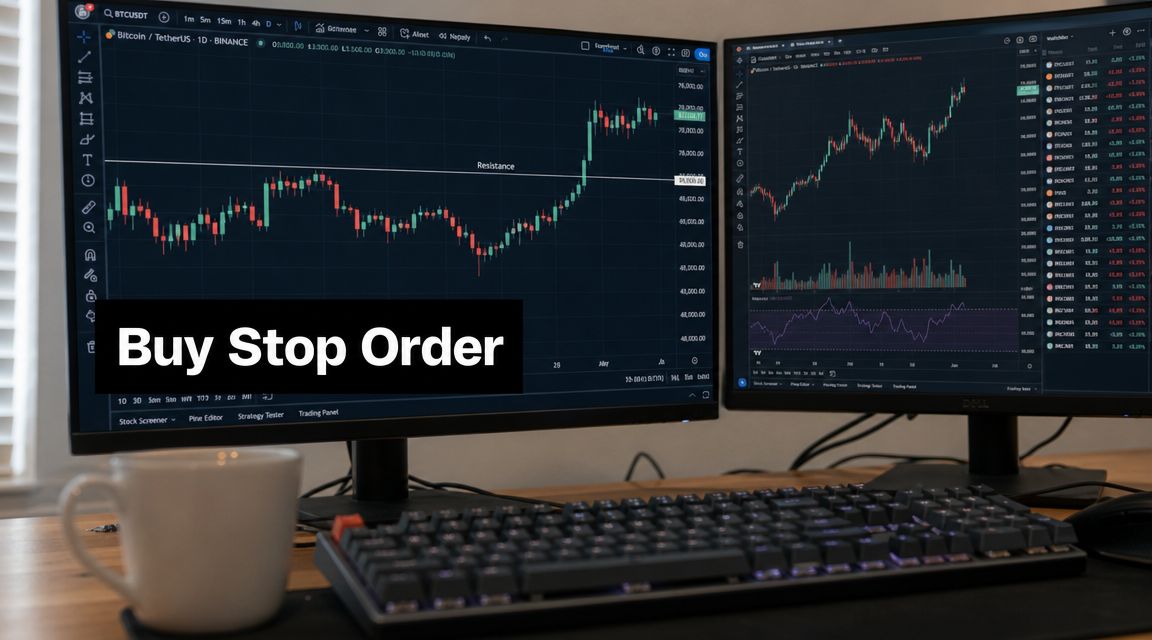
You're probably in a familiar spot. Price has been pressing into a clear resistance area for hours, maybe days. You can see the setup. If buyers finally push through that level, the move could run hard. But you can't sit in front of the chart all day waiting for a candle to break.
That's where traders stop acting like spectators and start using orders with intent.
A buy stop order lets you predefine the exact level where you want to get involved if price proves its strength. Instead of chasing a breakout late or entering too early because you're impatient, you tell your platform: buy only if the market trades higher and confirms the move. Used well, it becomes one of the cleanest tools in a price action trader's playbook.
The Trader's Dilemma Capturing Moves You Can't Watch
Most beginners think order types are just platform settings. They're not. They're part of your strategy.
If you trade breakouts, this problem shows up all the time. Price builds under resistance. The structure looks tight. The highs are obvious. You suspect that if the level breaks, momentum traders will pile in. But life doesn't care that your chart is setting up. You have work, meetings, sleep, or other positions to manage.
A buy stop solves that by automating your decision at the one level that matters.
Where it fits in a real trading plan
You don't use a buy stop because you're bullish in a vague sense. You use it because you want confirmation. You're saying, “I'm interested, but only if price can trade through this level.”
That's a disciplined mindset. It keeps you from buying while price is still trapped below resistance, and it keeps you from hesitating if the breakout comes when you're away from the screen.
A buy stop is useful when you want the market to earn your entry.
There's another side to it that many traders miss. Investor.gov notes that investors commonly use buy stop orders to limit a loss or protect a profit on a stock they have sold short in its overview of types of orders. That matters because it shows the order isn't only for breakout entries. It also has a core risk-management role.
Why price action traders rely on it
Price action traders care about levels. Highs, lows, breakout points, failed breaks, retests. A buy stop fits that logic perfectly because it is level-based and conditional.
In practice, it helps you do three things:
- Wait for proof: You don't enter just because a market looks strong. You enter if it trades through your line in the sand.
- Reduce emotional decisions: The order is placed before the breakout chaos begins.
- Stay available without staring at charts: Your plan can execute even when you're not watching every tick.
That's the practical answer to what is a buy stop order. It's not just a definition from a textbook. It's a practical trigger that lets you trade momentum with rules instead of impulse.
Understanding the Core Mechanics of a Buy Stop Order
A buy stop order is a conditional instruction placed above the current market price. If the market trades at or through that stop level, the order becomes a market order, as explained in FINRA's investor guidance on stop orders during volatile markets.

That single detail changes how you should think about the order. You are not telling the broker, “Buy me at this exact price.” You are telling the broker, “If price gets there, enter me at the next available market price.”
Think of it as an alert that also acts
A price alert tells you something happened. A buy stop tells your platform to act when it happens.
That's why it's useful for breakout traders. If resistance sits above current price, you can place the buy stop just above that level and let the market trigger you only if buyers force the issue.
Core idea: A buy stop sits above current price because you want to join strength, not buy weakness.
Buy stop versus market order versus buy limit
A standard market order says buy now. No condition. A buy stop says buy later, but only if price rises enough to trigger the order. A buy limit says buy only at a lower or specified price, usually because you want a pullback or better value.
Here's the cleanest way to separate them:
| Order Type | Where it sits | What it says |
|---|---|---|
| Market order | At current conditions | Buy immediately |
| Buy stop | Above current price | Buy if price proves strength |
| Buy limit | Typically below current price | Buy if price dips into value |
Why traders misuse it
New traders often place buy stops in random places. That usually means one of two mistakes.
- They place it too close to resistance: The order triggers on noise, not a real break.
- They place it with no exit plan: The entry is automated, but the risk isn't defined.
A buy stop works best when the level is clear and the reason for entry is specific. If the chart doesn't show a meaningful breakout point, the order becomes a guess dressed up as a rule.
Buy Stop vs Buy Limit Comparing Key Order Types
The fastest way to stop confusing these orders is to tie them to market behavior.
A buy stop is for strength. You expect price to move higher and want in only after the move starts. A buy limit is for pullbacks or reversals. You want price to come down into your level so you can buy at a better spot. The two orders are almost opposite in intent.
A price action example
Say a stock has been stuck under resistance for several sessions. Every push into that ceiling gets rejected, but buyers keep holding higher lows. That tells you pressure is building.
If you believe the trade only makes sense on a breakout, a buy limit is the wrong tool. A buy limit asks for lower prices. But your thesis says the true opportunity begins if price clears overhead supply. That's a buy stop setup.
Now flip the situation. Price sells off into prior support and you want to buy the dip if it tags your zone. That's where a buy limit belongs.
Side by side comparison
| Order Type | Placement vs. Price | Trader's Expectation | Primary Use Case |
|---|---|---|---|
| Buy Stop | Above current price | Continued upward momentum | Breakout entry or covering a short if price rises |
| Buy Limit | Below current price | Reversal or pullback entry | Buying a dip into support or value area |
| Buy Stop-Limit | Above current price, with a price cap after trigger | Upward momentum, but with tighter control over fill price | Breakout entry when you want to limit slippage risk |
The hybrid order matters too. A buy stop-limit adds a cap after the trigger. Personal Finance Lab explains in its glossary on stop orders that unlike a standard buy stop, which converts to a market order, a buy stop-limit prevents fills above a certain price. That gives you more control in fast conditions.
When the stop-limit version helps
At this stage, practical trading takes over from theory.
A regular buy stop is better when execution matters most. If price breaks and runs, you want in. A buy stop-limit is better when you refuse to pay above a certain price, even if that means missing the trade.
If you need certainty of participation, traders usually choose the plain buy stop. If you need tighter control over price, they look at the stop-limit version and accept the risk of no fill.
If you want a broader comparison of how stops and limits behave in live trading, Colibri Trader has a useful breakdown of the difference between stop and limit order.
What usually works and what doesn't
What works is matching the order to the setup.
- Use a buy stop when the trade thesis begins on a breakout.
- Use a buy limit when the thesis is based on retracement into support.
- Use a buy stop-limit when slippage control matters more than guaranteed entry.
What doesn't work is using a buy stop because you're afraid of missing out. If the level isn't meaningful, the order won't save you from a poor setup.
How to Use Buy Stops for Breakout Trading
When traders ask me what is a buy stop order in practical terms, I answer like this: it's your breakout trigger. It tells the market, “I'm interested only if you can trade above this structure.”
That's why it belongs naturally inside a price action approach.

Step one is finding a level that matters
A buy stop is only as good as the level behind it. You want a resistance area the market has already respected. That could be a swing high, the top of a range, or the upper edge of a tight consolidation.
The best breakout levels are usually obvious even before you draw them. If multiple candles have stalled in the same area, you've got a decision point. That's where the order starts to make sense.
Placement is about confirmation, not prediction
The order goes above the current market because you want proof of strength. You're not trying to pick the exact turning point. You're waiting for price to show its hand.
That small shift in mindset fixes a lot of bad entries. Traders who buy under resistance are anticipating. Traders who use buy stops are demanding confirmation.
A few practical rules help:
- Use clean structure: Place the order above a level the market has clearly reacted to.
- Give the breakout room: If you put the trigger right on top of obvious resistance, noise can activate it.
- Know what invalidates the setup: If the breakout fails, you should already know where you're wrong.
For a deeper look at price structure and timing, this guide on how to trade breakouts is worth studying alongside your charts.
Trigger price and fill price are not the same thing
Many beginners are often surprised. A buy stop has a trigger. Once price trades at or through that level, the order becomes active as a market order. The actual fill happens at the next available price.
That means your entry can differ from the stop level, especially when price moves fast.
XS describes this clearly in its article on the buy stop order. Once the stop price is reached, the order becomes a market order and fills at the next available price, which is why it is exposed to slippage and gap risk.
On a clean breakout, the difference may be small. On a thin or fast market, the difference can be meaningful.
A short video can help if you want to see breakout logic in action:
The price action edge
The edge isn't the order by itself. The edge comes from combining the order with the right structure.
When price compresses under resistance, then breaks cleanly, a buy stop lets you participate without guessing. It keeps you out of weak setups that never break and gets you involved in the ones that do. That filtering function is why breakout traders keep coming back to it.
Navigating Triggers Fills and Slippage
Execution is where trading plans meet reality.
A buy stop can be perfectly placed and still fill differently than you expected. That's not broker sabotage. That's how the order is built. Once triggered, it becomes a market order, and market orders fill at the next available price.

Separate the trigger from the fill
The trigger price is the level you choose. It's the point where your order activates.
The fill price is where the order executes after activation. Those two prices can be close together in calm conditions. They can also spread apart when the market is moving quickly, liquidity is thin, or price jumps through your level.
Why slippage happens
Slippage is the difference between the stop level that triggered your order and the price where you got filled. Since the order converts to market on activation, that risk is baked into the order type.
This matters in both breakout trading and short risk management. A buy stop can help you enter a momentum move, and it can also help a short seller cover when price rises against the position. In both cases, the order favors execution over price certainty.
A practical way to understand this:
- In slower conditions: the fill may be near the trigger.
- In fast conditions: the market can trade through the stop and fill higher.
- Around sudden moves: gaps can make the difference larger than expected.
If you want a plain-English explanation of this effect, Colibri Trader's guide on what slippage is in trading is a useful companion.
Execution rule: A buy stop can improve discipline, but it cannot promise your exact entry price.
Rules that keep you out of trouble
Good traders don't use buy stops blindly. They account for how the order behaves.
- Avoid placing them into chaos. If a market is whipping around, a trigger above resistance can become an expensive chase.
- Respect liquidity. Thin conditions make fills less predictable.
- Use them where structure is clean. The clearer the breakout level, the more sense the order makes.
- Plan for the after-entry risk. Once the order triggers, the trade is live. Your protective exit should already be decided.
That last point matters most. The buy stop gets you in. It does not manage the rest of the trade for you.
Best Practices for Placing and Managing Buy Stops
The best use of a buy stop is simple. Use it when your trade depends on upward confirmation, or when you need an automatic buy order to manage risk on a short position.
Everything else is detail.
A practical checklist
- Choose a real level: Use a clearly defined high, range top, or resistance area. Random triggers create random trades.
- Don't place it at the most obvious line without thought: Crowded levels can trigger a lot of orders at once. Give the setup enough room to confirm itself.
- Know your next order before entry: Once the buy stop fills, your protective stop-loss should already be planned based on market structure.
- Be selective in volatile conditions: A standard buy stop prioritizes getting you into the trade, not controlling the exact fill.
- Use the stop-limit version when price control matters more than participation: That choice can reduce ugly fills, but it can also leave you unfilled if the market runs away.
What works in practice
What works is treating the buy stop as part of a complete trade plan. Entry level, invalidation level, and trade management all need to be decided before the order is placed.
What doesn't work is dropping buy stops above every chart that looks strong. Momentum entries are powerful when the structure is clean. They become expensive when you use them to chase noise.
If you remember one thing, remember this: a buy stop is not a magic button. It's a disciplined way to say yes only when price confirms your idea.
If you want to sharpen that kind of rule-based execution, Colibri Trader teaches price action with a strong focus on support and resistance, trade planning, and practical order placement. It's a useful resource if you want to turn order types like the buy stop into part of a repeatable trading process.