
A Price Action Trader’s Guide to the Trailing Stop Order
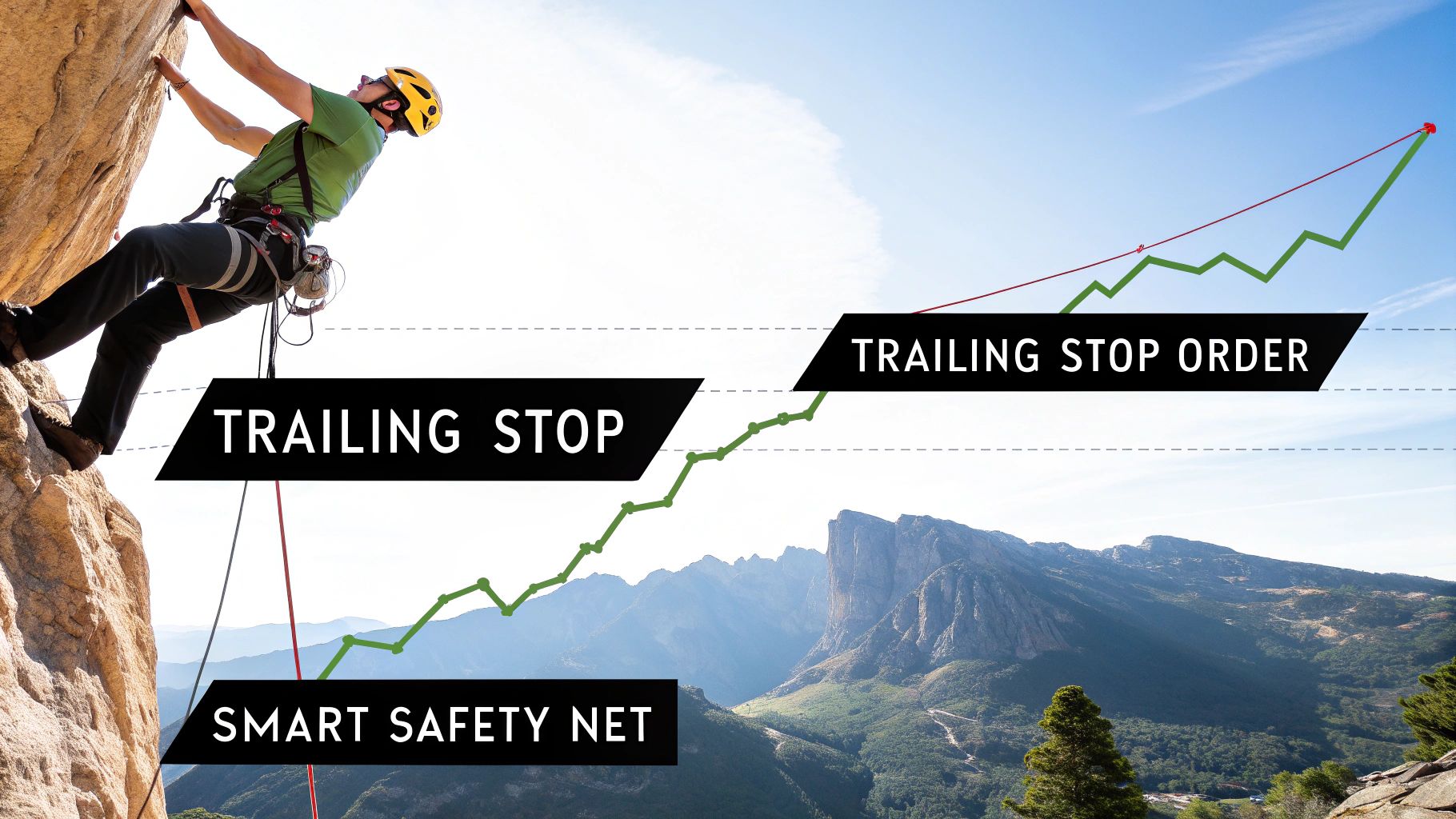
A trailing stop order is one of the smartest tools in a trader's risk management toolkit. Think of it as a dynamic stop-loss that automatically follows your trade as the price moves in your favor. Unlike a standard, fixed stop-loss that just sits there, a trailing stop is designed to trail a profitable position, helping you lock in gains while still giving the trade room to run. Its whole purpose is to protect your profits without you having to manually move your exit point every five minutes.
Your Automated Profit Protection Tool
Here’s a simple analogy: imagine you're climbing a mountain, aiming to get as high as you can. As you make your way up, you place a safety anchor just below you. Every time you climb higher, you move that anchor up with you. Now, if you suddenly slip and fall, that anchor is there to catch you, preventing a disastrous fall all the way back to the bottom.
A trailing stop order is your trading safety anchor. It’s an instruction you give your broker to sell an asset if its price drops by a specific amount or percentage from its highest point after you've entered the trade. This is what makes it so different—and often, so much more effective—than a standard, static stop-loss.
While a classic stop-loss is set at one price and stays there, a trailing stop is built to move in only one direction.
- It moves up as the price rises (for a long position).
- It moves down as the price falls (for a short position).
- It locks in place the moment the price starts moving against you.
This clever mechanism lets you ride a trend for all it's worth, potentially capturing a much bigger move than you would with a fixed profit target. Your trade only closes when the price finally reverses enough to hit your trailing stop level, automatically securing the profit you’ve built up. Before diving deeper, it's a good idea to have a solid grasp of the basics by understanding how to set stop losses.
Key Differences at a Glance
The main distinction is simple: one is static, the other is dynamic. A standard stop-loss is like setting an alarm clock for a single, fixed time. A trailing stop is more like a smart alarm that adjusts based on your progress, only going off when a genuine reversal happens. This flexibility is a cornerstone of smart risk management, which you can read more about by exploring stop-loss and take-profit orders in trading.
A trailing stop order aims to solve a classic trading dilemma: how to protect your downside without prematurely capping your upside. It automates the process of "cutting losses short and letting winners run."
This automated discipline is a game-changer because it takes emotion out of your exit strategy. Instead of agonizing over when to sell, the order executes based on rules you defined beforehand, making it an essential tool for any systematic trader.
To make the comparison crystal clear, here’s a quick breakdown of how these two vital order types stack up.
Trailing Stop Order vs Standard Stop-Loss Order at a Glance
| Feature | Trailing Stop Order | Standard Stop-Loss Order |
|---|---|---|
| Behavior | Dynamic; adjusts with favorable price movement. | Static; remains at a fixed price level. |
| Primary Goal | Protect unrealized profits while allowing for more gains. | Prevent excessive losses beyond a set point. |
| Movement | Moves in one direction only (up for longs, down for shorts). | Does not move unless manually changed. |
| Placement | Set as a percentage or dollar amount from the peak price. | Set at a specific, absolute price level. |
| Use Case | Ideal for trending markets to maximize gains on winning trades. | Best for defining initial risk on any trade. |
Ultimately, the trailing stop is about intelligently managing a winning trade, while the standard stop-loss is your foundational safety net for every position you open.
How a Trailing Stop Order Actually Works
At its core, a trailing stop order is a simple but brilliant instruction you give your broker. Think of it as a dynamic "if-then" command that protects your downside while giving your profits room to run. It all boils down to two key parts: the trail value and the trigger rule.
The trail value is the distance you want your stop loss to follow, or "trail," the market price. You get to define this distance in one of two ways:
- A fixed point or dollar amount (like $1.00, 50 cents, or 20 pips).
- A percentage amount (like 2% or 5% below the highest price).
Once you've set that trail value, the order gets to work. It continuously calculates a stop price that's always the exact distance you specified away from the best price the trade has seen. For a long position, that's the peak price; for a short, it's the lowest price (the trough). Here’s the magic: the stop only moves in your favor. If the price pulls back, your stop stays put, locking in your gains. It only triggers an exit when the price reverses enough to hit that stop level.
This simple three-step flow shows how the order protects you as a trade moves your way.
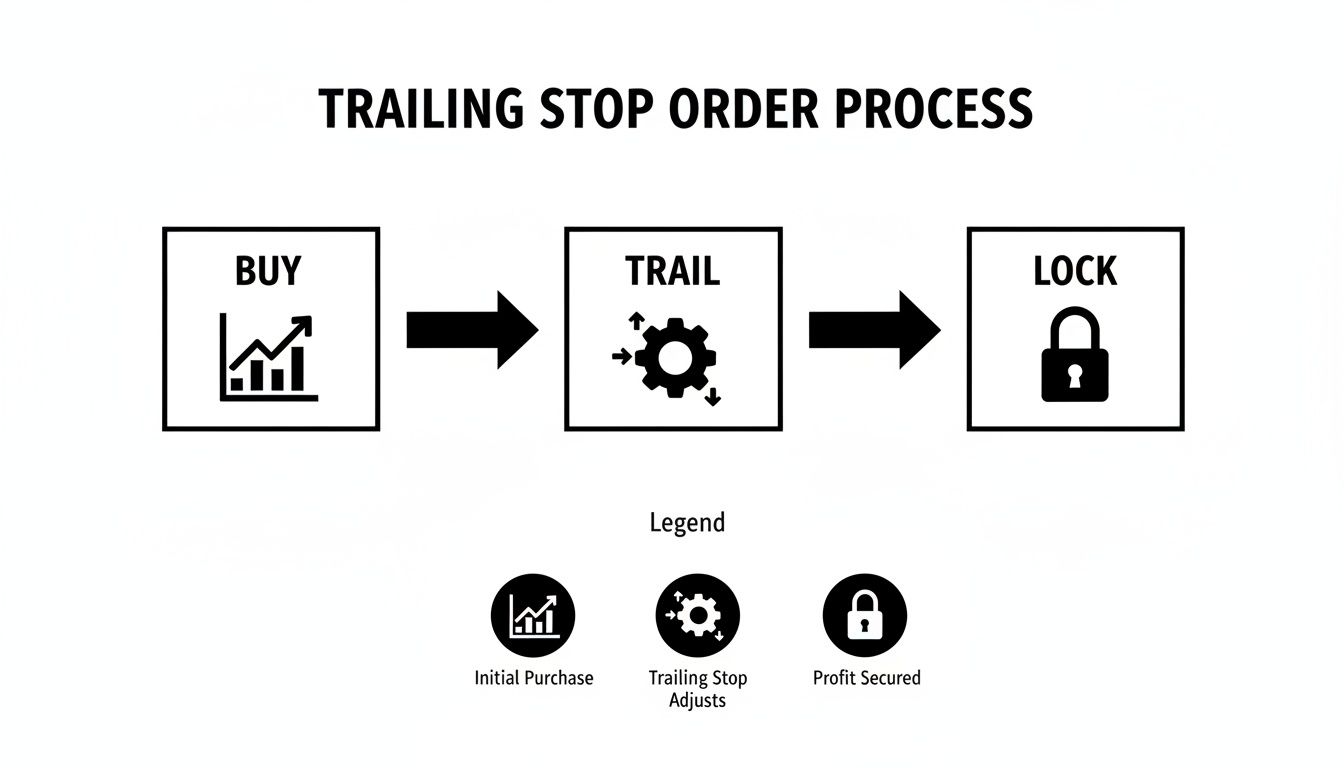
As you can see, the process is straightforward: you enter a trade, the stop adjusts upward as the price climbs, and then it holds firm to secure your profit when the market turns.
The Point-Based Trail in Action
Let's walk through a real-world example. Say you buy 100 shares of a stock at $50 per share. You decide you're only willing to risk $1 per share, so you set a trailing stop order with a $1.00 trail value.
Right away, your stop-loss is set at $49 (your $50 entry minus the $1 trail). Now, watch what happens as the price moves.
- Price Rises to $52: The stock is moving in your favor. Your trailing stop automatically follows it up, always keeping that $1 distance. The new peak price is $52, so your stop is now at $51.
- Price Rises Further to $55: The trend is your friend. The peak price hits $55, and your stop diligently trails behind, moving up to $54. At this point, you've already locked in a guaranteed profit of $4 per share.
- Price Dips to $53.50: The market pulls back a bit. This is the crucial part: your stop price does not move down. It's locked in at its highest point, which is $54.
- Price Reverses and Hits $54: If the price keeps falling and touches $54, your trailing stop order triggers. A market order is immediately sent to sell your 100 shares, closing your position and banking your profits.
It's this dynamic, one-way adjustment that makes trailing stops such a powerful tool for anyone trying to ride a trend.
Understanding the Percentage-Based Trail
A percentage-based trail works on the same principle, but its distance adapts as the price changes. This gives your risk management a more dynamic feel because the actual dollar value of the stop widens as your profits grow. This can give a winning trade more room to breathe during the bigger pullbacks that often come with strong trends.
The effectiveness of trailing stops varies significantly based on market conditions, with percentage-based trails offering an adaptive approach to risk management that fixed-point stops cannot match.
For instance, one case study shows a trader buying an ETF at $433.16 with a 1% trailing stop. Initially, this put the stop price at $428.82, a distance of $4.34. As the market rallied and the ETF hit $434.76, the stop automatically adjusted to $430.41. Notice the gap is now wider at $4.35. You can see more examples of how these orders adapt on Schwab.com.
This adaptability is a huge advantage with volatile assets, where a fixed-point trail might be too tight during small moves or too loose after a massive price run-up. Using a percentage keeps your risk perfectly proportional to your position's current value.
How to Set the Right Trail Distance
This is where the rubber meets the road. Setting the right trail distance is easily the most important decision you'll make when using this order type. It’s a delicate balancing act. Set it too tight, and you'll get shaken out by the market's everyday noise. Set it too wide, and you're just giving back way too much of your hard-won profits.
The trick is to stop guessing and start using a data-driven approach based on how the asset actually moves. You need to give your trade enough room to breathe without taking on sloppy, unnecessary risk. Every market has its own unique personality, so a one-size-fits-all distance just doesn’t cut it. We need a method that respects an asset's natural rhythm, and that’s where volatility comes in.
Using Volatility to Your Advantage
One of the best ways to nail down a logical trail distance is by measuring the asset’s recent volatility. It’s just common sense: a high-flying stock that swings wildly needs a much wider stop than a stable, slow-moving blue chip. Trying to slap a 50-cent trail on a stock that regularly moves $5 in a single day is a recipe for getting stopped out before your trade even gets going.
For this job, the Average True Range (ATR) is the perfect tool. The ATR indicator gives you a concrete number representing the asset's typical price movement over a specific period. By basing your trail distance on the ATR, you're syncing your risk management with the market's current behavior.
Here's a simple framework many pros use:
- Find the ATR: Most trading platforms have a built-in ATR indicator. A 14-day period is a common setting.
- Use a Multiplier: Once you have the ATR value, multiply it to get your trail distance. A multiplier of 2x or 3x the ATR is a solid starting point.
- Set Your Trail: This calculated value becomes your trailing stop. For example, if a stock's 14-day ATR is $1.50, a 2x ATR trail would be $3.00.
Using an ATR multiple helps you place your stop just outside the zone of random market chatter, giving your trade a much better chance of survival.
Aligning Trails with Market Structure
Another powerful technique, especially for price action traders, is to anchor your trail distance to key market structure. We know markets don’t move in straight lines; they move in waves, creating a series of swing highs and lows. These points are the most logical places to hide a stop because they represent areas where buyers or sellers previously stepped in.
Your trailing stop distance shouldn't be arbitrary; it should be a calculated decision based on how the asset actually behaves. Using volatility and market structure turns your trailing stop from a simple tool into a strategic weapon.
For a long trade, you might place your initial stop just below a recent, significant swing low. As the price pushes higher and forms a new, higher swing low, you can manually adjust your trailing stop to sit just below that new point. It's a more hands-on approach, but it keeps your stop in the most logical defensive position based on what the chart is telling you right now.
This method requires more active management, but it's incredibly adaptive. You aren't just trusting a fixed volatility number; you're reacting to how the price story is unfolding, candle by candle.
Choosing Your Method
At the end of the day, the best trail distance comes down to your trading style, your timeframe, and your personal risk tolerance. A day trader scalping for quick profits will naturally use a much tighter trail than a swing trader looking to ride a trend for several weeks.
Keep these factors in mind when making your decision:
- Your Time Frame: Shorter time frames demand tighter stops. Longer time frames need more room.
- Asset Volatility: High-beta stocks and volatile forex pairs need wider stops. Period.
- Your Strategy: Are you trying to capture quick bursts or ride out long, established trends?
- Risk Tolerance: Never, ever set a trail that exposes you to more risk than you're comfortable losing on a single trade.
The best thing you can do is experiment on a demo account. See what feels right. I've found that combining a volatility-based method like the ATR with a keen awareness of market structure often creates the most robust and effective framework for setting a smart trailing stop.
How to Use Trailing Stops in Price Action Trading

If you're a price action trader, a trailing stop order is more than just a safety net—it’s a strategic partner. We read the market's story through raw price movements, and a trailing stop helps automate the happy ending by locking in profits as the story unfolds in our favor.
Instead of guessing where a trend might fizzle out or setting some arbitrary profit target, you can let the market itself tell you when the party's over. It’s a purely mechanical way to enforce that age-old wisdom of "letting your winners run" while keeping a tight leash on your capital. This takes the emotion and guesswork out of the exit, tying it directly to the price action you see on the chart.
Strategy 1: Riding Strong Trends
The killer app for a trailing stop is capturing the lion's share of a powerful, sustained trend. We've all been there: you nail an entry, the trade moves beautifully, you take your profits… only to watch in agony as it keeps running for hundreds more pips. A trailing stop is the perfect antidote to this frustration.
Picture a stock in a textbook uptrend, carving out a clean series of higher highs and higher lows. You jump in with a long position and tuck a trailing stop just below a recent swing low.
- As the price marches higher, your trailing stop follows it, ratcheting up and securing more and more of your paper profits.
- The trade stays open, breathing through minor pullbacks and sideways grinds.
- Your position is only closed when the price finally violates that established trend structure, giving a clear signal that a reversal could be underway.
This technique keeps you in the trade for the bulk of the move, exiting automatically when the market’s behavior shifts. It’s a foundational tactic for anyone wanting to learn how to trade with the trend. Your job is to spot the trend; the trailing stop's job is to manage the exit.
A trailing stop order automates discipline. It forces you to stay in a winning trade longer than your fear might allow and gets you out when the price action confirms the trend is likely over—not when you think it might be.
Strategy 2: Protecting Breakout Profits
Breakouts are thrilling but notoriously fickle. A classic price action pattern is a powerful surge through resistance followed by a sharp retest or, worse, a complete failure. A trailing stop is tailor-made to manage this chaos, protecting your profits once a breakout gets going.
Here’s how you’d apply it in the real world:
- Spot the Breakout: Price smashes through a key resistance level, preferably with a surge in volume.
- Enter the Trade: You go long right as the breakout happens.
- Set Your Initial Stop: Place a hard stop-loss just below that broken resistance level (which should now act as support).
- Engage the Trail: Once the price has moved a decent amount in your favor—say, a 1:1 risk/reward ratio—you flip the switch from a static stop to a trailing stop.
This two-step approach gets you through the initial whiplash of the breakout. From there, the trailing stop takes over, locking in gains as the new trend hopefully takes shape. It's a savvy way to bank the profits from that first burst of momentum.
Trailing stops have also become a go-to tool in the fast-paced world of futures markets. When a futures trader goes long with a trail set below the current market price, the stop automatically adjusts as the price rallies. For example, a trader might buy a contract at 2650.25 with a 12-tick trailing stop, initially setting the exit at 2647.25. If the market rips higher to 2655.25, the stop instantly moves up to 2652.25, always keeping that precise 12-tick buffer and dynamically protecting profits.
At the end of the day, building the trailing stop order into your price action toolkit allows you to systematize your exits based on what the market is actually doing, which is how you turn a good entry into a great trade.
Common Mistakes to Avoid With Trailing Stops
A trailing stop order is a fantastic tool for taking the emotion out of profit protection, but it’s far from a “set it and forget it” magic bullet. I’ve seen countless traders turn this powerful ally into a source of real frustration. A few common missteps can lead to getting kicked out of good trades too early or watching huge gains vanish into thin air.
Let's walk through the biggest pitfalls so you can sidestep them.
Setting the Trail Too Tight
This is easily the most common mistake. In an effort to lock in every last tick of profit, traders choke the life out of their trades by setting the trail distance too tight. It's like holding the reins on a racehorse with zero slack—the slightest stumble, and you're thrown off.
Markets simply don't move in a straight line. They ebb and flow, pulling back and consolidating even within the strongest trends. This is normal, healthy price action. A trail that’s too restrictive doesn't give the trade room to breathe, and you end up getting stopped out by random market noise right before the price rips higher again.
Setting the Trail Too Wide
On the flip side, some traders go too far in the other direction and set their trail too wide. This usually comes from a fear of getting stopped out prematurely, but it creates a whole new problem: you give back an unacceptable amount of your open profits.
Imagine you're sitting on a $1,000 paper profit. The market turns hard against you, but your stop is so far away that by the time it finally triggers, you walk away with just $200. Sure, it’s a winning trade, but giving back 80% of your potential gain is a massive psychological and financial blow. The whole point is to find a balance between riding the trend and practicing smart capital preservation. A loose stop defeats half that purpose.
A well-placed trailing stop finds the sweet spot between market noise and a meaningful reversal. Too tight, and noise stops you out. Too wide, and you surrender too much profit.
Using Trailing Stops in the Wrong Market
Here's a critical rule: a trailing stop is a trend-following tool. It shines when a market is making a clear, directional move with good momentum. Where does it fail? In choppy, sideways, or range-bound markets.
When the price is just whipping back and forth without going anywhere, a trailing stop is a guaranteed way to get chopped to pieces. It will almost certainly be triggered on a meaningless swing, locking in a small loss or a tiny gain before the price swings back the other way.
Your first job as a trader is to correctly identify the current market condition. If you can't spot a clear trend, a trailing stop is simply the wrong tool for the job.
Overriding the Order Manually
This last one is a killer, and it’s all about discipline. You set a trailing stop to automate your exit and remove emotion from the equation. Then, as the price inches closer to your stop, the fear kicks in. You start thinking, "I'll just move it a little further away… I feel like it's about to turn around."
The moment you do that, you've completely defeated the purpose of the tool. You've just re-injected emotion, guesswork, and bad habits right back into your exit strategy. Trust the plan you made when you were calm and objective, not the impulse you feel in the heat of the moment. Letting your automated orders do their job without interference is one of the biggest tests of a trader's discipline.
Your Top Questions Answered
Even after you get the hang of how trailing stops work, some practical questions always pop up. I've been there. This section is designed to give you clear, straight-from-experience answers to the most common things traders ask, helping you handle the finer points with more confidence. Let's clear up any confusion so you can get back to the charts.
Can a Trailing Stop Order Guarantee My Exit Price?
No, and this is a huge point to burn into your memory. A trailing stop order isn’t an execution guarantee at a specific price; it's a trigger. Once the market touches your stop level, your order simply becomes a plain old market order. From there, it gets filled at whatever the next available price is.
In fast-moving markets, this reality introduces slippage. Slippage is that frustrating gap between where your stop was triggered and where you actually got out. For instance, if your stop is set at $50, a violent price drop might mean you get filled at $49.95 or worse. While it's usually just a few cents, slippage can become a serious problem during major news events or in thinly traded markets.
What’s the Difference Between a Trailing Stop and a Trailing Stop Limit Order?
The difference comes down to what happens after your stop price gets hit. As we just covered, a standard trailing stop turns into a market order, which prioritizes getting you out of the trade fast, not at a specific price.
A trailing stop limit order, on the other hand, gives you more control over the price. When the stop is triggered, it places a limit order at a price you defined beforehand.
- Trailing Stop: Hits the stop price → becomes a market order → executes at the next best available price, no matter what it is.
- Trailing Stop Limit: Hits the stop price → becomes a limit order → executes only at your limit price or better.
The trade-off here is certainty of execution. A trailing stop limit protects you from ugly slippage, but it carries the risk your order might not get filled at all. If the price gaps right past your limit and keeps running, you're still in the trade.
Are Trailing Stop Orders Available on All Platforms?
Unfortunately, no. While trailing stops are a standard feature on most modern brokerage platforms, you can't take their availability for granted. Some brokers might only offer them on their desktop software but not their mobile app, while others may not support them for assets like options or certain cryptocurrencies.
It’s not unheard of for exchanges to update their systems and temporarily—or even permanently—remove support for them. It’s always smart to double-check your broker's documentation or support page to see exactly which order types they offer for the markets you trade. It’s a simple step that ensures you have the tools you need before you put your capital on the line.
Always verify that your trading platform supports the specific type of trailing stop you want to use—be it point-based, percentage-based, or a limit version—for your chosen asset.
Can I Use a Trailing Stop on a Short Position?
Absolutely. Trailing stops are just as effective for managing short positions; they just work in reverse. When you short a stock (betting the price will drop), your stop will trail the price downward, locking in profits as the stock falls in your favor.
Here’s how it would play out on a short sale:
- You short a stock at $100 and set a $2 trailing stop. This places your initial buy-to-cover stop-loss at $102.
- The stock price drops to $95. Your stop automatically follows it down, moving to $97 (always $2 above the lowest price reached).
- The price suddenly reverses and rallies to $97. Your trailing stop triggers, sending a market order to buy back the shares and close your position, locking in your profit.
The mechanics are exactly the same—it just mirrors the price action for a bearish trade.
When Should I Not Use a Trailing Stop Order?
A trailing stop is a fantastic tool, but it's not the right tool for every job. It shines brightest in trending markets that show clear, directional momentum. Trying to force it to work in the wrong environment will just chop up your account.
You should think twice about using a trailing stop in these conditions:
- Choppy or Sideways Markets: In a range-bound market where price is just bouncing around, a trailing stop is almost guaranteed to get hit by random noise, stopping you out for a small loss or break-even.
- Extremely Low Volatility Markets: If a stock is barely moving, a tight trail is useless, and a wide one doesn't really protect you from anything.
- Right Before Major News Events: High-impact events like earnings or Fed announcements can cause huge price gaps overnight. A trailing stop offers zero protection if a stock gaps down right through your stop level at the opening bell.
In these scenarios, you're often better off using a classic static stop-loss combined with a pre-defined profit target.
At Colibri Trader, we teach traders how to master price action so they can confidently decide which exit strategy—whether a trailing stop, a fixed target, or another method—is the right choice for any market condition. Our programs are designed to build your skills from the ground up, focusing on real-world application rather than abstract theory. Discover your trading potential and learn a proven, indicator-free approach by visiting us at https://www.colibritrader.com.