Finding the Right Trading Mentorship Programs for You
So, you want to learn how to trade. You could piece together a strategy from scattered YouTube videos, social media gurus, and contradictory blog posts. Many try this path. Most fail.
Staring at fluctuating charts on your own can feel like captaining a ship in a storm with nothing but a torn map and a broken compass. You see the waves and hear the thunder, but you don't know which signals matter and which are just noise. This is where most aspiring traders get stuck, drowning in information overload.
It’s this chaos that leads to analysis paralysis, emotional trades, and a slowly draining account balance. The problem isn't a lack of information—it’s the absence of a coherent framework to apply it.
Why a Trading Mentor Is Your Edge in the Market

A trading mentor is your seasoned navigator. They’ve sailed these waters a thousand times, know where the rocks are hidden, and can read the weather patterns that new traders miss. They don’t just hand you a map; they teach you how to read it yourself, helping you steer clear of common pitfalls like revenge trading or FOMO (fear of missing out).
A mentor's greatest value isn't giving you winning trades; it's building the framework that allows you to find them yourself, consistently and confidently, for the rest of your career.
This is what truly separates a hobbyist from a professional. Instead of reacting to market swings with fear or greed, you learn to execute a tested plan with discipline. A good mentor provides the objective, honest feedback you need to spot bad habits and fix them before they become costly routines.
The True Value of a Structured Approach
Think of trading mentorship programs as a direct investment in your most important asset: your own skill. They offer a clear path to understanding the core pillars of trading—price action, risk management, and market psychology. This structured approach helps you build a solid foundation, not the shaky one you get from trial and error.
With a mentor, you can expect to:
- Develop a Coherent Strategy: Learn a single, effective methodology from start to finish, not a confusing mix of conflicting ideas.
- Master Risk Management: This is the key to survival. A mentor shows you how to protect your capital, which is the only way to stay in the game long enough to win.
- Build Emotional Discipline: Get practical insights into managing the psychological pressure that causes the majority of traders to fail.
Ultimately, this transforms trading from a high-stakes guessing game into a repeatable, process-driven business. It’s not about finding a magic bullet, but about forging the skills, mindset, and discipline needed for long-term success.
The Tangible Impact Of Mentorship On Trader Performance
Buying a trading handbook feels empowering, but does guided coaching actually move the needle? The short answer: absolutely. When you pair up with an experienced mentor, cold data show clear lifts in win rates, tighter risk control and smoother consistency.
Think of it like repairing a high-end watch. You could study a manual all day, but one tiny misalignment and the mechanism freezes. A mentor, in this analogy, is the watchmaker at your side—spotting that misaligned gear and explaining why it matters. In trading, that real-time correction and insider insight save you time, capital and needless frustration.
This one-on-one feedback loop is what accelerates your learning curve. A mentor can catch those sneaky mistakes—like creeping your stop-loss wider out of hope or jumping into random trades when you’re bored. Ironing out these tiny, repeated errors is the foundation for consistent profitability.
Breaking Destructive Habits With Expert Feedback
Emotions are trading’s biggest saboteur. A mentor steps in as an impartial observer who flags and dismantles profit-draining behaviors.
Common traps they help you avoid:
- Revenge Trading: Chasing losses with impulsive trades, almost always leading to deeper drawdowns.
- Hesitation: Freezing on a valid setup, missing high-probability moves and eroding confidence.
- Failing to Cut Losses: Clinging to losing positions in the hope they’ll reverse, breaking basic risk management rules.
By holding up that mirror, your mentor rewires your decision process with specific action plans and accountability—critical elements for mastering trading psychology and building the mental toughness top traders rely on.
Quantifying The Mentorship Advantage
Mentorship isn’t just feel-good fluff—it delivers measurable gains. Programs that pair traders with seasoned guides report:
Effective mentorship replaces the painful trial-and-error grind with a targeted, data-driven system that builds skill and confidence at once.
Real results from macro trading cohorts include 40% increases in trade consistency over a year. Participants learn to spot recurring mistakes early and slash drawdowns, outperforming solo learners by an average of 22% in simulated stress tests during major market swings.
These figures underscore a key truth: mentorship isn’t about trading tips. It’s about a systematic upgrade in how you analyze, execute and manage every single trade.
From Inconsistent Results To A Professional Process
A top-tier mentorship program does more than teach you strategies—it makes you self-sufficient. The true win is becoming an independent trader who:
- Improves Win Rate: Focuses on high-probability setups and filters out emotion-driven slip-ups.
- Masters Risk Management: Defines risk on each trade, protecting capital and ensuring survival through market storms.
- Builds Confidence: Follows a proven process that eliminates the anxiety and guesswork holding back many developing traders.
That transformation—turning random outcomes into a disciplined, repeatable trading business—is the real return on your investment.
Choosing Your Mentorship Style: One-on-One vs. Group Programs
So, you've decided to get a mentor. Great. Now comes the next big decision: what kind of guidance actually works for you? Trading mentorships aren't a one-size-fits-all deal. They typically break down into two main flavors: personalized one-on-one coaching and structured group programs.
Which path you take really boils down to your learning style, personality, and where you're at in your trading journey right now.
The Power of Personalized Attention in One-on-One Mentorship
Think of one-on-one mentorship as hiring a personal trainer for your trading. The entire program is built around you—your unique strengths, your persistent weaknesses, and exactly what you want to achieve.
Struggling with discipline on Tuesdays but spotting great patterns on Fridays? A good mentor will tailor your sessions to tackle precisely that. It's a completely bespoke experience.
This kind of direct, customized feedback loop is priceless for traders who are stuck on a specific problem. You get undivided attention, which means you can do deep dives into your trading journal and build a level of accountability that’s almost impossible to find anywhere else.
Here’s what this focused approach delivers:
- Targeted Feedback: Your mentor is looking over your trades, pointing out bad habits you probably don’t even know you have.
- Maximum Accountability: With someone checking in on you directly and regularly, it's a lot harder to stray from your trading plan or skip the hard lessons.
- Flexible Scheduling: Life happens. One-on-one sessions can often be scheduled around your job and other commitments, which is a massive advantage.
Of course, this premium level of personalization usually comes with a premium price tag. It also misses out on the community vibe that a lot of traders find really motivating. If you’re someone who feeds off the energy of others, going it alone might feel a bit isolating.
The Collaborative Edge of Group Programs
On the other hand, you have group programs, which operate more like a specialized trading bootcamp. You're learning alongside a cohort of peers, all marching toward the same finish line. This creates a powerful sense of community and shared purpose that can keep you pushing forward when things get tough.
You’re not just learning from one expert; you're learning from everyone's questions, mistakes, and breakthroughs. This collaborative environment often brings up angles and perspectives you would've never thought of on your own. For a deeper dive, there's a fantastic ultimate guide to cohort-based courses that explains how these learning models are built for success.
In a group, you quickly realize you're not alone in your struggles. Watching others conquer the same hurdles you're facing builds incredible confidence and drives the key lessons home.
This structure is particularly fantastic for newer traders who need a clear, step-by-step roadmap. If you're just starting out, checking out trading classes for beginners can give you the solid foundation you'll need to really make the most of a group program. The main trade-off? Less one-on-one time. Your specific trading issues might not always be the main focus of a session.
Comparing Trading Mentorship Models
To make it even clearer, here’s a breakdown of how one-on-one and group mentorship stack up. This table breaks down the key differences between the two formats to help you choose the best fit for your learning style and goals.
| Feature | One-on-One Mentorship | Group Mentorship |
|---|---|---|
| Personalization | High: The program is entirely built around your individual needs and progress. | Medium: Follows a set curriculum, though good programs allow for Q&A. |
| Accountability | Very High: Direct, personal accountability with your mentor. | High: Peer pressure and scheduled sessions create strong accountability. |
| Cost | Higher: A premium price for dedicated, personalized attention. | Lower: More affordable due to the shared cost structure. |
| Community | Low: Typically an individual experience between you and the mentor. | High: Strong focus on peer support, discussion, and collaborative learning. |
| Best For | Traders needing to fix specific issues or those who prefer a customized path. | Beginners needing structure or traders who thrive in a collaborative environment. |
Ultimately, there's no single "best" option—only what's best for you. Consider your budget, how you learn most effectively, and what you need to break through to the next level in your trading.
How to Vet Trading Mentorship Programs and Avoid Scams
The world of trading mentorship is a crowded space, and frankly, it can be tough to tell the real experts from the slick marketers. With countless programs out there, you need a solid game plan for checking out potential mentors and spotting the red flags that scream "scam." Your goal isn't just to find a program; it's to find the right one that actually teaches you a skill, not just sells you a dream.
To do this, you've got to look past the flashy profit screenshots and glowing testimonials. You need to dig into the mentor’s actual trading history, get a feel for their teaching style, and confirm they obsess over the one thing that truly matters for survival: risk management. This process is about protecting your wallet and making sure you learn from someone who's credible.
The Litmus Test: Verifiable Track Record and Transparency
A legit mentor's history should be an open book. While past performance never guarantees future results, a verifiable track record proves their strategies actually work in live markets, not just on a PowerPoint slide. Be very skeptical of anyone who only shows you their winning trades. Every real trader has losses, and an honest mentor teaches you how to manage them—that's where the real learning happens.
If you're checking out a mentor who's also a registered financial advisor, you can use public databases like the Central Registration Depository (CRD) to look into their background. It’s one more tool for your due diligence toolkit.
A truly transparent mentor will:
- Share a Verifiable History: They should have a consistent, long-term presence in the markets that you can see.
- Discuss Both Wins and Losses: A mentor who breaks down their losing trades is offering pure educational gold.
- Avoid Unrealistic Profit Claims: Any promise of guaranteed returns is a massive red flag. Professional trading is about playing the probabilities, not dealing in certainties.
Evaluating Teaching Style and Risk Management Focus
Here's a hard truth: a great trader isn't always a great teacher. Your mentor’s ability to break down complex ideas is just as critical as their P/L. Look for programs that give you a taste of their style first—maybe through a trial, free content, or a live webinar. You need to see if their approach clicks with you before you hand over any money.
The best mentors don't create followers; they create independent thinkers. Their goal should be to make you self-sufficient, not dependent on their signals or alerts forever.
Most importantly, how much do they hammer on risk and money management? If a program dives straight into aggressive strategies without building a rock-solid foundation of capital preservation, it's setting you up to blow up your account. A top-tier mentor will spend a ton of time teaching you how to define your risk on every single trade, size your positions correctly, and protect your capital at all costs.
The simple decision tree below can help you figure out if a one-on-one or group structure is a better starting point for your needs.
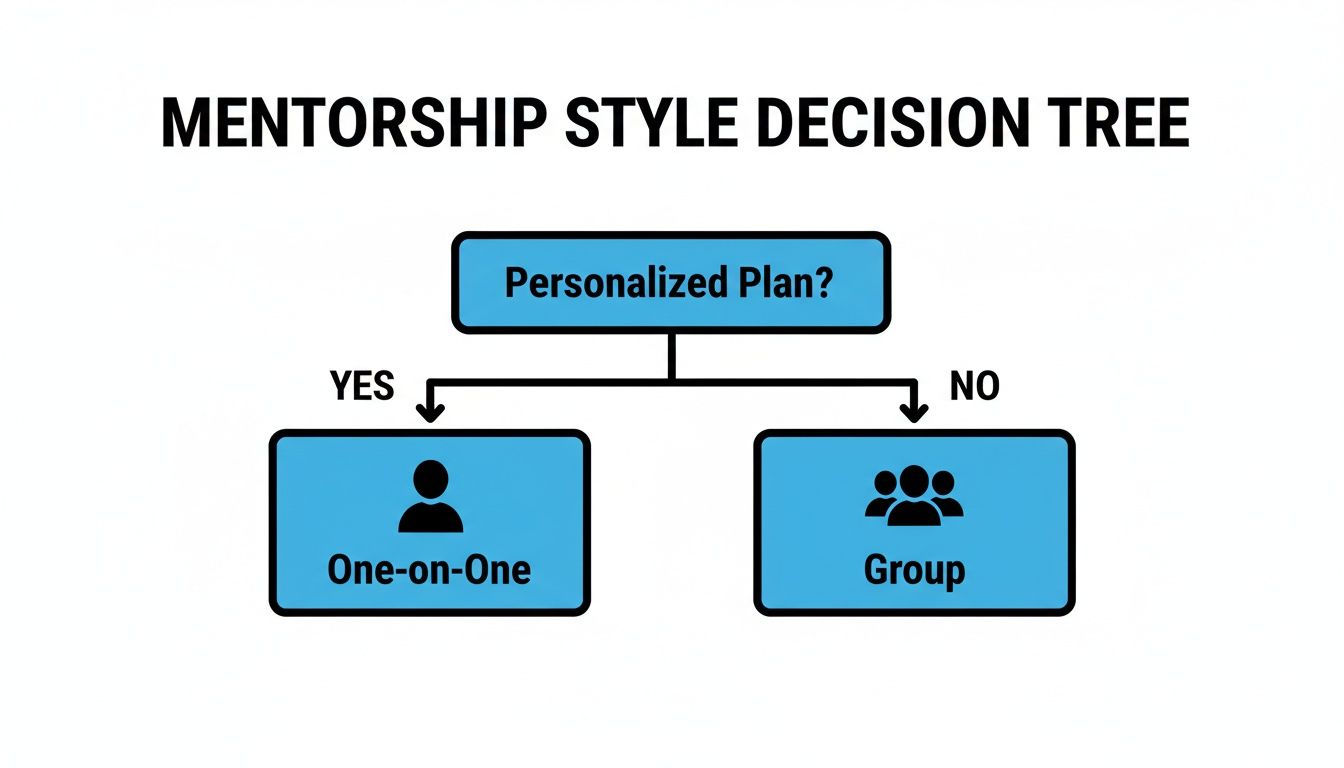
This just helps clarify whether a personalized plan or a more structured group environment makes more sense for how you learn.
Red Flags That Scream Scam
Legit mentors talk about process and education. Scammers play on emotion and urgency, preying on that desire to get rich quick. Learning their playbook is your best defense.
Be on high alert if you run into any of these tactics:
- Guaranteed Profits: Nobody can guarantee returns in the markets. This is the oldest and most dangerous lie in the book.
- High-Pressure Sales Tactics: A good program doesn't need a "limited-time offer" countdown clock. Its value should speak for itself.
- Vague or Secretive Strategies: If they can't clearly explain their methodology before you pay, they probably don't have one worth paying for.
- Emphasis on Lifestyle over Strategy: Watch out for marketing that's all Lambos and mansions but offers zero substance on actual trading education.
- Lack of Verifiable Proof: If they can't show you any third-party verified results or a long-term trading history, you should run, not walk, away.
By keeping this critical lens, you can cut through the noise and find a genuine mentorship program that puts your education first.
Understanding the Cost and True ROI of Mentorship
Let's get right to it and talk about the elephant in the room: the price tag. Investing in a trading mentorship program can feel like a huge financial leap, and you absolutely need to know what you’re paying for. Prices are all over the map, driven by the mentor's reputation, how deep the program goes, and the level of personal access you get.
It’s easy to get sticker shock. But the real question isn't just about the initial cost; it's about the value you get in return. The global market for stock trading education, which includes mentorship, was valued at a massive USD 2.5 billion in 2023 and is projected to more than double by 2032. You can explore the full market analysis on dataintelo.com to see what's fueling this boom.
This explosion in growth means you have more choices than ever, but it also means you have to be much more careful. A higher price doesn't automatically mean better education. So, instead of getting hung up on the upfront fee, it's time to shift your focus to the long-term return on investment (ROI).
Shifting Focus from Cost to Long-Term Value
The true ROI of a great mentorship isn’t measured by how much you make next week. That’s a lottery ticket mentality. The real return comes from building a durable, repeatable skill set that can serve you for your entire trading career.
Think of it like this: paying for mentorship is like paying tuition for a specialized trade. You're investing in your own human capital to learn skills with real, long-term earning potential.
A top-tier mentorship program pays for itself not by giving you winning trades, but by preventing years of costly, account-draining mistakes. It’s an investment in consistency over luck.
The most valuable things you’ll gain are often intangible at first, but they become the very foundation of your success. These are the skills that separate professional traders from the hobbyists who consistently burn through their accounts.
Defining Your Real Return on Investment
Your ROI goes way beyond the number in your trading account. A quality program delivers returns in a few key areas that are incredibly difficult, if not impossible, to develop on your own.
- Systematic Skill Development: You’re not just getting tips; you’re learning a proven, step-by-step process for analyzing the market, executing trades, and managing your positions. This eliminates the guesswork.
- Emotional Discipline: A mentor provides the objective, outside perspective you need to get a handle on fear and greed. This helps you stick to your plan, especially when the market gets choppy.
- Robust Risk Management: This is the big one. Learning how to protect your trading capital is the only way to make sure you stay in the game long enough to become profitable. You can also learn more about the importance of capital preservation in our detailed guide.
Legitimate Guarantees Versus Dangerous Red Flags
Finally, let's talk about guarantees. In the world of trading, some promises are golden, while others are giant red flags. Knowing the difference is critical.
A legitimate trading mentorship program can and should guarantee a few things: a structured curriculum, access to the mentor, a supportive community, and a clear methodology for you to learn. They are guaranteeing to teach you a specific skill set.
However, any program that guarantees profits or specific financial returns is a scam. Full stop. No one can predict the market with 100% certainty, and anyone who tells you otherwise is selling snake oil. A real mentor prepares you for uncertainty and teaches you how to manage risk; a scammer sells you an impossible dream of risk-free profits. Remember, your investment is in your education, not a promise of effortless wealth.
How Mentorship Is Building a More Inclusive Trading Community
Beyond just teaching strategies and risk management, trading mentorship programs are doing something much deeper: they're building a stronger, more open financial community for everyone. For a long time, the trading world felt like an exclusive club with high barriers to entry, something that kept a lot of women and other underrepresented groups on the sidelines. Mentorship is changing that, one trader at a time.
By creating a clear path to learning, these programs are making financial education accessible to anyone with the drive to succeed. They offer a supportive space where a person’s background or connections don't matter as much as their discipline. It's not just about learning to read charts; it's about building genuine confidence and feeling like you belong.
A truly great mentor gives you more than just a trading plan. They’re a source of encouragement, a safe person to ask the "dumb" questions, and a bridge to a network of fellow traders. For many who feel like they're going it alone, this community support is the missing piece of the puzzle.
Breaking Down the Old Barriers
For decades, trading floors and big financial firms were overwhelmingly male-dominated, which naturally created an intimidating atmosphere for anyone who didn't fit that mold. Mentorship directly challenges this by creating dedicated spaces for people to grow and feel empowered.
When a new trader sees a mentor who looks like them or comes from a similar background, it sends a powerful signal: "You can do this too." That kind of representation is incredibly important. It helps dismantle the psychological hurdles that have kept so much talent from even trying.
The best mentorship programs aren't just creating profitable traders. They're nurturing an entire ecosystem where different perspectives can flourish, which ultimately makes the market smarter and more resilient.
This approach helps ensure that skill and hard work—not just who you know—are what truly drive success.
Initiatives Creating Real Change
This isn't just talk; we're seeing real action across the industry to level the playing field. A fantastic example is the growing effort to support women in finance.
Seeing the huge gender gap on trading desks, the Buy-side Trading Community launched a global mentor network in 2023 specifically for women. This program offers free, direct access to experienced guides, helping women build the professional networks and confidence they need for lasting careers in asset management and hedge funds. You can discover more about this inclusive mentorship initiative on The TRADE.
Programs like this show just how much things are changing for the better. They prove that mentorship is one of the most powerful tools we have for building a more diverse, fair, and ultimately stronger trading community for the future.
Common Questions About Trading Mentorships
Even when you see the value, jumping into a trading mentorship can feel like a big step. It’s natural to have a few last-minute questions, and getting them answered properly is what gives you the confidence to move forward.
Let's clear up some of the most common things aspiring traders ask before they commit.
How Much Time Do I Really Need to Put In?
This is a big one, and the answer varies, but a good rule of thumb is to set aside 5 to 10 hours per week. This gives you enough time to actually digest the lessons, spend time on your charts applying what you've learned, and join in on any live sessions or community chats.
But let's be clear: just watching videos won't cut it. The real progress comes from the hours you spend practicing, reviewing your own trades (the good and the bad!), and asking for feedback. That’s how knowledge turns into an actual skill you can use to make money.
Do I Need Any Trading Experience to Start?
Not always. In fact, a lot of the best trading mentorship programs are built specifically for people starting from scratch. They'll walk you through the absolute essentials—like market structure, price action, and risk management—from the ground up.
The key is to be honest with yourself about where you are. Jumping into an advanced program when you don't know the basics is like trying to run a marathon without ever having jogged around the block. Check if a program is for beginners, intermediate, or advanced traders, and make sure it’s the right fit for you.
The goal of a great mentorship program is not to impress you with complexity, but to empower you with clarity. Choose a program that meets you where you are.
What’s a Realistic Outcome After I Finish?
A realistic outcome isn't about getting a certificate that guarantees a certain income. It's about developing consistency and confidence. By the time you’re done with a solid program, you should have a trading plan you trust inside and out, a rock-solid grip on your risk, and the discipline to actually follow your own rules.
Success means you've officially stopped gambling and started operating your trading like a business. You’ll be making calculated moves based on a proven method, not emotional guesses. That professional mindset is the real prize and the foundation for any long-term profit you'll make.
Ready to build the skills for consistent, long-term success? At Colibri Trader, we teach a clear, price-action methodology that works without indicators or complicated analysis. Learn how our practical mentorship can transform your trading today.