
Trading In The Zone Book A Guide for Price Action Traders
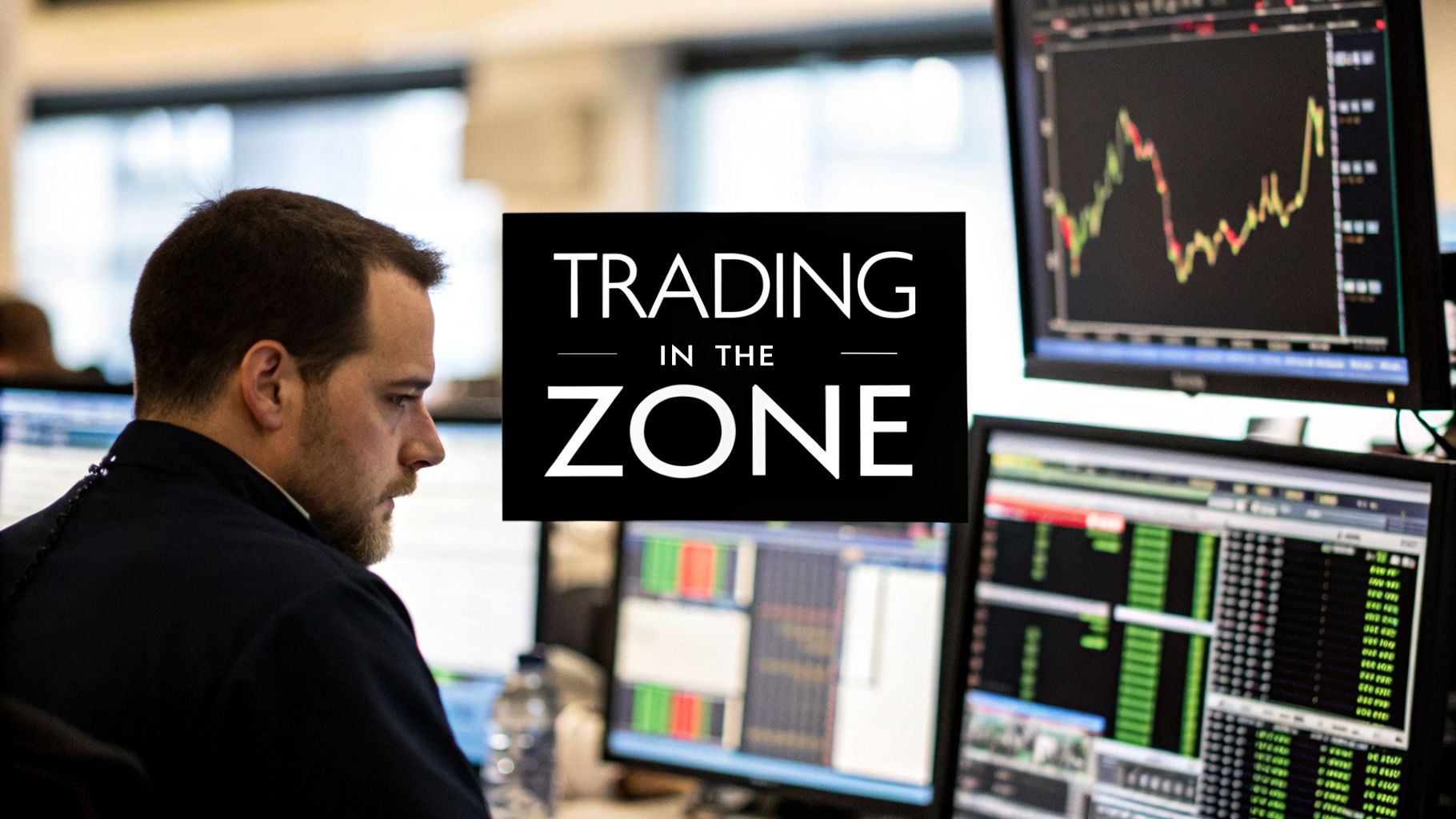
Let's be honest—most traders lose money. It's a frustrating, often brutal, truth. But what if I told you it's rarely because their strategy is broken? In his classic book, Trading in the Zone, Mark Douglas argues that the real battlefield isn't the charts; it's the six inches between your ears.
He provides a definitive game plan for mastering the mental side of trading, and it's something I've seen play out in my own career countless times.
Why Most Traders Fail And How This Book Fixes It
Have you ever found the perfect trade setup, only to freeze and watch the price rocket away without you? Or maybe you've chased a trade out of sheer Fear of Missing Out (FOMO), tossing your well-crafted rules right out the window.
If that sounds familiar, you're not alone. It’s a universal experience for traders, and it points to one critical reality: a world-class strategy is completely useless if you don't have the mental discipline to actually execute it.
Think of it like this: you've been given the keys to a Formula 1 car, but you're too scared to push the accelerator. That’s exactly what happens when your trading psychology isn't aligned with your system. You can have the best price action strategy on the planet, but if fear is in the driver's seat, you will find ways to sabotage your own results again and again.
The Three Core Trading Fears
After years of observation, Mark Douglas pinpointed the universal fears that plague nearly every trader. These psychological hurdles are the primary reason for blown-up accounts and inconsistent performance. Recognizing them is the very first step toward conquering them.
- Fear of Being Wrong: This is the fear that causes hesitation. You see your setup, but the anxiety of taking a loss is so paralyzing that you end up doing nothing at all.
- Fear of Losing Money: This nasty little fear makes you do things like moving your stop-loss "just a little bit" further away or snatching tiny profits off the table way too early. It forces you to cut your winners short and let your losers run.
- Fear of Missing Out (FOMO): This is pure impulse. It's the emotional gut punch that makes you chase trades that don't meet your criteria, leading to terrible entries and even worse decisions.
These emotional reactions are the true root cause of most trading failures. Trading in the Zone was groundbreaking because it looked this problem straight in the eye. Douglas came to a stark conclusion: a staggering 95% of traders fail not because their strategies are flawed, but because their fears are unmastered.
His research showed that the fear of being wrong stops traders from entering a valid setup 70% of the time, while FOMO is responsible for an incredible 60% of all account blow-ups. You can find more insights like these on sites like TraderLion.
Before we move on, let's quickly summarise the mental shift Douglas advocates. It’s all about moving from a mindset rooted in fear to one based on pure probability.
Mindset Shift From Novice to Zone Trader
| Novice Trader Mindset (Fear-Based) | Zone Trader Mindset (Probability-Based) |
|---|---|
| Tries to predict the market's next move. | Thinks in probabilities; knows anything can happen. |
| Sees each trade as a reflection of their skill. | Understands a single trade's outcome is random. |
| Avoids losses at all costs. | Accepts losses as a normal business expense. |
| Makes impulsive, emotional decisions. | Executes their pre-defined strategy without hesitation. |
| Focuses on the outcome of the current trade. | Focuses on executing a series of trades flawlessly. |
This table really gets to the heart of it. Becoming a "Zone Trader" isn't about being right all the time; it's about consistently executing your edge over the long run, regardless of the outcome of any single trade.
“The key to trading success is emotional discipline. If intelligence were the key, there would be a lot more people making money trading.” – Victor Sperandeo
This quote perfectly captures the book's central message. The path to consistent profits isn't about finding a magic indicator or a secret pattern. It’s about rewiring your brain to operate without fear.
By mastering your trading psychology, you can finally execute your strategy with the discipline it demands. To continue your journey on this topic, you might be interested in our guide on mastering trading psychology. This book provides the essential blueprint for that transformation.
Internalizing The Five Fundamental Truths Of Trading
If you want to stop fighting the market and actually start working with it, you have to let go of your need to be certain. It's a tough pill to swallow. In his book Trading in the Zone, Mark Douglas lays out the mental framework for this, built on what he calls the Five Fundamental Truths. These aren't just motivational quotes for your desk; they are the bedrock principles for surviving in the markets.
When you truly get these truths, you break free from the cycle of predicting, guessing, and just hoping for the best. You stop getting emotionally yanked around by every tick of the chart and start operating from a place of pure probability. I’ve seen it time and again—this shift is what separates struggling traders from consistently profitable ones.
The Five Truths That Define The Zone
Getting your head around these concepts is probably the hardest—and most critical—work you’ll ever do as a trader. They go against our very human nature to want to be right and feel in control.
- Anything can happen.
- You don't need to know what's going to happen next to make money.
- There is a random distribution between wins and losses for any given set of variables that define an edge.
- An edge is nothing more than an indication of a higher probability of one thing happening over another.
- Every moment in the market is unique.
Let's take the first one: "Anything can happen." It's like looking outside and seeing dark clouds. You know a storm is probably coming, but can you predict where every single lightning bolt will strike? Of course not. Trading is the same. You can have the most perfect-looking price action setup, and it can still fail spectacularly for no obvious reason.
This is where most traders trip up. They get stuck on fear—fear of being wrong, fear of losing money, and the big one, FOMO. These emotions are what keep them from accepting that the market can, and will, do anything.

The inability to accept that outcomes are random is a huge reason for the 95% failure rate among new traders. As soon as you genuinely accept that anything can happen on any given trade, the fear of the unknown starts to lose its grip. You stop trying to be a fortune-teller and start acting like a risk manager.
Moving From Prediction To Probability
This flows right into the second truth: "You don't need to know what's next to make money." Think like a casino. The house has no idea if the next roulette spin will land on red or black. They don't care. They know that over thousands of spins, their small statistical edge guarantees they will come out ahead.
Your trading edge is exactly the same. Let’s say you have a price action strategy that wins 60% of the time. That means you should fully expect to lose on the other 40% of your trades. A loss isn't a red flag that your strategy is broken; it’s just a normal, expected part of a winning system.
The goal of a trader is not to produce winning trades, but to trade his or her system flawlessly. By focusing on the process, the profits will take care of themselves.
Once you really internalize these ideas, everything changes. A losing trade is no longer a personal failure that sends you spiraling. It’s just one data point in a very large set of trades. It becomes a simple business expense on the road to long-term profit. That, right there, is the "zone"—where fear vanishes, and disciplined trading just becomes what you do.
Thinking In Probabilities To Achieve Consistency

This is where the rubber meets the road. All the theory from Trading in the Zone comes down to this single, powerful shift: learning to think in probabilities.
The end goal is simple. You need to get to a place where you treat every single trade as just one event in a long, long series. You have to completely detach your ego from the outcome. This is the only way I’ve seen traders find real, lasting consistency.
Think about it like this. Say you have a special coin, and you know for a fact it’s weighted to land on heads 60% of the time. If you flip it and it comes up tails, do you get upset? Do you start questioning your entire coin-flipping method? Of course not. You fully expect tails to show up 40% of the time. It’s a built-in part of the process.
Your trading edge is no different.
Defining Your Edge Like A Casino
A casino owner doesn't waste time trying to guess who will win the next hand of blackjack. They don’t care. Instead, they rely on a small, proven statistical advantage that guarantees they make money over thousands and thousands of hands.
This is exactly how a professional trader needs to see their system. Your edge isn't some crystal ball for predicting the future. It’s just a slightly higher probability of one thing happening over another, played out over a large sample size of trades.
To make this practical, you have to do three things:
- Define Your Edge Clearly: You must know exactly what price action setups you trade. What are your non-negotiable rules for entry, stop-loss, and take-profit? It has to be objective and mechanical.
- Accept The Risk Upfront: Before you ever click that mouse, you must genuinely and completely accept that the trade might lose. This single act defuses the fear of being wrong.
- Execute Flawlessly: Your only job is to follow your rules. No hesitation, no second-guessing. Let the market handle the random distribution of wins and losses.
Once you truly internalize this, you stop trying to be right on every trade and start focusing on being disciplined. The whole point of the Zone Mindset is to build consistent performance. By focusing on your process and not the outcome of any single trade, you learn how to be consistent.
Embracing The Random Distribution
The most freeing moment in any trader’s journey is when they truly accept that the outcome of any given trade is random.
Even with a strategy that wins 70% of the time, you could easily have a string of five, six, or even seven losses in a row. A probabilistic mindset doesn’t see this as a system failure. It understands it's a statistical certainty that will happen eventually.
"When you have a defined edge, and you're thinking in probabilities, the market can't make you do anything wrong. You have no reason to be afraid because you've already accepted the risk and know that your edge will play out over time." – Mark Douglas, Trading in the Zone
Since it was published back in 2000, Trading in the Zone has sold over 500,000 copies. That’s because its message is timeless. Douglas famously argued that success is 80% psychology and only 20% strategy.
In fact, traders who adopt this mindset have seen their win rates climb from around 30% to a more consistent 55-60% over a series of 100 trades. They didn't change their strategy—they changed how they thought about it. You can discover more about the book's profound impact on EBC.com.
This shift moves your focus away from trying to predict the market's next move to simply executing your plan without error. When you achieve that, consistency isn't some far-off dream. It becomes the natural result of your disciplined work.
Actionable Exercises To Develop The Zone Mindset

Understanding the concepts in the Trading in the Zone book is one thing. Actually living them when your money is on the line is a different game entirely. Just reading about a probabilistic mindset won't break your bad habits—only deliberate practice can do that.
These exercises are designed to help you bridge that gap. They help rewire your brain to focus on the one thing you actually have control over: your execution. This is how you start building the objective, disciplined habits of a professional trader.
Start An Execution Journal
Your first step is to start a journal, but with a twist. This journal completely ignores your profit and loss. That's right—we're not tracking money here.
Instead, after every single trade, you're going to answer a few simple questions. This process forces you to redefine what a "successful" trade looks like. Your goal isn't to win money; it's to execute your plan perfectly.
Ask yourself:
- Did this trade meet every single one of my predefined entry rules? (Yes/No)
- Did I pre-define my stop-loss and take-profit levels before entering? (Yes/No)
- Did I fully accept the risk of a full loss before I clicked the buy or sell button? (Yes/No)
- Did I interfere with the trade once it was live (for example, move my stop or close out early)? (Yes/No)
This checklist makes you look at your actions, separate from the outcome. It's a critical step toward building the right trading mindset. You can dive deeper into this topic in our dedicated article on the trading mindset.
Take The 20-Trade Challenge
To really cement these habits, commit to the 20-Trade Challenge. For your next 20 trades, your only goal is to get a perfect score in your execution journal.
Forget about the P&L. Winning or losing money is completely irrelevant for this exercise.
This challenge starves the part of your brain that thrives on fear and ego. By detaching from the outcome, you create the mental space to build the muscle memory for perfect discipline. You’ll learn to execute your strategy like a machine, which is the cornerstone of long-term consistency.
Practice Pre-Trade Visualization
Before you even think about entering a trade, take 60 seconds to run through it in your mind. Close your eyes and see the setup forming on your chart. Then, vividly imagine two different scenarios unfolding.
First, see yourself taking the trade and watch it go straight to your stop-loss for a full loss. Feel that brief sting, accept it as a normal cost of doing business, and then calmly move on to find the next opportunity, totally free of emotion. Next, visualize the trade hitting your profit target. See yourself closing it exactly as you planned, without any greed.
This kind of mental rehearsal helps neutralize the emotional charge of both winning and losing. To truly change your trading psychology, you have to do the mental work. It helps to actively train your brain and develop a successful trading identity and build on what you're learning.
Putting these exercises into practice will give you the solid psychological foundation you need to trade in the zone.
Pairing The Zone Mindset With Price Action Strategy
Having a rock-solid mindset is fantastic, but it's only one piece of the puzzle. To actually make money, you need to connect that mindset to a clear, effective strategy that tells you what to do on the charts. This is where the powerful psychology from the trading in the zone book meets the real world of price action.
The perfect partner for a "Zone" mindset is a simple, rule-based price action strategy.
Think about it this way: complex trading systems loaded with a dozen lagging indicators just create noise and confusion. They become a source of hesitation and second-guessing—the very things that destroy the disciplined state Mark Douglas talks about. You find yourself analyzing your indicators instead of just executing your edge.
A clean price action approach does the exact opposite. It gives you the objective signals you need to trade without getting your emotions tangled up in the process.
Why Price Action Is The Perfect Vehicle
Price action trading is all about reading the raw movement of price on a clean chart. You learn to identify key patterns and important zones of supply and demand. This method strips away all the clutter, giving you a clear, repeatable framework for every decision you make.
It’s the perfect vehicle for a probabilistic mindset, and here’s why it works so well with the lessons from the book:
- Objective Signals: A well-defined price action setup—like a pin bar appearing at a key support level—is an objective event. It either happens or it doesn't. This removes the subjective guesswork that leads to emotional mistakes.
- Clear Rules: A solid strategy has non-negotiable rules for your entry, where to place your stop-loss, and where to take profits. This mechanical structure is absolutely essential for building the discipline to execute flawlessly time and time again.
- Focus on Process: Because the rules are so clear, your job changes. You're no longer trying to "predict" where the market will go next. Your only job is to "execute" your plan when your setup appears. This lines up perfectly with the core message of focusing on the process, not the outcome of any single trade.
If you’re looking to build a robust system like this, our detailed guide on how to trade with price action is a great place to start. It gives you the strategic foundation you need to apply a "Zone" mindset effectively.
A Real-World Example: Strategy And Psychology
Let's imagine your price action strategy is to trade bullish engulfing patterns that form at proven daily support levels. You're watching the EUR/USD chart, and a perfect setup appears.
First, your price action strategy answers the "what" and "where":
- What: A bullish engulfing candle.
- Where: At a confirmed daily support zone.
- The Plan: You will enter on the close of that candle, place a stop-loss just below the low, and set a profit target at the next resistance level.
The rules are clear and mechanical.
Now, the Zone mindset kicks in to handle the execution. It provides the "how" and "why":
- You fully accept the risk of the trade before you even click the buy button.
- You execute the entry without any fear or hesitation because the setup meets your pre-defined rules.
- You don't get emotionally attached as the price wiggles up and down. You know that the outcome of this specific trade is essentially random.
- You simply let the trade play out, allowing it to hit either your stop-loss or your take-profit without you interfering.
This marriage of strategy and psychology is where the magic happens. Your strategy provides the statistical edge, but it's your psychology that allows you to actually use that edge consistently over hundreds of trades. You simply won't find lasting success without both working together.
Your Next Steps To Mastering The Mental Game
So now you have the blueprint. Real trading consistency doesn’t come from a secret indicator or some "holy grail" algorithm. It’s built inside your own head, through pure discipline.
The lessons are simple, but that doesn't make them easy. It boils down to controlling your emotions, thinking strictly in probabilities, and executing your strategy without flinching.
But knowing this is just the first step. The real work starts now. Here’s what you need to do to move from just reading about it to actually doing it.
Your Action Plan
First, you have to truly commit. If you're serious about changing your trading for good, you need these ideas to become part of you. The best way I know to make that happen is to get a copy of the trading in the zone book. Don't just read it once—read it over and over until it's second nature.
Next, remember that mindset alone isn't enough. It's like having a great driver with no car. You need to pair this mental game with a solid, rules-based strategy. A clean price action approach works perfectly here, giving you the clear signals you need to apply this new discipline.
The journey to consistent profitability is an internal one. Stop searching for the next magic bullet and start the real work of mastering yourself.
This is the path. It takes a lot of dedication and a focus on the process, not just the profits. If you can do that—pair the right mindset with the right strategy—you'll build the skills to become the trader you want to be.
Frequently Asked Questions About Trading In The Zone
After digging into the concepts from Trading in the Zone, it’s only natural for a few practical questions to pop up. Let's go over some of the most common ones I hear from traders to help you on your path.
How Long Does It Take To Develop A Zone Mindset?
There’s no finish line you cross here. Developing a true Zone mindset is a constant process of practice and self-awareness, not a destination you just arrive at. Every trader’s journey is different.
That said, if you really commit to the principles, you'll see a change. Traders who diligently work on their execution and emotional control often tell me they feel a real shift in their consistency within just a few months.
Can I Apply These Principles Without A Defined Trading Strategy?
The psychological framework is powerful, but you only unlock its true potential when you pair it with a trading strategy that has a proven statistical edge. The whole point of the Zone mindset is to help you execute that edge without messing it up.
Without an edge, you're not really trading—you're just trying to manage the psychology of gambling. The mindset is what gives you the discipline to let your strategy’s edge play out over the long haul.
What If I Keep Making Emotional Mistakes?
Don't beat yourself up; this is completely normal. Reading the book is just the first step. Actually breaking old, ingrained emotional habits takes time and real effort. If you find yourself slipping back into fear or FOMO, it's not a sign of failure.
Instead, get practical. The first thing you should do is drastically cut your position size. This immediately lowers the emotional temperature. Then, shift your entire focus away from the money and onto 100% flawless execution. Track your discipline in a trade journal—it will become your best tool for spotting exactly what triggers your emotional responses so you can finally address them.
Ready to pair a professional mindset with a proven strategy? At Colibri Trader, we provide the rules-based price action education you need to apply these concepts effectively. Start your journey today.