


Your Guide to the Reverse Head and Shoulders Pattern

When you see a reverse head and shoulders pattern taking shape, pay attention. It's a classic bullish reversal signal, and it often marks the bottom of a downtrend.
Think of it as the chart telling you a story: the bears are getting tired, and the bulls are starting to wake up. This pattern is essentially an upside-down version of a person's head and shoulders, and it’s a powerful sign that sellers are losing their grip.
Understanding This Bullish Reversal Signal
Imagine a tug-of-war on the charts. For a while, the sellers have been in complete control, dragging the price down. The reverse head and shoulders pattern shows you the exact moment that tug-of-war begins to turn. It's not just a random shape; it’s a visual map of market psychology shifting from fear to confidence.
This formation is one of the most reliable signals in technical analysis. It tells us that a downtrend is likely ending and a new, significant uptrend could be just around the corner. For price action traders like us, spotting this pattern early gives us a fantastic, high-probability chance to get into a new trend right at the beginning.
The Story Behind the Pattern
The pattern builds in three clear stages, each one revealing a key part of the market narrative:
- Sellers Make Their Move: The downtrend is still technically active, but it’s starting to show cracks.
- Buyers Fight Back: The bulls start stepping in with more force, preventing the price from making new lows and flexing their muscles.
- The Final Breakout: Confidence shifts for good. Buyers overwhelm the last of the sellers, and the new uptrend officially launches.
The real beauty of the reverse head and shoulders is its clarity. It gives you a logical roadmap with clear entry points, stop-loss levels, and even profit targets. It takes a lot of the guesswork out of trading reversals.
In this guide, we're going to skip the dry theory and get straight to what matters: how to actually trade this pattern. We’ll cover actionable steps, look at real-world chart examples, and give you the insights needed to trade this signal with discipline.
Mastering this pattern will also improve how you see other forex chart patterns, making you a more well-rounded trader. It's a cornerstone of many successful strategies and definitely belongs in your toolkit.
The Anatomy of a Bullish Reversal
To confidently trade the reverse head and shoulders pattern, you first have to understand its DNA. Don’t think of it as just a random shape on your chart. Instead, see it as a three-act play where the balance of power shifts dramatically from sellers to buyers. Each part of the pattern tells a crucial piece of this story.
When you break down this formation, you're really reading the market psychology at play. By learning to spot each component, you're not just identifying a pattern; you're seeing the narrative of a market bottoming out and getting ready for a powerful new move up. This is the foundation of any solid trading setup.
This chart shows the visual flow from a downtrend to an uptrend, with the reverse head and shoulders pattern acting as the critical turning point.
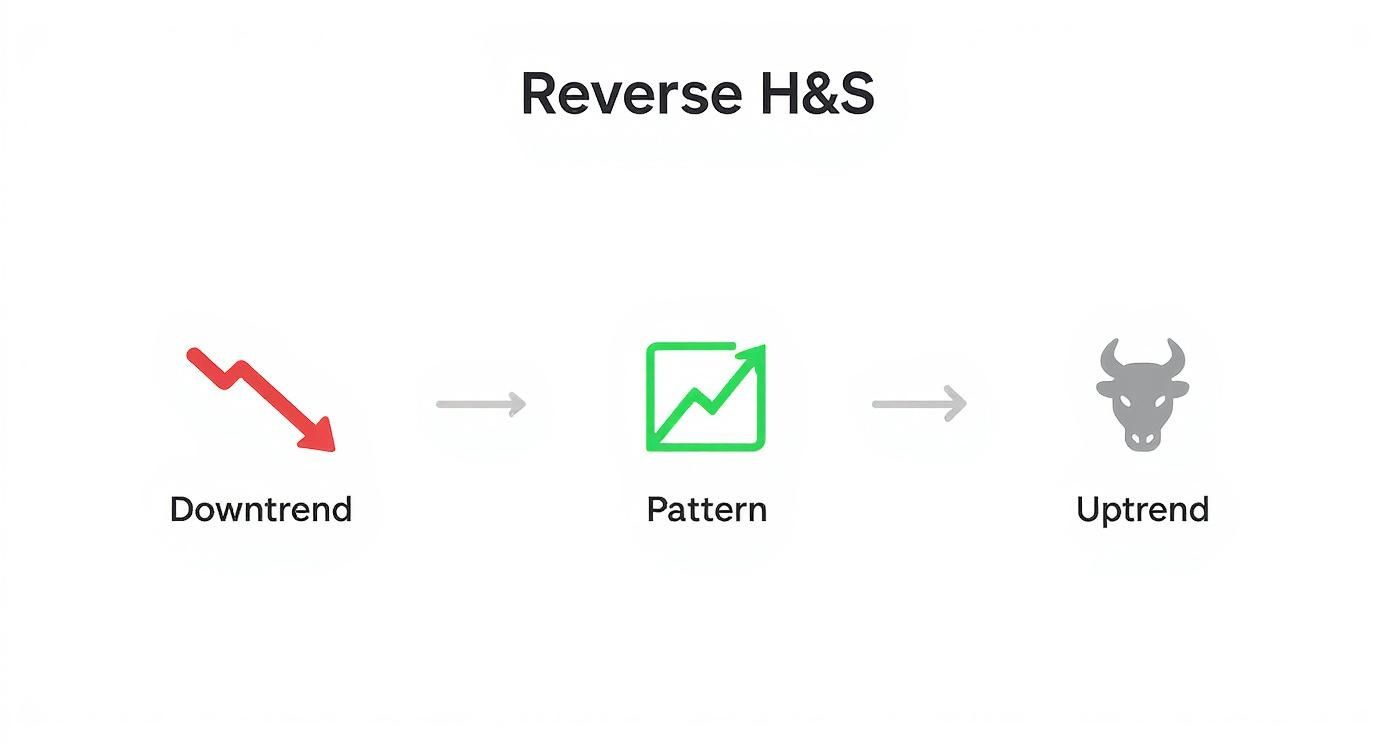
The key takeaway here is how the pattern serves as a bridge, signaling the end of bearish control and the beginning of bullish momentum.
The Left Shoulder: The First Warning Sign
The story begins with the Left Shoulder. At this point, the market is still in a clear downtrend. Sellers are in the driver's seat, pushing the price down to create a new swing low.
But then, something interesting happens. Buyers step in with enough force to cause a noticeable bounce. This initial pushback is the very first hint that selling pressure might be running out of steam. It's a warning shot fired by the bulls, even if the bears quickly regain control for a little while longer.
The Head: The Climax of Selling Pressure
Next up is the Head, which is the centerpiece of the whole formation. This is where sellers make their final, exhaustive push, driving the price down to its lowest point. On the surface, it looks like a clear win for the bears.
But this new low is deceptive. It actually represents a moment of capitulation, where the last of the weak-handed sellers finally throw in the towel. The rally that follows is often stronger than the bounce from the left shoulder, signaling that the buyers are growing more determined. Critically, the head must be the lowest point; otherwise, the pattern isn't valid.
The Right Shoulder: The Shift in Power
The Right Shoulder is where the story's momentum truly shifts. After the rally from the head, sellers try to push the price down one more time, but they can't manage to make a new low. The bottom of the right shoulder is noticeably higher than the head—a massive sign of bullish strength.
This failure by the sellers is hugely significant. It shows that buyers are now stepping in earlier and with more conviction. They're effectively drawing a line in the sand, refusing to let the price fall any further and setting the stage for the final act.
A valid Right Shoulder that forms higher than the Head is the market's way of telling you that the bears are exhausted. It’s the clearest signal yet that the downtrend is losing its power.
The Neckline: The Final Barrier
Finally, we have the Neckline. This is arguably the most important part of the entire reverse head and shoulders pattern. It's a resistance line drawn by connecting the high points of the rallies that happened after the left shoulder and the head.
Think of the neckline as a ceiling. Until the price can break through and, more importantly, close above this level, the bullish reversal isn't confirmed. It's the final barrier that buyers have to smash through to prove they're in control. A decisive break of the neckline is the green light traders are waiting for, confirming the pattern and signaling the start of a potential new uptrend.
How to Confirm the Pattern Is Real
Spotting a shape that looks like a reverse head and shoulders pattern is the easy part. The real skill lies in knowing if it's a genuine signal or just another fakeout waiting to happen. Anyone can see a pattern, but an experienced trader knows how to validate it.
Think of confirmation as your quality control. It’s what separates a high-probability setup from a hopeful gamble. Without it, you're just trading a pretty picture. We need hard evidence that the tide has truly turned from bearish to bullish. The two most powerful tools for this are the neckline breakout and trading volume.

The Ultimate Green Light: The Neckline Breakout
The neckline is the last line of defense for the sellers. It's the ceiling holding the price down, and until the buyers can smash through it, the bears are still in control. A decisive breakout above this level is the ultimate sign that power has officially shifted.
But not all breaks are created equal. A timid poke above the neckline that immediately retreats is a warning, not a green light. What we’re looking for is a move with conviction.
The most reliable confirmation is a full-bodied candlestick closing firmly above the neckline. This proves that buyers not only had the muscle to push through resistance but also held their ground until the session closed.
That strong close is everything. It tells you the big players—the institutional funds—are likely stepping in and providing the fuel needed for a real trend. Without it, you’re just hoping the breakout sticks. Nailing down how to identify support and resistance levels like the neckline is a foundational skill for this very reason.
Reading the Story in Trading Volume
If the neckline breakout is the main event, trading volume is the crowd's reaction. It tells you whether that event was a blockbuster or a dud. Volume gives you a peek behind the curtain, revealing the emotion and conviction driving the price.
For a reverse head and shoulders, volume should tell a very specific story: sellers are getting tired, and buyers are getting excited. First, selling pressure fades, and then, buying pressure explodes.
You'll often see volume tapering off as the left shoulder and head form, which shows sellers are running out of steam. Then, as price breaks the neckline, you want to see a massive spike in volume—often 25-40% above the 50-day average. This surge is your confirmation that buyers have stormed the field with authority.
Volume Confirmation Checklist for the Reverse Head and Shoulders
To make this dead simple and repeatable, I use a mental checklist for volume. This table breaks down what you should see at each stage of the pattern. It turns a subjective feeling into an objective, evidence-based decision.
This quick reference helps you validate the story that volume is telling throughout the pattern's formation.
| Pattern Stage | Ideal Volume Characteristic | What It Signifies |
|---|---|---|
| Left Shoulder | Moderate to high, then decreasing | The downtrend is still active, but sellers are starting to lose interest. |
| Head | Lower than the left shoulder | A classic sign of seller exhaustion; very few are left to push prices lower. |
| Right Shoulder | Continues to be light or low | Sellers have lost their conviction; the bears are essentially out of the game. |
| Neckline Breakout | Surges dramatically | A wave of enthusiastic buyers has entered, confirming the bullish reversal. |
By walking through these volume checks, you add a powerful layer of confirmation to your trade idea. A pattern that nails both the neckline breakout and the volume criteria has a much higher probability of success, transforming a simple chart shape into a robust, data-backed setup.
Building a Complete Trading Strategy
Just spotting a reverse head and shoulders pattern is one thing, but turning that chart pattern into actual profit is another game entirely. It's a fantastic start, for sure. But without a clear, repeatable plan, you’re just gambling.
A real trading strategy isn't just about knowing when to buy. It's a complete framework that dictates your exact entry, defines precisely how much you're willing to risk, and lays out your profit goals before you even click the mouse. This section will give you that plan, breaking down three distinct entry methods and the exact rules for managing the trade from start to finish.
Three Core Entry Strategies Explained
How you enter the trade has a massive impact on your potential risk-to-reward ratio. Some traders like to jump in early, hoping to catch the entire move. Others are more patient, waiting for extra confirmation to avoid getting caught in a false breakout.
There’s no single "best" method here. The right choice comes down to your personal risk tolerance and what you’re comfortable with.
Let's walk through the three main approaches:
- The Aggressive Entry: Buying as soon as the price breaks and closes above the neckline.
- The Conservative Entry: Waiting for the breakout, then entering when the price pulls back to retest the neckline as new support.
- The High-Risk Entry: Trying to get in near the low of the right shoulder, well before the neckline even breaks.
Each of these has its own pros and cons, which we'll dive into right now.
Executing the Trade Step-by-Step
A solid plan is your best defense against emotional trading. It’s a checklist that keeps you grounded, ensuring every action you take is logical and pre-determined. Let's build out a complete trading framework for each entry type, covering the trigger, stop-loss, and profit targets.
1. The Aggressive "Breakout" Entry
This is the most common way traders play this pattern. You simply wait for a strong candle to close decisively above the neckline. That close is your green light to enter a long (buy) position. The biggest plus here is you won't miss the move if the price just takes off and never looks back.
- Stop-Loss Placement: Tuck your stop-loss just below the low of the right shoulder. This gives the trade some breathing room to handle normal volatility but gets you out if the pattern completely fails.
2. The Conservative "Retest" Entry
This approach demands a bit more patience, but it often leads to a much better risk-to-reward setup. After the price breaks out, you sit on your hands and wait for it to pull back and "retest" the old neckline area. If the neckline holds as new support and you see a bullish signal (like a pin bar or engulfing candle), that's your trigger to buy.
- Stop-Loss Placement: Because you've waited for confirmation that the neckline is holding, you can place a much tighter stop-loss just below it. Your potential loss is smaller compared to the breakout entry.
The inverse head and shoulders pattern is widely seen as one of the most reliable bullish reversal signals out there. The stats are pretty impressive: research shows that in 98% of cases, the exit from the pattern sparks a bullish move, and the price hits its target objective 74% of the time after the neckline breaks. You can find more insights on pattern reliability over at CentralCharts.
3. The High-Risk "Anticipatory" Entry
Let's be clear: this is an advanced technique and definitely not for beginners. With this method, you're trying to anticipate the pattern's completion by entering near the low of the right shoulder, before the neckline gives way. The goal is to get the absolute best entry price possible. But the risk is way higher because the pattern isn't confirmed and could easily fall apart.
- Stop-Loss Placement: The stop-loss is non-negotiable here. It must go just below the low of the head. If the price drops below the head, the entire pattern is invalid, and you need to be out.
Setting Profit Targets and Managing Your Position
Once you're in a trade, you need to know where you're getting out. The classic way to set a profit target for this pattern is simple and incredibly effective.
The Measured Objective Technique
- Measure the Height: Calculate the vertical distance from the lowest point of the head straight up to the neckline.
- Project the Target: Take that same distance and project it upward from the point where the price broke the neckline. This level is your minimum profit target.
While the measured move gives you a great primary target, smart traders often peel off profits along the way. Think about taking some profits at key resistance levels the price might struggle with on its way to your final target. This locks in gains and de-risks the trade.
Finally, none of this matters without proper position sizing. Understanding what lot sizing is and how to calculate it is a critical skill for long-term survival in this business.
Analyzing Real-World Chart Examples

Learning the theory behind the reverse head and shoulders pattern is one thing. Seeing it unfold on a live chart is where the real learning kicks in. This is where abstract ideas become tangible, actionable trade setups. By breaking down real examples, we can move past the neat textbook diagrams and see how the pattern truly behaves in the messy, unpredictable world of the live markets.
We'll look at a few charts from different markets—stocks, forex, and crypto—to show you just how versatile this formation can be. Each example will highlight the key pieces we've discussed: the shoulders, the head, the neckline, and that all-important volume spike that tells us the breakout is for real. This kind of practical analysis is what bridges the gap between knowing the rules and actually trading them with confidence.
A Stock Market Example
Let's start with a classic stock chart. Picture a well-known tech company that's been bleeding value for months in a downtrend. The price action carves out a clear left shoulder, then takes a deeper dive to form the head. You can almost feel the sellers making their final, exhaustive push.
Next, a rally tries to reclaim old ground but fails, and sellers give it one last shot to drive the price down. But they can't even get close to the low of the head, and they form a higher low—the right shoulder. This is a massive tell; it screams seller weakness. The neckline, connecting the peaks between these troughs, is now plain as day.
When the price finally punches through that neckline, we see a huge surge in trading volume. This isn't just noise. It's a decisive shift in market sentiment, likely backed by big institutional money. That combination—a clean pattern and a powerful volume confirmation—gives us a high-probability entry for a new uptrend.
A Forex Pair in Action
Now, let's jump into the fast-paced world of forex. On a 4-hour chart of a major pair like EUR/USD, a similar story unfolds after a long sell-off. The structure takes shape with three clear troughs, with the middle one being the lowest.
The neckline here might not be perfectly horizontal; it could be slanted a bit. This is a common variation you'll see in the wild, so don't let it throw you off. The crucial part is that the right shoulder's low is still significantly higher than the head's low.
The breakout happens with a strong, full-bodied bullish candle closing firmly above that sloped neckline. A more conservative trader might wait for a small pullback to the neckline, which now acts as new support, before jumping in. That patience often pays off with an even better risk-to-reward ratio.
Trading is a game of probabilities, not certainties. The reverse head and shoulders pattern gives you a statistical edge, not a crystal ball. Embracing this mindset is crucial for developing the discipline needed for long-term success.
Understanding the Statistical Edge
Look, no pattern is going to work 100% of the time. That's why we have to think in terms of probabilities and stacking the odds in our favor. The legendary technical analyst Thomas Bulkowski did some landmark analysis on chart patterns that gives us powerful insights here. His work showed a success rate of around 93% for the standard (bearish) head and shoulders pattern.
That high reliability carries over to its inverse cousin. Studies show the reverse head and shoulders pattern has an accuracy of roughly 75% in signaling bullish reversals. You can find more data on these pattern success rates on Quantified Strategies.
This data proves that when you trade a well-formed pattern with the right confirmation, the odds are on your side. It’s not a guarantee, but it is a measurable edge. In this business, a consistent edge is everything.
Common Mistakes and Pattern Variations
Even the best-looking chart patterns can burn you if you're not wise to the common pitfalls. The reverse head and shoulders is a powerful setup, no doubt, but sidestepping a few classic mistakes will make a world of difference to your bottom line.
Just as important is learning to spot the pattern's variations. The market rarely hands you a perfect, textbook-ready setup, so knowing how to adapt is key.
One of the biggest blunders I see is jumping the gun. Impatience is a trader's worst enemy. If you get into a trade before the right shoulder is fully carved out—or worse, before the neckline gives way—you aren't really trading the pattern. You're just gambling on what might happen.
Another huge mistake is ignoring volume. A breakout above the neckline on weak, pathetic volume is a massive red flag. It tells you there's no real conviction behind the move, making it a prime candidate for a fakeout. A genuine reversal needs fuel, and that fuel is a surge of buying pressure, which you'll see plain as day in the volume bars.
Common Trading Errors to Avoid
To keep your strategy sharp, watch out for these specific missteps. They're easy to make when you're starting out but also easy to correct once you build a little discipline.
- Forcing the Pattern: Don't try to see a reverse head and shoulders that isn't there. If the head isn't the obvious lowest point, or the shoulders look completely out of whack, just step aside. It's far better to wait for a clear signal than to force a trade on a questionable setup.
- Ignoring the Broader Trend: This pattern signals a potential reversal of the immediate downtrend. But what if the bigger, long-term trend is still powerfully bearish? In that case, your "bullish reversal" might just be a small bounce before the price continues its long slide down. Always zoom out and consider the bigger picture.
Remember, a confirmed breakout requires a strong candle closing above the neckline. A quick wick poking through the level doesn't count. Patience here is your real edge.
Recognizing Pattern Variations in the Wild
Real-world charts are messy and rarely look as clean as the diagrams in trading books. The reverse head and shoulders can show up with a few common twists that are perfectly valid if you know what you're looking for.
Sloping Necklines
The neckline doesn't always have to be a perfect horizontal line. It’s quite common to see it sloping up or down. A breakout from a sloping neckline is traded in the exact same way—the angle doesn't change the pattern's predictive power.
Multiple Shoulders
Sometimes you'll spot a pattern with two left shoulders or two right shoulders. This is often called a complex head and shoulders pattern. Don't let it throw you off. As long as the "head" remains the single lowest point, these complex variations are still valid and signal the same potential bullish reversal. Being able to recognize these less-than-perfect formations will open up more trading opportunities.
Still Have Questions? Let's Clear Things Up
Even after walking through a pattern step-by-step, it's totally normal to have a few questions rattling around. Let's tackle some of the most common ones I hear from traders about the reverse head and shoulders so you can trade it with confidence.
Is the Reverse Head and Shoulders Pattern Bullish or Bearish?
This one is strictly bullish. Think of it as a bottoming pattern. It shows up after a solid downtrend and signals that the bears are running out of steam, potentially paving the way for a reversal to the upside.
Its evil twin, the classic head and shoulders pattern, is the bearish version you'd look for at market tops.
How Reliable Is This Pattern?
In my experience, the reverse head and shoulders is one of the more dependable reversal patterns out there. Of course, no pattern in trading is a sure thing, but its success rate is impressively high, especially when you get that clean break of the neckline on a big spike in volume.
Some studies even put its accuracy around the 75% mark.
Just remember, we're playing a game of probabilities. A pattern like this gives you a solid statistical edge, but it's not a crystal ball. A signal can always fail, which is why your risk management has to be locked in on every single trade.
What Are the Best Time Frames to Trade This Pattern?
This pattern really shines on the higher time frames. I'm talking about the 4-hour, daily, and weekly charts.
Why? Because formations on these charts are built from the decisions of major market players, not just short-term noise. They carry more weight. While you might spot what looks like a reverse head and shoulders on a 15-minute chart, those signals are far less reliable and much more likely to be false breakouts.
Can the Neckline Be Sloped?
Absolutely. The perfect, horizontal neckline you see in textbooks is rare in the wild. Real-world charts are messy, and it’s very common to see the neckline sloping up or down.
Don't let a sloped neckline throw you off. The angle doesn't invalidate the pattern one bit. The trading rules—waiting for the breakout and potential retest—are exactly the same.
Ready to stop relying on indicators and master the art of price action? At Colibri Trader, we provide a no-nonsense, step-by-step approach to help you trade with confidence. Unlock your full potential and achieve consistent results by visiting us at https://www.colibritrader.com.