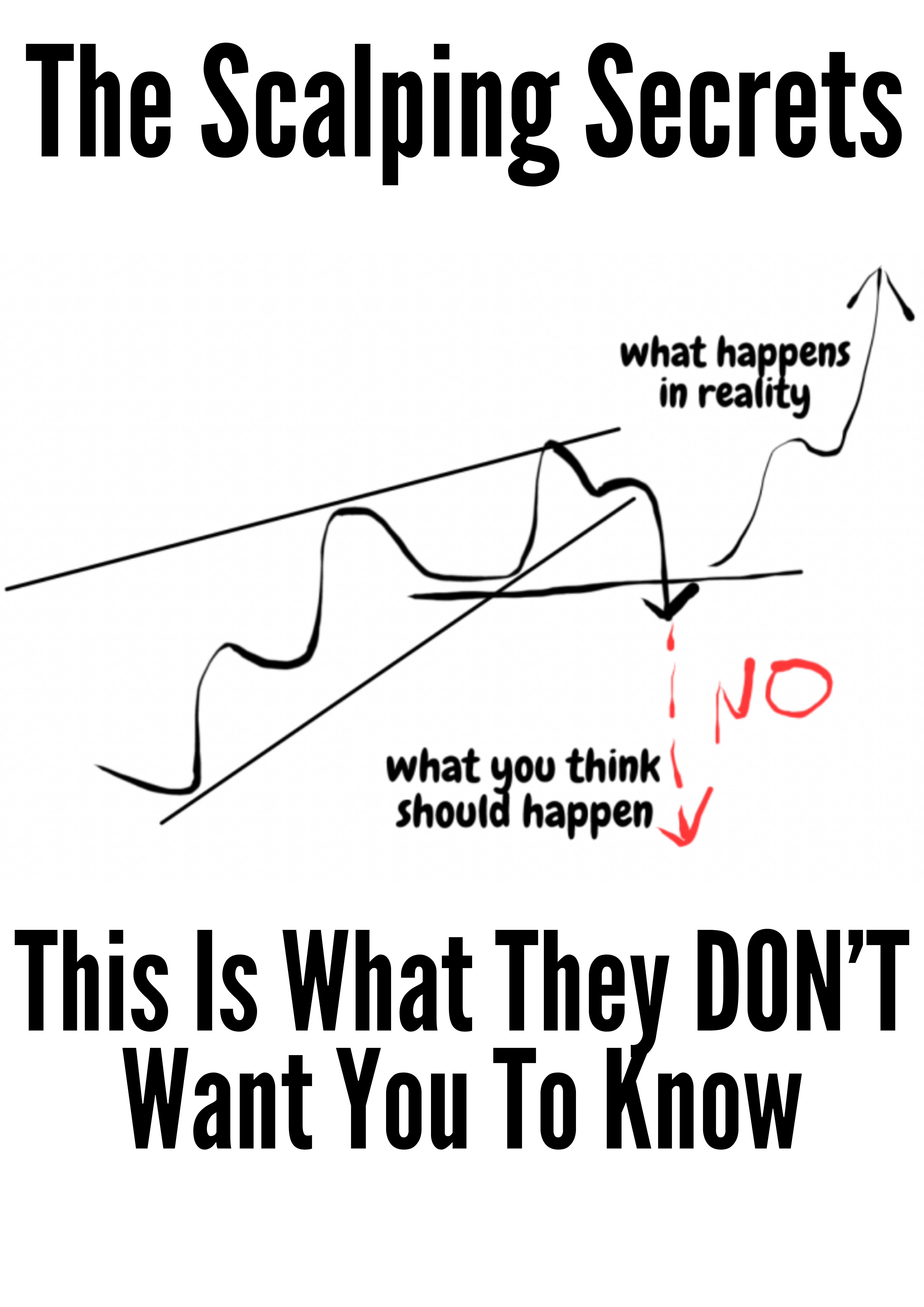
A Beginner’s Guide to Online Commodity Trading
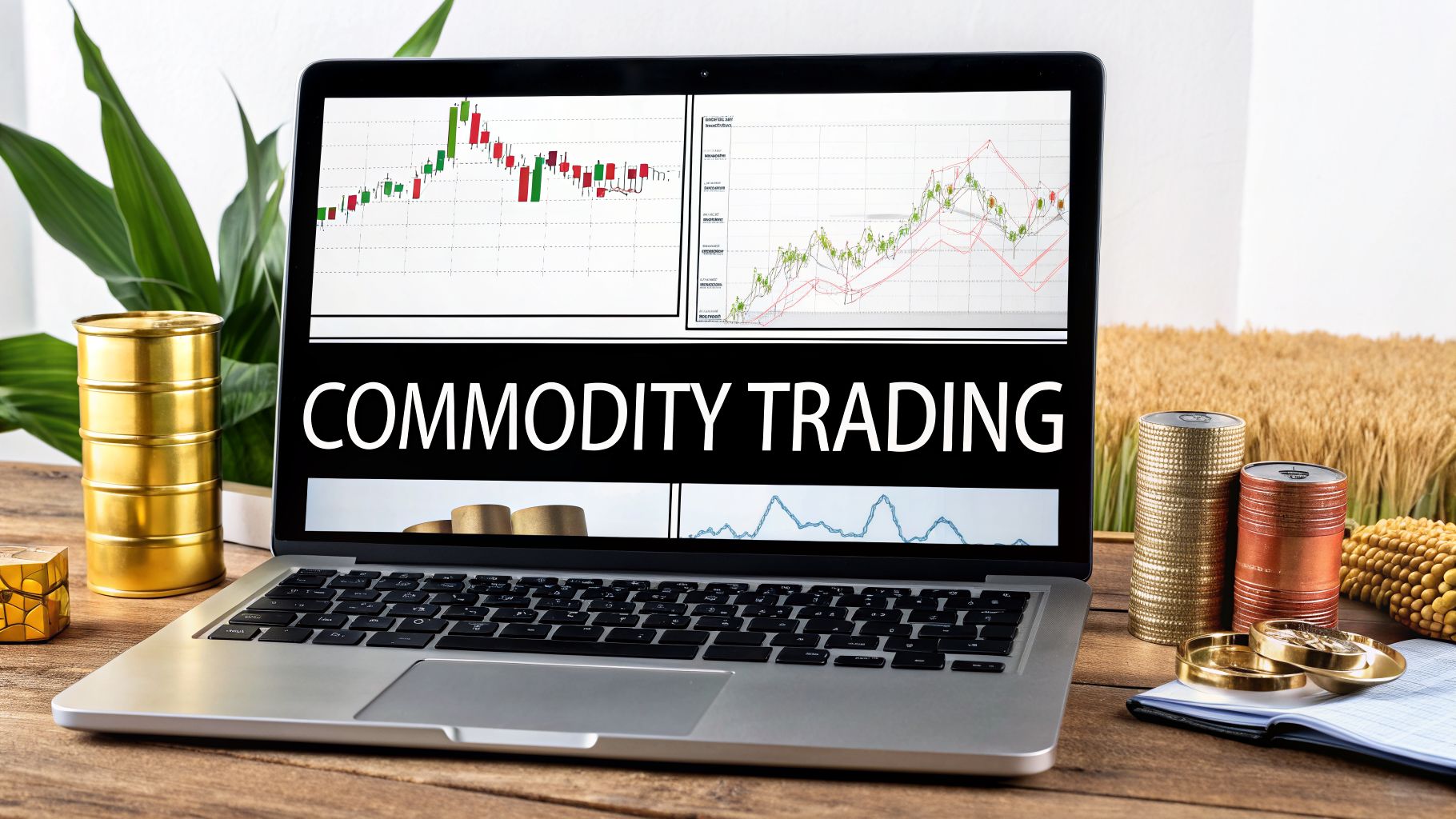
So, what exactly is online commodity trading?
At its core, it's a way to trade the prices of raw materials—think gold, oil, and coffee—without ever having to store a single barrel or bean in your garage. You're not buying the physical stuff. Instead, you're making a calculated trade on whether you think its price will go up or down, all from your trading platform.

To get a clear picture, let's break down the key parts of online commodity trading. This table gives you a quick snapshot of what you're getting into.
Online Commodity Trading at a Glance
| Component | What It Means for You | Example |
|---|---|---|
| The Assets | You're trading raw materials that power the global economy. | Gold, Brent Crude Oil, Wheat, Soybeans |
| The Action | You're predicting price movements, not buying physical goods. | Going "long" on oil if you expect a price rise. |
| The Goal | To profit from the difference between your entry and exit price. | Buying a gold CFD at $2,300 and selling it at $2,350. |
| The Venue | Everything happens on a digital trading platform. | Using a broker's app on your phone or computer. |
| The Access | Markets once for institutions are now open to individual traders. | Anyone with an internet connection can open a trading account. |
Essentially, you're tapping into the very foundation of the global economy, and you can do it from anywhere.
Getting a Feel for the Commodity World
For a long time, trading these essential goods was a game reserved for massive corporations and financial giants. They were the only ones with the capital and infrastructure to play.
But technology changed everything. Today, online commodity trading has blown the doors open for retail traders like you and me. It's a global, decentralized system that lets you trade the price action of these critical materials directly. This wave of new participants has brought a tremendous amount of activity and liquidity to the markets.
The Main Commodity Groups
Commodities are usually split into four main buckets. Knowing these helps you understand the different opportunities out there.
- Metals: This covers precious metals like gold and silver, which traders often flock to in uncertain times, plus industrial metals like copper and aluminum. The prices of industrial metals are a great barometer for economic health and construction activity.
- Energy: This is a huge one. It includes major players like crude oil (WTI and Brent) and natural gas. Geopolitics, OPEC meetings, and global demand shifts make this one of the most volatile and closely watched sectors.
- Agriculture: These are often called "softs." We're talking about everything from grains like wheat and corn to lifestyle goods like coffee, sugar, and cotton. Here, things like weather reports and harvest forecasts are massive price drivers.
- Livestock and Meat: A smaller but still significant category that includes cattle and hogs. Traders here are speculating on factors like feed costs, animal populations, and consumer demand for meat.
The real secret to online commodity trading isn't about possession, it's about prediction. Your job is to forecast where the price is headed based on solid market analysis, not to arrange for a truckload of soybeans to be delivered to your door.
This digital access has done more than just empower individual traders; it's also making markets more active globally. Take Vietnam, for example. In 2025, its centralized commodity market saw trading value per session explode to around 7.5 trillion VND—a massive 46% jump from the year before. One session even hit a staggering 17 trillion VND. It's a perfect example of how these markets are integrating and creating more opportunities, as you can see from the record-high liquidity in this maturing market.
When you engage in online commodity trading, you’re doing more than just clicking buttons. You are directly interacting with the powerful forces of global supply and demand that shape our world every single day.
Alright, you've got the basics of what online commodity trading is all about. Now, let's talk about the tools of the trade. Think of these as different vehicles for navigating the markets—some are like heavy-duty trucks, others are more like nimble sports cars.
Your choice of instrument is a big deal. It will shape your entire strategy, how much risk you're taking on, and what your potential profits might look like. The two main ways you'll likely start are with futures contracts and Contracts for Difference (CFDs).
Futures Contracts: The Foundation of Commodity Trading
A futures contract might sound complicated, but it's really just a formal agreement to buy or sell a commodity at a set price on a date in the future. It’s the bedrock of the commodity world.
Imagine a coffee farmer who’s worried that prices will tank before her beans are ready for harvest. To protect her profits, she can sell a futures contract today, locking in a guaranteed price for her coffee three months from now. A major coffee company might buy that contract to lock in its costs. Both sides have now removed a ton of uncertainty.
A futures contract is like a pre-order for a commodity. You and another party agree on a price today for an exchange that will happen in the future, removing price uncertainty for both sides.
As traders, we aren't planning to have thousands of barrels of oil or bushels of wheat delivered to our doorstep. We trade the contract itself, aiming to profit from its price changes before it expires. You can see exactly how this works with our practical futures contract example.
Contracts for Difference (CFDs): A Flexible Alternative
Contracts for Difference, or CFDs, give you a more direct way to speculate on where you think prices are heading. A CFD is simply an agreement between you and your broker to pay each other the difference in a commodity's price from the time you open the trade to when you close it.
You never actually own the underlying gold, oil, or corn. You’re just placing a wager on its price direction. If you think gold is going up, you buy a gold CFD. If you're right and the price rises, you cash in on the difference. If you're wrong, you pay the difference.
This simplicity and flexibility make CFDs a really popular starting point for new traders exploring online commodity trading. They usually require less capital to get started and let you trade in smaller amounts (micro-lots), which is fantastic for managing risk while you're still learning the ropes.
The instrument you choose might also depend on what’s hot in the market. For instance, between 2021 and 2023, the value of agricultural product exports soared by 34% to $2.3 trillion, while energy's share dipped. This shows how opportunities shift, and CFDs offer a flexible way to jump on these trends across different sectors. You can dive deeper into these global commodity shifts in this detailed UNCTAD report.
Futures vs. CFDs: A Practical Comparison for Beginners
Choosing between Futures and CFDs can feel tricky at first. Both let you trade commodities, but they are built for different types of traders and different goals. I've put together this simple table to break down the key differences that matter most when you're starting out.
| Feature | Futures Contracts | Contracts for Difference (CFDs) |
|---|---|---|
| Ownership | A standardized contract traded on an exchange. Potential for physical delivery (though very rare for traders). | No ownership of the asset. It's a private contract with your broker based on price movement. |
| Regulation | Traded on large, highly regulated central exchanges like the CME Group. | Traded "over-the-counter" (OTC) directly through individual brokers. Regulation varies by broker and region. |
| Contract Size | Large, fixed contract sizes (e.g., 1,000 barrels of crude oil or 5,000 bushels of corn). | Flexible and much smaller lot sizes are available, giving you more control over your position size. |
| Best For | Institutional players and well-capitalized traders who need the structure of a formal exchange. | Retail traders who want flexibility, lower capital requirements, and the ability to trade smaller positions. |
For most new traders I talk to, CFDs offer a more manageable entry point. The ability to control your position size precisely is a massive advantage when you are focused on protecting your capital and learning a solid strategy. Futures are a different ballgame, better suited for those with a lot more experience and capital behind them.
How to Read What Moves Commodity Prices
What makes the price of gold suddenly shoot up, or oil take a nosedive? It all comes back to the oldest rule in the book: supply and demand. If you can get your head around this, you're on the right path to understanding online commodity trading.
Think about it in simple terms. If a bad harvest in Brazil wipes out a huge chunk of the coffee bean supply, the price for your morning cup is going to climb. On the flip side, if a perfect growing season leads to a massive surplus, you’ll see prices drop.
Commodity markets are exactly the same, just on a massive, global scale.
The Two Sides of the Price Coin
Every single price move you see on a chart boils down to an imbalance between how much of something is available (supply) and how much everyone wants it (demand).
- Supply Shocks: These are the sudden, often unexpected events that mess with production. A hurricane in the Gulf of Mexico can shut down oil rigs. A drought can ruin a corn crop. A major mine strike can halt copper production. These events squeeze the available supply, and prices often spike as a result.
- Demand Pulls: This is about shifts in what the world needs. A booming electric vehicle market creates a huge appetite for copper and lithium. An unexpectedly cold winter in Europe cranks up demand for natural gas. When economies grow, so does their need for raw materials, which pulls prices higher.
A flare-up in geopolitical tensions can threaten oil supply lines, and you'll see prices jump on fears of a shortage. On the other hand, if a major economy like China reports slowing growth, it suggests they'll need fewer industrial metals, and prices can fall.
Every news event, government report, and weather forecast is a potential catalyst. But trying to trade off this information alone is like trying to drink from a firehose. It's overwhelming, and frankly, it often just leads to confusion.
This is where you need a different, much smarter approach.
Price Action: Your Ultimate Guide
Instead of drowning in an endless sea of news and economic data, professional traders learn to read the story the market is telling them directly. And there's only one place where all of it comes together—every fear, hope, and forecast: the price chart.
This is the very heart of price action trading. It's a method built on one powerful idea: the price movement on a chart reflects the sum total of what every single market participant believes and is doing. The chart cuts through the noise and shows you the true balance of supply and demand.
For example, if big institutions are quietly accumulating oil contracts because they anticipate a supply crunch, you'll see their footprints in the price action long before it makes the evening news. Their buying pressure creates specific chart patterns that a trained price action trader can spot.
Broader economic trends are also powerful forces. As commodity prices are often tied to these bigger pictures, knowing how to invest during high inflation can offer vital clues about where the market might be heading. These macroeconomic waves are ultimately reflected in the price patterns you see on your charts.
What the Chart Tells You
When you learn to read price action, you start seeing the tracks left by the big money. It allows you to position yourself alongside them instead of reacting after the fact.
Here’s what price action really helps you see:
- Who is in control? Are the buyers (bulls) pushing the market up, or are the sellers (bears) in command? Candlestick patterns give you clear, visual answers.
- Where are the key battlegrounds? These are the areas of support (price floors) and resistance (price ceilings). They show you the critical levels where big money is making decisions and where supply and demand are in a fierce tug-of-war.
- Is the trend strong or weak? By analysing the series of highs and lows, you can gauge the strength and direction of the underlying trend. This is crucial for deciding whether to go long or short.
This approach is central to my own philosophy here at Colibri Trader. It moves you away from guessing and toward making clear, confident decisions based on what the market is actually doing. You stop trying to predict the news and start reading the market's reaction—a much more reliable path in online commodity trading.
Your First 90 Days in Commodity Trading
Diving headfirst into commodity trading without a roadmap is a recipe for disaster. It’s like trying to navigate a storm without a compass. Your first 90 days aren't about striking it rich; they're about building the habits that will keep your capital safe and set you up for a long career in the markets.
Your very first move is choosing a broker. This is more than just finding the lowest fees or the slickest platform. Your broker is your gateway to the market, and their reliability is everything.
I always recommend looking for brokers regulated by top-tier authorities like the Financial Conduct Authority (FCA) in the UK or the Australian Securities and Investments Commission (ASIC). This kind of oversight is a massive layer of protection for you and your money.
Month 1: The Sandbox Phase
The most important thing you can do this month is open a demo account. Forget about live trading. This is your risk-free sandbox, using fake money but with real-time market data. Trying to learn with a live account is the fastest way I know to lose your shirt.
Your only job here is to get your hands dirty and learn the mechanics.
- Platform Mastery: Figure out how to place a trade. More importantly, learn how to set a stop-loss order and a take-profit target.
- Instrument Selection: Click around. Look at the chart for Gold, then switch to Oil, then Wheat. Get a feel for how differently they move.
- Basic Charting: Start drawing. Find the obvious spots on a chart where price turned around and draw a simple horizontal line. That's a start.
A demo account is your flight simulator. It’s where you practice takeoffs, landings, and handling turbulence without risking a real crash. Every successful trader I know started here, building muscle memory before putting a single dollar on the line.
Spend at least 30 days in this environment. To really grasp why this is so critical, you can learn more about the benefits of a demo trading account and why I consider it a non-negotiable step. This isn't about making fake profits; it's about building confidence in your tools and your process.
This infographic is a great reminder of what's actually moving the prices you see on the screen.

It all boils down to the simple forces of supply and demand. Every pattern and wiggle on your chart is just a shadow of these real-world economic pressures.
Month 2: Building a Simple Routine
Alright, time to bring some order to the chaos. In month two, you're still on your demo account, but now you'll build a simple, repeatable trading routine based purely on price action. This is the core of how I trade: read the chart, not the headlines.
Your daily routine should circle around three basic price action elements:
- Identify Support and Resistance: Find those clear, horizontal levels where the market has bounced or been smacked down before. These are the battlegrounds where buyers and sellers are fighting it out.
- Spot Key Candlestick Patterns: At those key levels, look for simple reversal patterns like a Pin Bar or an Engulfing Bar. These patterns can signal that the momentum is about to shift, giving you a valid reason to think about a trade.
- Define Your Trade: Before you even think about clicking the "buy" or "sell" button, you must define three things: your exact entry point, your stop-loss, and your profit target. No exceptions.
This simple routine builds discipline. It stops you from random gambling and turns you into someone who executes a plan. By the end of this month, you should have a journal full of dozens of demo trades, each with a clear "why" behind it.
Month 3: Going Live with Micro-Stakes
If you’ve stuck to the plan and shown discipline on your demo account for two months, you can consider going live. But this transition has to be handled with extreme care. You need to start with the smallest possible trade size your broker offers.
Your goal for this month is not to make money. It’s to feel what it's like to have real money on the line. A $5 loss feels completely different from a $5 demo loss. Trust me on that.
During this final phase of your 90-day kickoff, your only mission is to stick to the price action routine you built in month two. Execute your plan perfectly, manage your trades without letting emotions take over, and keep journaling every single result. This disciplined approach to online commodity trading, focusing on your process instead of your profits, is the foundation for a long and successful trading career.
Mastering Risk and Money Management
Let me be clear: this is probably the most important section in this entire guide. New traders often think success is about finding a magic strategy that wins every time. That’s a fantasy. Real success in online commodity trading comes from managing your losses so you can survive the bad days and be around to profit from the good ones.
Think of your trading capital as the hull of a ship and losses as small leaks. One or two tiny leaks seem harmless. But if you ignore them, they add up, and eventually, the whole ship goes down. Your job isn't to prevent leaks entirely—that’s impossible. Your job is to have a system to patch every single one, immediately, so your ship stays afloat.

The Golden Rule of Capital Protection
The bedrock of all money management is one simple, non-negotiable rule: never risk more than 1% of your trading account on any single trade idea. This is famously known as the 1% rule.
If you have a $5,000 account, you never stand to lose more than $50 on one trade. For a $10,000 account, your maximum risk is $100. It might not sound like a lot, but its power is immense. It means you could lose five, or even ten, trades in a row and still be in the game.
Sticking to this rule is what builds the mental toughness needed for long-term trading. It keeps your emotions from spiralling out of control because no single trade can ever wipe you out. This is a core discipline I hammer home in my Colibri Trader mentorship.
Your Two Most Important Tools
To actually follow the 1% rule, you need two things on every single trade you take: a stop-loss order and a properly calculated position size.
The Stop-Loss Order: This is your safety net. It’s an instruction you give your broker to automatically close your position if the price moves against you to a level you've already decided on. You must know where your stop-loss is before you even think about hitting the "buy" or "sell" button.
Position Sizing: This is how you decide how much to trade (how many contracts or lots). Based on where you enter and where your stop-loss is, you adjust the size of your trade so that the total potential loss equals exactly 1% of your account.
For example, let's say your 1% risk is $100 and your trade setup on a crude oil CFD needs a 50-pip stop-loss. You would then calculate the exact position size where those 50 pips of movement against you would equal a $100 loss. This is the art and science of risk management in practice. Leverage plays a big part here, which you can learn more about in our guide on how to define margin trading.
A trader without a stop-loss is like a trapeze artist without a net. You might get away with it a few times, but one bad fall is all it takes to end your career. Placing a stop-loss on every single trade is not optional; it is the mark of a professional.
Mastering this is more critical than ever. The commodity trading industry's gross margins recently dropped by over 20% from the volatility highs of the previous year, though they are still double the levels seen in the 2010s. This return to normal market conditions means there's less room for error, demanding sharper risk management from everyone involved. You can discover more insights about these commodity market shifts on oliverwyman.com.
Accelerate Your Learning with Colibri Trader
Knowing the theory is one thing, but actually making consistent money from online commodity trading is a whole different ball game. This is the biggest hurdle I see traders face. You've read the books and watched the videos, but how do you put it all together when your own money is on the line?
This is exactly where a proven, battle-tested trading approach becomes your most important tool.
Here at Colibri Trader, my philosophy is simple: no indicators, no fundamentals, no noise. I believe everything you need to make a trading decision is right there on the price chart. This focus is designed to cut through the clutter and information overload that leaves most new traders frozen with indecision.
The Journey from Overwhelmed to Confident
So many aspiring traders get stuck in a frustrating loop. They chase after every new indicator, hoping to find the magic formula, or they try to time the market based on a constant flood of economic news. This almost always leads to what we call "analysis paralysis," missed trades, and a lot of frustration.
My programs are built to break you out of that cycle. I take you on a journey, starting from the very basics of price action and building your skills one logical step at a time.
"I was completely overwhelmed and unprofitable, following every news event and trying dozens of indicators. Colibri Trader taught me to ignore the noise and just read the chart. That shift in focus was everything—it brought me confidence and, finally, consistency."
This is a story I hear all the time from my students. The real change happens when you stop trying to predict what the market will do and instead learn to react to what it is doing right now. You’re building a real-world skill, not just collecting more useless information.
A Structured Path to Mastery
I believe learning to trade is like mastering any other high-performance skill. You need a rock-solid foundation and a clear path to follow. My lessons are designed to develop your trading ability in a logical order, not just throw random tips at you.
Here is how I structure the learning path:
- Foundational Concepts: We start by making sure you have a deep understanding of support and resistance. This is the true framework of any market.
- Price Action Patterns: Next, you’ll learn how to spot the specific, high-probability candlestick patterns that tell you when the balance of power might be shifting at those key levels.
- Advanced Analysis: From there, we move into more advanced concepts like supply and demand zones, where I show you how to identify the areas where institutional money is likely making its moves.
Each lesson builds directly on the one before it, giving you a complete and cohesive trading strategy. This isn't just a collection of tricks; it’s an entire system of analysis built for clarity and confidence.
Beyond Theory: Real Skill and Mentorship
The goal here isn't to get a certificate; it's to help you achieve real, tangible results in your trading account. A huge part of that is developing the discipline and psychological strength to handle the market's ups and downs for the long haul.
Through direct mentorship and our community of other price action traders, you get the support you need to navigate the emotional side of trading. This is what truly speeds up the learning curve.
You’re not just passively watching videos. You’re actively applying proven techniques, getting my feedback, and building the hands-on skill that finally turns all that theory into consistent results in online commodity trading. Your journey to becoming a confident trader starts with one clear, focused method.
Common Questions About Online Commodity Trading
When you're first getting into commodity trading, it’s completely normal to have a ton of questions. Let’s cut through the noise and answer a few of the big ones I hear from new traders all the time. Getting these straight from the start will give you a much better footing.
How Much Money Do I Need to Start Trading?
There’s no magic number here, and honestly, it’s probably less than you think. Plenty of good brokers will let you open an account with just a few hundred dollars. But the minimum deposit isn't what you should be focused on.
What really matters is this: only trade with capital you can afford to lose. I can't stress this enough. Even more important, I always tell new traders to start on a demo account. Get your strategy down without risking a single dollar. When you do go live, your success will depend on a strict money management plan—like risking only 1% of your capital per trade—not how much you started with.
Do I Need to Be an Economics Expert?
Absolutely not. It's true that big economic reports and world news can send prices flying, but trying to trade off that information is a recipe for confusion and what we call "analysis paralysis."
A price action approach, like the one we teach at Colibri Trader, lets you read the market’s story right from the charts. The price itself is the ultimate indicator—it already contains all the available information, from economic forecasts to breaking news.
By learning to read the patterns the price makes, you can find high-probability setups without ever needing a degree in economics. You're focused on what the price is actually doing, not guessing why it's doing it.
Is Online Commodity Trading a Way to Get Rich Quick?
No. And it's critical you understand this from day one. Successful online commodity trading is a serious, skill-based profession. It takes discipline, the right education, and a whole lot of patience. It is absolutely not a lottery ticket.
Real, lasting success is built on the consistent application of a tested strategy, iron-clad risk management, and a commitment to always be learning. It’s about building the habits of a professional trader to achieve steady, long-term growth, not chasing some crazy, high-risk jackpot.
Ready to stop guessing and start building a real, professional trading skill? At Colibri Trader, our programs are built to give you a clear, step-by-step path to mastering price action without indicators or other noise. See how you can learn to trade with real confidence and consistency by visiting https://www.colibritrader.com and take the first step today.