How to Start Trading Currency a Practical Guide

So, you're ready to start trading currency. The basic path is straightforward: open an account with a regulated Forex broker, get some funds in there, and start making trades on their platform. But the real work—the part that separates successful traders from everyone else—is about learning the market, building a solid trading plan, and managing your risk like a hawk on every single trade.
It’s a journey, for sure, one that blends serious education with disciplined, hands-on practice.
Understanding the World of Currency Trading
Before you even think about clicking "buy" or "sell," you have to get your head around the environment you're stepping into. The foreign exchange (or Forex) market is the global arena where all the world's currencies are traded. It’s a massive, decentralized marketplace that sets the exchange rates we see every day.
Unlike the New York Stock Exchange, there’s no physical building with a trading floor. Forex is an over-the-counter (OTC) market, which just means all the transactions happen electronically. It's a vast network connecting banks, brokers, huge institutions, and individual traders like you.
This market never really sleeps, running 24 hours a day, five days a week, across the major financial hubs of London, New York, Sydney, and Tokyo. This constant churn is fueled by everything from international trade and tourism to geopolitical shifts and economic news.
The Building Blocks of Forex Trading
At its core, currency trading is surprisingly simple: you buy one currency while simultaneously selling another. This is why currencies are always quoted in pairs.
Take the EUR/USD, for example. This pair shows the relationship between the Euro and the U.S. Dollar. The price you see is how many U.S. dollars it takes to buy a single Euro.
If you have a hunch the Euro is about to get stronger against the Dollar, you’d buy the EUR/USD pair. If you think it’s going to weaken, you’d sell it. Your profit (or loss) comes from getting that prediction right. This is the fundamental engine driving every trade, and you can dig deeper into how the forex trading process operates in detail.
The goal is simple: buy a currency pair when it's cheap and sell it when it's expensive, or sell a pair high and buy it back lower. Your success hinges on your ability to anticipate where the price is headed next.
Key Terms You Must Know
Getting fluent in the language of Forex isn't optional—it's essential. You’ll see these terms pop up all over your trading platform, and knowing what they mean is critical to making smart decisions.
To help you get started, I've put together a quick table of the absolute must-know terms.
Essential Forex Terms for New Traders
| Term | What It Means for Your Trades |
|---|---|
| Pip | This is the tiny unit used to measure a currency pair's price change. For most pairs, a pip is 0.0001. Pips are how you'll track your profits and losses. |
| Spread | This is the small difference between the buy price (ask) and the sell price (bid). Think of it as the broker's built-in fee for handling your trade. |
| Leverage | Leverage lets you control a large amount of currency with a small amount of your own money. While it can amplify your wins, it will also magnify your losses just as quickly. |
Learning these terms is your first step toward navigating the market with confidence.
The sheer scale of this market is mind-boggling and is what creates so much opportunity. The global Forex market was valued at an astonishing $2.4 quadrillion back in 2020. This massive liquidity involves over 170 global currencies, with the US dollar being on one side of 88.5% of all trades.
For a deeper dive into the market's structure and the players involved, this piece on Understanding the Global Currency Exchange Market is a great resource.
Choosing Your Broker and Trading Platform
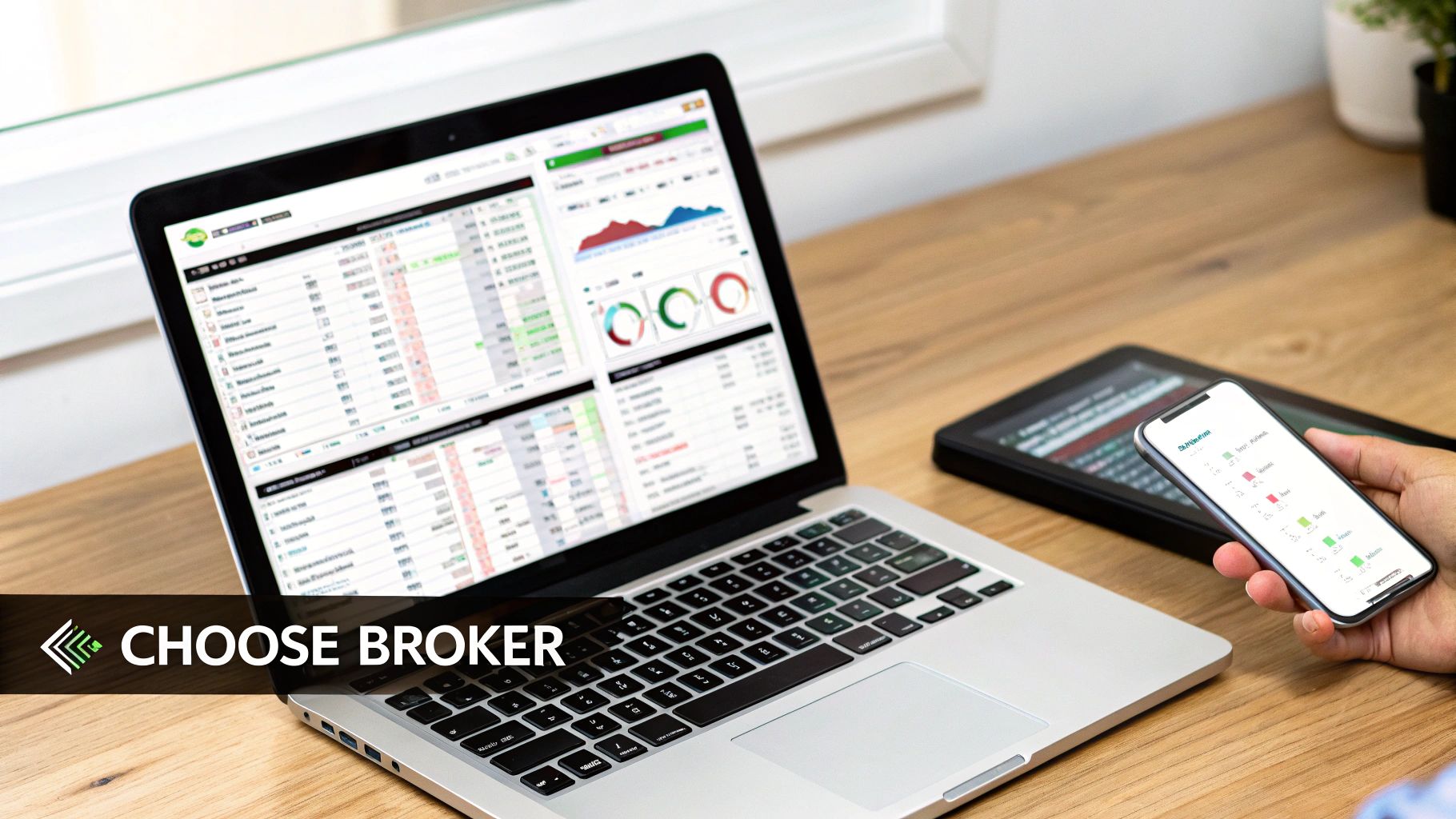
Alright, let's talk about one of the most important decisions you'll make: picking your broker. This isn't just a logistical hoop to jump through. Your broker is your partner in this journey, the gatekeeper to the currency markets. The platform they provide, the fees they charge, and the security of your money all hinge on this choice.
Frankly, getting this right from the start saves you a world of headaches later on.
First things first, and this is non-negotiable: regulatory compliance. If a broker isn't overseen by a reputable financial authority, walk away. It’s a massive red flag. These agencies are there to protect you from dodgy practices and outright fraud.
They enforce critical rules, like making sure your trading funds are kept in segregated accounts, completely separate from the broker's own money. This means if the brokerage hits financial trouble, your capital is safe.
What to Look for in a Regulated Broker
When you're sizing up a potential broker, you need to check which top-tier authority regulates them. The specific one will depend on where the broker is based and the countries they serve.
A few of the heavyweights you want to see are:
- Financial Conduct Authority (FCA) in the United Kingdom
- Australian Securities and Investments Commission (ASIC) in Australia
- Commodity Futures Trading Commission (CFTC) in the United States
- Cyprus Securities and Exchange Commission (CySEC) in Cyprus
You can usually find this information in the footer of the broker's website. But don't just take their word for it. Cross-check their license number on the regulator's official site. It's a simple step that could save you a fortune.
Where your broker is located matters more than you might think. Major financial centers have the infrastructure for smooth, liquid trading. As of April 2025, the UK is still the king of the hill, handling about 38% of global FX turnover. The US is next at around 19%, and Singapore has surged to 11.8%. You can dig into the numbers yourself in this report on global FX turnover.
Understanding Your Trading Costs
Once you’ve verified a broker is legit, it's time to get into the nitty-gritty of their fees. These costs directly chip away at your profits, especially if you plan on being an active trader.
The two main costs you'll encounter are spreads and commissions. The spread is simply the tiny difference between the buy (ask) price and the sell (bid) price of a currency pair. The tighter the spread, the less it costs you to get in and out of a trade.
Some brokers lure you in with super-low or zero-spread accounts but then charge a fixed commission for every trade you make. Others roll their fees into a wider spread and skip the commission. Neither model is inherently better; it all comes down to your trading style. Scalpers and high-frequency traders usually lean towards the commission model for its tight spreads, while someone trading less often might prefer the all-in-one simplicity of a spread-only account.
Key Takeaway: You're looking for transparency and competitive costs that match your strategy. Watch out for hidden fees and crazy-wide spreads—they are profit killers.
Evaluating Trading Platforms and Tools
Your trading platform is your cockpit. It's where you’ll analyze charts, execute trades, and manage your open positions. Most retail brokers will point you toward one of two platforms from MetaQuotes: MetaTrader 4 (MT4) or MetaTrader 5 (MT5).
They look quite similar at first glance, but they have some key differences.
- MetaTrader 4 (MT4): This is the old reliable, the industry standard. It's known for being straightforward and has a gigantic community that has built thousands of custom indicators and automated trading bots (called Expert Advisors).
- MetaTrader 5 (MT5): This is the newer, more powerful version. MT5 offers more chart timeframes, a bigger selection of built-in indicators, and can also connect to other markets like stocks and futures.
For anyone just figuring out how to start trading currency, MT4 is often the best starting point. It’s incredibly user-friendly and the amount of community support is unmatched. But don't feel locked in. It's worth exploring some of the best trading platforms designed for beginners to see what else is out there.
The best platform is the one that clicks with you. Always open a demo account first and take it for a spin. Make sure the charting tools feel right, the trade execution is snappy, and the software is stable. You need to be comfortable with the tools you're using before you put a single dollar on the line.
Mastering The Demo Account Before Going Live
Alright, you’ve picked a broker and a platform. I know the feeling—you're itching to jump in and start trading for real. But let me stop you right there. The single most important thing you can do right now is open a demo account and live in it for a while.
Think of it as your personal trading simulator. It's a perfect replica of the live market, but you're using virtual money. This isn't just about learning where the "buy" button is. It's your risk-free dojo where you build muscle memory, test out ideas, and get a feel for the market's pulse without any of the financial pain. Too many new traders skip this, thinking it's a waste of time, but I can tell you from experience, it’s where you separate theory from reality.
A demo account is where you get to make all your rookie mistakes for free. Learn the lessons, build the habits, and develop your edge without losing a single dollar of your hard-earned capital.
Getting Familiar With Your Trading Cockpit
Your first mission in the demo account is simple: just get comfortable. Before you can even think about executing a profitable strategy, you need to be able to navigate your platform without thinking. Spend your first few hours just clicking around, exploring the interface, and figuring out what everything does.
Here’s a look at a typical interface from MetaTrader 5, which is a hugely popular platform in the trading world.
See the key areas? You've got the main price chart, the list of currency pairs (often called the Market Watch), and the toolbox at the bottom that shows your open trades, account history, and so on. Your first real assignment is to understand how these pieces fit together.
Building A Practical Skill Checklist
A demo account is for deliberate practice, not just random clicking. Don't just place trades for the sake of it. You should have a clear checklist of skills to master until each one becomes second nature.
Before you even think about going live, make sure you can do all of these effortlessly:
- Placing Different Order Types: Go beyond just hitting "buy" or "sell" at the current market price. You need to practice setting limit orders (to buy or sell at a specific target price) and stop orders (to get into a trade only after the price hits a certain level).
- Setting Your Safety Nets: This is non-negotiable. For every single practice trade, you must set a stop-loss and a take-profit level. This is the core habit that will protect your capital when real money is on the line.
- Understanding Position Sizing: Get a feel for risk. Place a trade with a 0.01 lot size and watch how your virtual balance moves. Then, do the same trade with a 0.10 lot and see the difference. This is a critical lesson in leverage and risk.
- Reading Price Charts: Learn to flip between different timeframes—like the 1-hour, 4-hour, and daily charts. Start practicing how to spot basic trends and chart patterns. The pressure is off, so just focus on observation.
Testing A Simple Trading Strategy
Once the mechanics of the platform feel natural, it’s time to apply a basic strategy. This doesn't need to be some complicated, secret formula. A simple plan is perfect. For example: "I will buy a currency pair when it bounces off a key support level, and I will sell it when it gets rejected from a key resistance level."
The goal here isn't to make a million virtual dollars. It's to prove to yourself that you can follow a set of rules consistently, trade after trade.
- Define Your Rules: Write them down. Be specific about what conditions must be met before you enter a trade.
- Follow Them Religiously: For at least 50 demo trades, stick to your rules without any deviation. No excuses.
- Review Your Results: Keep a trade journal. Look back at your trades. Did you follow the plan? Where did you get it right, and where did you break your own rules?
This process builds the discipline that separates successful traders from the rest. There's a reason so many retail traders lose money, and a big part of it is the lack of a tested plan. Mastering your strategy in a demo account first will dramatically stack the odds in your favor when you finally decide to trade with real funds.
Building Your First Trading Strategy
Jumping into the market without a plan is a bit like trying to navigate a maze blindfolded. Sure, you might get lucky once or twice, but you're eventually going to hit a wall. A trading strategy is your map—it's a clear set of rules that tells you exactly when to get into a trade, when to get out, and how to manage your money along the way. This isn't about some magic formula; it's about building a consistent, repeatable process.
Relying on gut feelings or hot tips from some guy on the internet is the fastest way I know to drain an account. A solid strategy takes emotion out of the driver's seat and replaces your impulsive decisions with disciplined, logical execution. It’s what separates professional traders from gamblers.
And the arena you're stepping into is massive. The daily global Forex trading volume rocketed to an incredible $9.6 trillion in April 2025. That's a huge 28% jump from $7.5 trillion back in 2022. Understanding the sheer scale of this market is key as you start shaping your approach. You can always discover more insights about forex trading statistics to get a better feel for the landscape.
Two Core Schools of Thought
As you start digging into trading, you’ll quickly find that almost every strategy falls into one of two main camps: technical analysis and fundamental analysis. Most experienced traders I know use a bit of both, but when you're just starting out, it’s much easier to focus on one.
Technical Analysis is all about the charts. The core idea here is that everything—economic news, political events, market sentiment—is already baked into the current price. Technical traders use chart patterns, trendlines, and indicators to forecast where the price is likely headed next.
Fundamental Analysis, on the other hand, digs into the "why" behind price moves. These traders are looking at economic data (like inflation or employment numbers), central bank decisions, and geopolitical events to figure out what a currency is actually worth. The thinking goes: if a country has a strong, growing economy, its currency should, in theory, go up.
Key Insight: Don't get stuck in the "technical vs. fundamental" debate. I like to think of them as two different lenses for viewing the market. Technical analysis helps you decide when to trade, while fundamental analysis can help you figure out what to trade.
Foundational Strategies for Beginners
You don’t need a super-complex, multi-layered strategy to get started. In fact, some of the most simple, time-tested approaches are the most effective, especially while you're still learning the ropes. They are much easier to stick to and help you build the discipline required for long-term success.
Here are a couple of straightforward strategies that are perfect for new traders.
-
Trend Following: This one is exactly what it sounds like. You identify an established trend—either up or down—and you simply trade in that same direction. The old saying, "the trend is your friend," is the entire basis for this strategy. Your job is to ride the wave, not fight it.
-
Support and Resistance Trading: This approach is built around key price levels where the market has turned around in the past. A support level acts as a price floor where buyers tend to step in and push prices back up. A resistance level is the opposite—a price ceiling where sellers typically take control and push prices down.
Comparing Popular Beginner Trading Strategies
Picking your first strategy is a personal choice. It really has to mesh with your personality, your schedule, and how much risk you're comfortable with. A day trader who loves constant action will need a very different game plan than a swing trader who prefers to set a trade and check back in a few days.
To help you get started, here’s a quick breakdown of some common strategies.
| Strategy | Primary Focus | Ideal for Traders Who… | Common Tools Used |
|---|---|---|---|
| Trend Following | Identifying and trading in the direction of the market's momentum. | …are patient and prefer to let their profits run over days or weeks. | Moving Averages, Trendlines |
| Support & Resistance | Trading bounces or breaks of key horizontal price levels. | …like clear, defined entry and exit points and shorter-term trades. | Horizontal Lines, Pivot Points |
| Breakout Trading | Entering a trade when the price breaks out of a defined range. | …can act quickly and want to capture strong, sudden price moves. | Chart Patterns, Volume |
| Range Trading | Buying at the bottom of a range and selling at the top. | …prefer markets that are not strongly trending and are more predictable. | Oscillators (like RSI), Support/Resistance |
Ultimately, the best strategy for you is the one you understand inside and out—the one you can execute without second-guessing yourself. Pick one from this list, study it, and then test it like crazy in a demo account. Define your rules for getting in and getting out with absolute clarity.
Remember, your goal isn't to win every single trade. Nobody does. The real goal is to have a plan that gives you a statistical edge over the long haul.
Managing Risk and Placing Your First Trade
You've picked a broker, played around with the platform, and maybe even sketched out a basic strategy. Now for the exciting part, right? This is where the rubber meets the road—but it's also where most new traders trip up badly.
Before you ever place a trade with real money, you have to become obsessed with risk management. I know, it’s not the sexy part of trading, but it’s the single most important skill for staying in the game long enough to actually get good at it.
A killer strategy is useless without a rock-solid risk plan. Why? Because a string of unexpected losses can wipe out an account in a heartbeat. The pros who last for years aren't the ones who are right all the time; they're the ones who are masters at damage control when they're wrong.
The Bedrock Principles of Capital Protection
The core idea couldn't be simpler: never risk more than you can comfortably afford to lose on a single trade. It sounds obvious, but you’d be surprised how easy that rule is to forget when the market is moving and emotions are running high. That's why your rules have to be set in stone before you even think about clicking the "buy" or "sell" button.
One of the most effective guidelines out there is the 1% rule.
This principle is exactly what it sounds like: you never risk more than 1% of your total account balance on any one trade. If you have a $2,000 account, your maximum loss is capped at just $20. Think of it as a financial and psychological firewall that saves you from a devastating bad trade or just an unlucky streak.
By sticking to the 1% rule, you'd have to lose 100 consecutive trades to blow your account. That discipline gives you the staying power to survive the market's mood swings and the inevitable learning curve.
Using Orders to Enforce Discipline
Your trading platform has powerful tools to automate these rules. The two most critical are the stop-loss order and the take-profit order. Using these isn't optional for a serious trader—it's fundamental.
A stop-loss is an order that automatically closes your trade if the price moves against you to a predetermined level. It’s your safety net. Before you open a position, you decide the exact price point where your trade idea is proven wrong, and you get out. No questions asked. For a deeper dive, check out this guide on what a stop-loss is in trading and how to use it effectively.
A take-profit order does the opposite. It automatically closes your trade when it hits your profit target. This is crucial for locking in gains and fighting the urge to get greedy—a classic mistake that can turn a great winning trade into a loser.
The infographic below breaks down the simple, repeatable process every single trade should follow.
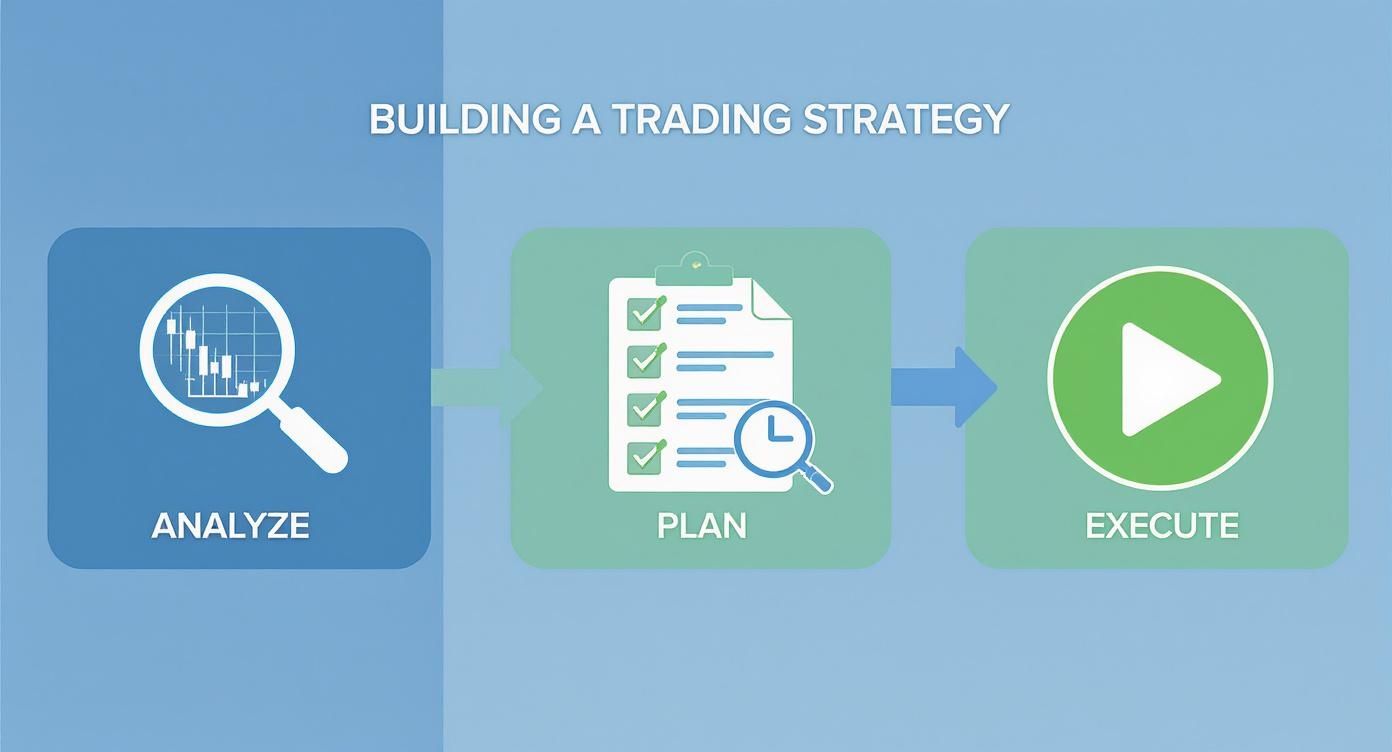
This three-step flow—Analyze, Plan, Execute—forces you to make calculated decisions, not emotional impulses.
Your First Live Trade: A Real-World Walkthrough
Let's walk through a practical example. Imagine you have a $1,000 account and you're watching the EUR/USD pair.
- Analyze and Form a Plan: Using a basic support and resistance strategy, you notice EUR/USD has pulled back to a strong support level at 1.0750. Your analysis suggests the price is likely to bounce higher from here.
- Define Your Risk: You decide to place your stop-loss just below that support level, at 1.0725. This gives the trade a bit of breathing room in case of a small dip. The distance between your entry (1.0750) and your stop (1.0725) is 25 pips.
- Set Your Profit Target: You spot the next resistance level up at 1.0825. This looks like a logical place to take profits, giving you a potential gain of 75 pips. This setup offers a nice 3:1 risk-to-reward ratio, which is a great target.
- Calculate Position Size: Time for the 1% rule. Your maximum risk on a $1,000 account is $10. With a 25-pip stop-loss, a quick calculation shows you can trade a position size of 0.04 lots (or 4 micro-lots) to keep your risk at $10.
- Execute the Trade: Now, you go to your platform. You enter a buy order for EUR/USD at 1.0750 and—at the same time—place your stop-loss order at 1.0725 and your take-profit order at 1.0825.
Once those orders are set, your job is done. You step back and let the market do its thing. No fiddling with your stop-loss, no second-guessing the plan. This disciplined, process-driven approach is the foundation of trading successfully.
Common Questions from New Currency Traders
Even with the best plan in hand, jumping into currency trading for the first time will naturally bring up a lot of questions. Getting straight answers to these common sticking points can give you the confidence you need to really get started on the right foot.
Let’s cut through the noise and tackle some of the most frequent questions I hear from traders who are just starting out.
How Much Money Do I Need to Start Trading Currency?
This is, without a doubt, the question I get asked the most. The truth is, there's no single magic number. A lot of brokers will let you open an account with as little as $100. While you can technically start with that, it’s not something I'd recommend.
A much more realistic starting point is somewhere between $500 and $1,000. Why? Because this amount gives you enough breathing room to trade with very small position sizes (called micro-lots) and still manage your risk properly. When you're only risking 1-2% of your account on any single trade, a larger balance means you can weather a few losses without blowing up your account. If you start too small, you'll find it almost impossible to apply sound risk management from day one.
What Are the Best Currency Pairs for Beginners?
When you’re new to this, stick with the major currency pairs. These are the most traded pairs on the planet, and that brings two massive advantages for a new trader.
First, their huge trading volume—what we call liquidity—tends to create smoother, more predictable price movements. You'll see fewer of those wild, out-of-nowhere spikes that can catch you off guard. Second, all that volume means transaction costs are lower, which translates to tighter spreads for you.
Here are the pairs you should be focusing on:
- EUR/USD (Euro/U.S. Dollar): Often called the best pair for beginners. It has massive trading volume and tends to behave in a relatively stable way.
- GBP/USD (British Pound/U.S. Dollar): A little more volatile than EUR/USD, but it's still incredibly liquid and a staple for many traders.
- USD/JPY (U.S. Dollar/Japanese Yen): Another major with deep liquidity that is well-known for following clear, sustained trends.
Don't get tempted by exotic or minor pairs. I know they can seem exciting, but their lower liquidity leads to wider spreads and much more erratic price action. They are simply harder to trade successfully.
Trading isn't about finding the most obscure opportunities; it's about mastering the most reliable ones. Stick with the majors until you have a consistently profitable strategy and a firm grasp on risk management.
How Long Does It Take to Become a Profitable Trader?
Ah, the million-dollar question. The honest answer is that it's completely different for everyone. There’s no set timeline for success in trading. It all comes down to your personal dedication, discipline, and how well you learn from your mistakes.
Some traders manage to find a degree of consistency within their first year. For many others, it can take several years of hard work, practice, and continuous learning. One of the biggest mistakes you can make is trying to rush the process.
Your focus in the beginning shouldn't be on making money. Instead, focus on building the right habits:
- Follow your trading plan on every single trade. No exceptions.
- Manage your risk obsessively. Never risk more than your predetermined amount.
- Keep a detailed trade journal to review your wins and, more importantly, your losses.
If you concentrate on mastering the process and building unshakable discipline, profitability will eventually follow as a natural result of your good habits.
Ready to move beyond theory and start building real trading skills? At Colibri Trader, we teach a straightforward, price-action approach that works in any market condition. Take our free Trading Potential Quiz to see where you stand and get instant access to the first two chapters of our Amazon bestselling book. Discover your trading potential and start learning with Colibri Trader today!