

How to Learn Day Trading Stocks: A 2026 Roadmap
Only 1% to 3% of day traders consistently outperform the market after costs (research summary). That single fact should change how you approach how to learn day trading stocks. The goal isn't to find a flashy entry pattern and hope for the best, it's to build a process that survives fees, taxes, slippage, and your own psychology.

The Brutal Truth About Day Trading Survival Rates
Most beginners ask which setup pays the most. The better question is whether a trader can stay alive long enough to learn anything useful. In a large real-world sample summarized from French data, day traders lost an average of 23.9 basis points per day net of fees and taxes, only about 5% were profitable on average from 1995 to 2006, and survival dropped from 44% after one year to 24% after two years and 15% after three years.
What those numbers mean in practice
Those figures do not mean the market is “rigged.” They mean edge is rare, and weak edge disappears fast. Another compiled summary of the same research says only about 1% to 3% of day traders consistently outperform after costs, which is why the traders who last usually focus on risk control, small position sizes, and stop-loss discipline instead of chasing constant action.
That survival problem shows up early. Independent summaries say about 40% of day traders quit within the first month, only 13% remain after three years, and roughly 72% ended a year with financial losses in a widely cited FINRA-based estimate (statistics overview). That is not a motivational speech, it is a filter.
Practical rule: if your plan depends on being right often, you are already behind. Durable results come from keeping losses small enough that your best setups can pay for the noise.
Altymo's day trading guide sits in the same practical lane as the hard-data view here. It is most useful once you accept that day trading is a craft, not a shortcut. For a broader profitability lens, Colibri Trader's is trading profitable? page adds another reality check.
Treat trading like a statistical validation process, not a personality test. The right question is not, “How do I trade every day?” It is, “How many simulated trades does this setup need before I can say the numbers justify risking live capital?”
Mastering Price Action Fundamentals Without Indicators
Indicators can help you describe a chart, but they don't replace reading price itself. The strongest beginners I've seen learn to anchor their decisions in location, then use candlesticks to confirm what price is trying to do. A bullish candle at random air means little. A bullish candle at a well-defined support area can mean a lot.
Three patterns that matter more than a crowded chart
A bullish engulfing pattern is worth watching when it appears at strong support, especially after a pullback into a prior demand zone. The candle matters less than the context. If price has already shown buyers defending the same area, that engulfing candle can mark a shift from hesitation to acceptance.
A pinbar rejection is the cleaner tell at supply. You're watching for price to probe into an area where sellers have shown up before, then reject it with a long wick. The signal is strongest when the wick forms at a clear resistance level, not in the middle of nowhere. A pinbar at the wrong location is just a candle.
An inside bar often shows compression before expansion. On its own, it's not a signal to jump in. At a major level, though, it can show the market pausing before it decides whether to break or fail.
The candle is the last piece of information, not the first. If the level is weak, the candle won't save the trade.
That's why traders who rely on price action usually strip their charts down. The internal link trading without indicators reinforces the same idea, less noise, more attention on the tape. A cluttered chart makes it easier to feel busy and harder to see where buyers and sellers reacted.
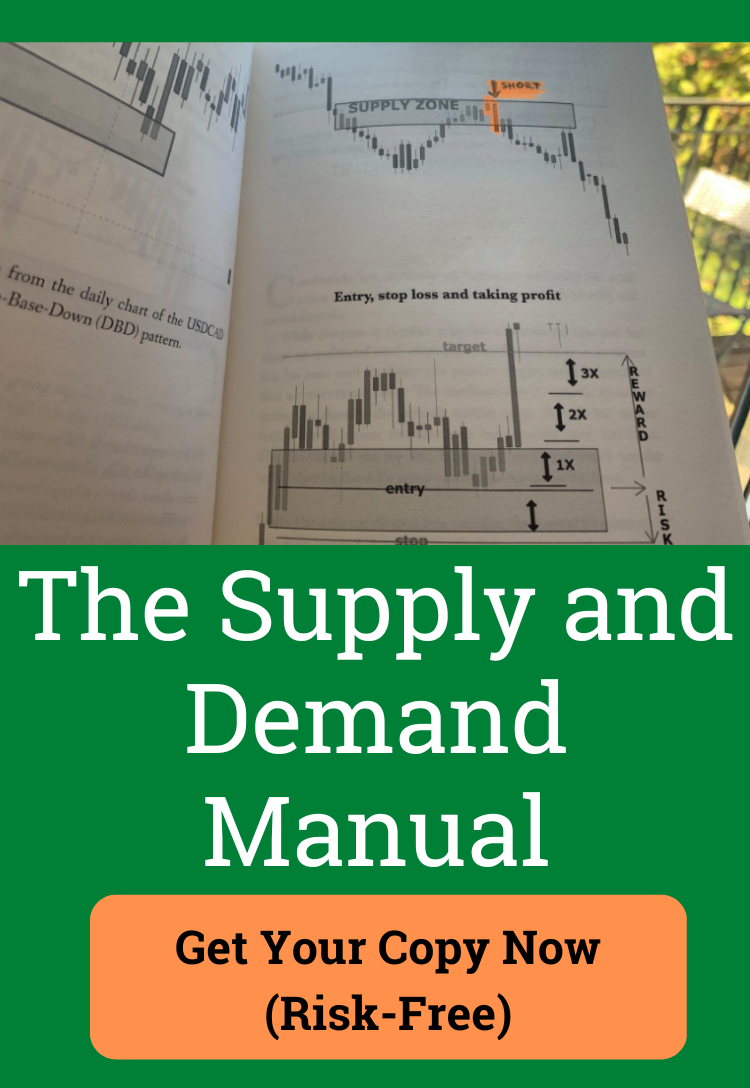
The practical habit is simple. Mark prior highs, prior lows, obvious demand zones, and obvious supply zones. Then wait for price to come to you. If price never reaches a meaningful area, there's no trade, just movement. That discipline matters more than memorizing a long list of patterns.
A cleaner way to read the chart
Use three questions before every entry. First, is price at a level that has mattered before. Second, does the candle show rejection, continuation, or compression. Third, does the move give you a logical stop above or below the level. If any answer is weak, pass.
That kind of filtering is why a few setups mastered thoroughly beat twenty setups known superficially. You're not trying to become fluent in every candle on the screen. You're training yourself to recognize when price is offering a low-risk decision point.
Building a Daily Trading Routine That Builds Skill
The fastest way to waste a month is to “watch the market” without a routine. Day trading skill improves when your day has repeated inputs, repeated reviews, and repeated decisions. Trading all day usually creates fatigue, not edge. Focused work does the opposite.
What a useful trading day looks like
Start with pre-market prep. Review overnight news, check which stocks gapped, and mark support and resistance before the open. Your watchlist should usually stay tight, five to ten names at most, because a focused list helps you learn how a few stocks behave instead of scattering attention across dozens.
Then narrow your execution window. For many beginners, the highest-value action happens around the open, when volume and volatility are highest. That's where you'll see clean range breaks, fast rejections, and momentum continuation. Midday often turns choppy and forgiving only to the market makers, so if your setup needs movement, forcing trades at lunch is usually a mistake.
After the session, review every trade with screenshots. Write down the setup type, the reason for entry, your emotional state, and whether you followed your rules. A journal that only records profit and loss misses the learning. A journal that records process quality tells you whether the setup or the trader needs work.
Operational rule: if you can't explain why you took a trade in one sentence, the trade was probably too vague to repeat.
A structured study habit works the same way. If you want a framework for building repeatable habits outside trading, the study plan guide for students is relevant because the mechanics are similar, plan, execute, review, adjust. Trading is a harsher classroom, so the habit has to be tighter and the feedback loop has to be honest.
A practical schedule can stay short. Two or three focused hours of chart work, execution, and review usually beats eight distracted hours of staring at candles. The point is to accumulate deliberate reps, not to simulate busyness. For the money side of that process, the money management in trading framework belongs inside the routine too, because position size and risk limits shape what you can learn from each session.
Risk and Money Management Rules That Protect Your Capital
Most trading blowups don't come from one bad setup. They come from a good setup sized too large, a stop ignored, or a bad morning allowed to snowball. That's why risk management deserves more attention than setup hunting. If you protect capital, you buy time. If you lose capital too quickly, you lose the chance to learn.

Position size should be built from the stop, not the ego
The cleanest rule is to decide how much you're willing to lose on the trade, then calculate shares from the stop distance. A wider stop means fewer shares. A tighter stop means more shares, but only if the setup really deserves it. That logic keeps your risk stable even when the chart changes.
A commonly used development rule is to keep risk per trade small and consistent while you're learning. That's not about fear, it's about staying alive long enough to collect enough samples to know what works. The money management in trading guide fits neatly here because the math matters more than the emotion.
Why hard stops matter on every trade
Stop-loss orders are not just defensive tools. They're decision tools. If your stop is where the trade idea is wrong, then the stop defines the trade. Without that line, you're not trading a plan, you're improvising under stress.
You also need a daily cut-off. Once the day starts going badly, the risk isn't just financial. It becomes psychological. One bad trade can make the next trade worse if you're trying to get back what you lost instead of reading the market.
Simple test: if a trade can damage your account enough to make you angry, it was too large.
Withdraw profits on a schedule that keeps you grounded, not euphoric. That habit reduces the temptation to treat every green day like proof you've “made it.” In trading, staying humble is part of capital preservation.
Validating Your Strategy Before Risking Real Money
Learning day trading stocks should be treated like a validation project, not a content binge. You're not collecting patterns for trivia night. You're gathering enough trade samples to know whether a setup has a real edge for your personality, schedule, and execution quality. The important distinction is between understanding a setup and proving it works for you.
Build evidence before you build confidence
Start with a single setup and define it precisely. If the entry rules change from trade to trade, your data becomes noisy and almost useless. Record the market context, entry trigger, stop placement, and exit reason every time. Screenshots matter because they show whether you followed the plan or just remember that you did.
The practical validation stage works best in a simulator or demo environment first. Colibri Trader's beginner day trading course, for example, is built around defining a setup, collecting trade samples, tracking win rate and drawdown, and reviewing screenshots and notes before moving live. That's the kind of structure beginners need when they're still separating skill from luck.
| Metric | Minimum Threshold | Why It Matters |
|---|---|---|
| Sample size | Enough trades to see repeated behavior, not isolated wins | Small streaks can deceive you |
| Rule adherence | Most trades taken exactly as planned | Execution matters as much as setup quality |
| Drawdown behavior | No emotional rule-breaking after losses | Shows whether you can stay disciplined |
| Setup consistency | The same setup logic across trades | Keeps the data clean |
| Live transition readiness | Smooth execution with minimal hesitation | Reduces the jump from demo to real money |
A useful way to support this process is to collect and organize chart data well. If you need a technical workflow for pulling market data into spreadsheets or models, stock market data for AI training is a practical reference point for how structured data collection gets handled in other contexts. The exact tools differ, but the discipline is the same, clean inputs produce better decisions.
Don't confuse variance with a broken system
A few losses don't prove the setup is bad. A few wins don't prove it's good either. What matters is whether the edge survives across different market conditions and whether you can execute it without bending the rules. If your journal shows that you only perform well on days when everything feels easy, you don't have a strategy yet. You have a favorable environment.
Common Mistakes and How to Recover From Them
One trader I knew had a clean first month, then gave most of it back in week five. The problem wasn't the market. It was revenge trading after a small loss, followed by moving stops farther away, followed by one oversized trade that turned a manageable mistake into a bad streak. That pattern is common because it starts with emotion but ends with math.
The mistakes that usually snowball
Revenge trading shows up right after frustration. The trader wants the account back to even, so the next click becomes emotional instead of selective. The fix is boring but effective. Step away after a loss, close the platform, and don't reopen it until you can describe the previous trade without anger.
Moving stops farther away is another classic self-sabotage move. A trader watches price approach the exit, decides the market “must” come back, and turns a planned loss into an unplanned one. The recovery rule is simple. The stop is set before entry, and it doesn't move unless the trade plan itself changes.
Overtrading often comes from boredom, not opportunity. A quiet market can tempt a beginner into forcing patterns that aren't there. The better response is to treat no-trade days as part of the job. Protecting mental energy matters as much as protecting capital.
If the market is dull, your job is to wait, not to manufacture activity.
When a setup stops working, don't defend it out of habit. Review the journal, separate execution mistakes from market-condition changes, and pause the setup if the evidence weakens. That pause is not failure. It's data discipline.
The fastest recovery after a rough patch is usually a reset, not a comeback trade. Smaller size, tighter rules, and less screen time bring the noise down. Once your decision-making is stable again, the account usually follows.
Your Path Forward and Realistic Timelines
The traders who improve fastest usually do two things at once. They keep a narrow focus on one or two setups, and they get feedback from someone who can spot what they can't see yet. Mentorship doesn't replace reps, but it can prevent months of spinning in circles. That matters because the learning curve is long enough without paying tuition to avoidable mistakes.
A realistic progression looks like this
In the early phase, focus on paper trading, chart reading, and journal discipline. After that, move to tiny live size only when your execution is stable and your notes show repeatable behavior. Scaling comes later, after the setup is proven and your psychology has been tested in real money conditions. Professional-level consistency usually grows from process stability, not from trying to hit a home run.
A strong mentor can shorten the learning curve because feedback turns hidden mistakes into visible ones. A weak mentor becomes a crutch if you stop thinking for yourself, so evaluate teachers by how clearly they explain rules, risk, and validation. The best guidance makes you more independent, not more dependent.
The timeline matters because day trading is demanding even when the routine is simple. You need a quiet way to work, a repeatable prep process, and the willingness to keep studying when the market doesn't reward you right away. The people who last are usually the ones who treat the next six to twelve months as a craft-building phase, not a verdict on their potential.
If you want a structured place to keep building that process, Colibri Trader offers price-action education, trading plans, and mentorship-oriented learning built around rules, validation, and disciplined execution. It's a sensible fit for traders who'd rather train a process than chase excitement.