


A Trader’s Guide to Forex Market Hours
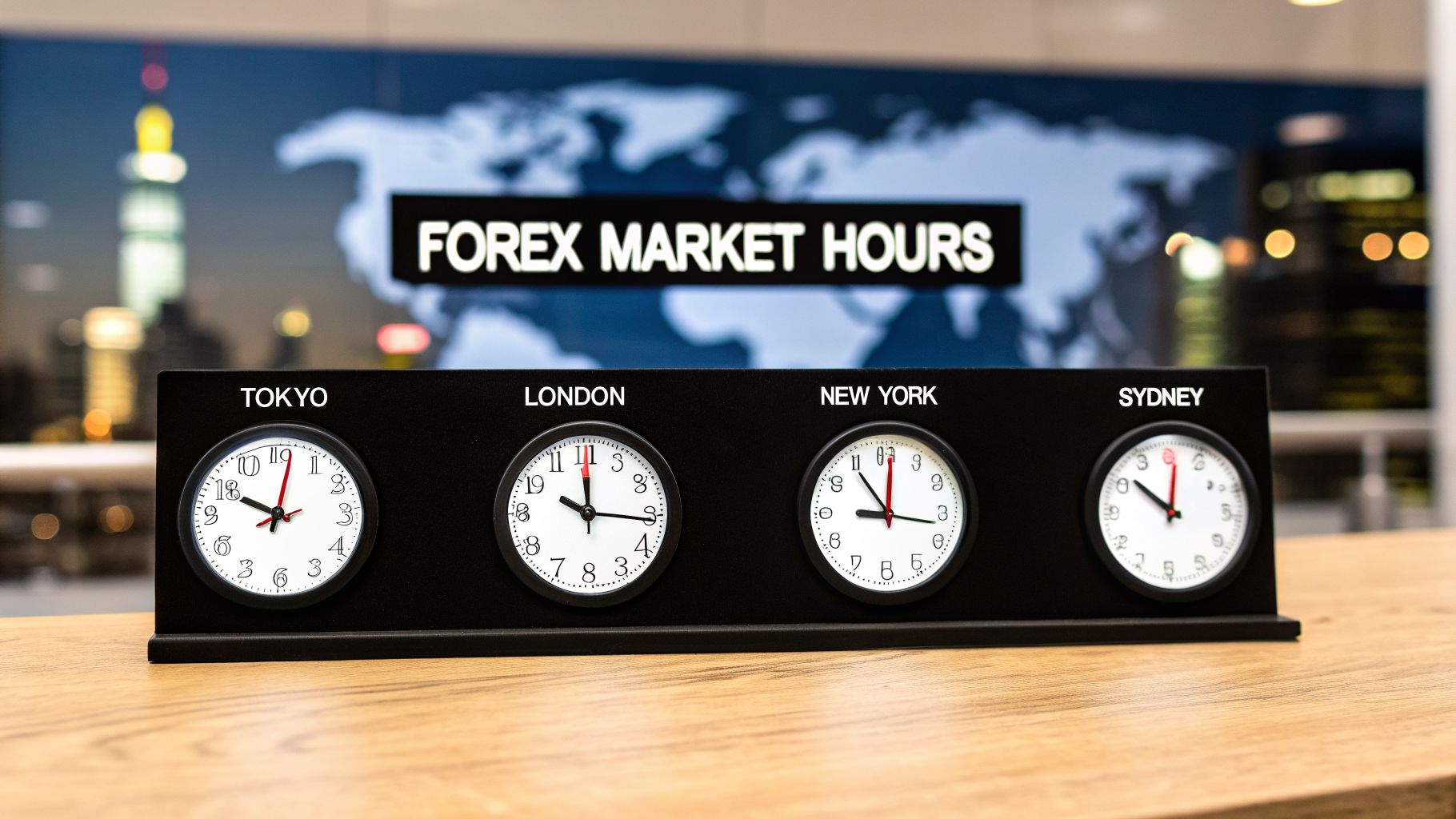
The forex market famously operates 24 hours a day, five days a week, a fact that can be both a blessing and a curse. Because it literally follows the sun around the globe, there's always a market open somewhere, from the moment Sydney kicks things off on Sunday evening until New York winds down on Friday.
But here's a secret that separates struggling traders from profitable ones: success isn't about trading all the time. It's about trading during the right time.
Your Guide to Navigating the 24-Hour Forex Market
Staring at your charts 24/5 is a classic rookie mistake, and it's a fast track to burnout, not profits. It's easy to feel like you have to be in on the action constantly. But the real pros know that the key is to trade smarter, not harder. This mindset turns the market's constant motion from an overwhelming challenge into your greatest strategic advantage.
This is the absolute core of my trading philosophy—using pure price action during specific, high-probability windows to find consistent setups. You don't need a screen cluttered with complex indicators when you understand the market's natural rhythm. By focusing on the hours when the market is most active, you can find much clearer and more reliable opportunities. This is the first step toward building a disciplined and profitable routine.
The Four Major Forex Trading Sessions
The global forex market isn't just one single entity; it's a collection of major financial centers, each with its own trading session. Think of it like a global relay race, where the trading "baton" is passed from one major city to the next. This continuous hand-off is what gives the forex market its 24-hour nature and ensures there's almost always liquidity.
This infographic gives you a great visual breakdown of how these sessions flow into one another.

As you can see, just as one market is closing, another is already open or just getting started. This seamless overlap creates the 24-hour trading environment we know from Monday to Friday.
Here's a quick look at the major players in this global relay:
The Four Major Forex Trading Sessions at a Glance
This table breaks down the four sessions, their typical operating times, and the currencies they most influence. It’s a handy reference for figuring out which session to focus on.
| Session | Main Operating Hours (UTC) | Key Characteristics | Primary Currencies |
|---|---|---|---|
| Sydney | 22:00 – 07:00 | The first session to open for the week. Often quieter but sets the early tone. | AUD, NZD |
| Tokyo | 00:00 – 09:00 | Dominates Asian trading. The third-largest session by volume. | JPY, AUD, NZD |
| London | 08:00 – 17:00 | The world's largest and most important financial center by volume. High liquidity. | EUR, GBP, CHF |
| New York | 13:00 – 22:00 | The final session of the day. Known for high volatility, especially at the open. | USD, CAD |
The real magic happens during the overlaps. These are the periods when multiple major markets are open simultaneously, creating a surge in trading volume and volatility.
The London-New York overlap, for example, is the most active period of the entire trading day. This window, roughly from 13:00 to 17:00 UTC, accounts for over 50% of the daily global turnover on average. This is when the big moves often happen.
The key takeaway is that you don't need to be glued to the screen for all of them. The most profitable price action often occurs when these sessions intersect, creating surges in volatility and liquidity that are ideal for day traders.
Of course, knowing when to trade is only half the battle. You also need to know what you're looking for. Understanding how to read the charts during these active periods is crucial for spotting high-probability setups without relying on indicators. If you're new to this, you might be interested in our detailed guide on how to read forex charts.
By aligning your trading schedule with these powerful market rhythms, you put yourself in the best possible position to capture the moves that matter.
Understanding the Four Major Forex Trading Sessions

The forex market runs 24 hours a day, but it’s not just one continuous, flat ocean of trading activity. It’s better to think of it as a series of interconnected trading sessions, each with its own unique personality, volume, and rhythm.
Getting a feel for these personalities is the first step. It allows you to sync up your own strategy with the market’s natural pulse instead of fighting against it. Let's move past simple time zones and dig into how each of the four major sessions actually behaves and what that means for your trading.
The Sydney Session: The Quiet Opener
The trading week officially kicks off down under in Sydney, Australia. I like to call this session "The Quiet Opener." It's the smallest of the major sessions, which means it often has lower liquidity and volatility than what's to come. But don't mistake quiet for useless.
For a price action trader, this calmness can be a huge plus. With less market "noise" and fewer frantic moves, chart patterns and key support and resistance levels often stand out much more clearly. It’s a great time for traders who prefer a more methodical, analytical approach without the chaos of busier hours.
- Typical Market Behavior: The market is often in a state of consolidation, digesting the weekend gap. Prices tend to move within a defined range, which can be perfect for range-bound strategies or for spotting the initial levels that might break out later.
- Most Active Pairs: Unsurprisingly, the local currencies are the main event. You'll see the most action in pairs involving the Australian Dollar (AUD) and New Zealand Dollar (NZD), such as AUD/USD, NZD/USD, and AUD/JPY.
The Tokyo Session: The Early Mover
As traders in Sydney are getting ready for their lunch break, Tokyo comes online, bringing a serious injection of trading volume. The Tokyo session acts as "The Early Mover," often setting the tone for the entire Asian trading day and establishing early trends that can hold for hours. As the world's third-largest forex trading center, Tokyo's influence is massive.
This session is known for heavy participation from commercial banks and major corporations, which can fuel sustained, directional moves, especially in Japanese Yen (JPY) pairs. As a price action trader, this is where you start looking for clear momentum and trend continuations.
Key Insight: The Tokyo session is when major economic data from Japan, China, and Australia hits the wires. A surprise announcement can trigger a sudden burst of volatility, so keeping an eye on the economic calendar is non-negotiable.
The London Session: The Global Hub
When the London session opens, everything changes. The market shifts into high gear. This is "The Global Hub"—the largest and most important trading session by far, accounting for over 35% of the total daily turnover. Critically, it overlaps with both the end of the Tokyo session and the start of the New York session.
This massive wave of liquidity causes spreads to tighten and volatility to explode. For price action traders, this is prime time. The sheer volume of orders flowing through London makes it the perfect environment for breakout strategies, as key support and resistance levels are often smashed through with conviction.
- Typical Market Behavior: Expect extremely high volatility and deep liquidity. Trends that started in Tokyo can either accelerate dramatically or reverse on a dime. The day's major, defining moves often happen right here.
- Most Active Pairs: All major pairs are in play, but European currencies take center stage. EUR/USD, GBP/USD, USD/CHF, and EUR/JPY see absolutely enormous trading volumes.
Understanding the unique character of each session is fundamental to successful trading. If you want to go deeper on this, you might find our guide on the best time to trade forex helpful.
The New York Session: The Powerhouse
Last but definitely not least, the New York session opens while London is still in full swing. I call this one "The Powerhouse" because it has the clout to either turbocharge the momentum from London or stop it dead in its tracks and send it the other way. The U.S. dollar is on one side of roughly 90% of all forex trades, so the U.S. open carries incredible weight.
The single most important period of the entire trading day is the overlap between the London and New York sessions. For about four hours, the world's two largest financial centers are operating at the same time, creating an unmatched surge of liquidity and volatility.
For a price action trader, this is the main event. The market is at its most active, delivering the kind of powerful, clear moves that are ideal for supply and demand strategies. Major U.S. economic data, like the Non-Farm Payroll report, is released during these hours, acting as a massive catalyst for sharp price swings. Once the London session closes, you'll typically see volatility start to taper off as the New York session winds down for the day.
Why Session Overlaps Are a Price Action Trader's Best Friend

This is where all the theory about forex market hours gets real. If each trading session has its own personality, the overlaps are when they all show up to the same party. The energy just explodes.
Think of it like a busy highway. When traffic is flowing one way, it’s steady. But when two major highways merge, the sheer volume of cars—and the potential for action—goes through the roof. In forex, this "traffic" is liquidity and volatility, the two things every price action trader lives for.
During these overlap windows, the market is flooded with orders from traders and big institutions across multiple continents. This is what creates the clean, powerful price moves that are the bread and butter of our Colibri Trader strategies.
The Power of Peak Liquidity and Volatility
When more than one major financial center is open, the number of buyers and sellers skyrockets. This has a few huge benefits for day traders who rely on pure price action.
First, liquidity is off the charts. With so many people in the market, it’s far easier to get in and out of trades at the price you want. Even better, all that activity forces the bid-ask spread—the small cost you pay on every trade—to tighten up dramatically.
Instead of a wide, expensive spread that eats into your profits, overlaps can squeeze spreads on major pairs down to just a fraction of a pip. That means more of every winning trade stays in your account. You can dive deeper into this in our guide on what market liquidity is and why it matters.
Second, volatility kicks into high gear. Volatility isn't just random, messy price swings; it’s the engine that drives trends. For a price action trader, a dead, sideways market is the absolute enemy. We need the price to move with conviction, and session overlaps provide the fuel for those big moves.
The Undisputed Golden Hours of Forex Trading
There are three key overlaps, but one stands head and shoulders above the rest: the London-New York session overlap. This is, without a doubt, the "golden hour" of the trading day, and for very good reason.
From roughly 13:00 to 17:00 UTC, the two biggest financial centers on the planet are fully active. This four-hour window is a perfect storm of trading activity.
Here’s what makes it so powerful:
- Massive Institutional Volume: European and North American banks, hedge funds, and corporations are all online, executing their biggest orders of the day.
- Major News Releases: This is prime time for critical economic data from the U.S. and Canada (think employment numbers or GDP), which acts as a major catalyst for price.
- Peak Currency Activity: The U.S. Dollar (USD), Euro (EUR), and British Pound (GBP) are the three most-traded currencies in the world. During this window, they are all at their absolute peak of activity.
This convergence creates an environment where price doesn't just drift—it moves with purpose. Key support and resistance levels get tested and broken with force, serving up the high-probability setups that supply and demand strategies are built on.
The London-New York overlap isn't just a little more active; it's a completely different market environment. It's where the majority of the day's biggest moves happen, offering the clearest opportunities for traders who know what to look for.
The forex trading hours from 1 PM to 5 PM UTC generate incredible volumes. With the market’s daily turnover hitting $7.5 trillion according to 2022 BIS data, this four-hour period can account for up to 70% of the daily volume for USD-related pairs.
The London session alone handles 35-40% of global volume, and New York adds another 20%. Their overlap concentrates this power, tightening spreads on major pairs to as low as 0.1-0.5 pips and creating the sharp, decisive price reactions we look for.
A Tale of Two Overlaps
To put this into perspective, let's compare the main overlaps. While the London-New York window is the main event, the other two have their own unique character.
| Session Overlap | Typical UTC Window | Key Characteristics | Best Pairs to Watch |
|---|---|---|---|
| Tokyo-London | 08:00 – 09:00 | A short but important handover. Volatility from the end of Tokyo can spill over into the London open. | EUR/JPY, GBP/JPY |
| London-New York | 13:00 – 17:00 | The most liquid and volatile period of the day. Perfect for all major pairs, especially those with USD, EUR, & GBP. | EUR/USD, GBP/USD, USD/CHF |
| Sydney-Tokyo | 00:00 – 07:00 | Generally calmer, but offers good setups on AUD, NZD, and JPY pairs as Tokyo's liquidity comes online. | AUD/JPY, NZD/USD |
For anyone following the Colibri Trader methodology, the choice is simple. Our strategies thrive on the clean, powerful trends that come from high liquidity and volatility. The explosive price action you see in pairs like EUR/USD and GBP/USD during the London-New York overlap creates the perfect canvas for spotting high-probability supply and demand zones.
This isn't about trying to catch every little wiggle; it's about positioning yourself to ride the major, predictable waves of activity.
How to Build Your Perfect Forex Trading Schedule

Alright, it’s time to move from theory to action. Understanding the forex market hours is one thing, but actually building a trading schedule that fits your life—and sets you up for success—is a different game entirely.
There's a huge myth in trading that you need to be glued to your charts all day to be profitable. That idea isn’t just wrong; it’s a recipe for burnout and terrible decisions. My approach is the complete opposite: focused, high-impact trading for just a few hours a day.
By targeting the market's most active periods, you trade less but with far greater potential.
A Four-Step Guide to Your Trading Routine
Creating a personalized trading routine isn’t as complicated as it sounds. It’s all about being realistic with your time and strategic with your focus. Here’s a simple, step-by-step process to turn the abstract idea of market hours into a practical, daily action plan.
Pinpoint Your Availability and Time Zone: First things first, be honest with yourself. Look at your daily schedule and find a consistent 2-4 hour block where you can trade without distractions. Mark this window in your local time, then convert it to UTC to easily line it up with the global sessions.
Identify the Best Overlap: With your trading window defined, find the most active session overlap that falls inside it. If you can trade during the London-New York overlap (13:00 – 17:00 UTC), that's your prime time. If not, the Tokyo-London or Sydney-Tokyo overlaps also offer great opportunities.
Select Your Target Pairs: Your chosen session tells you what to have on your watchlist. During the London-New York overlap, you should be focused on major pairs like EUR/USD, GBP/USD, and USD/CHF. For the Tokyo-London window, EUR/JPY and GBP/JPY are ideal. This makes sure you're trading pairs with the most liquidity and volatility during your specific hours.
Commit to Discipline: Once you’ve built your schedule, you have to stick to it. Discipline is the glue that holds a successful trading plan together. You have to resist the urge to trade outside your window, even if the market looks tempting. Consistency is your greatest ally here.
Just as stock investors use strategies for identifying optimal trading times, we as forex traders must fine-tune our schedules based on market activity. The goal is to show up when the action is predictable and powerful.
Sample Price Action Trading Schedules
Let’s make this more concrete. What does this look like in practice for traders in different parts of the world? Your location doesn’t limit your potential; it just shapes your strategy for accessing the best forex market hours.
Here are two examples showing how you could structure an effective schedule, tailored to different time zones.
| Trader Location | Local Time Window | Target Session | Primary Pairs | Trading Focus |
|---|---|---|---|---|
| New York, USA (EDT) | 8:00 AM – 12:00 PM | London-New York Overlap | EUR/USD, GBP/USD, USD/CAD | Capitalize on the most volatile four hours of the day. Focus on major news releases and strong breakout patterns. |
| Perth, Australia (AWST) | 3:00 PM – 7:00 PM | London Open | EUR/AUD, GBP/AUD, EUR/GBP | Target the initial burst of volatility as London comes online. Look for trend continuations or reversals from the Asian session. |
These examples show how you can zero in on the best action, no matter where you are. It’s about being smart, not being busy.
The perfect trading schedule is not the one that forces you to trade the most. It’s the one that aligns the market’s best hours with your personal availability, allowing for consistent and focused execution.
This structured approach takes the guesswork and emotional decisions out of the equation. You're no longer chasing the market; you're meeting it at a pre-arranged time and place where you hold the strategic advantage. This level of discipline is what turns trading from a chaotic gamble into a methodical business.
The Story of Forex Hours and Why It Still Matters in 2026
To really get a feel for the forex market, you have to know where it came from. The 24-hour, five-day-a-week rhythm we all trade today wasn't some grand design. It was actually born from a huge shake-up in the global economy.
This nonstop market is a direct result of the Bretton Woods Agreement collapsing back in the early 1970s. Before that, currencies were fixed to the U.S. dollar, which was tied to gold. When that system fell apart, currencies were free to "float" against each other, with their values decided by good old supply and demand. This created an immediate need for a constant, around-the-clock marketplace to trade these ever-changing values.
From Billions to Trillions
The growth that came next was just staggering. A market that started out for governments and giant corporations has absolutely exploded. This whole process got supercharged in the 1990s with the rise of electronic trading, which seamlessly linked up the big financial hubs like Tokyo, London, and New York.
This tech jump cemented the power of these major sessions and turned forex market hours into the global relay race we know today. Just look at the volume numbers to see how dramatic this story is. Daily turnover rocketed from $1.2 trillion in 2001 to a mind-boggling $7.5 trillion by 2022.
Go back even further, and the data from the Bank for International Settlements shows that in 1989, daily volume was a mere $590 billion. It's an incredible story of growth.
This isn't just a history lesson. It proves that the intense liquidity and volatility we see when market sessions overlap is a fundamental, deeply-rooted feature of the market—not just a temporary trend.
Why This History Gives You an Edge in 2026
So, why should you, a trader focused on 2026, care about 50-year-old history? Because it’s the "why" behind our entire trading approach. The hard data shows that a huge chunk of daily trading volume—often over 50%—is still packed into those few hours when European and American traders are both active.
Knowing this history confirms that focusing on prime forex market hours, like the London-New York overlap, is a timeless strategy. It’s not some new fad or gimmick. It's a method grounded in the very structure of the global financial system.
As the market keeps changing, this core understanding becomes your best tool for tuning out the noise, avoiding burnout, and zoning in on the high-probability windows where the real price action happens.
Got Questions About Forex Market Hours?
Once you start wrapping your head around the different forex sessions, a bunch of practical questions will inevitably pop up. Moving from the what to the how is where the rubber meets the road. This section is all about giving you direct, no-fluff answers to the most common questions I hear from traders trying to build a solid trading routine.
We’ll tackle the age-old question of the "best" time to trade, what to do if you have a tricky schedule, and how the market's energy shifts throughout the week. My goal is to give you the clarity you need to trade smarter, not harder.
What Is the Single Best Time to Trade Forex?
For any day trader who lives and breathes price action, one window stands head and shoulders above the rest. The most consistently active and liquid period is the London-New York session overlap, which runs from about 1:00 PM to 5:00 PM UTC.
I often call this four-hour slot the "golden window" of forex trading, and for good reason. It’s when the world’s two largest financial centres are firing on all cylinders, creating a perfect storm of opportunity.
During this overlap, you can almost always expect to see:
- The Highest Trading Volume: A massive number of transactions are flying back and forth, which means incredible market liquidity.
- The Tightest Spreads: All that activity and competition between buyers and sellers naturally squeezes the bid-ask spread, which lowers your cost of entry.
- The Most Significant Price Moves: This is when major economic news bombs from the U.S. and Europe tend to drop, often kicking off strong, clean trends.
For these reasons, the London-New York overlap is the prime hunting ground for day traders looking for high-probability setups, especially on major pairs like EUR/USD, GBP/USD, and USD/CHF.
Can I Succeed If I Can't Trade the Main Overlap?
Absolutely. Let's be crystal clear: while the London-New York overlap is the most explosive period, it is by no means the only time to find great trades. Success in this business is far more about your discipline and strategy than it is about being glued to your screen during a specific four-hour window.
If your life or job doesn't line up with that main overlap, your job is simple: become a specialist in the hours you can trade. The trick is to adapt your strategy and expectations to the market conditions in front of you.
For instance, the Sydney-Tokyo overlap (around 12:00 AM to 7:00 AM UTC) can offer fantastic opportunities on pairs like AUD/JPY, NZD/USD, and other Asia-Pacific crosses. The moves might not be as wild as the London open, but they are often cleaner and more predictable. For a price action trader, that can be a massive edge.
The most important factor is not when you trade, but how you trade. A disciplined trader with a solid strategy who focuses on the Tokyo session will always outperform an impulsive trader randomly chasing moves during the London-New York chaos.
Your goal is to pinpoint the most active session within your trading hours and master the currency pairs that have the most life during that time. Consistency in your approach is what builds an account, period.
Which Days of the Week Are Best for Trading?
Just as the market has a daily rhythm, it also has a weekly one. Understanding this flow helps you manage your expectations and pour your energy into the days that offer the highest potential.
As a general rule, volatility tends to peak from Tuesday to Thursday. These mid-week days often produce the clearest trends and most reliable price action, making them the sweet spot for most traders.
Here’s a rough breakdown of a typical trading week:
- Mondays: Trading often starts off a bit sluggish as the market digests whatever happened over the weekend and tries to find its direction. The major trends for the week might start to form, but the action is generally more subdued.
- Tuesdays, Wednesdays, and Thursdays: This is the heart of the trading week. Volume and volatility are usually at their highest, serving up the most opportunities for day traders.
- Fridays: This day can be a mixed bag. The first half often carries the mid-week momentum. But watch out for the second half, which can get choppy as traders start closing out positions and taking profits before the weekend. Major news like the U.S. Non-Farm Payroll (NFP) report on the first Friday of the month can also unleash extreme, difficult-to-trade volatility.
By focusing your efforts on the mid-week sessions, you’re putting yourself in sync with the market's most active and predictable periods.
At Colibri Trader, we teach you how to master price action so you can confidently trade during these high-opportunity windows without relying on indicators. If you're ready to transform your trading with a proven, no-nonsense approach, discover your potential with our powerful programs at https://www.colibritrader.com.