
Your Ultimate Guide to the Demo Trading Account
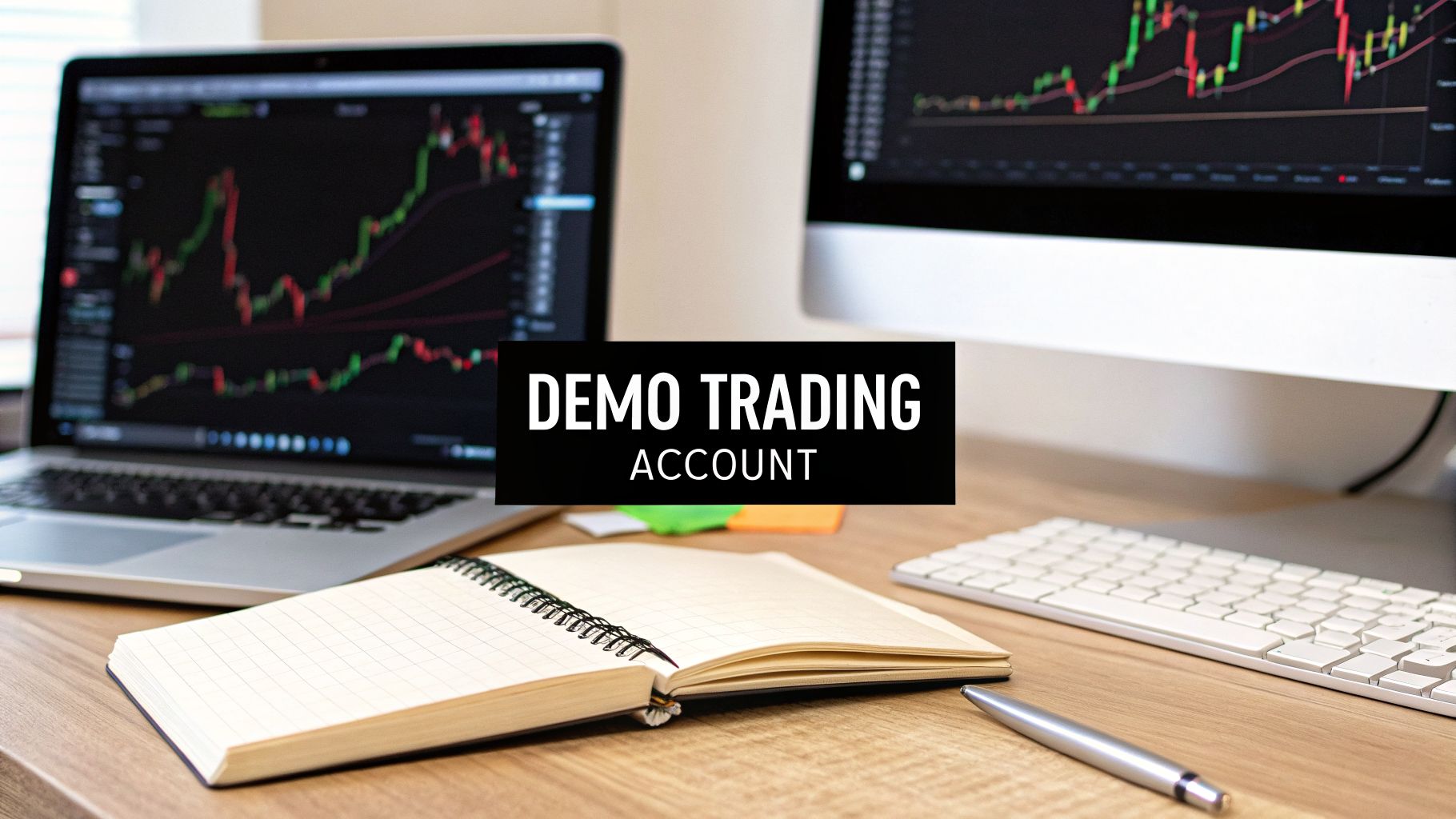
A demo trading account is essentially a flight simulator for the markets. It’s your chance to practice trading with virtual money in a surprisingly realistic setting, letting you learn the ropes, test out strategies, and make all your rookie mistakes without losing a single real dollar.
What Is a Demo Trading Account

Think of it as your personal practice field before stepping into the big league. A broker provides you with a simulated platform that perfectly mirrors the live trading environment. You get the same real-time price feeds, the same professional tools, and the same interface you’d use with a live account. The only difference? Every trade is funded with play money.
This setup is crucial for closing the gap between reading about trading and actually doing it. Instead of just theorizing about placing an order or analyzing a chart, you get to build real muscle memory and confidence. For anyone new to the markets, this kind of hands-on experience is priceless. It also lets you try out different account types, like a demo trading account for forex or one for stocks, to see what fits.
A demo account isn’t just a nice-to-have tool; it's a foundational step. It's where you build discipline, get a feel for market volatility, and refine your entire approach before risking any of your hard-earned capital.
You'll often hear the term used interchangeably with "paper trading," a practice that's been around for decades. You can dive deeper into its roots in our guide on what paper trading is and why it's been a staple for traders for so long.
How a Demo Account Works
The mechanics are pretty straightforward. When you sign up, the broker drops a chunk of virtual cash into your account—usually anywhere from $10,000 to $100,000. You then use these funds to trade just as you would in the real world.
A few key things are happening behind the scenes:
- Real-Time Data Feeds: The account streams live price data, meaning the charts and price action you see are identical to what live traders are looking at.
- Full Platform Access: You get to use the entire suite of the broker's platform, from advanced charting packages and technical indicators to essential order types like stop-loss and take-profit.
- Risk-Free Execution: Since the money is fake, your profits and losses are just numbers on a screen. This is huge, as it lets you experiment with position sizing and different strategies without the gut-wrenching fear of losing real money.
To make the differences crystal clear, it helps to see the two account types side-by-side.
Demo Account vs Live Account At a Glance
| Feature | Demo Trading Account | Live Trading Account |
|---|---|---|
| Capital | Virtual, risk-free funds provided by the broker | Real money you deposit from your own bank account |
| Market Environment | Simulated but uses real-time price data | The actual, live market with real liquidity |
| Psychological Impact | Minimal to no emotional pressure | High emotional pressure (fear, greed, stress) |
| Trade Execution | Instant fills with no slippage | Can experience slippage and delays during volatility |
| Primary Goal | Learning, practice, and strategy testing | Generating real profit and capital growth |
| Consequences | No financial gain or loss; a pure learning experience | Real financial profits and losses |
This table really highlights the core distinction: a demo account is for education, while a live account is for execution. The lack of real risk in a demo is its greatest strength and its biggest weakness, something we’ll cover in more detail later.
Why It Is an Essential First Step
Jumping straight into live trading with real money is one of the most common—and expensive—mistakes a new trader can make. It’s a baptism by fire that usually ends in a blown account.
Recent industry analysis shows a telling split: a staggering 70% of new forex traders dive right into live accounts. The other, smarter 30% take the time to build their skills on a demo account first. This simple choice often separates those who learn through costly errors from those who practice and prepare for free.
By starting with a demo, you give yourself the breathing room to build a solid foundation. You’ll learn how to navigate your trading platform in your sleep, understand the real impact of spreads and fees, and get a feel for the market’s rhythm—all before putting your capital on the line.
How to Choose the Right Demo Trading Account
Picking a demo trading account isn't as simple as grabbing the first one you see. Not all are created equal, and the one you choose will have a huge impact on how well you practice.
Think of it like a professional fighter choosing a sparring partner. If the partner doesn't fight anything like the real opponent, the training is pointless. You'll build the wrong habits and get a nasty surprise on fight night.
The same goes for your demo account. It has to mimic a live trading environment as closely as possible. The entire point is to build skills that transfer directly to the real world, so realism is everything. You need to look past the big, flashy virtual balance and dig into the features that create a genuine trading experience.
Aligning the Platform with Your Goals
First things first, let's talk about the trading platform. Most brokers will give you access to the industry standards like MetaTrader 4 (MT4) or MetaTrader 5 (MT5). These are excellent choices for practicing price action, with clean charts and all the analytical tools you need to learn to read the market.
When you're looking at a platform, ask yourself a few key questions:
- Can I trade what I want to trade? If your goal is to trade major Forex pairs like EUR/USD or indices like the S&P 500, make sure the demo account actually offers them with live data.
- Are the charting tools any good? You need professional-grade tools for drawing trendlines, marking support and resistance, and analyzing candlestick patterns. A platform that skimps on these basics will only hold you back.
- Is it easy to use? Your focus should be on learning to trade, not wrestling with a clunky or confusing interface.
The best demo accounts simulate real market conditions with startling accuracy. They give you a risk-free sandbox that mirrors the live environment right down to the spreads, execution speeds, and platform tools. Some of the top-tier simulators, for instance, can give you ECN-style precision on MT4/MT5 with ultra-tight spreads, commissions, and large virtual funds, which is perfect for practicing price action.
Verifying Market Realism and Account Settings
Once you've found a platform you like, it's time to get into the weeds. This is where you separate the great demo accounts from the ones that will teach you bad habits. The most critical piece is the accuracy of the market conditions.
The most significant mistake you can make is practicing in an unrealistic environment. A demo account with zero spreads or no commissions teaches you nothing about managing real-world trading costs.
Look for a broker that offers realistic spreads and commissions in their demo. These costs are a non-negotiable part of trading, and learning how to factor them into your entries and exits is a vital skill. If your demo account pretends they don't exist, you're setting yourself up for a rude awakening when you go live. You can also check out our guide on forex trading platforms to see what features the best options provide.
Another crucial point is the virtual starting capital. A $500,000 virtual balance might sound fun, but it's completely useless if you plan to start your live account with $2,000. Always set your demo account balance to the exact amount you plan to deposit for real. This forces you to learn proper risk management and position sizing from day one.
Finally, check for any restrictions. Some demo accounts expire after 30 or 90 days. While this can add a little pressure, I generally find an unlimited demo is better. It lets you practice without a clock ticking until you are truly confident and consistently profitable with your strategy.
A Blueprint for Effective Demo Trading Practice
If you're just randomly clicking buttons on a demo trading account, let's be clear: you aren't practicing. You're just gambling with fake money. To build skills that will actually translate to a live account, you need a structured plan.
Think of it like a musician rehearsing scales. It’s not the most glamorous part of learning an instrument, but it builds the foundational muscle memory needed for a flawless performance. Your demo account is where you practice the "scales" of trading—spotting your setups, managing your risk, and executing cleanly.
Without a real plan, your time in a demo account is completely wasted. The key is to treat every single action with the same seriousness you would if your own hard-earned money were on the line.
Building Your Trading Playbook
The very first thing you need is a "Trading Playbook." This isn't just a simple journal; it's your personal rulebook, your strategy guide, and your performance log all in one. Before you even think about clicking the buy or sell button, every single trade must be documented here first.
Each entry in your playbook needs to cover a few crucial points:
- The Setup: Why are you even looking at this trade? You need to write down the exact price action pattern you see. Is it a pin bar at a major resistance level? An engulfing candle at support? Be specific.
- Reason for Entry: This is your hypothesis. Write it out. For example, "I'm entering a short on EUR/USD because price has rejected the 1.0750 resistance for a third time, and a bearish engulfing pattern has formed on the 4-hour chart."
- Risk Management: You must define your stop-loss and take-profit levels before you enter the trade. This is non-negotiable. It's the most important habit you will ever build in trading.
- The Outcome: After the trade is closed, log the result. Was it a win, a loss, or did you break even? More importantly, analyze why it played out that way.
This process forces you to be deliberate. It kills the temptation to take random, impulsive trades and replaces it with a methodical approach. Over time, your playbook becomes an invaluable set of data on your own trading, showing you which setups are working and where you're making mistakes.
Treating your demo account with the same strict rules and risk management as a live account is the secret to building professional discipline. If you can't follow your plan with fake money, you stand no chance when real emotions and real capital are at stake.
This visual guide breaks down the essential things to consider when you're setting up your practice environment.

As the image shows, getting the platform, spreads, and starting capital right are the cornerstones of a realistic practice setup.
A Daily Practice Routine for Mastering Price Action
With your playbook ready to go, it’s time to lock in a consistent practice routine. Your goal should be to master price action—the art of reading the market's structure without a chart full of lagging indicators. Here is a simple but powerful routine I recommend.
Your 60-Minute Daily Practice Session:
- Market Analysis (20 minutes): Before you even hunt for trades, get the big picture. Start on the daily and 4-hour charts. Find the key support and resistance levels, figure out the trend, and identify the major market structure. Mark these levels right on your charts.
- Setup Identification (20 minutes): Now, zoom into your preferred trading timeframe (like the 1-hour or 4-hour). This is where you practice patience. Wait for one of the setups from your playbook to appear at or near the key levels you just marked. If nothing shows up, you don't trade. Simple as that.
- Trade Execution and Management (20 minutes): Once a valid setup appears, document it in your playbook. Then, and only then, do you execute the trade in your demo account with the pre-defined stop-loss and take-profit. Remember, the goal isn't to make fake money; it's to execute your plan perfectly.
This structured approach stops you from over-trading and builds the discipline of patience. A lot of new traders think more screen time equals faster learning, but it's the quality of your practice, not the quantity, that makes the difference. A focused, one-hour session every day is worth far more than eight hours of random clicking.
This routine is what turns your demo trading account from a video game into a serious skill-building workshop.
The Hidden Dangers of Demo Trading and How to Avoid Them

While a demo trading account is a tool I recommend to every new trader, it’s loaded with psychological traps that can build some truly destructive habits.
Ignoring these dangers is a lot like a pilot who only trains in a simulator with perfect weather. The moment they hit real-world turbulence, they’re unprepared, and things can go wrong fast. The core issue is that practice trading often feels more like a video game than a serious rehearsal for your business.
The most common trap I see is the "Monopoly Money" effect. When your own capital isn't on the line, the very real fear of loss simply isn't there. This encourages traders to take on massive, completely unrealistic risks they’d never dream of taking with their own savings. A 50% drawdown in a demo account feels like nothing. In a live account, that’s a catastrophic, career-ending event.
This detachment from real financial pain breeds terrible habits. A trader might throw a "Hail Mary" on a whim, just to see what happens. When sheer luck makes it pay off, it reinforces a flawed decision-making process that the live market will punish, severely.
The Emotional Disconnect
The single biggest difference between demo and live trading isn’t the charts or the platform—it’s you. It's your own mind. Demo trading does absolutely nothing to simulate the powerful emotions of fear and greed that grab hold of you when your money is at risk.
That gut-wrenching anxiety when a trade moves against you, or the greedy impulse to snatch a small profit too early—these are powerful forces you just don’t experience with fake funds.
A profitable demo account proves you understand a trading strategy. A profitable live account proves you have mastered your emotions. The latter is infinitely more difficult.
This emotional disconnect is the reason so many traders who are superstars in a demo environment completely fall apart the moment they go live. They have a tested strategy but a completely untested mindset.
To bridge this emotional gap, you have to actively simulate the pressure:
- Journal Your Emotions: Don't just log your setup and P/L. Write down how you feel. Were you nervous hitting the buy button? Impatient while waiting for your entry? This is how you build self-awareness.
- Adhere to Strict Rules: Follow your trading plan with zero exceptions. If you can't find the discipline with fake money, you have no chance when real emotions are flooding your brain.
- Visualize Real Stakes: Constantly remind yourself that the goal isn't to win fake points. The goal is to execute your plan perfectly, as if every virtual dollar was pulled from your own bank account.
Technical Illusions and False Security
Beyond the psychological games, demo accounts often paint a technically perfect picture of reality, creating a false sense of security. There are two major illusions that can give you an unrealistic view of how trading actually works.
The rapid growth in online trading has only made these issues more common. Demo account adoption has skyrocketed, with platforms reporting massive user growth. For instance, Interactive Brokers hit 4.13 million registered accounts, a 32% year-over-year increase in Q3 2025, with a huge portion of those users starting on demos. This shows how popular the tool is, but it also highlights the risk of users becoming detached from real-world factors like slippage, which demos often ignore. You can find more details about the rising popularity of demo accounts and their features in this forex brokers guide.
This brings us to the most common technical illusions you need to be aware of.
Common Demo Account Illusions:
- Perfect Order Fills: In a demo, your orders usually fill instantly at the exact price you see on the screen. There’s no delay and no discrepancy.
- Zero Slippage: Slippage is the difference between the price you expect and the price you actually get. During volatile news or in fast-moving markets, slippage is a normal, unavoidable part of live trading. Demo accounts almost never simulate it.
These illusions can trick you into thinking your strategy is far more profitable than it really is. I’ve seen traders develop scalping strategies that look perfect in a demo, only to find they bleed money in a live environment because of tiny bits of slippage and execution delays.
To fight this, always factor in a buffer for costs and slippage when you calculate your risk and potential reward. Assume things won't be perfect, because in the real market, they rarely are.
Metrics to Know When You Are Ready for Live Trading
So, you’ve been practicing in your demo trading account. The big question on every new trader's mind is, when are you really ready to trade with your own money?
The answer isn't a gut feeling. It’s written in the numbers you produce. Just looking at your profit and loss is a classic rookie mistake and can be incredibly misleading. You need a solid checklist based on performance to know you're truly prepared.
This data-first approach takes the guesswork out of the equation. It's about proving to yourself, with hard evidence, that you've got a strategy that works and the discipline to stick to it. This is very similar to measuring success with proven strategies and metrics in any other performance-based field.
Without this proof, you’re essentially just gambling that you can handle the psychological heat of the live markets. That’s a bet most new traders lose, and lose badly.
The Three Pillars of Readiness
From my experience, readiness for live trading stands on three core pillars: consistency, positive expectancy, and iron-clad discipline. You have to prove you’ve mastered all three over a decent number of trades before you even think about risking real capital.
1. Consistent Win Rate Over a Large Sample Size
Anyone can get lucky on a few trades. A short winning streak doesn't mean a thing. Real skill, however, shows itself over the long run.
You absolutely must track your performance over at least 100 demo trades. This is the magic number where luck starts to fade and your true edge begins to show. If you win 55 of those 100 trades, your win rate is 55%. That's a real, tangible metric, not a guess. If you need a refresher on the calculation, check out our guide on how to calculate win rate.
2. A Consistently Positive Risk-to-Reward Ratio
Your win rate is only half the battle. I'd argue the other half, your risk-to-reward (R:R) ratio, is even more important. This simply measures how much you stand to make on a trade versus how much you're willing to lose.
A positive R:R means your winning trades are bigger than your losing ones. For instance, risking $50 to potentially make $100 gives you a 1:2 R:R. I tell my students to consistently look for trades with an R:R of at least 1:1.5 or better. This is how you can be profitable even with a modest win rate of 45-50%.
3. Unwavering Trading Discipline
This is the most crucial piece of the puzzle, but it's also the hardest one to track with a simple number. The best way I’ve found is to measure a "Plan Adherence Rate."
For every single trade you take, ask one simple question: Did I follow my trading plan to the letter?
Your goal should be a Plan Adherence Rate of 95% or higher over your last 100 trades. This means you stuck to your entry, exit, and risk rules without wavering on at least 95 of those trades. It proves you have the mental fortitude to trade your system, not your emotions.
Your Readiness Checklist and Tracking Template
To keep yourself honest, you need to be diligent about tracking your performance. A simple spreadsheet is all you need. I've put together a checklist below to help you gauge your readiness. Don't even consider moving to a live account until you can confidently check every single box.
Readiness Checklist for Transitioning to a Live Account
Use this checklist to objectively assess if you have developed the consistent habits and metrics required to successfully transition from a demo to a live trading account.
| Metric/Habit | Target | My Status (Check when consistently achieved) |
|---|---|---|
| Trade Sample Size | Minimum of 100 trades executed in the demo account | ☐ |
| Win Rate | Consistently above 40% (or your strategy's break-even point) | ☐ |
| Risk-to-Reward Ratio | Average R:R is consistently 1:1.5 or better across all trades | ☐ |
| Profitability | Account balance shows a net profit after 100 trades | ☐ |
| Plan Adherence | Followed the trading plan on at least 95% of trades | ☐ |
| Emotional Control | Journal shows no evidence of revenge trading or FOMO-driven entries | ☐ |
| Risk Management | Never risked more than the pre-defined percentage (e.g., 1%) per trade | ☐ |
When you've hit these targets, you haven't just gotten lucky. You have built and validated a profitable system. More importantly, you've proven to yourself that you have the discipline to execute it when it counts. That, right there, is the true sign that you’re ready to step into the live arena.
Making the Leap From Demo to a Live Account
Moving from a demo trading account to a live one is probably the single biggest jump you’ll make in your trading journey. This is where the rubber meets the road, where all your practice gets put into action with real money on the line. It's a huge psychological shift, and if you don't handle it with a clear plan, it can be a rough ride.
Your first step is simple: open a small live account. I mean it. This isn't the time to throw in your life savings. You need to fund it with an amount you're truly okay with losing. Think of it as the price of admission for your real-world trading education.
Starting small takes the pressure off. It helps you get past that crippling fear of a major loss, so you can actually focus on trading your plan under real-market pressure.
Taming the Emotional Rollercoaster
The first thing that hits most new live traders is the sheer emotional intensity. The fear and greed you read about? They suddenly become very, very real. In demo, they were nowhere to be found, but now they can feel completely overwhelming.
The best way I've found to manage this is to cut your position size way, way down. If you were comfortably trading one standard lot in your demo account, you should be trading a micro-lot (0.01) for your first few live trades.
This isn’t about making money; it’s about managing your own head. Smaller position sizes lead to smaller P/L swings, which keeps the anxiety from taking over. Your main job in the first few weeks of live trading is just to get used to the feeling of having real skin in the game while sticking to your rules.
The moment you go live, your job title changes. You are no longer just a technical analyst; you are a risk and emotions manager. Your ability to handle the psychological pressure is now your most important skill.
Executing Your First Live Trades
Okay, you've got a small account funded and your position size is tiny. Now it's time to pull the trigger. The secret here is simple to say but incredibly hard to do: do exactly what made you successful in the demo. Don’t change a thing. Don't start second-guessing your strategy or tweaking your risk rules.
Follow this process for your first live trades. No exceptions.
- Wait for Your A+ Setup: Be patient. Only take the high-probability setups you’ve already defined in your trading playbook. This is where most traders fail.
- Define and Set Your Risk: Before you even think about clicking "buy" or "sell," you need to know exactly where your stop-loss and take-profit will be. Place those orders the second your trade gets filled.
- Execute and Walk Away: Once the trade is on, your job is done. Trust the analysis you did beforehand. Step away from the screen and stop staring at the chart. Let your plan do its thing.
This final part of the transition is all about proving to yourself that you can hold onto the discipline you built in demo, even when the pressure is on. Stick to your plan, manage your emotions by keeping your risk small, and trust the process. This is what builds the foundation for a real trading career.
Of course. Here is the rewritten section, crafted to sound like it was written by an experienced human expert, following the specified style and tone.
Frequently Asked Questions About Demo Trading
Even after you understand the good and the bad of demo trading, a few questions always pop up. I get these all the time from new traders.
Let's clear the air and tackle some of the most common ones. This will help you sidestep the usual myths and really make your practice time count.
Are Demo Trading Accounts Really Free?
Yes, they are. Any reputable broker will offer a demo trading account completely free of charge, with no strings attached.
Brokers aren't just being generous; it's a smart marketing move on their part. They give you a way to test-drive their platform and get a feel for their trading conditions without you having to risk a single cent. It’s a win-win. You get an essential tool for learning the ropes, and they get a chance to prove their worth, hoping you'll stick with them when you're ready to trade with real money.
Think of it as a totally free, unlimited test drive.
What Is the Best Demo Account for Trading?
The "best" demo account isn't about a specific brand. It's the one that most closely matches the live account you plan to trade with later.
What you're looking for is realism. The demo should use the same platform (like MT4 or MT5), have similar spreads, and give you access to the exact currency pairs or instruments you want to trade. Don't be fooled by accounts offering a million dollars in virtual cash—that's not the point.
The best demo account isn’t the one with the most virtual money; it’s the one that most accurately mirrors the live trading conditions you will eventually face. This realism is what transforms practice into genuine skill-building.
How Long Should I Use a Demo Account?
There's no magic number, but here's my rule: stay on the demo until your data proves you're ready.
This means you should have a track record of at least 100 trades where you've consistently hit your performance goals. Are you maintaining a positive risk-to-reward ratio? Is your "plan adherence rate" over 95%? These are the questions that matter.
Some traders get there in a few weeks, while others might take a few months. The calendar is irrelevant; your trading journal is everything. Don't even think about going live until you have hard proof that your strategy works and—more importantly—that you have the discipline to follow your rules. Rushing this is one of the biggest mistakes a new trader can make.
At Colibri Trader, we believe that mastering price action is the key to consistent trading success. Our action-based programs are designed to give you the skills and discipline needed to thrive in any market, transforming your performance without relying on complicated indicators. Discover your trading potential and start your journey with us today. Learn more at Colibri Trader.