



Bullish or Bearish: Master Market Regimes in 2026 for Consistent Wins

Before you even think about placing a trade, there's one fundamental question you have to answer: is the market bullish or bearish? Getting this right is the bedrock of any solid trading plan. A bullish market is one where prices are climbing, fueled by optimism. A bearish market is the opposite—prices are falling, and pessimism is everywhere.
Your ability to tell these two apart is what separates consistently profitable traders from the rest.
Defining Bullish vs Bearish Market Conditions

Figuring out if a market is bullish or bearish goes way beyond just seeing if the price is going up or down. These terms really describe the dominant mood—the collective psychology of everyone in the market. It's all about the raw emotions of fear and greed that push prices around.
A bull market is a period where prices keep pushing higher. This is usually driven by strong confidence, good economic news, and a ton of demand for an asset. Optimism is in the air. You’ll often see traders get that "fear of missing out" (FOMO), which makes them buy even more aggressively and send prices sky-high.
On the other hand, a bear market is defined by a long, painful slide in prices. This is almost always kicked off by economic worries, negative news, and widespread fear. When pessimism takes over, traders start selling off assets to cut their losses. Supply swamps demand, and prices have nowhere to go but down.
These two environments are night and day, and they demand completely different strategies and mindsets. To really get a handle on how these trends develop, I recommend reading my guide on what market structure is and how it shapes price.
To help you get started, I’ve put together a quick comparison table. It breaks down the key differences so you can spot the current market state right away.
Bullish vs Bearish Markets At a Glance
Here’s a simple look at the core traits that define these two market conditions.
| Characteristic | Bullish Market | Bearish Market |
|---|---|---|
| Price Trend | Sustained upward movement | Sustained downward movement |
| Investor Sentiment | Optimism, confidence, greed | Pessimism, fear, anxiety |
| Economic Outlook | Generally strong and growing | Generally weak or contracting |
| Trading Volume | Tends to increase as prices rise | Increases as prices fall; declines on rallies |
| Dominant Strategy | "Buy the dip" | "Sell the rally" |
This table gives you the basic framework. As you can see, everything from the price trend to the go-to trading strategy flips depending on whether the bulls or the bears are in control. Keep these differences in mind as you analyze your charts.
Mastering Bull Market Price Action

When you're trying to figure out if the market is bullish or bearish, price action gives you the straightest answer. A real bull market isn’t just a gentle upward drift; it has a very specific, readable structure. The absolute core of this structure is a repeating pattern of higher highs and higher lows.
I like to think of it as climbing a staircase. Each step you take upwards is an impulsive move, where buying pressure is overwhelming and the price surges to a new peak—a higher high. After that powerful push, the price needs to take a breather. It pulls back in what we call a corrective move, forming a higher low. This pullback is crucial; it’s where demand steps back in, preventing the price from dropping below its previous low point.
This rhythm—impulse up, correction down, then another impulse up—is the very heartbeat of a bull trend. As a price action trader, your main job is to see this pattern unfolding and trade in sync with it.
Reading the Language of a Bull Market
Recognising a bullish trend means you have to learn to ignore the noise from most indicators and focus on the raw language of the chart itself. The real key is confirming the sequence of those highs and lows.
- Higher Highs (HH): Every new peak in price has to climb above the last one. This is your confirmation that buyers are strong enough to smash through old resistance.
- Higher Lows (HL): Each dip or pullback needs to find its bottom at a price level higher than the previous low. This shows you that buyers are getting more aggressive, stepping in earlier to soak up any selling.
When you can clearly see a series of HH and HL on your chart, you have the visual proof you need: demand is in control. This is the perfect environment to look for those "buy the dip" opportunities, entering long trades during the corrective pullbacks.
A confirmed uptrend is one of the most powerful signals in trading. It tells you the path of least resistance is up. Trying to fight it is a low-probability game. Your goal should be to join the trend, not to call the top.
Historically, bull markets have offered incredible opportunities. Just look at the S&P 500 from 1980 to 2000, which generated a total return of about +1,259%. Statistics show that since 1932, the average bull market lasts 4.9 years and delivers cumulative returns of +177.6%, completely dwarfing the average bear market.
At Colibri Trader, my focus is on teaching traders how to spot these powerful supply and demand imbalances without a chart full of lagging indicators. A classic bullish continuation pattern like a bull flag, for instance, can be a very high-probability setup in these uptrends. You can check out my guide on how to trade the bull flag and pennant patterns to see exactly how I approach this. The goal is always to trade what you see, and in a bull market, what you see is a clear pattern of strength.
Decoding Bear Market Price Action

While a bull market feels like a party, a bear market is driven by the exact opposite: widespread fear and panic. From a price action trader’s point of view, this psychological flip creates a very distinct market structure we can trade. Figuring out whether you’re in a bullish or bearish environment is the first and most critical step to getting your strategy aligned with the market's real momentum.
In a bear market, the chart tells a clear story of sellers being in total control. The key signature I always look for is a consistent series of lower lows (LL) and lower highs (LH). This pattern is the perfect mirror image of a bull trend and it’s your signal that sellers are running the show.
Each big move down is what we call an impulsive move. This is where supply just crushes demand and the price falls to a new low, often in a very sharp, aggressive way. After that big drop, you'll see a weak corrective rally that pushes the price up a bit before sellers jump back in, stopping it well short of the previous high. This failure to rally creates that lower high, and it's the setup for the next leg down.
The Psychology of a Downtrend
The feeling inside a bear market is nothing like a bull run. That "Fear Of Missing Out" (FOMO) that drives people to buy at any price gets replaced by outright panic and a mad dash for the exits. This emotion is something you can literally see on the chart.
In a bear market, fear is the fuel. Weak rallies get smothered by selling as trapped buyers desperately try to get out at break-even and new sellers pile in. For a skilled price action trader, this is where you find your high-probability "sell the rally" opportunities.
This kind of environment is a golden opportunity for disciplined traders. While amateurs are panicking, a price action trader sees a clear, repeating pattern. The predictable sequence of lower highs gives us excellent entry points for short positions, letting us profit from the downward slide.
Recognizing Bear Market Opportunities
Identifying a downtrend is all about connecting the dots on your chart. I look for these two simple but powerful signals:
- Lower Lows (LL): Each new bottom forms below the last one. This confirms that selling pressure is strong enough to smash through previous support.
- Lower Highs (LH): Every attempt to rally fizzles out before it can reach the peak of the last one. This is a critical sign that sellers are defending their ground and buyers have no conviction.
A lot of traders are terrified of downtrends, but they are a completely normal part of the market cycle. Bear markets might be scary, but history shows they're usually shorter than bull markets—averaging just 1.5 years with a cumulative loss of -35.1% since 1932. Even the brutal dot-com bust, which dragged on for 12.6 years and wiped out -57% at its worst, taught traders a priceless lesson in resilience. You can see more data on these cycles from this detailed analysis by Stifel. For my students at Colibri Trader, this is prime time to master price action.
Comparing Bullish and Bearish Trading Setups
Knowing the market's direction is one thing, but profiting from it is another beast entirely. The real skill for a price action trader is picking the right setup for the right conditions. A bullish strategy in a bear market is a recipe for disaster, and the same goes for a bearish setup in a bull run.
Let’s break down the two bread-and-butter price action setups: “buying the dip” in a bull market and “selling the rally” in a bear market.
While they look like mirror images on a chart, trading them requires two completely different mindsets. In a bull market, your job is to find a smart entry to join the prevailing strength. In a bear market, you're looking to pounce on moments of fleeting strength before sellers regain control.
The Bullish Setup: Buying the Dip
The classic bullish strategy is to buy the dip. This isn’t about chasing price at the top. It’s about waiting patiently for price to pull back and carve out a higher low within a clear uptrend. You're entering after a healthy correction, betting that the primary trend is about to resume.
Your ideal entry point is a demand zone. Think of this as a floor where buyers have previously shown up in force, overwhelming sellers. This could be an old resistance level that has now flipped into support, or the base where a previous explosive move upward began.
- Entry Trigger: I look for a bullish candlestick pattern, like a bullish engulfing bar or a pin bar, to form right at or near that demand zone. This is my signal that buyers are stepping back in and the pullback has likely run its course.
- Stop-Loss Placement: Your stop-loss goes just below the demand zone and the swing low of that pullback. This gives your trade some breathing room while providing a clear point where you know your idea was wrong.
The entire goal is to catch the next impulsive wave up. By waiting for the pullback, you get a much better entry price and a tighter stop-loss, which dramatically improves your risk-to-reward ratio.
The Bearish Setup: Selling the Rally
When the market is bleeding, the highest-probability play is to sell the rally. Here, you're waiting for the price to bounce upward into a significant resistance area before you enter a short position. You’re shorting into what you believe is temporary strength, anticipating that the dominant downtrend will kick back in.
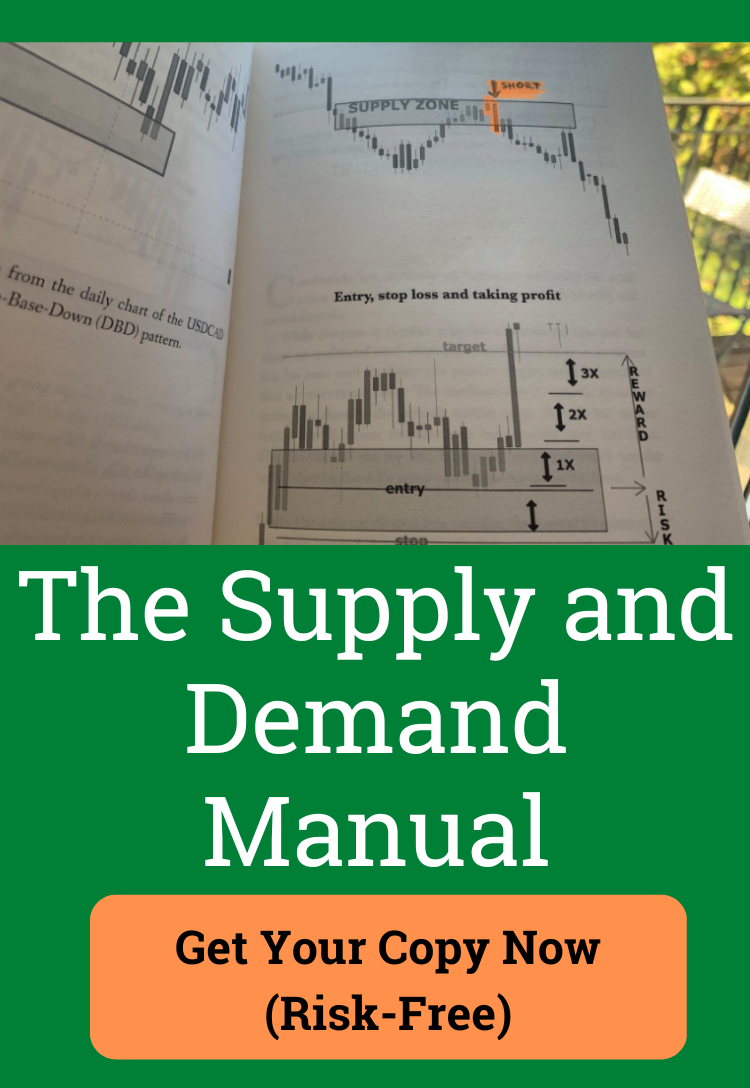
The best entries happen at a supply zone—an area on the chart where sellers previously swamped buyers and pushed the price down hard. This is often an old support level that has now become a ceiling.
A key psychological point to remember is that rallies in a bear market are often weak and short-lived. Fear is the dominant emotion, so sellers tend to reappear very quickly, making these bounces prime opportunities for a well-timed short.
Just like with our bullish setup, your timing is everything.
- Entry Trigger: You need to see a bearish candlestick pattern—like a bearish engulfing bar or a shooting star—form at the supply zone. This is your confirmation that sellers have wrestled back control from the weak bounce.
- Stop-Loss Placement: The stop-loss must be placed just above the supply zone and the peak of the rally (the lower high). This cleanly defines your risk and gets you out if the bounce unexpectedly turns into a full-blown trend reversal.
By selling the rally, you are trading along the path of least resistance. In a bear market, that path is down.
Practical Trade Setup Comparison Bull vs Bear
To put it all together, let's look at a side-by-side comparison of the rules for each setup. This is how you build a concrete plan for whatever the market throws at you.
| Trading Component | Bullish Setup (Buy the Dip) | Bearish Setup (Sell the Rally) |
|---|---|---|
| Market Structure | Confirmed series of Higher Highs (HH) and Higher Lows (HL). | Confirmed series of Lower Lows (LL) and Lower Highs (LH). |
| Entry Area | At or near a key demand zone (previous resistance turned support). | At or near a key supply zone (previous support turned resistance). |
| Entry Trigger | Confirmation of a Higher Low with a bullish candlestick pattern. | Confirmation of a Lower High with a bearish candlestick pattern. |
| Stop-Loss | Placed just below the recent higher low and the demand zone. | Placed just above the recent lower high and the supply zone. |
| Profit Target | The next logical resistance level or the previous higher high. | The next logical support level or the previous lower low. |
Mastering both of these setups is what makes a price action trader truly adaptable. You stop hoping for the market to move in your preferred direction and instead develop a clear plan to trade what you actually see, whether it's green or red.
How to Identify the Current Market Regime
It’s one thing to know what a bull or bear market is. It’s another challenge entirely to spot which one you’re in on a live chart, with your money on the line.
This is where real skill comes into play. You need a systematic approach to take the guesswork and emotion out of the equation. The last thing you want is to be caught fighting the dominant market force.
The secret is multi-timeframe analysis. I always start by looking at a higher timeframe, like the daily or weekly chart, to get the big picture. Is the market carving out a clear series of higher highs and higher lows (bullish), or lower lows and lower highs (bearish)? This macro view gives you the context you need to make sense of everything else.
A Practical Checklist for Market Analysis
Once you have the primary trend figured out, you can drill down to a lower timeframe, say the 4-hour chart, to find your entry points. I follow this process every time to build a clear read on the market.
Identify the Sequence of Highs and Lows: This is your first and most important job. Mark out the major swing points on your chart. A consistent pattern of HH/HL or LL/LH is the cleanest signal of a trend you’ll ever get.
Draw Key Trendlines: Next, connect the swing lows in your uptrend or the swing highs in your downtrend. A clean break of a major trendline is often the first real warning sign that the current regime is losing steam or about to shift.
Pinpoint Major Supply and Demand Zones: Finally, mark the price levels where you saw powerful buying (demand) or selling (supply) in the past. These zones are like magnets for price and give you high-probability areas for either trend continuation or a full-blown reversal. You can learn more about how to identify market trends using these core principles in our detailed guide.
This structured process helps you trade what you see, not what you feel. Of course, you should also keep an eye on key macroeconomic indicators. Things like the SA inflation target can trigger fundamental shifts that drive major changes in price action.
The diagram below gives you a simple decision-making framework for choosing between bullish and bearish setups.

As you can see, once you’ve confirmed the trend, your job becomes much simpler. You're either looking to buy the dip in a bullish market or sell the rally in a bearish one.
Building Your Trading Strategy with Colibri Trader
Knowing if you’re in a bull or bear market is a great start, but it won’t make you money on its own. For that, you need a proven system. This is where my price action methodology really makes a difference.
I’ve built my entire trading approach around one simple idea: stop guessing and start reading. The charts tell you everything you need to know about market direction through pure price action.
Many strategies get bogged down by lagging indicators that are always a step behind. I take a different approach. My programs give you a solid skillset based on what actually moves the market—structure, supply, and demand. This way, you can spot high-probability setups no matter what the market is doing. The principles stay the same whether prices are climbing or crashing.
A Path for Every Trader
I’ve designed a clear path for traders of all backgrounds. If you’re just starting out, my courses will give you the foundation you need by focusing on the core mechanics of how price moves.
Once you have that down, you can move into more specialised programs. There, you’ll master the exact bullish and bearish setups we’ve just talked about in this guide.
- Foundational Skills: Learn to see trends and key zones without cluttering your charts with useless indicators.
- Advanced Setups: Master the art of “buying the dip” and “selling the rally” with precision.
My goal isn’t to teach you a few patterns to memorise. It's to give you a deep understanding of market dynamics so you can think and trade like a professional. True consistency comes from discipline and a reliable process, not from a magic indicator.
With direct mentorship and an active trading community, you get the support you need to put theory into practice. With my help, you’ll learn to stop fighting the market and start trading in harmony with it.
That’s how you build the confidence and skill to trade profitably, regardless of whether the bulls or bears are in control.
Frequently Asked Questions About Market Regimes
Let’s clear up a few common questions that trip up a lot of traders when they’re trying to read the market. Getting these concepts straight is essential.
Can a Market Be Both Bullish and Bearish?
Yes, it absolutely can. This isn’t a contradiction; it’s a matter of which timeframe you’re looking at.
You might see a powerful, multi-year uptrend on the weekly chart, but at the same time, the daily chart could be showing a sharp bearish correction. This is where a lot of traders get confused and make costly mistakes.
This is exactly why I always stress the importance of multi-timeframe analysis. You have to understand that a primary trend (say, bullish) can exist at the same time as a secondary, shorter-term trend (bearish). This allows you to either wait for the pullback to exhaust itself or even make a quick, tactical trade against the main trend.
How Long Do Bull and Bear Markets Last?
There are no hard and fast rules, but looking at history gives us a useful guide. Since 1932, bull markets have tended to last much longer, averaging around 4.9 years.
In contrast, bear markets are usually shorter and much more violent. They’ve lasted an average of just 1.5 years.
Remember, these are just averages. They aren't a crystal ball. The real insight here is that bull markets give you long periods of potential growth, while bear markets offer condensed, high-volatility trading environments.
Don't fall into the trap of thinking a trend is "due" to reverse just because it's been running for a certain amount of time. Adapt to what the chart is telling you now.
What Is the Most Important Trading Skill?
A good strategy is important, but it’s not what will ultimately make or break you as a trader. I’ve seen it time and time again: the single most critical skill for long-term profit is discipline and strict money management.
It’s your ability to master your emotions, follow your trading plan without fail, and manage your risk on every single trade. This is what separates the professionals from the amateurs.
A brilliant strategy is worthless if you throw it out the window because of fear or greed. This disciplined mindset is the core of what we teach at Colibri Trader, because I know from experience it’s the only real foundation for a lasting trading career.
Ready to stop guessing and start trading with a proven, price-action-based system? Explore the programs at Colibri Trader and learn how to build a profitable strategy that works in any market condition. Find out more at https://www.colibritrader.com.