

A Trader’s Guide to the Bull Flag Pennant Pattern
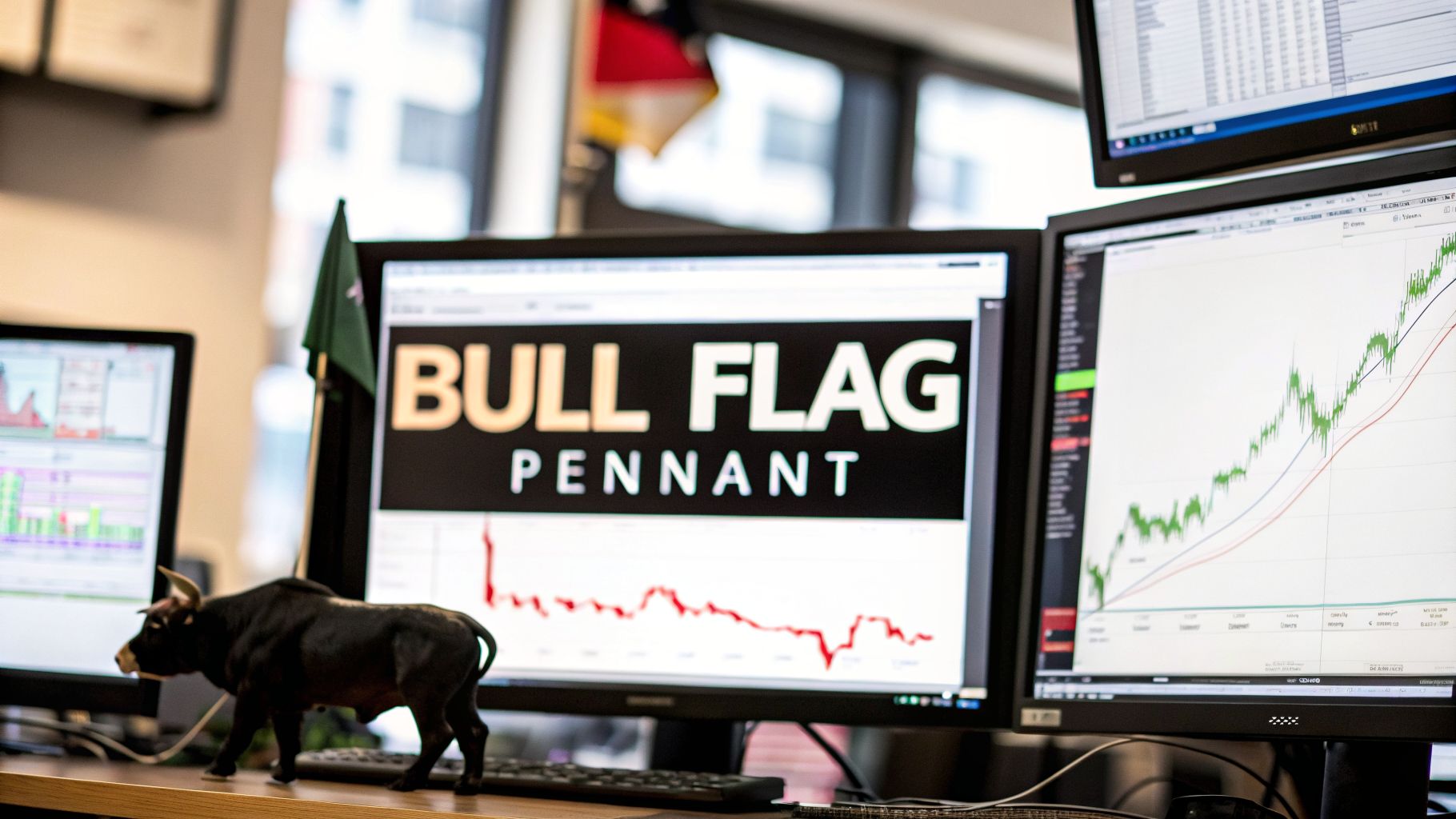
When you see a powerful, explosive move in a stock or currency pair, what often follows? A brief, quiet pause. This is exactly what a bull flag or a bull pennant is—the market catching its breath after a huge push upwards before it continues its climb.
For price action traders, these formations are classic bullish continuation patterns. They signal that the underlying strength is still there, and the upward momentum is likely to pick back up.
What Are Bullish Continuation Patterns?

Think of it like a long-distance race. A runner can't sprint the entire way. They need to slow down for a moment, take a few deep breaths, and gather energy for the next burst of speed. This is what a bull flag or a bull pennant looks like on a chart—a short consolidation after a big rally.
These are called "continuation" patterns because they suggest the original trend is just pausing, not reversing. They form when early buyers start to cash in and take profits, but new buyers are stepping in to absorb that selling pressure. This tug-of-war creates a temporary balance before the original buying force overwhelms the sellers and pushes the price higher again.
The Three Core Components
Every true bull flag and pennant is made of the same three building blocks. Learning to spot each one is the key to identifying a solid setup and, just as importantly, knowing when to stay away from a weak one.
- The Flagpole: This is the initial, powerful price surge that kicks everything off. It should be sharp and almost vertical. A strong flagpole shows real conviction from the buyers. If the flagpole is weak or short, the pattern probably isn't reliable.
- The Consolidation: This is the actual "flag" or "pennant" shape where the price action stalls and drifts sideways or slightly downwards. You'll often see volume dry up here, which is a great sign—it shows a lack of real selling conviction.
- The Breakout: This is the big moment. The price breaks cleanly above the upper trendline of the consolidation, signaling that the uptrend is back on. This move is usually powered by a big spike in volume as buyers rush back in.
That breakout is your green light. A common mistake is jumping in before the price actually closes above the pattern. Be patient—the pattern could just as easily fail and break down.
Quick Comparison of Flag and Pennant Structures
At a glance, flags and pennants look quite similar, and they both signal the same thing. But their small structural differences can give you subtle clues about what's happening under the surface.
To learn more about how these fit into a broader trading strategy, check out our guide to the best chart patterns for day trading.
Here’s a simple table to help you tell them apart.
| Characteristic | Bull Flag | Bull Pennant |
|---|---|---|
| Consolidation Shape | A rectangular channel | A small, symmetrical triangle |
| Trendlines | Parallel and downward-sloping | Converging |
| Market Psychology | Suggests orderly, controlled profit-taking | Implies a tightening coil of tension between buyers and sellers |
Understanding these nuances helps you read the market's mind. A flag shows a calm pause, while a pennant shows a build-up of tension before the next big move. Both are powerful tools in a price action trader's arsenal.
Bull Flag vs. Bull Pennant: Which One Can You Trust More?
On the surface, a bull flag and a bull pennant look like close cousins. Both signal that an uptrend is likely taking a breather before pushing higher, and to the untrained eye, the differences seem minor.
But for a price action trader, those subtle distinctions tell two very different stories about what’s happening under the hood. One pattern is a sign of a healthy, orderly market, while the other hints at a tense, coiled-up battle. Understanding this is key to knowing which one to put your money behind.
The bull flag, with its neat, parallel channel, suggests organized and controlled profit-taking. Think of it as a healthy pause. The initial buyers are cashing in some chips, but their selling is being calmly absorbed by new buyers who are confident in the trend. This creates a gentle, orderly drift sideways or slightly down.
A bull pennant, on the other hand, tells a story of rising tension. Its converging trendlines paint a picture of a market coiling up like a spring. Buyers and sellers are getting more aggressive as the price range tightens, squeezing the price into a smaller and smaller space. This "squeeze" can lead to an explosive move, sure, but it also carries a lot more uncertainty.
The Numbers Don't Lie
So, does this difference in market psychology actually matter for your trading results? Absolutely.
While both patterns have a place in a trader's toolkit, the historical data shows a clear winner in the reliability department. One is a solid A-grade setup, while the other is more of a B-minus that really needs some extra convincing before you should risk your capital.
Understanding the statistical edge of one pattern over another isn't just an academic exercise—it's a critical part of a professional trader's filtering process. It’s how you focus your capital on the highest-probability setups.
Historical analysis backs this up in a big way. One extensive analysis found the bull flag has a 67.13% success rate, which soundly beats the bullish pennant at just 54.87%. This data, pulled from major U.S. markets over a 25-year period, confirms that the flag’s more stable structure often leads to more dependable outcomes. You can dig deeper into these price action statistics and see how they were calculated.
Other studies add more color. A bull flag's failure rate is only around 10-15% in a strong uptrend. But, that number can easily double in weaker market conditions. And what’s the ultimate validator? Volume. A breakout on volume that is 150% of the recent average has a 70% chance of succeeding. This is exactly why experienced traders often consider the bull flag the superior, more conservative pattern.
Practical Takeaways for Your Trading
This statistical edge gives you a clear framework for how to handle each pattern. It’s not about writing off the bull pennant completely, but about understanding its limitations and adjusting your approach.
- For Bull Flags: Given their higher reliability, you can trade these patterns with more confidence when all the rules of your setup are met. They simply represent a more stable and predictable market structure.
- For Bull Pennants: These require a lot more caution. A success rate that’s barely better than a coin flip means you have to demand more confirmation. I’m talking about waiting for an undeniable volume spike on the breakout or looking for other signals on the chart that all point in the same direction.
At the end of the day, the bull flag’s parallel channel represents a more balanced and orderly pause in the market, and that translates directly to a higher statistical chance of continuation. The bull pennant, while still a valid pattern, reflects a more frantic coiling of energy that can just as easily snap in the wrong direction.
By prioritizing the higher-probability setup, you’re putting a statistical edge in your corner. And in trading, that's the only edge that matters.
Anatomy of a High-Probability Bull Pennant
While a bull flag often gives you a cleaner, more reliable setup, the bull pennant can still pack a serious punch—if you know exactly what to look for. The name of the game here is selectivity. You have to learn how to spot the textbook examples coiled for a breakout versus the weak look-alikes that are far more likely to fizzle out.
A high-probability bull pennant isn't just a random triangle on a chart; it tells a specific story about market psychology. It kicks off with an explosive move, pauses with coiled tension, and then resolves with a fresh wave of conviction. Developing a sharp eye for this anatomy is what separates the pros from the rookies chasing every potential pattern.
The Flagpole A Non-Negotiable Prerequisite
The entire pattern hangs on the strength of its flagpole. This initial, aggressive price surge is the most critical piece of the puzzle, since it signals the powerful buying momentum you want to jump on. No strong flagpole, no valid pattern. Simple as that.
A quality flagpole has a few distinct traits:
- Steep and Decisive: The move needs to be sharp, almost vertical. A slow, grinding climb just doesn't show the same level of buyer conviction.
- Significant Magnitude: Look for a move that's at least a 20-30% increase. This signals a sudden, powerful shift in market sentiment.
- Clear Impulse: It should be a clean, impulsive wave, not choppy, overlapping price action. That clarity tells you one side—the buyers—is firmly in charge.
The Pennant Dissecting the Consolidation
After the flagpole is in place, the market takes a breather and enters the consolidation phase—the pennant itself. This is where the tug-of-war between early profit-takers and new buyers creates a tightening price range. A healthy pennant has a very specific structure.
The two trendlines that form the pennant have to be converging, creating that classic symmetrical triangle shape. Ideally, you want to see the price touch each trendline multiple times, which confirms they are valid boundaries. To make sure you’re drawing these correctly, check out our detailed guide on how to draw trendlines.
Volume is the ultimate truth-teller during this phase. As the pennant forms, you should see volume steadily decline. This "drying up" of activity is a fantastic bullish sign, suggesting that sellers lack the conviction to push the price down in any meaningful way.
Understanding the Statistical Reality
It's absolutely critical to approach the bull pennant with a professional, data-driven mindset. While it’s a recognized pattern, its reliability is simply not as high as its cousin, the bull flag. This infographic gives you a stark visual comparison of their historical success rates.

The numbers don't lie. The bull flag is a statistically stronger pattern, which is why we have to be much stricter with our entry criteria when trading a bull pennant.
Looking at the data, the bull pennant has a success rate of around 54% for upside breakouts in a bull market. But that comes with a very significant 46% failure rate. This makes it a pattern that can easily trap inexperienced traders who jump the gun instead of waiting for confirmation. A disciplined approach focused on pure price action is essential to navigate these odds successfully.
Ultimately, a trader’s job isn't to predict, but to react to what the market is actually showing us. By mastering the anatomy of a high-probability bull pennant—a strong flagpole, a tight consolidation on declining volume, and a confirmed breakout—you learn to filter out the noise and focus only on the setups that give you a genuine edge.
Executing Your Trade: A Price Action Blueprint
Spotting a high-quality bull flag or pennant is a great skill, but it’s only half the battle. Honestly, a perfect pattern means nothing if you don't have a disciplined, repeatable plan to actually trade it. Price action trading is all about reacting to what the market is doing, not what you hope it will do.
This blueprint gives you a clear, mechanical process for entering, managing, and exiting a trade. No confusing indicators, no complex formulas—just a logical approach based on price itself. By defining your entry, stop-loss, and target before you even think about clicking the buy button, you replace emotion with a structured plan.
Pinpointing Your Entry Signal
The single biggest mistake I see traders make with these patterns is jumping in too early. Trying to front-run a breakout before it actually happens is a recipe for disaster. The pattern could just as easily fail and break to the downside. Patience here is your most valuable asset.
Your entry signal is a confirmed breakout. This isn't just the price poking its head above the upper trendline of the consolidation. A real signal is a strong, decisive candle closing firmly above that line. A long-bodied candle that closes near its high shows real conviction from the buyers.
Here’s a simple checklist to keep you honest:
- Identify the Pattern: You’ve found a strong flagpole followed by a clean flag or pennant.
- Draw the Trendline: Connect the highs of the consolidation with a clear trendline.
- Wait for the Break: Patiently watch for a candle to push through this line.
- Confirm the Close: This is the critical step. Do not enter until that candle closes above the trendline. This confirms the breakout has strength.
This simple act of waiting for a confirmed close filters out the vast majority of "fakeouts" and weak moves that quickly reverse. This disciplined approach is fundamental, and you can learn more about the mechanics in our guide explaining how to enter a trade properly.
Setting a Logical Stop-Loss
Every single trade you take needs a clearly defined exit point in case you're wrong. A stop-loss isn't a sign of failure; it’s a professional tool for preserving your capital. With a bull flag or pennant, price action gives us a very logical place to set our stop.
The most common and effective spot for a stop-loss is just below the lowest point of the consolidation. This area represents the most recent swing low where buyers previously stepped in and showed support. If the price breaks the upper trendline but then reverses and falls below this low, the pattern's bullish structure is officially invalidated.
By placing your stop-loss below the consolidation low, you give the trade room to breathe while clearly defining the exact point at which your trade idea is proven wrong.
This method keeps your risk contained to a small, calculated amount relative to the pattern itself. The rule is simple: if the low of the flag or pennant is violated, the bullish thesis is broken, and it's time to get out with a minimal loss.
Calculating Your Profit Target
Just as you need a plan for when you're wrong, you need one for when you're right. A common way to set a realistic profit target for a bull flag or pennant is the measured move technique. This approach uses the pattern's own structure to project a logical price objective.
The process is straightforward:
- Measure the Flagpole: Calculate the distance in price from the start of the flagpole (the initial swing low) to its peak (the high point just before the consolidation began).
- Project from the Breakout: Take that same distance and add it to the low of the consolidation area. This projection gives you your calculated price target.
For example, if a stock rallies from $50 to $60 (a $10 flagpole) and then consolidates before breaking out from a low of $58, your target would be $68 ($58 + $10). This technique provides a data-driven target based on the initial momentum, helping you avoid greedy decisions and lock in profits systematically.
Real-World Chart Examples and Analysis

Moving from theory to the live charts is where a trader’s real skill is built. It's one thing to see a perfect diagram in a book, but it's another thing entirely to spot these patterns in the wild. Analyzing historical charts trains your eyes to see the subtle clues that separate a high-probability setup from a costly trap.
Let's break down some real-world examples. We'll look at what made certain patterns work beautifully while others fell flat. This case-study approach is how you develop the gut feeling and intuition needed to trade price action successfully.
Case Study 1: The Textbook Bull Flag Success
Our first chart shows a classic bull flag that did exactly what it was supposed to do—it led to a powerful continuation move. This setup had all the right ingredients, making it a perfect model to study.
First, look at that flagpole. It was a sharp, almost vertical rally, showing intense buying pressure and real conviction. This was followed by a shallow, orderly consolidation that formed a perfect downward-sloping channel (the flag). Most importantly, volume dried up completely during this consolidation. That told us sellers had no power to push the price down.
The breakout was the final piece of the puzzle. A large, bullish candle closed decisively above the flag's upper trendline, and it was accompanied by a massive spike in volume. This was the signal that buyers were back in control, ready to drive the price higher.
Case Study 2: The Failed Bull Pennant
Now, let’s look at a bull pennant that failed. Dissecting these failures is just as important as studying the wins because it teaches you which red flags to watch for.
In this case, the flagpole was weak and choppy. It lacked the explosive momentum you want to see. The pennant that followed was sloppy and poorly defined, with erratic price action instead of a tight, coiling consolidation. A clean pattern reflects clear market psychology; a messy one suggests confusion.
But the biggest warning sign was the breakout attempt itself. Price did poke above the upper trendline, but it happened on very low volume. This lack of participation from buyers showed there was zero conviction behind the move. Unsurprisingly, the breakout fizzled out, and the price reversed, trapping anyone who jumped in too early.
A breakout without a significant increase in volume is like a car trying to accelerate without fuel. It might lurch forward for a moment, but it lacks the power for a sustained move.
Are These Patterns Still Relevant Today?
Absolutely. Even in today's fast-moving, volatile markets, the bull flag pennant remains a consistently reliable pattern. Why? Because these formations reflect timeless market psychology, and they appear across all asset classes and timeframes.
For instance, recent stock scans showed live bullish pennant setups in major global tickers. Vodafone (VOD) formed a 1-week pennant after a sector rally, while Moog Inc. (MOG-A) showed a similar pattern over two weeks. These examples prove that while markets change, the human behaviors that create these patterns don't. You can see more examples of how live pennant patterns are identified and tracked on stockmarketguides.com.
Key Takeaways from Chart Analysis
By comparing these examples, a clear checklist emerges. A winning pattern almost always has these characteristics, while a failed one is usually missing at least one.
- A Strong Flagpole: The initial move must be sharp and decisive. This is non-negotiable.
- Clean Consolidation: The flag or pennant should be well-defined and orderly, not messy.
- Declining Volume: Volume must taper off during the consolidation, showing a lack of selling interest.
- A Confirmed Breakout: Price has to close decisively above the pattern on a spike in volume.
If you ignore any of these elements, you dramatically lower the odds of a successful trade. Your job as a price action trader isn't to force a pattern to fit what you want to see. It's to wait patiently for all these conditions to align perfectly.
Burning Questions on Bull Flags and Pennants
Even when you know the textbook definition of a pattern, a lot of questions pop up when you're staring at a live chart. Trading a bull flag pennant isn't just about spotting the shape; it's about having the conviction to act when the time is right.
This section cuts through the noise and answers the most common questions I hear from traders. Let's clear up the confusion so you can trade these patterns like a pro.
What’s the Minimum Length for a Flagpole?
There isn't a single magic number, but let's be clear: the flagpole is the engine of this entire setup. It's the initial blast of buying pressure you're looking to ride. A weak flagpole almost always leads to a failed pattern.
As a solid rule of thumb, I look for a sharp, almost vertical surge of at least 20-30% before the consolidation begins. This isn't just a random figure; it’s a sign of real market enthusiasm. A flagpole that’s choppy, slow, or short just doesn’t have that urgency. Think of it like a sprinter's start—without that explosive first step, the race is already lost.
How Does Trading Volume Confirm a Breakout?
Volume is your lie detector. It tells you if the big money is behind a move or if it's just a bit of market noise. For a high-quality bull flag or pennant, volume gives you two crucial clues.
First, as the flag or pennant forms, you want to see volume dry up. This is an incredibly bullish sign. It means sellers are losing steam and the pause in the trend is just that—a healthy pause.
The real moment of truth, though, is the breakout itself. You absolutely must see a big spike in volume as price closes above the pattern's upper trendline. I’m looking for a surge of 1.5 to 2 times the recent average volume. This is your confirmation that buyers are back in force and ready to drive the price higher.
Can These Patterns Appear on Any Timeframe?
Yes, absolutely. The great thing about pure price action patterns like these is that they are fractal. This means the market psychology they represent—a strong move followed by a brief rest—happens on every single timeframe.
You can find and trade a bull flag on a 5-minute chart for a quick scalp, a 4-hour chart for a swing trade, or even a weekly chart for a longer-term position.
The core rules never change, no matter the chart:
- Find a powerful flagpole.
- Spot a clean consolidation with fading volume.
- Wait for a breakout confirmed by a surge in volume.
The only things that change are how long the pattern takes to play out and the size of the price target, which will always be relative to the timeframe you're trading.
What Is the Biggest Mistake Traders Make?
Hands down, the most common and costly mistake is jumping the gun. So many traders get anxious, scared of missing the move, and enter while the price is still chopping around inside the flag. They're trying to predict the breakout, not react to it.
This is just a low-probability gamble. The pattern could just as easily break down and hit your stop. A professional trader understands their job is to react to what the market does, not what they think it will do.
Always, always wait for confirmation. That means seeing a strong candle close decisively above the upper trendline, ideally with that spike in volume we talked about. Patience is what separates the amateurs from the pros. It’s much better to miss the first few ticks of a move and enter a confirmed trade than it is to guess early and take a completely unnecessary loss.
At Colibri Trader, we teach traders how to build real confidence by focusing on high-probability price action setups, just like these. If you're tired of guessing and want to start trading with a clear, repeatable strategy, check out our programs at https://www.colibritrader.com.