

The 12 Best Trading Platforms for Day Traders in 2025

In the high-stakes environment of day trading, your platform is your most critical tool. It's the cockpit from which you navigate market volatility, and its performance directly impacts your profitability. A platform with slow execution, high fees, or clunky charting can erode your edge, turning potential gains into frustrating losses. This is why selecting from the best trading platforms for day traders is not a trivial decision; it's a foundational step toward consistent success.
This guide cuts through the marketing fluff to provide a comprehensive, actionable analysis of the top platforms available today. We dive deep into the specific features that active traders rely on, such as order execution speed, direct market access, advanced charting tools, and competitive commission structures. For traders focused on price-action, having a platform that is both powerful and intuitive is non-negotiable.
We’ve done the heavy lifting to help you find the perfect match for your strategy, whether you're a novice learning the ropes or a seasoned professional executing complex trades. Each review includes a detailed breakdown of pros, cons, and "best-for" scenarios, complete with screenshots and direct links to get you started. Remember, your software is just one part of the equation. Your physical environment is also crucial for maintaining focus and efficiency during long market hours. To that end, creating an optimal dual monitor setup for day trading can significantly enhance your workflow and reduce physical strain, allowing you to concentrate fully on the charts. Let's find the platform that will become your trusted partner in the markets.
1. Interactive Brokers (IBKR)
Interactive Brokers, often known as IBKR, is a powerhouse in the brokerage world and consistently ranks as one of the best trading platforms for day traders who demand institutional-grade tools and direct market access. It is the go-to choice for serious, active traders due to its sophisticated technology, global reach, and exceptionally low costs. The platform's core strength lies in its powerful Trader Workstation (TWS), a desktop application packed with advanced charting, order types, and algorithmic trading capabilities.
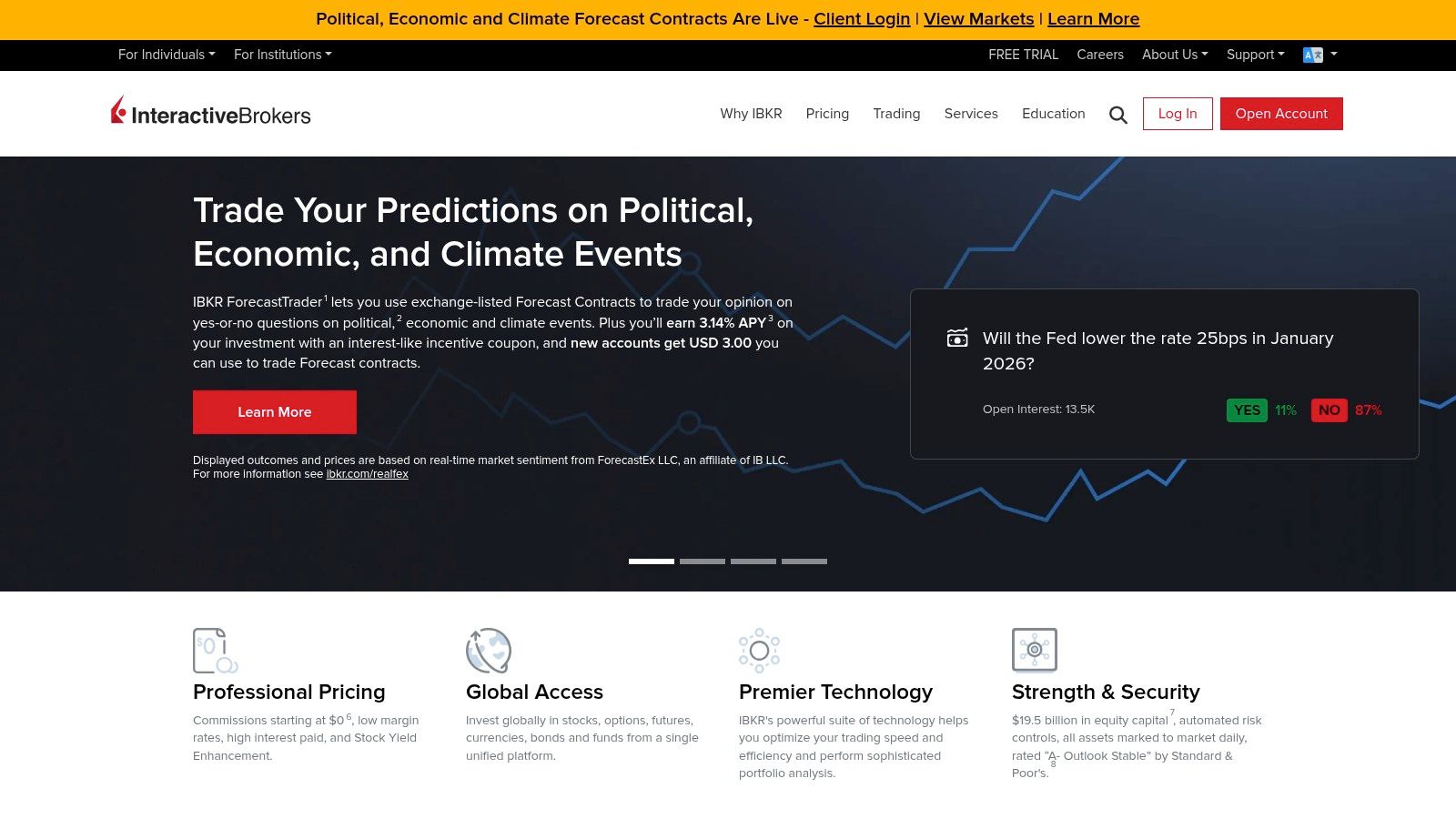
IBKR’s proprietary IB SmartRouting technology is a key differentiator, designed to find the best possible price execution by scanning competing market centers. This focus on execution quality, combined with some of the lowest margin rates and commissions in the industry, can significantly impact a day trader's bottom line. For those just beginning their journey, you can learn how to start day trading and then leverage IBKR's paper trading account to master the platform before committing real capital.
Key Features and Pricing
- Pricing Model: IBKR offers two main commission structures: Tiered and Fixed. The Tiered plan is ideal for high-volume traders, with stock commissions starting as low as $0.0035 per share, plus exchange and regulatory fees. The Fixed plan provides a simple, flat rate of $0.005 per share ($1 minimum).
- Trader Workstation (TWS): This is IBKR's flagship platform, offering comprehensive charting, hundreds of order types (including complex algorithmic orders), and customizable layouts. It has a steep learning curve but is unrivaled in its power.
- Global Access: Provides access to over 160 market centers in 34 countries, allowing traders to engage with stocks, options, futures, and forex from a single account.
Pros:
- Superior execution quality with IB SmartRouting
- Industry-leading low commissions and margin rates
- Extensive access to global markets and financial instruments
Cons:
- Trader Workstation (TWS) can be complex and intimidating for beginners
- The data fee structure can be confusing to navigate
Website: https://www.interactivebrokers.com
2. Charles Schwab (thinkorswim)
Following its acquisition of TD Ameritrade, Charles Schwab now offers the legendary thinkorswim platform, a top-tier choice that solidifies its spot among the best trading platforms for day traders. This comprehensive suite is renowned for its institutional-grade charting capabilities, advanced order types, and in-depth analysis tools, making it a favorite for technical traders and options specialists. The platform's powerful desktop version provides an unmatched level of customization for analyzing price action and market data.
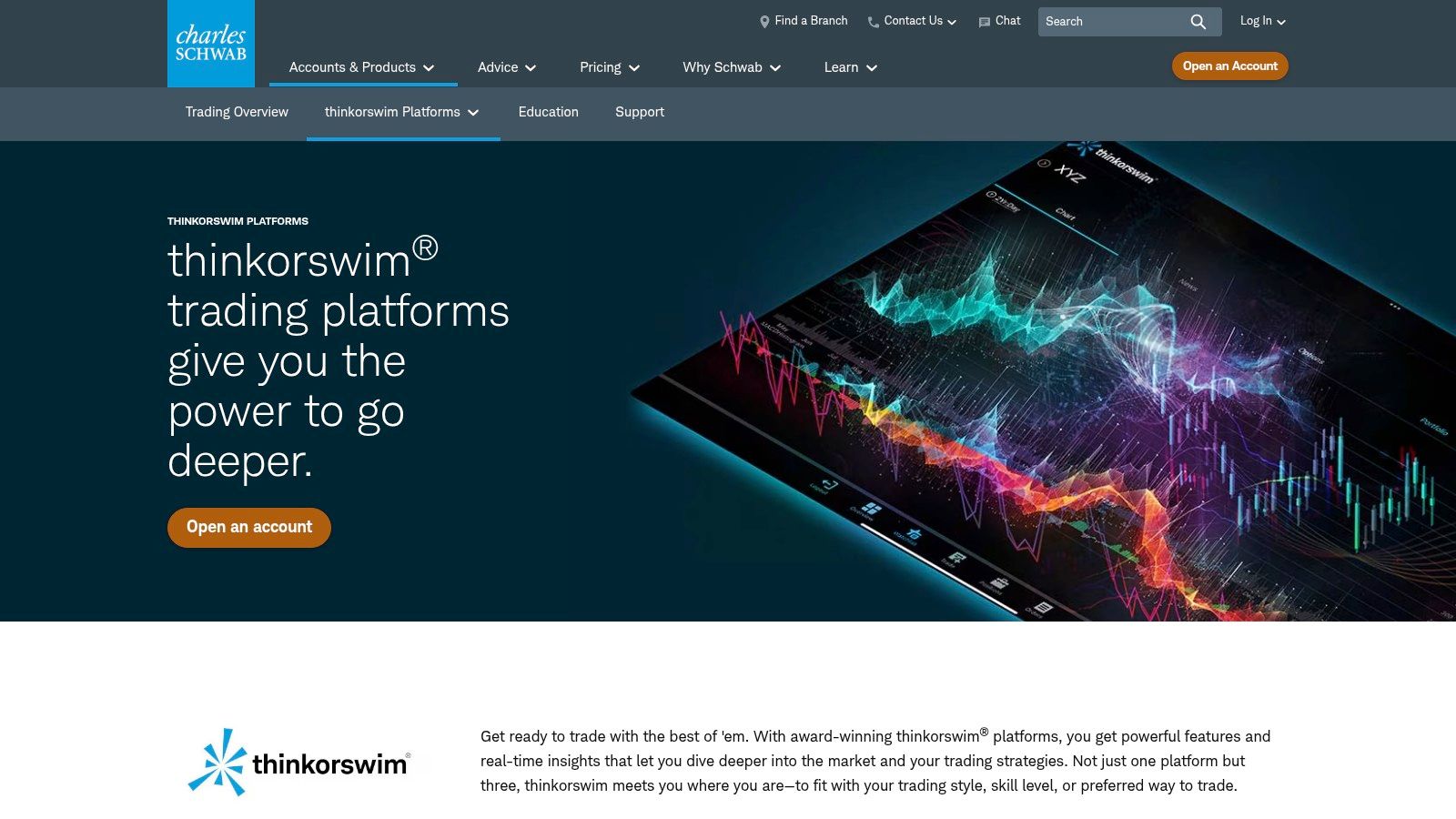
The thinkorswim ecosystem excels in providing everything a day trader needs within a single interface, from integrated news feeds to sophisticated options strategies. A key feature for both new and experienced traders is the paperMoney simulator, which allows for risk-free practice using real-time market data. This is an excellent way to master the platform's robust charting tools; you can learn how to read market charts effectively and then apply that knowledge in a simulated environment before risking capital.
Key Features and Pricing
- Pricing Model: Charles Schwab offers a straightforward pricing structure with $0 commissions for online U.S. stock, ETF, and options trades. Options contracts have a standard fee of $0.65 per contract.
- thinkorswim Platform: Available on desktop, web, and mobile, this platform is the main draw. It offers elite-level charting with hundreds of technical studies, complex order types (like conditional orders), and powerful market scanning tools.
- paperMoney Simulator: A highly realistic virtual trading account that mirrors the live platform, perfect for testing strategies, learning the software, and building confidence without financial risk.
Pros:
- Widely praised professional-grade desktop platform
- Rich studies, conditional orders, and strong educational resources
- Good customer support for active traders
Cons:
- Heavier platform that can be complex and resource-intensive
- Not the simplest choice for first-time traders
Website: https://www.schwab.com/trading/thinkorswim
3. TradeStation
TradeStation has earned its place among the best trading platforms for day traders by offering a powerful, professional-grade desktop platform tailored for active and systematic traders. It is particularly renowned for its advanced tools, including the RadarScreen scanner and the proprietary EasyLanguage scripting language, which allows traders to build, backtest, and automate their custom trading strategies without needing complex programming skills. This makes it a top choice for traders who rely on data-driven analysis and automation.
The platform's strength lies in its comprehensive feature set, combining robust charting, rapid order execution, and sophisticated analysis tools like OptionStation Pro. While its powerful features are a significant draw, traders must be mindful of their strategy's risk parameters. Implementing best practices for risk management is crucial when using TradeStation's advanced automation and leverage capabilities to protect trading capital.
Key Features and Pricing
- Pricing Model: TradeStation offers several commission plans. For equities, the TS SELECT plan offers commission-free trades. The TS GO plan is also commission-free but has fewer features. For active futures traders, pricing can be as low as $0.25 per contract with a tiered structure.
- EasyLanguage: This is TradeStation's signature feature, an easy-to-learn programming language that lets traders design custom indicators and automated trading strategies. The platform comes with thousands of built-in strategies and indicators.
- RadarScreen and OptionStation Pro: RadarScreen is a real-time market scanner that can monitor up to 1,000 symbols based on custom criteria. OptionStation Pro provides advanced options analysis, including strategy optimization and probability cones.
Pros:
- Advanced scanning, backtesting, and automation at scale with EasyLanguage
- Powerful, institutional-grade desktop platform
- Competitive futures pricing tiers for active traders
Cons:
- Inactivity or account service fees can apply on some commission plans
- Platform subscription fees if used without a brokerage account
Website: https://www.tradestation.com
4. tastytrade
tastytrade, formerly known as tastyworks, has carved out a significant niche as one of the best trading platforms for day traders who specialize in options. Built by experienced traders, its platforms are engineered for speed, efficiency, and the unique workflow of derivatives trading. The brokerage champions a transparent and highly competitive commission structure, particularly for high-volume options traders, making it a compelling choice for those active in the options market.
The platform's design is intuitive yet powerful, focusing on visual tools that help traders quickly analyze potential profit and loss, implied volatility, and probability of profit. This options-first approach is evident across its desktop, web, and mobile applications, ensuring a consistent and streamlined experience. While it also supports stocks, ETFs, futures, and crypto, its core strength and standout features are unequivocally tailored to the options and futures trading community.
Key Features and Pricing
- Pricing Model: tastytrade's pricing is a major draw. For options, it charges $1 per contract to open and $0 to close, with a cap of $10 per leg. This structure is extremely cost-effective for traders executing multi-leg strategies or scaling in and out of positions. Stock trades are commission-free.
- Trader-Focused Platforms: The desktop, web, and mobile platforms are fast and packed with tools designed for active traders, including curve analysis, customizable watchlists, and quick-roll features for options positions.
- Extensive Education: The platform is backed by the tastytrade financial network, offering a massive library of educational content, research, and live programming aimed at retail traders.
Pros:
- Highly competitive, capped commission structure for options traders
- Platforms are purpose-built for speed and options trading workflow
- Strong educational content and an active trading community
Cons:
- Charting tools are less advanced compared to stock-focused platforms
- Fewer third-party software integrations than some larger brokers
Website: https://tastytrade.com
5. Lightspeed
Lightspeed is a direct-market-access (DMA) brokerage built from the ground up for serious, high-volume day traders who prioritize execution speed and reliability above all else. It is specifically designed for professionals who need ultra-fast order routing, extensive customization, and a robust infrastructure that performs under heavy load. The platform is not for casual investors; it's a specialized tool for traders whose strategies depend on shaving milliseconds off their execution times.
The core offering revolves around its flagship Lightspeed Trader platform, known for its stability and customizable hotkey-driven workflows that allow for rapid-fire trade entries and exits. Traders get granular control over order routing, enabling them to direct orders to specific exchanges or ECNs to seek out liquidity or minimize costs. This level of control is a critical feature for advanced day trading strategies, making it a staple among the best trading platforms for day traders who operate at a professional level.
Key Features and Pricing
- Pricing Model: Lightspeed offers both per-share and per-trade commission schedules. Per-share rates start at $0.0045 and decrease with higher monthly volume. Per-trade pricing is a flat $4.50 for stocks and ETFs. Active traders can also qualify for platform fee rebates.
- Pro-Level Platforms: In addition to the flagship Lightspeed Trader, the brokerage offers access to other institutional-grade platforms like Sterling Trader Pro and Eze EMS (formerly RealTick), catering to different professional needs.
- Direct Market Access (DMA): Provides traders with direct, low-latency connections to major exchanges and ECNs, offering superior control over order execution and routing.
- Customizable Hotkeys: Extensive hotkey configuration allows for near-instantaneous order placement, modification, and cancellation without using a mouse, a crucial feature for scalpers and momentum traders.
Pros:
- Exceptional execution speed and platform reliability under heavy trading volume
- Granular control over order routing to specific market centers
- Aggressive volume-based discounts for highly active traders
Cons:
- Platform and market data fees can be expensive for those who don't meet volume thresholds
- The platform's features and complexity are often overkill for casual or low-volume traders
Website: https://lightspeed.com
6. CenterPoint Securities
CenterPoint Securities is a specialized brokerage firm designed for professional and highly active day traders. It caters to those who require sophisticated tools, direct market access, and robust short-selling capabilities. The platform distinguishes itself by offering access to elite trading software like DAS Trader Pro and Sterling, providing the speed and routing control necessary for executing complex, high-frequency strategies. It is an ideal choice for traders who prioritize execution quality and need access to hard-to-borrow stocks for shorting.
The firm's focus is less on a retail-friendly interface and more on providing the raw power and infrastructure that microstructure-savvy traders demand. Its pricing model is built to reward high volume, making it one of the best trading platforms for day traders who operate at a professional level. The ability to locate and borrow hard-to-find shares for shorting is a significant advantage that sets CenterPoint apart from many mass-market brokers, giving traders an edge in bearish market conditions.
Key Features and Pricing
- Pricing Model: Offers a competitive per-share commission structure that becomes progressively cheaper with higher trading volumes. This model is highly beneficial for scalpers and other high-frequency traders.
- Platform Access: Provides access to third-party professional platforms, including DAS Trader Pro and Sterling Trader Pro, known for their speed, advanced charting, and Level 2 data integration.
- Short-Locate Service: Features a dedicated stock-locate desk and automated tools to help traders find and borrow hard-to-borrow (HTB) securities for short selling, a critical tool for many day trading strategies.
Pros:
- Excellent execution quality with advanced order routing control
- Superior access to hard-to-borrow stocks for shorting
- Platform and data fee waivers available for high-volume traders
Cons:
- Not commission-free; platform and data fees can be costly for infrequent traders
- The website and overall feel are less oriented toward beginner or retail investors
Website: https://centerpointsecurities.com
7. Cobra Trading
Cobra Trading is a direct-access broker built specifically for serious, high-volume day traders who prioritize execution speed and advanced order routing. It caters to a professional clientele, offering elite platforms like DAS Trader Pro and Sterling Trader Pro, which are known for their speed, stability, and Level 2 data. The firm distinguishes itself with a focus on personalized service, including a dedicated support desk and robust short-selling capabilities.
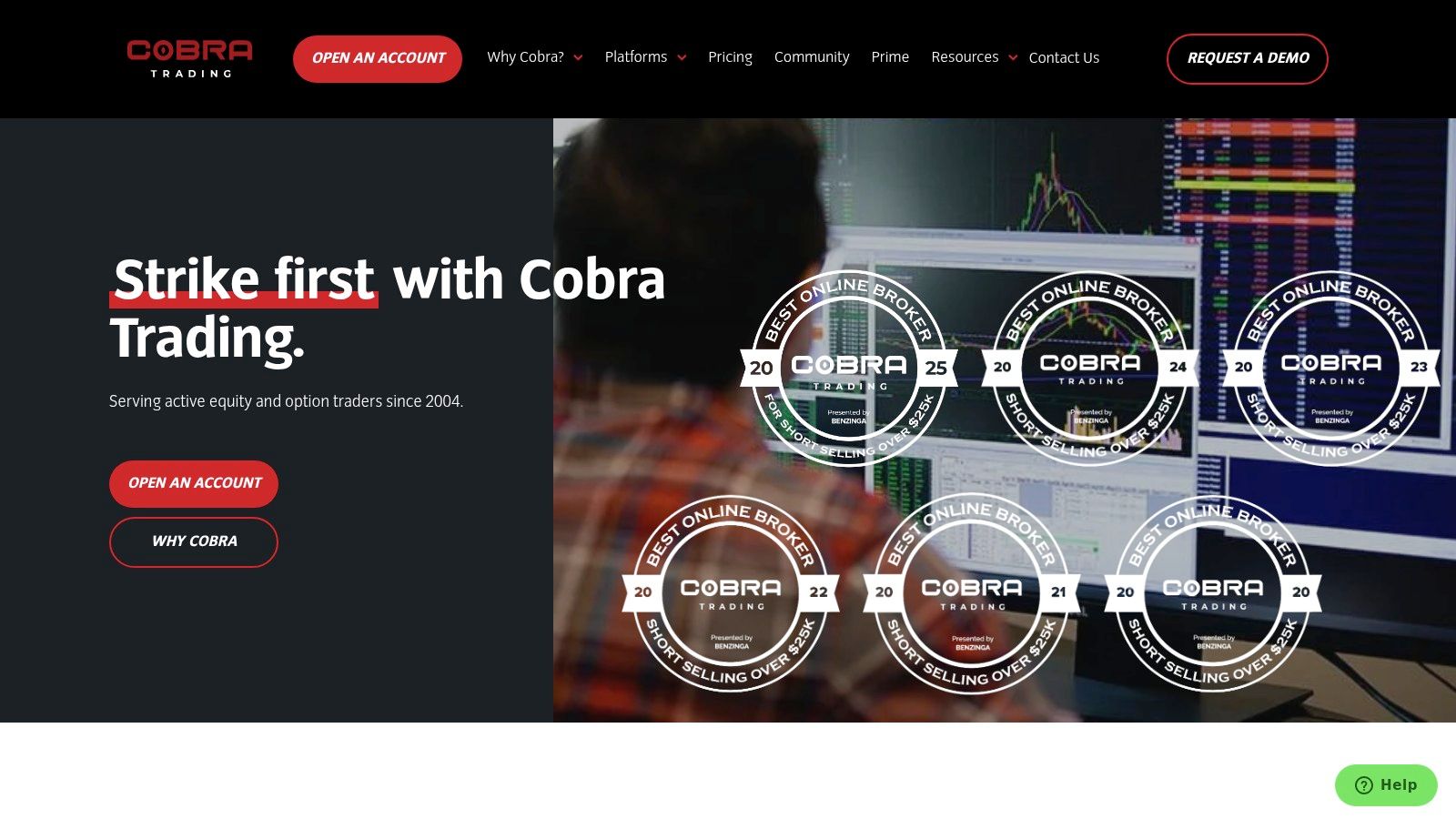
The primary advantage of Cobra Trading is its exceptional locate service for shorting hard-to-borrow (HTB) stocks, a critical tool for many short-biased day traders. This, combined with its transparent, pass-through fee structure, makes it one of the best trading platforms for day traders who operate with sophisticated strategies. While not geared toward beginners due to its higher account minimums and professional-grade tools, experienced traders will find the direct market access and tailored support invaluable.
Key Features and Pricing
- Pricing Model: Offers competitive, volume-tiered commission plans. Equity commissions start at $0.0035 per share and decrease with higher trading volume. Options are priced per contract, also with volume discounts available.
- Platform Options: Provides access to industry-standard, direct-access platforms, including DAS Trader Pro, Sterling Trader Pro, and Cobra TraderPro, each offering advanced charting, hotkeys, and multi-route order entry.
- HTB Short Locates: Features a dedicated locate desk and multiple clearing firms, providing an extensive inventory for shorting hard-to-borrow securities.
- Personalized Support: Known for its high-touch customer service, giving traders direct access to a knowledgeable support team for platform and trading-related issues.
Pros:
- Excellent access to hard-to-borrow inventory for short selling
- Direct-access routing with professional-grade trading platforms
- Competitive, volume-based commission structure
Cons:
- High account minimums ($25,000 for US, $30,000 for non-US)
- Platform and data fees can be expensive
- Not suitable for new or infrequent traders
Website: https://www.cobratrading.com
8. Webull
Webull has emerged as a major contender among the best trading platforms for day traders, especially for those who are newer to the market or prioritize a modern, user-friendly interface. It successfully bridges the gap between basic, mobile-first apps and more complex legacy brokers by offering a feature-rich desktop and mobile platform without commission fees on stocks, ETFs, and options. Its low-friction onboarding and clean design make it an accessible entry point for active traders.
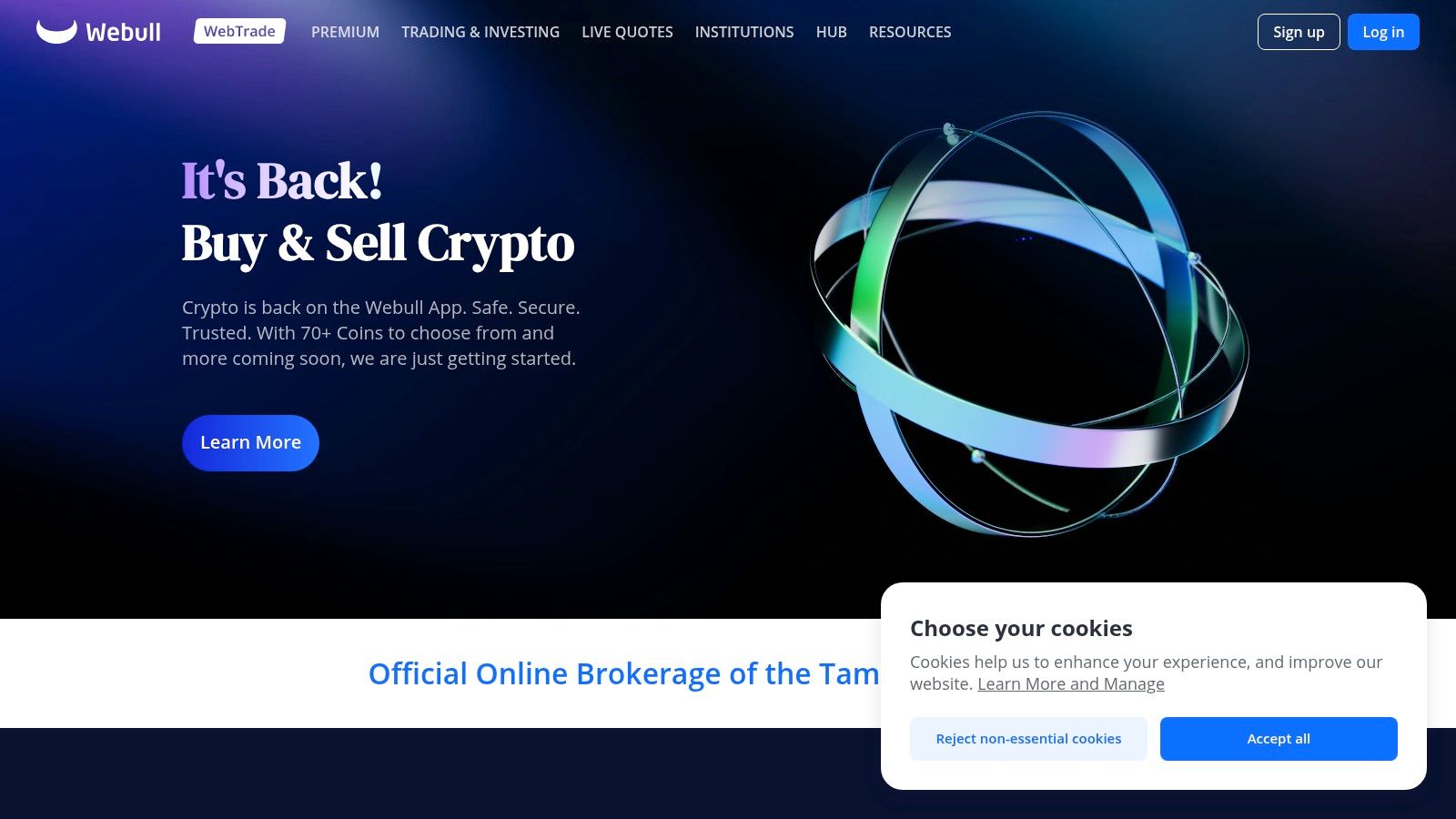
The platform's strength lies in its balance of cost-effectiveness and capable tooling. While it may not offer the direct market access of a professional-grade broker, it provides robust charting, technical indicators, and a valuable paper trading mode for practicing strategies without risk. The transparent margin rate schedule and clear short-borrow fee disclosures are also beneficial for traders looking to employ more advanced tactics. This combination makes Webull a powerful and economical choice for the developing day trader.
Key Features and Pricing
- Pricing Model: Webull offers commission-free trading for U.S. stocks, ETFs, and options. Note that regulatory and exchange fees still apply. Margin rates are competitive and tiered based on account balance.
- Desktop and Mobile Platforms: Provides seamless, full-featured trading experiences across its desktop application, web browser, and mobile app, all equipped with a paper trading simulator.
- Advanced Data: While basic data is free, traders can subscribe to Level 2 market data (Nasdaq TotalView) for deeper market insight, which is a common requirement for serious day trading.
- Community Features: Includes a social component where users can share insights and commentary on specific stocks, fostering an active community environment.
Pros:
- Low barrier to entry with $0 commissions on core trading products
- Modern, intuitive interface on both desktop and mobile
- Free paper trading account for strategy testing and practice
Cons:
- Lacks the professional-grade order routing controls of DMA brokers
- Deeper market data required for serious day trading comes with a subscription fee
Website: https://www.webull.com
9. NinjaTrader
NinjaTrader has carved out a niche as one of the best trading platforms for day traders specializing in futures markets. It combines a high-performance desktop platform with its own brokerage services, creating an integrated ecosystem for active futures traders, from scalpers to swing traders. Its core strength lies in its advanced charting, order-flow analysis, and sophisticated tools like Market Replay, which allow traders to practice strategies using historical tick data.
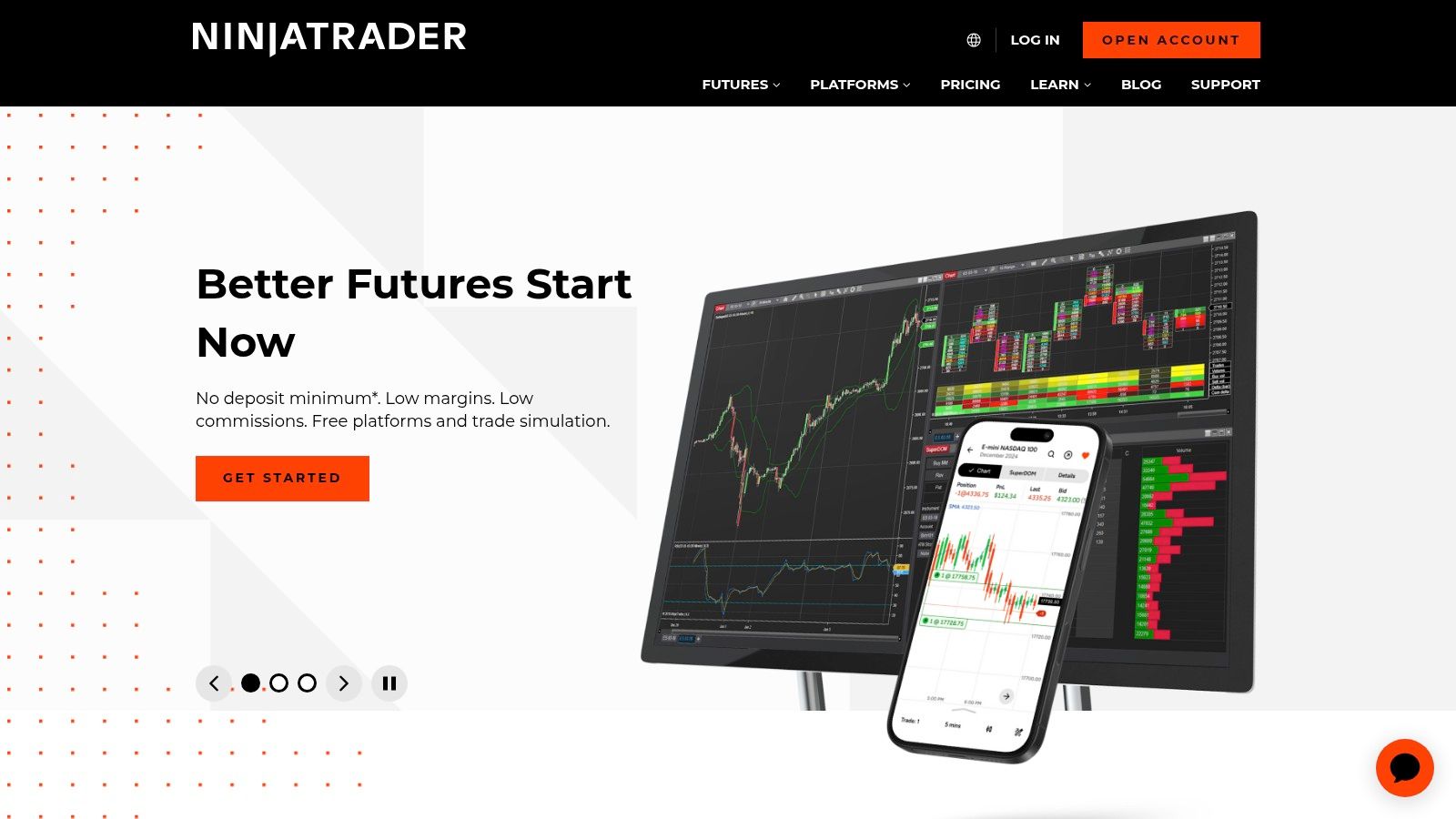
The platform is renowned for its low intraday margins on futures contracts, enabling traders to control larger positions with less capital. This, combined with its highly customizable Depth of Market (DOM) interface and hotkey-driven workflows, makes it a top choice for those who rely on speed and precision. The platform's extensive support for third-party add-ons and automated strategy development via NinjaScript further enhances its appeal to serious traders seeking a tailored experience.
Key Features and Pricing
- Pricing Model: NinjaTrader offers flexible licensing options. The Free plan includes standard features but has higher commissions. Paid options include a Monthly Lease or a Lifetime License, which unlock premium features and significantly lower commission rates, rewarding high-volume traders.
- Futures-Focused Tools: Offers advanced charting with Order Flow+ tools, a powerful Market Replay simulator, and a customizable DOM designed for rapid order entry and management.
- Low Day-Trade Margins: Provides exceptionally low intraday margins for popular futures contracts, such as $50 for Micro E-mini contracts, maximizing capital efficiency for day traders.
- Extensibility: Supports a vast ecosystem of third-party indicators and automated strategies, along with C#-based NinjaScript for custom development.
Pros:
- Very low intraday margins and scalable commissions for active futures traders
- Advanced charting, order-flow analytics, and powerful trade simulation tools
- Highly customizable with extensive support for third-party add-ons and APIs
Cons:
- Exchange, clearing, and market data fees can add up and be complex
- The free plan includes an inactivity fee if no trades are placed within a 30-day period
Website: https://ninjatrader.com
10. TradingView
TradingView has become the definitive charting and social networking platform for traders worldwide, earning its spot as one of the best trading platforms for day traders focused on technical analysis. While not a direct broker, its strength lies in providing best-in-class, web-based charting tools that are fast, intuitive, and highly customizable. The platform’s Pine Script language allows traders to create, share, and use an endless library of custom indicators and strategies developed by its massive community.
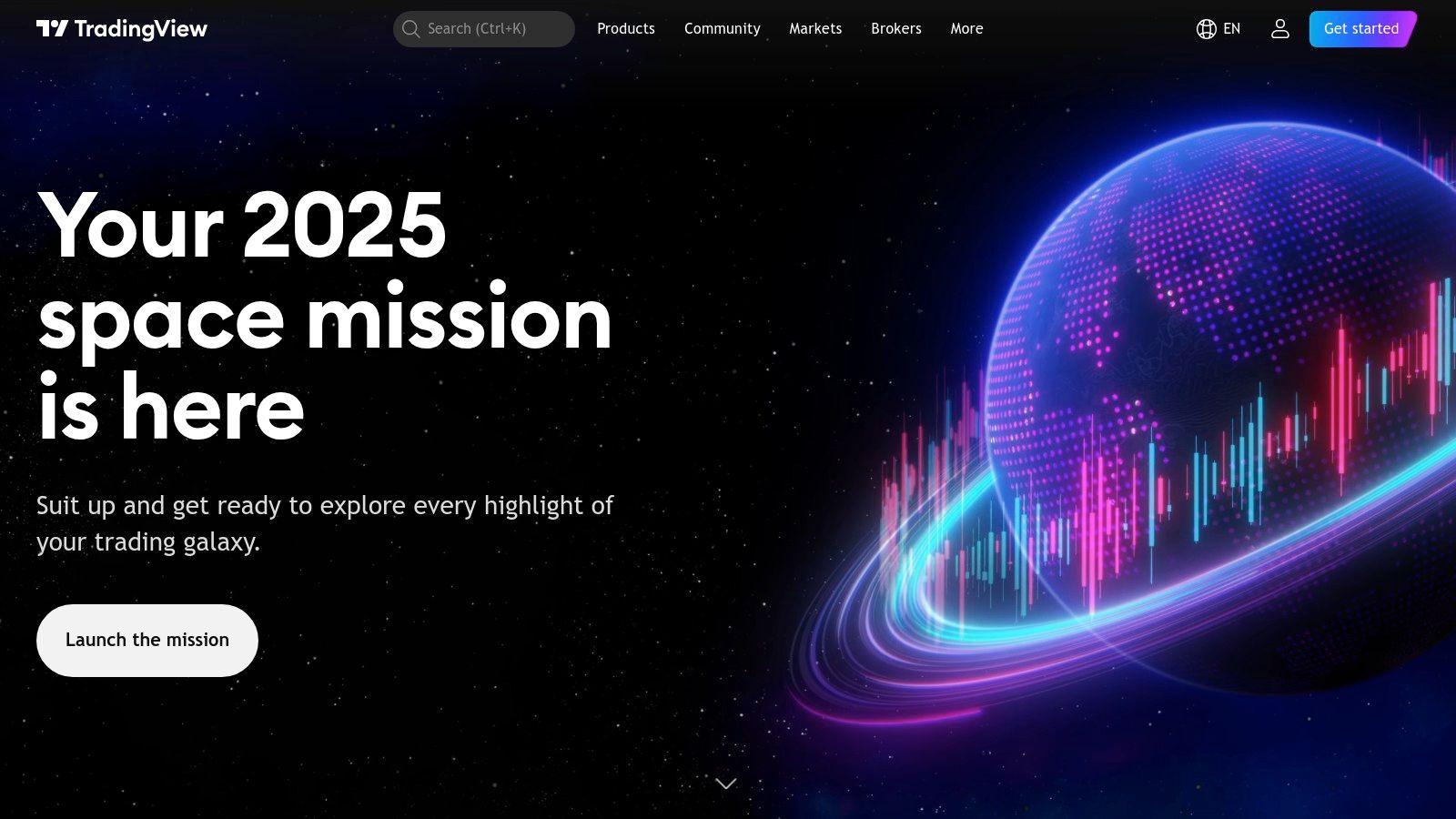
The platform's core appeal is its seamless combination of powerful charting, robust screening tools, and a collaborative environment where traders share ideas and scripts. It integrates with numerous popular brokers, allowing users to place trades directly from its charts, thus bridging the gap between analysis and execution. For those interested in the underlying capabilities and potential of platforms like this, exploring a TradingView demo web application can provide valuable insight into its powerful architecture.
Key Features and Pricing
- Pricing Model: TradingView operates on a freemium model. The Basic plan is free with ads and limited features. Paid plans (Pro, Pro+, and Premium) start at around $14.95 per month and offer multi-chart layouts, more indicators per chart, and server-side alerts. Real-time exchange data often requires separate monthly subscriptions.
- Advanced Charting: Features hundreds of pre-built indicators, drawing tools, and the proprietary Pine Script language for building custom technical analysis tools. The charts are known for being exceptionally smooth and responsive.
- Broker Integration: Connect your account from supported brokers like TradeStation, Interactive Brokers, and others to execute trades directly from the TradingView interface.
Pros:
- Superior web-based charting technology with extensive customization
- Massive library of community-generated scripts and trading ideas
- Scales from a powerful free version to professional-grade tiers
Cons:
- Real-time data for most exchanges is a paid add-on
- Trading functionality is entirely dependent on the integrated third-party broker
Website: https://www.tradingview.com
11. FOREX.com (U.S.)
As a dedicated forex broker regulated in the U.S., FOREX.com is a specialized and powerful choice for day traders who focus exclusively on currency markets. Its strength lies in providing a focused, high-performance environment with transparent execution metrics and flexible pricing structures designed to suit different trading volumes and styles. The platform caters to both discretionary and automated traders by offering its proprietary Advanced Trading Platform alongside the universally popular MetaTrader 4 and 5.
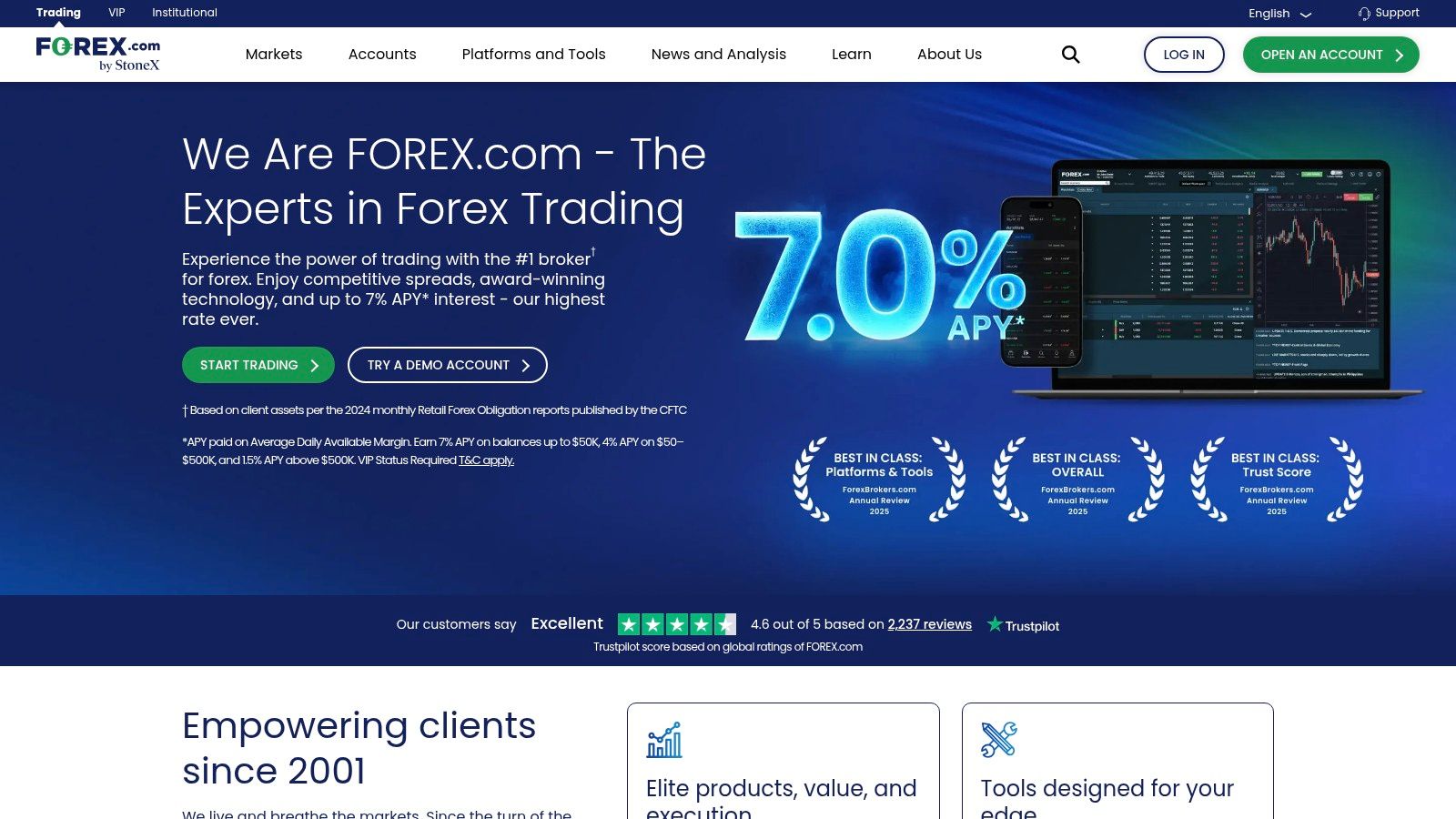
What sets FOREX.com apart is its commitment to transparent pricing and execution quality, publishing its typical and as-low-as spread data. This allows day traders to accurately assess potential trading costs. Additionally, the platform’s active trader program offers cash rebates and other benefits, directly rewarding high-volume traders by reducing their overall expenses, making it one of the best trading platforms for day traders specializing in forex.
Key Features and Pricing
- Pricing Model: Offers two clear pricing accounts. The Standard account is commission-free with costs built into the spread, ideal for simplicity. The RAW Pricing account provides access to tighter spreads (as low as 0.0 pips) combined with a competitive commission, which is better suited for high-frequency strategies.
- Platform Choice: Supports its own robust web and desktop platforms, featuring advanced charting tools and integrated analysis, as well as the full MetaTrader suite (MT4 and MT5) for those who prefer its interface or use expert advisors (EAs).
- Execution Transparency: Publicly discloses its execution statistics, including speed and price improvements, giving traders confidence in the quality of their fills.
- Active Trader Program: Provides cash rebates and dedicated support for traders who meet specific monthly volume thresholds, effectively lowering trading costs for serious participants.
Pros:
- Transparent pricing models and public execution data
- Cash rebates can significantly reduce costs for high-volume traders
- Strong platform choices with both proprietary and MetaTrader options
Cons:
- Exclusively focused on forex, so it's unsuitable for equity or options day traders
- Spreads and costs can vary significantly based on market volatility and the specific currency pair
Website: https://www.forex.com
12. StockBrokers.com – Best Day Trading Platforms (research)
While not a trading platform itself, StockBrokers.com is an indispensable research tool for any trader hunting for the best trading platforms for day traders. This independent guide provides in-depth, expert analysis and hands-on testing of dozens of brokers. It serves as a crucial starting point for comparing platforms on the metrics that matter most to day traders, such as execution speed, platform tools, fees, and research capabilities. The site’s strength lies in its meticulous, data-driven approach, which cuts through marketing hype to deliver unbiased insights.
Traders can use the comprehensive comparison tables and detailed reviews to create a shortlist of potential brokers that align with their specific strategy and needs. The site regularly updates its content based on new features and industry changes, ensuring the information remains relevant and accurate. By leveraging their annual awards and broker ratings, you can quickly identify industry leaders in categories like "Best for Day Trading" or "Best Trading Technology" before committing to opening an account.
Key Features and Pricing
- Pricing Model: Access to all research, reviews, and comparison tools on the site is completely free. There are no subscriptions or hidden fees.
- Broker Comparison Tables: Detailed, side-by-side comparisons of brokers across hundreds of variables, including commissions, margin rates, available markets, and platform features.
- In-Depth Reviews and Testing: The team conducts thousands of hours of hands-on testing annually, providing editorial write-ups that detail the user experience, platform stability, and tool quality.
- Annual Awards: Highlights the best-in-class brokers across numerous categories, making it easy to identify top performers for specific trading styles.
Pros:
- Thorough, unbiased commentary helps you choose the right broker
- Updated regularly with hands-on testing and direct comparisons
- Excellent resource for understanding industry-wide fee structures and platform offerings
Cons:
- Research-only site; you must open accounts directly with the brokers
- Does not execute trades or provide any brokerage services
Website: https://www.stockbrokers.com/guides/day-trading
Top 12 Day Trading Platforms Comparison
| Platform | Core Features ✨ | Target Audience 👥 | UX / Quality ★ | Pricing / Value 💰 |
|---|---|---|---|---|
| Interactive Brokers (IBKR) | IB SmartRouting & advanced order types; TWS + API; global markets ✨🏆 | Serious day traders, algos & global traders 👥 | ★★★★★ — professional, steep learning | Ultra-competitive commissions; tiered/fixed models 💰 |
| Charles Schwab (thinkorswim) | thinkorswim charts, paperMoney simulator, deep options tools ✨ | Intraday chartists & options traders 👥 | ★★★★★ — feature-rich, heavy platform | $0 stocks/ETFs; $0.65/contract options 💰 |
| TradeStation | Desktop + RadarScreen; EasyLanguage scripting & automation ✨ | Traders building custom/automated strategies 👥 | ★★★★ — powerful for backtesting/automation | Tiered pricing; free with account or subscription options 💰 |
| tastytrade | Capped options pricing; fast trader-focused UI; live education ✨ | High-frequency options traders & active options flows 👥 | ★★★★ — intuitive for options workflows | Capped/transparent options fees — great for heavy options 💰 |
| Lightspeed | DMA execution, hotkeys, granular routing; pro platforms ✨ | High-volume equities/options pros needing speed 👥 | ★★★★ — ultra-fast, reliable under load | Per-share/per-trade pricing; platform/data fees possible 💰 |
| CenterPoint Securities | DAS/ Sterling access; hard-to-borrow locates; low per-share tiers ✨ | Professional, microstructure-savvy high-volume traders 👥 | ★★★★ — pro-grade routing & execution | Volume discounts; platform/data fees for light users 💰 |
| Cobra Trading | Direct-access routing (Sterling/DAS), locate services, desk support ✨ | Experienced, high-volume day traders 👥 | ★★★★ — fast routing, personalized support | Competitive per-share; higher minimums & inactivity fees 💰 |
| Webull | Commission-free stocks/ETFs, paper trading, mobile-first UX ✨ | Newer day traders & low-cost multi-device users 👥 | ★★★ — easy onboarding; fewer pro routing tools | $0 core commissions; paid real-time data add-ons 💰 |
| NinjaTrader | Futures-first: low intraday margins, Order Flow+, market replay ✨ | Futures scalpers & active intraday futures traders 👥 | ★★★★ — advanced order-flow & simulation | Free/Monthly/Lifetime licensing; exchange/data fees 💰 |
| TradingView | Best-in-class charting, Pine scripting, screeners & social ideas ✨🏆 | Chart-focused traders & community-researchers 👥 | ★★★★★ — fast charts, massive script library | Free→Pro tiers; real-time data packages extra 💰 |
| FOREX.com (U.S.) | Standard vs RAW pricing; MT & proprietary platforms; execution metrics ✨ | Intraday FX traders & high-volume FX users 👥 | ★★★★ — transparent pricing & execution | Spread-only or low-spread+commission; rebates for volume 💰 |
| StockBrokers.com (research) | Hands-on broker testing, execution & platform comparisons ✨ | Traders researching best brokers before opening accounts 👥 | ★★★★ — thorough, regularly updated reviews | Free research guide; no brokerage services (info value) 💰 |
Making Your Final Choice: From Platform Selection to Profitable Trading
Navigating the landscape of the best trading platforms for day traders can feel overwhelming, but this guide has equipped you with the detailed analysis needed to make an informed decision. We have explored a spectrum of options, from institutional-grade powerhouses like Interactive Brokers and Lightspeed, designed for high-volume professionals, to the versatile, user-friendly interfaces of thinkorswim and TradingView that serve a broader audience. Your final choice is not about finding a single "perfect" platform, but rather the one that best aligns with your unique trading DNA.
The right platform is a deeply personal decision, contingent on your specific needs, strategy, and experience level. A trader focused on shorting hard-to-borrow stocks will find immense value in the specialized locate services of CenterPoint or Cobra Trading, while a futures trader will naturally gravitate towards the dedicated tools of NinjaTrader. Similarly, an options strategist will thrive with the analytical power of tastytrade, and a beginner might prefer the low-barrier entry and intuitive design of Webull.
From Analysis to Action: A Strategic Framework for Your Decision
Making a confident choice requires moving beyond feature lists and into a practical self-assessment. To crystallize your decision, consider these critical factors as a final checklist:
- Strategy Alignment: Does the platform’s core strength match your trading style? If you are a scalper, execution speed and direct market access are non-negotiable. If you are a swing or position day trader, sophisticated charting and analytical tools might be more critical.
- Cost vs. Performance: Re-evaluate the fee structures. A commission-free model might seem appealing, but if it comes at the cost of poor fills or slow execution, it could be far more expensive in the long run. High-volume traders often save significantly with per-share or ticket-based commissions offered by direct-access brokers.
- Technical Proficiency and Support: Be honest about your comfort level with technology. A platform like TradeStation or IBKR offers unparalleled customization but comes with a steeper learning curve. If you value a more straightforward experience and strong customer support, a broker like Charles Schwab might be a better fit.
The Platform is the Vehicle, Not the Destination
Ultimately, selecting from the best trading platforms for day traders is just the foundational step. The most sophisticated software in the world cannot compensate for a flawed strategy or poor discipline. The platform is your vehicle, but you are the driver. True, sustainable success in the markets is forged through the relentless application of a robust, repeatable trading strategy.
Once you have made your selection, the real work begins. Dedicate significant time to mastering your chosen platform in a simulated or paper trading environment. This is your training ground. Use it to:
- Build Muscle Memory: Practice executing orders-market, limit, stop-loss, and advanced conditional orders-until it becomes second nature. Fumbling with the interface when real money is on the line is a recipe for costly errors.
- Test Your Strategy: Apply your trading plan rigorously in the demo account. Does your strategy perform as expected with the platform's data feed and execution model? This is the time to identify and resolve any friction between your method and the tool.
- Refine Risk Management: Use the platform’s risk management tools to set and enforce your rules. Learn how to calculate position sizes, set hard stops, and monitor your overall exposure directly within the software.
This disciplined onboarding process transforms a powerful platform from a mere piece of software into a seamless extension of your trading mind. It builds the confidence and competence required to navigate the live markets effectively, turning your investment in the right tool into a consistent source of trading success.
Ready to pair your chosen platform with a powerful, indicator-free trading strategy? At Colibri Trader, we teach a pure price-action methodology focused on market structure and supply and demand, giving you a clear edge in any market. Learn the strategy that transforms how you see the charts and empowers your trading decisions.