
A 1:16 Risk-to-Reward Trade- And Why Asymmetric Trading Changes the Maths
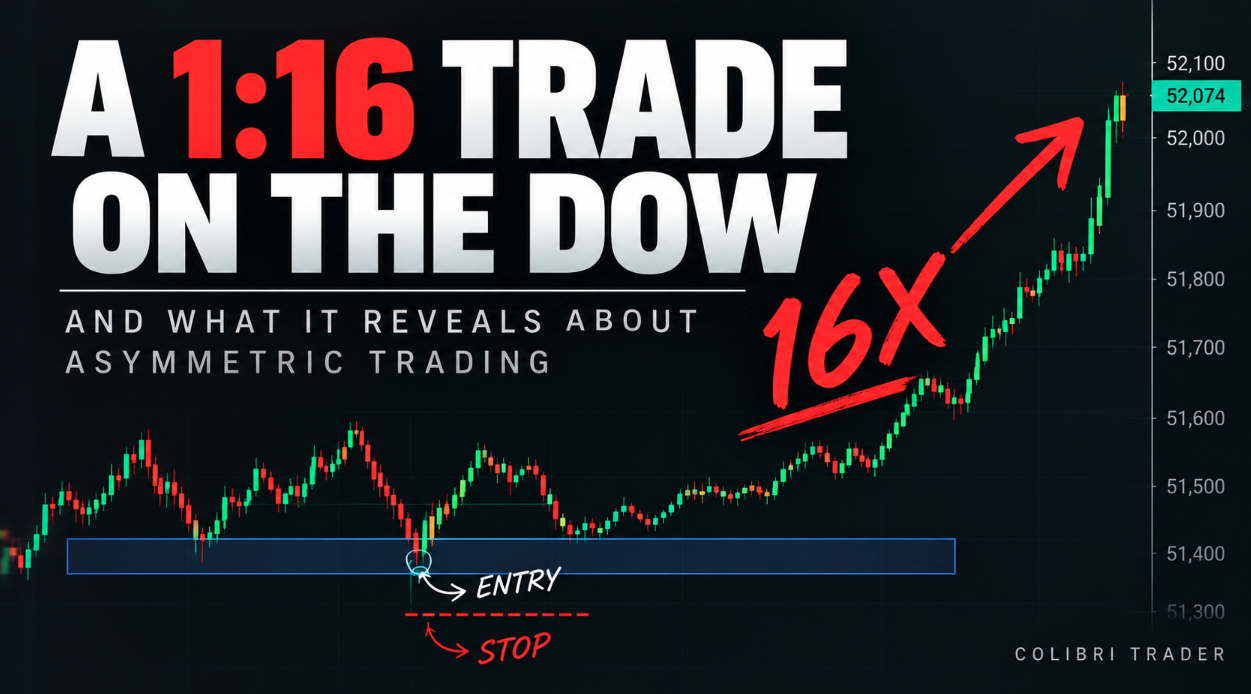
September has been an extraordinary month for my trading.
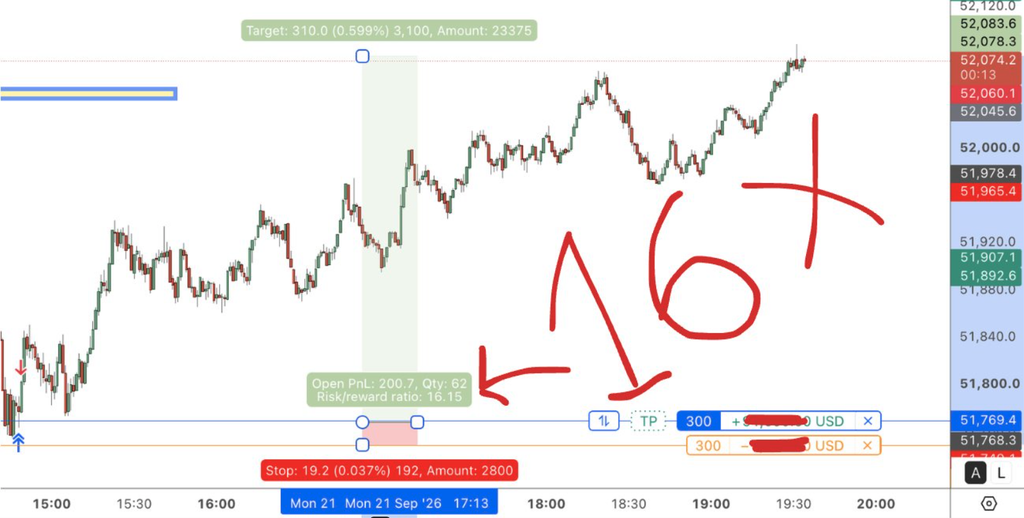
This week, I took a trade on the Dow that eventually produced a 1:16 risk-to-reward ratio.
In other words, for every 1 unit of risk, the market offered 16 units of potential reward.
But the interesting part isn’t the 16R.
It’s what a trade like this tells us about the way most traders think about profitability.
Because you don’t need to be right all the time when your winners have the potential to dramatically outweigh your losses.
That’s the foundation of asymmetric trading.
What Is Asymmetric Trading?
Most traders spend an enormous amount of time trying to increase their win rate.
They search for another indicator.
Another confirmation.
Another entry condition.
Another reason to wait.
The assumption is simple:
If I can be right more often, I’ll make more money.
But there’s another variable in the equation:
How much do you make when you’re right compared with how much you lose when you’re wrong?
That’s where asymmetry comes in.
Imagine two traders.
Trader A wins 70% of the time but typically makes 1R when right and loses 1R when wrong.
Trader B might be wrong far more frequently, but occasionally captures trades worth 5R, 10R or considerably more.
The second trader doesn’t necessarily need a high win rate.
The mathematics are completely different.
This is why I’ve spent years focusing less on trying to predict every market movement correctly and more on finding situations where the potential upside is significantly larger than the predefined downside.
The 1:16 Dow Trade
This week’s Dow trade is a good example.
The risk was defined before entering the trade.
That matters.
I wasn’t entering the market hoping it would run 16R.
I wasn’t increasing the risk because I was confident.
And I certainly didn’t know that the trade would ultimately travel that far.
The job at entry is not to predict exactly how far the market will go.
The job is to determine whether the opportunity makes sense relative to the risk being taken.
Once the trade began working, the market did the rest.
The result: approximately 16R of potential reward relative to the initial risk.
And this distinction is important.
The lesson isn’t:
“Find 16R trades.”
The lesson is:
Control the downside and create the conditions that allow exceptional upside to occasionally happen.
Those are two very different approaches.
You Don’t Need Every Trade to Look Like This
One of the biggest misunderstandings about asymmetric trading is that every trade needs to become a huge winner.
It doesn’t.
Some trades lose.
Some go nowhere.
Some move in your favour and then reverse.
Some become reasonable winners.
And occasionally, the market gives you something exceptional.
That’s precisely why risk management matters so much.
If your downside is controlled, you don’t necessarily need every trade to work.
Consider the mathematics.
Suppose you took ten trades and risked 1R on each.
Eight lost completely.
One made 2R.
And one produced 16R.
The result would still be:
+10R.
You would have been wrong 80% of the time and still finished profitable in this simplified example.
That’s an extreme illustration, of course, and real trading includes execution, partial exits, costs, slippage and other variables.
But it demonstrates the principle.
Win rate alone tells you surprisingly little about whether a trading approach is profitable.
You need to understand the relationship between losses and winners.
Why Traders Often Destroy the Asymmetry
Finding a good entry is only part of the problem.
The other challenge is what happens once money is on the line.
A trader risks 1R.
The market moves +1R.
They become nervous.
They close.
The next trade loses 1R.
Now they’re back to zero.
Then another loses.
Suddenly they’re negative.
This creates a strange situation where the trader may have correctly identified an opportunity capable of producing 5R, 10R or even more — but their execution never allowed them to participate in it.
This is why I don’t believe trading can be reduced to finding “better setups.”
Trade management matters.
So does patience.
So does accepting that you cannot know beforehand which trade will become the exceptional one.
The 1:16 Dow trade didn’t arrive with a label saying:
“THIS IS THE BIG ONE.”
No trade does.
Confirmation Can Be Expensive
There’s another problem.
Traders understandably want certainty.
So they wait.
They want another candle.
Another indicator.
Another confirmation.
Another signal that proves they’re right.
But every additional confirmation has a potential cost.
Price moves.
The entry becomes worse.
The stop may need to become wider.
And suddenly an opportunity that originally offered substantial asymmetry offers something much less attractive.
That’s why I often say:
Confirmation is expensive.
You’re effectively paying for additional certainty with your risk-to-reward ratio.
Sometimes that trade-off makes sense.
Sometimes it doesn’t.
The important thing is understanding that the trade-off exists.
September Has Been an Unusual Month
The Dow trade was not an isolated large move for me this month.
It became my ninth double-digit asymmetric trade of September.
That’s unusual.
August, by comparison, was relatively flat and uneventful.
September has been almost the complete opposite.
But that brings another lesson that doesn’t get discussed enough.
When things are going extremely well, that’s not necessarily the moment to become more aggressive.
It may actually be the moment to become more careful.
A strong run can quietly change your behaviour.
You feel sharper.
You start trusting yourself more.
You might take a trade that normally wouldn’t qualify.
You might increase size.
You might convince yourself that you’ve suddenly “figured out” the market.
That’s why after this recent run, I’ve actually been thinking about taking a break.
Not because something has gone wrong.
Because things have gone too well.
Sometimes staying one step ahead means staying one step ahead of yourself.
The Objective Isn’t to Predict the Market
This is perhaps the biggest shift I want traders to understand.
I don’t approach trading thinking:
“How can I predict what happens next?”
I would rather ask:
“If I’m wrong, what does it cost me – and if I’m right, what could the opportunity become?”
Those questions lead to very different trading behaviour.
The first encourages certainty.
The second encourages risk management.
The first makes losses feel like failures.
The second recognises that controlled losses are simply part of finding opportunities where the payoff can substantially exceed the risk.
That’s the essence of asymmetric trading.
You don’t need to catch every move.
You don’t need to win every day.
And you certainly don’t need to be right all the time.
You need a repeatable process that controls what happens when you’re wrong while giving your best trades enough room to matter.
This week’s 1:16 Dow trade is simply one example of what that asymmetry can look like.
Want to Learn How I Trade This in Real Time?
My Asymmetric Day Trading Mentorship is built around the complete framework I use to identify, execute and manage these opportunities.
It’s not about copying individual trades or chasing enormous R multiples.
It’s about developing the process behind them — from identifying the right areas and controlling risk to managing trades when the market starts moving.
[Learn more about the Asymmetric Day Trading Mentorship →]
Trading involves substantial risk and results vary. Examples shown are for educational purposes and do not guarantee future performance.